

Dental labs in the United States are under more production pressure than ever. Case volumes are rising, turnaround expectations are shortening, and referring dentists are becoming increasingly specific about esthetic outcomes particularly for anterior cases where shade accuracy and translucency directly determine whether a case passes or comes back for adjustment. The material you mill from is the single most controllable variable in that equation. Get the disc right, and the downstream workflow becomes faster, more predictable, and more consistent. Get it wrong, and you spend that time compensating through extra staining, extra polishing, and eventual remakes.
Multilayer dental zirconia discs have shifted the baseline for what dental labs should expect from a production disc. Not all multilayer products deliver on that promise equally, however. This guide focuses on what sets Aidite's 3D Pro multilayer zirconia apart from standard multilayer alternatives covering the material architecture, the clinical performance data, the workflow benefits, and the practical reasons US dental labs are standardizing on it.
What Makes a Multilayer Zirconia Block Different from Standard Zirconia?
To understand the 3D Pro advantage, it helps to first understand what multilayer architecture actually means in a zirconia disc — because the term is used loosely across the industry, and not all multilayer products are engineered the same way.
A standard (monolithic) zirconia blank is manufactured with uniform composition throughout. The yttria content, crystal phase ratio, translucency, and shade are identical from the cervical end of the disc to the incisal end. When you mill a crown from a standard disc, every zone of the crown has the same optical character — which means the cervical, body, and incisal all look the same before any staining is applied.
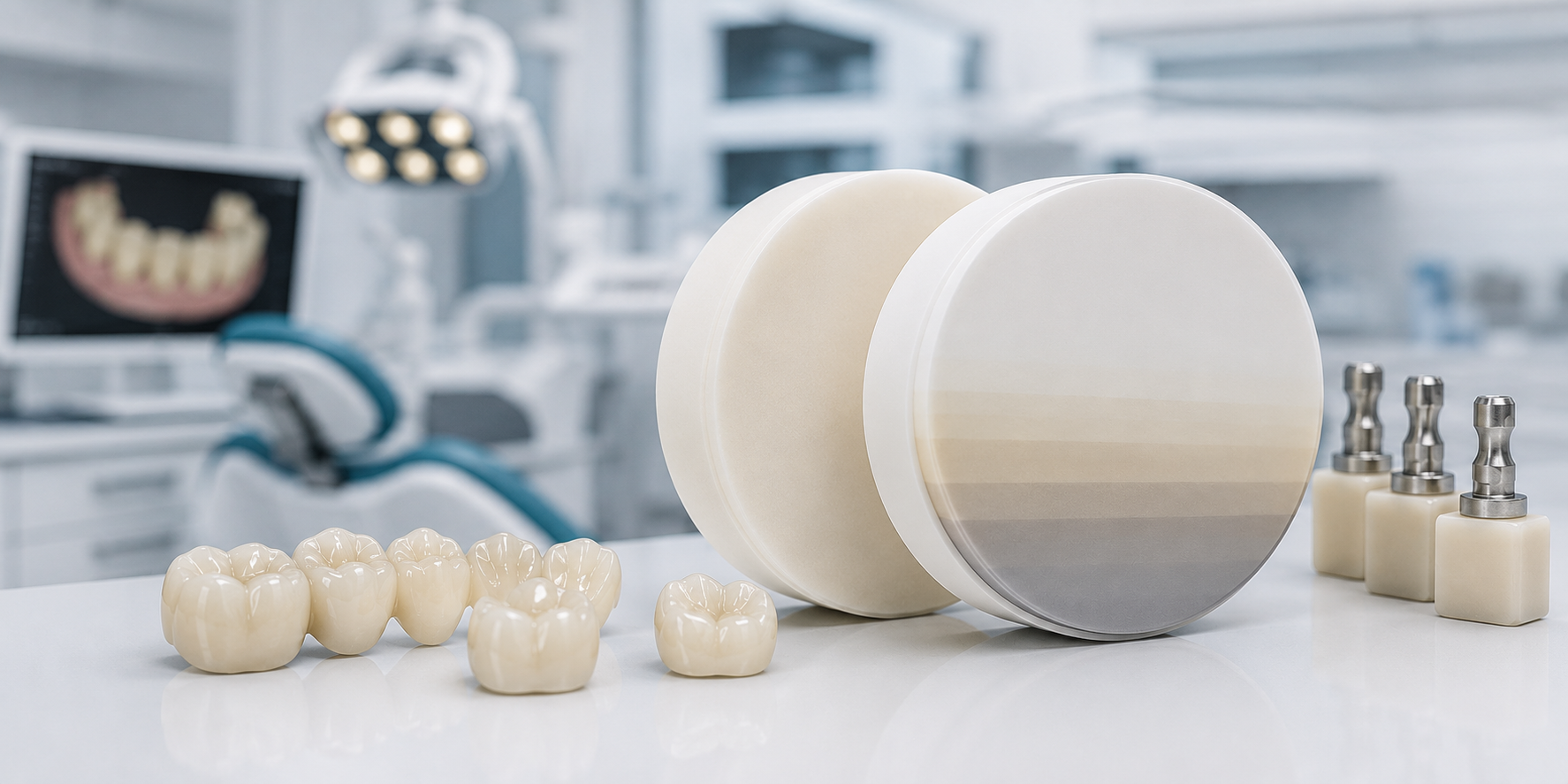
A multilayer zirconia blank is manufactured with a gradient of composition built into the disc during pressing and sintering. The cervical zone contains more opaque, higher-chroma material that replicates the saturated dentin at the base of a natural tooth. The body zone transitions to a balanced translucency. The incisal zone contains the highest-translucency formulation, replicating the opalescent quality of natural enamel. This gradient is not painted on or applied — it is part of the disc's physical structure, distributed across its depth in distinct layers that are fused during manufacturing.
The clinical difference is significant. When a multilayer disc is correctly oriented in the milling machine and the CAD toolpath is aligned with the internal zones, the milled crown exits the sintering furnace already carrying a natural shade gradient — cervical warmth, body balance, incisal translucency — without any external stain application. For standard A-shade cases, this eliminates the staining step entirely and reduces post-sintering bench time dramatically.
The Aidite 3D Pro Architecture: What Sets It Apart
The 3d pro zirconia disc from Aidite uses a proprietary three-dimensional multilayer gradient — the "3D" designation refers to the fact that the gradient is distributed across three dimensions within the disc, not simply as a two-layer top-bottom transition as in lower-tier multilayer products.
Most entry-level multilayer zirconia discs operate on a simple two-zone model: a cervical zone and an incisal zone, with a single transition between them. This two-zone architecture produces visible demarcation when the crown is milled at an angle to the disc axis a common issue in posterior cases where tooth orientation in the arch does not align cleanly with the disc's vertical gradient.
Aidite's 3D Pro architecture addresses this by engineering the gradient to transition gradually across multiple zones typically four to five distinct compositional layers with smooth, controlled transitions between each. The result is a disc where shade and translucency change predictably regardless of milling orientation, and where the gradient remains visually coherent even when the toolpath cuts across layer boundaries at an angle.
This engineering directly reduces one of the most common complaints about multilayer discs: inconsistent gradient appearance across a multi-unit case where different units are milled from different positions in the disc. With the 3D Pro architecture, labs report consistent shade gradients from the first blank to the last across the full disc.
Clinical Performance: Strength and Translucency Data
The aidite 3d pro zirconia blocks are engineered to a 4Y-equivalent mixed tetragonal-cubic formulation in the body and cervical zones, transitioning toward 5Y-equivalent cubic-dominant phase in the incisal zone. This phase gradient produces the following typical performance range:
Flexural strength by zone:
- Cervical zone: 700–800 MPa within 3Y/4Y structural range, suitable for connector regions in short-span anterior bridges
- Body zone: 600–750 MPa standard 4Y range, covers the majority of crown occlusal surface demand
- Incisal zone: 500–650 MPa 5Y-equivalent, appropriate for incisal edges where esthetic priority outweighs structural requirement
Translucency by zone:
- Cervical: Low-moderate replicates dentin opacity and warm chroma
- Body: Moderate-high balanced esthetic-structural zone
- Incisal: Very high approaches 5Y flat disc translucency in the top layer
This performance profile makes the 3D Pro disc appropriate for anterior single crowns, anterior 3-unit bridges, premolar single crowns, and anterior implant crowns. It is not designed for posterior bridges of 3 or more units, where a monolithic 3Y disc is the structurally correct choice.
Sintering parameters: Peak temperature 1480–1530°C, ramp rate ≤5°C/min, hold time per manufacturer specification. Deviating from these parameters — particularly running accelerated sintering cycles reduces incisal zone translucency and risks microcracking at interlayer interfaces.
Workflow Benefits: Where Labs Save Time with 3D Pro Multilayer
The production efficiency case for multilayer zirconia blocks dental labs rely on is measurable, not theoretical. Here is where the 3D Pro format delivers tangible time savings in daily lab workflow.
Elimination of staining on standard A-shade cases.
Pre-shaded 3D Pro discs are calibrated to VITA Classic A-D shade values from the factory. For the majority of anterior single-crown cases in standard A shades — which represent 70–80% of most labs' anterior production volume — the restoration exits sintering with the correct shade gradient without any external stain application. The only post-sintering step required is glaze firing for surface finish.
Reduced shade matching variability across multi-unit cases.
When a 3-unit anterior bridge is milled from a pre-shaded multilayer disc, all three units carry the same internal gradient from the same disc batch. External stain protocols introduce unit-to-unit variability that even skilled technicians struggle to eliminate perfectly. The pre-shaded multilayer format standardizes the shade baseline before any bench work begins.
Faster case communication with prescribing dentists.
Because the shade gradient of the 3D Pro format is consistent and documented, labs can communicate expected shade outcomes to prescribing dentists with greater confidence. Shade prescription documentation from the disc manufacturer supports the communication rather than relying entirely on the technician's interpretation of a shade tab match.
Lower bur wear versus higher-hardness monolithic discs.
The mixed-phase composition of the 3D Pro disc produces a pre-sintered blank that machines with lower cutting resistance than dense 3Y monolithic discs. Labs running high anterior case volumes report meaningfully lower bur replacement frequency on the 3D Pro format compared to standard single-grade 3Y discs.
Why US Labs Specifically Benefit from Aidite 3D Pro
The aidite 3d pro multilayer zirconia blocks usa supply through ZirconiaGuys addresses a specific challenge that US dental labs face when sourcing multilayer zirconia: consistency between the product spec and what arrives on the production floor.
Direct import purchasing from overseas manufacturers introduces batch variation risk that is difficult to manage when the lab has no direct relationship with the supplier's QC process. A disc batch that performs correctly in one shipment may shift in shade calibration, sintering behavior, or layer transition definition in the next — without any visible change to the product packaging or documentation.
ZirconiaGuys sources Aidite 3D Pro from authenticated supply channels and holds US inventory, which means labs receive the same product specification that the manufacturer documents — not a parallel market equivalent. Batch certificates are available on request, enabling labs to verify specification compliance for each production run. For labs that have experienced shade drift or inconsistent translucency with previous multilayer sources, this documentation chain is the practical solution.
Additionally, US inventory eliminates the lead time uncertainty of direct import. Most dental labs cannot afford to hold 6–8 weeks of disc inventory as a buffer against international shipping delays. Same-day or next-day shipping from US stock means labs can maintain lean inventory without risking production interruptions.
Choosing the Right Format: Pre-Shaded vs. White 3D Pro
The 3D Pro multilayer disc is available in both pre-shaded and white formats, and understanding which format serves each application is essential for getting the most out of the disc.
For labs sourcing aidite zirconia discs for dental labs in high-volume anterior production, the pre-shaded format is the correct default. It eliminates the staining step on standard cases, reduces per-case bench time, and produces consistent gradient quality across the full disc without operator-dependent variation. The pre-shaded format is the reason multilayer zirconia dental blanks have become the default anterior disc format in high-throughput labs — it standardizes the single most variable step in the anterior crown production workflow.
The white 3D Pro format is the right choice when:
- The case requires a shade outside the standard VITA A-D range
- The prescribing dentist has specified a custom characterization effect (craze lines, hypocalcification, fluorosis replication)
- The lab technician prefers full manual shade control for complex esthetic cases where the natural gradient architecture of the disc provides the structural foundation but the shade outcome requires custom built-up staining
Practical stocking guidance for US labs: Stock pre-shaded 3D Pro in A1, A2, A3, and A3.5 as your anterior production standard — these four shades cover the overwhelming majority of anterior crown cases. Stock white 3D Pro in a single size as your custom case and complex esthetic fallback. This two-format approach gives the lab full esthetic flexibility while standardizing the high-volume workflow on the pre-shaded format.
What to Look for in a Zirconia Materials Distributor USA
Sourcing multilayer zirconia from the right zirconia materials distributor usa matters as much as the product specification itself. The key criteria are not complicated, but they are frequently overlooked when labs prioritize price over supply reliability.
Authenticated supply chain.
Confirm that the distributor sources directly from the manufacturer or through an authorized distribution channel — not through parallel market or gray market imports where product specification cannot be guaranteed.
US inventory.
Distributors that hold US stock eliminate international lead times and give labs the ability to maintain lean inventory without production risk. Same-day or next-day shipping capability is the practical standard for a functional lab supply relationship.
Batch documentation.
Reliable distributors provide batch certificates on request, enabling labs to track specification compliance across orders and identify any drift before it affects clinical production.
Technical support.
Sintering profile guidance, milling parameter recommendations, and troubleshooting support for shade consistency issues are the difference between a transactional supplier and a supply partner that contributes to lab production quality.
Consistent pricing on the full Aidite range.
Labs that produce both fixed and removable restorations benefit from sourcing zirconia blocks alongside PMMA, stain and glaze, and other Aidite CAD/CAM materials from a single US supplier. The consolidation reduces ordering overhead and ensures consistent batch documentation across the full material range.
The Aidite 3D Pro multilayer zirconia block is not a marginal upgrade over standard multilayer alternatives — it is a fundamentally better-engineered disc that delivers measurable workflow improvements on every anterior case it produces. The three-dimensional gradient architecture, the pre-shaded format that eliminates staining on standard cases, the consistent shade performance across the full disc, and the authenticated US supply chain through ZirconiaGuys combine to make it the most practical choice for US dental labs serious about anterior esthetic production quality.
For labs evaluating their current anterior disc stock, the question is straightforward: how much time per case is your current disc costing you in post-sintering staining, shade correction, and gradient inconsistency between units? The answer to that question is the value of switching to the 3D Pro format.


