

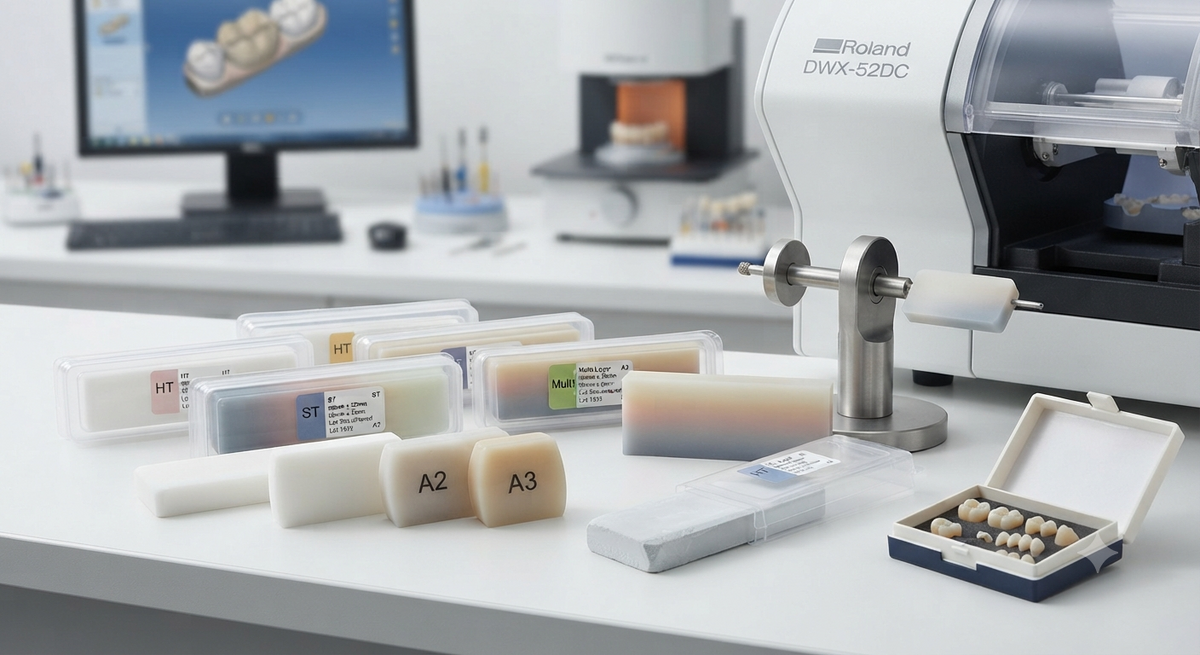
Choosing a zirconia block or disc becomes much easier when the laboratory starts with the restoration requirements rather than the product name. Different cases can require different levels of strength, translucency, thickness and shade control.
For dental laboratories using CAD/CAM production, the ideal material should not only suit the restoration but also fit the existing milling machine, CAM software, sintering workflow and finishing process.
Begin With the Restoration You Are Making
Before selecting a material, identify the type of restoration being produced. A single anterior crown may have different requirements from a posterior crown, multi-unit bridge or full-arch restoration.
Consider the expected functional load, required esthetics, available thickness and whether the final restoration will be monolithic, multilayered or further characterized.
This prevents a common mistake: selecting a blank simply because it is familiar instead of choosing it according to the case.
Understand the Main Material Differences
Dental zirconia products can differ in strength, translucency, shade behavior and recommended applications. High-strength materials may be suitable for cases where mechanical performance is particularly important, while more translucent materials can be useful where optical integration is a greater concern.
The goal is not to identify one universally "best" material. The goal is to match the material characteristics with the restoration requirements.
White, Pre-Shaded or Multilayer?
White zirconia gives technicians greater control over staining and characterization. It can be useful when the laboratory prefers to manage the final shade manually.
Pre-shaded materials simplify part of the coloring process by providing a base shade within the blank. Multilayer materials go a step further by incorporating different shade and translucency zones through the disc.
The choice depends on how the laboratory manages shade matching, staining, glazing and production time.
Check CAD/CAM Compatibility
A zirconia blank must work with the equipment already used in the laboratory. Confirm the dimensions, holder compatibility, CAM library, shrinkage factor and recommended milling parameters.
This is particularly important when using an aidite cad cam workflow or switching between different manufacturers.
A product can have excellent material properties but still create workflow problems if the CAM profile, tooling or sintering program is not correctly configured.
Consider Disc Size and Material Utilization
Larger is not automatically better. Selecting an unnecessarily thick or large blank can increase material waste.
Before purchasing dental zirconia blocks, review the restoration types your laboratory produces most frequently. Consider the number of crowns or bridges that can realistically be nested into a blank and whether the disc dimensions support efficient positioning.
Good nesting can reduce waste without compromising restoration placement.
Compare Manufacturer Specifications
When comparing products such as aidite zirconia blocks and an upcera zirconia block, look beyond the product name.
Review:
-
Strength
-
Translucency
-
Shade options
-
Recommended indications
-
Minimum thickness
-
Disc dimensions
-
Milling requirements
-
Sintering cycle
-
Coloring and finishing instructions
Similar-looking products can still have different processing requirements.
Think About Your Complete Laboratory Workflow
A zirconia blank is only one part of production. The selected material should work efficiently with the laboratory's CAD design, milling, sintering, staining, glazing and quality-control procedures.
For laboratories purchasing aidite zirconia discs for dental labs, it is useful to evaluate not only material specifications but also how easily the discs fit into existing production routines.
Create a Material Selection Checklist
Before starting a case, confirm:
-
Restoration type
-
Tooth position
-
Functional requirement
-
Required translucency
-
Desired shade
-
Disc diameter
-
Disc thickness
-
Machine compatibility
-
Milling strategy
-
Sintering cycle
-
Finishing requirements
This simple checklist can make material selection much more consistent.
Choosing the right zirconia disk is a CAD/CAM workflow decision rather than a simple purchasing decision. The best choice is the blank that matches the restoration, equipment, milling strategy and finishing process.
A structured approach helps laboratories reduce material waste, avoid processing errors and achieve more predictable results across different cases.


