

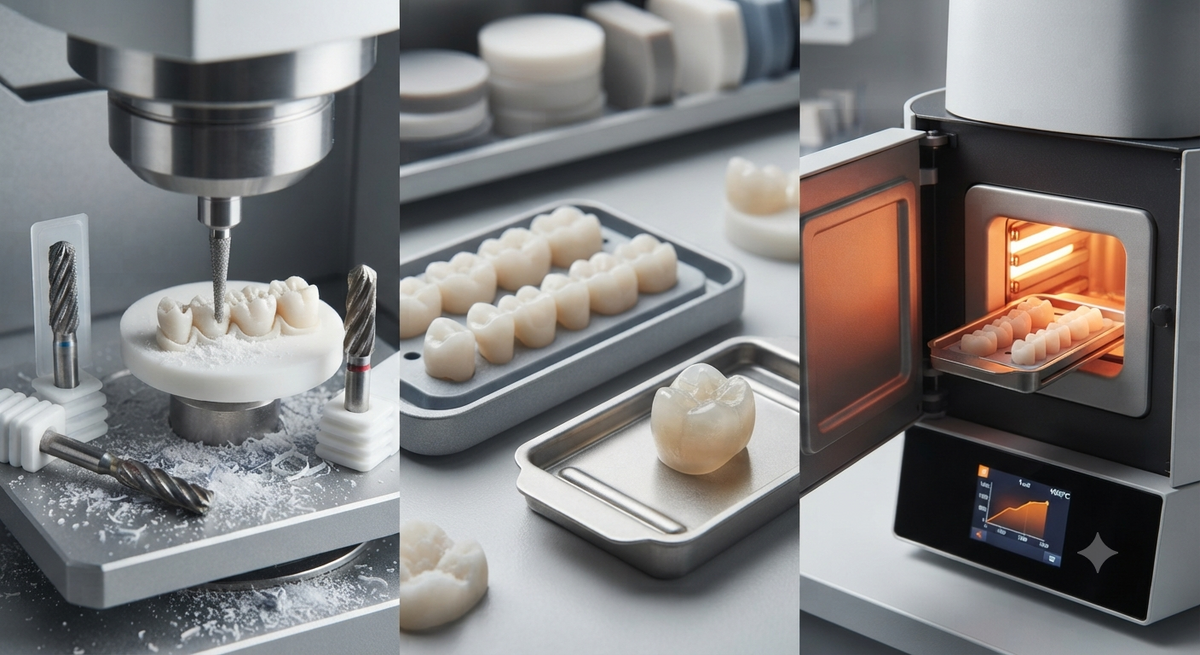
Most milling and sintering problems do not come from one big mistake. They build up from small settings that drift over time: a tired bur, a feed rate set too high, a furnace program copied from another brand. The good news is that these are easy to control once you know where to look. This guide covers tool life, edge chipping and shade accuracy, using gradient materials like ST multilayer zirconia as the example because they show errors quickly.
Why Milling and Sintering Have to Work as a Pair
Milling shapes the restoration while it is soft, and sintering locks that shape in. If the milled crown has micro-cracks or rough margins, sintering will not repair them, and it can make them more visible. If the furnace program is wrong, even a perfectly milled crown can warp or turn out the wrong color. Treat the two stages as one process and troubleshoot them together.
Spindle Speed, Feed Rate and Tool Life
Every mill and every bur has a recommended speed and feed range. Running faster saves a few minutes per disc, but it increases heat and wear, and a dull bur is the number one cause of rough surfaces. Start with the settings recommended for your machine and block, then adjust only one variable at a time so you can see what changed.
Many labs track tool life by milling hours or units instead of waiting for visible damage. A simple log taped to the mill is enough. When quality starts to slip, a fresh bur is the cheapest fix you can try first.
Stopping Edge Chipping Before It Starts
Chipping usually shows up at margins, thin cusps and connectors. Common causes are worn burs, aggressive toolpaths, thin unsupported edges and dust packed around the disc holder. Here is what helps:
• Replace burs on a schedule instead of running them to failure.
• Keep margins and thin areas supported with sensible sprue placement.
• Clean the holder and mill chamber so the disc sits true.
• Handle milled crowns gently, since pre-sintered zirconia is fragile.
Sintering Curves That Protect Shade
Each zirconia has its own recommended sintering curve: how fast it heats, the peak temperature, how long it holds and how it cools. Gradient discs like ST multilayer zirconia are especially sensitive, because the color and translucency layers develop during the cycle. Using the manufacturer's program for that exact disc keeps the gradient intact.
Furnace condition matters too. Worn heating elements, uneven loading and contamination from dust or metal can all cause blotchy color or lower translucency. Have the furnace calibrated regularly and keep the sintering tray clean.
Furnace Loading and Cooling Habits
How you load the furnace affects the result as much as the program does. Place crowns on the tray or in the beads as the manufacturer recommends, leave space between units so heat spreads evenly, and avoid stacking restorations unless the material allows it. Long-span bridges need more support than single crowns, otherwise gravity and heat can combine to distort the arch.
Equally important is the cooling phase. Opening the furnace too early exposes the restoration to sudden temperature change, which can cause stress or cracks that only show later. Wait until the furnace reaches the temperature your program specifies before taking restorations out. If you share the furnace between materials, use separate trays or run a cleaning cycle so stray colorants do not transfer.
Keeping Shade Consistent from Batch to Batch
Shade surprises often come from the material, not the technician. Working with pre-shaded zirconia blocks Aidite makes shade accuracy easier, because the color is built into the block and you are not relying on liquid shading technique.
If you prefer to color your own restorations, a white disc gives more control. Labs that use Aidite zirconia for staining & coloring can customize shades, then finish with Aidite stain and glaze for surface character. In both cases, give shading liquids time to dry before sintering, and sinter similar cases together so results stay comparable.
Quick Fixes for Three Common Problems
• Rough surface after milling: check bur wear and feed rate first.
• Warped long-span bridge: confirm the sintering program and support the bridge properly in the furnace.
• Dull or cloudy color: look at furnace cleanliness, program accuracy and shading liquid contamination.
Keep a short written record of your settings for each material. When a problem appears, you will know exactly what changed, and a documented routine, whether you mill ST multilayer zirconia or a single-shade grade, is the fastest way to protect both quality and tool budget.


