

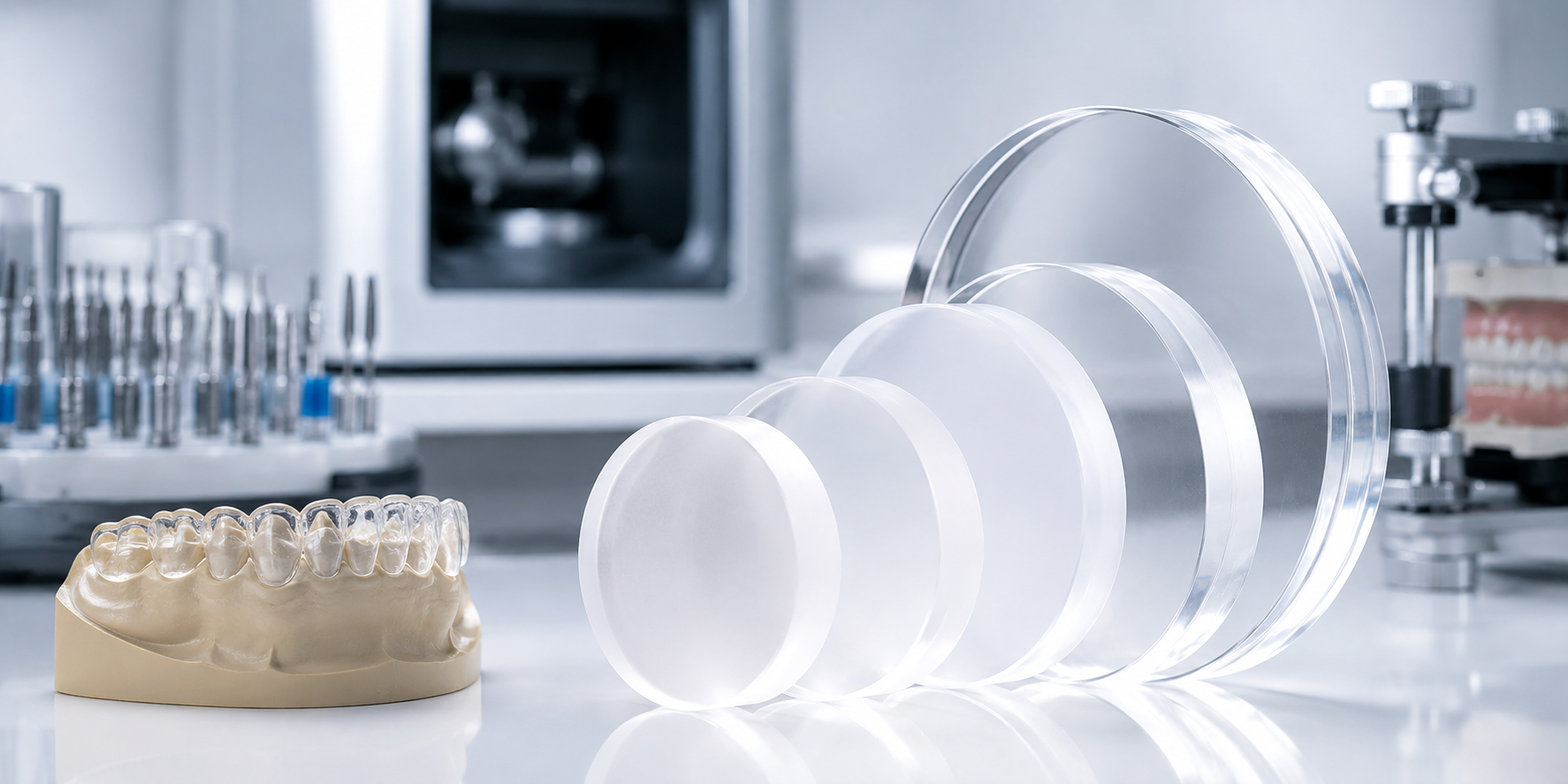
Dental labs running CAD/CAM workflows go through PMMA every day. It mills fast, finishes cleanly, and covers a wider range of applications than any single alternative. Yet most labs stock PMMA the same way they stock paper towels by habit, without fully evaluating whether the formulation matches the application or whether a better product exists at the same price point. That gap between routine purchasing and informed material selection is where avoidable production problems originate.
This guide covers everything a dental lab needs to know about PMMA discs: what the material actually is, how the different formulation types differ from each other, which applications each format is designed for, what to look for in a supplier, and how PMMA fits into a broader material workflow alongside dental zirconia discs and zirconia restorations. If your lab uses PMMA, this is the reference you should have had from day one.
What Is CAD/CAM PMMA and Why Does It Outperform Conventional Acrylic?
PMMA polymethyl methacrylate is a thermoplastic acrylic polymer that has been used in dentistry for over 80 years. The critical distinction for modern dental labs is between conventional bench-mixed acrylic and CAD/CAM-grade pre-polymerized PMMA discs. These are not the same material despite sharing the same polymer chemistry.
Conventional acrylic is mixed from powder and liquid monomer at the bench, packed into a flask, and cured under atmospheric pressure. The result is a material with residual monomer content of 3–5% or higher, significant internal porosity from trapped air, and dimensional variability dependent on technician skill and curing conditions. Residual monomer is both a biocompatibility concern it is associated with tissue irritation and allergic response in sensitive patients and a mechanical liability, as it acts as a plasticizer that reduces hardness and increases the material's susceptibility to staining.
CAD/CAM PMMA discs are manufactured by polymerizing the monomer under industrial high-pressure conditions typically 50 to 200 bar at elevated temperature. This process drives polymerization to near-completion, producing a material with residual monomer below 0.5%, near-zero internal porosity, and consistent mechanical properties throughout the disc. The dense, homogeneous polymer matrix that results is what gives CAD/CAM PMMA its superior machinability, lower staining tendency, better surface finish, and more reliable dimensional accuracy compared to anything produced by bench mixing.
For a lab running a digital workflow, this distinction translates directly into production outcomes. CAD/CAM PMMA mills to tighter tolerances, polishes to a higher gloss in fewer steps, maintains its surface quality over longer provisional wear periods, and produces fewer fit complications than equivalent applications in conventional acrylic. It is not simply a more convenient format it is a meaningfully better material.
PMMA Disc Formulation Types: Matching the Material to the Application
PMMA is a material class, not a single product. The four primary formulation types serve distinct clinical applications with different optical, mechanical, and biological requirements. Using the wrong formulation for the application is the most common and most avoidable PMMA selection error in dental labs.
Denture base PMMA is formulated for tissue-contact applications — full dentures, partial denture bases, and removable prosthetics. The key properties are gingival shade accuracy, biocompatibility, and dimensional stability under long-term tissue contact. Denture base discs are pigmented to replicate the pink-red tones of gingival anatomy across a range of patient tissue colors. The residual monomer content of quality denture base PMMA must meet ISO 20795-1 biocompatibility requirements, as the material sits against oral mucosa all day. The aidite denture base pmma disc is formulated specifically for this application — engineered for low residual monomer, consistent gingival shade accuracy across batches, and the polishability that long-term removable prosthetics require.
Multilayer tooth-shade PMMA is formulated for temporary crown and bridge provisionals — the highest-volume PMMA application in most dental labs. These discs are manufactured with a gradient of shade and translucency from the cervical end (higher chroma, more opaque, dentin-like) to the incisal end (lower chroma, more translucent, enamel-like). This gradient replicates the natural optical zonation of a tooth within a single blank, enabling temporaries that look natural directly from the mill without post-milling staining in standard A–D shade cases.
Clear PMMA is formulated for applications where optical clarity is the primary requirement — occlusal splints, night guards, clear retainers, and orthodontic appliances. Clear PMMA discs must deliver high light transmission with minimal internal haze or color. They are not suitable for crown and bridge provisionals, where tooth-shade coloration is required, and should not be used as a substitute for tooth-shade PMMA in those applications.
Single-shade opaque PMMA covers posterior single-unit provisionals and diagnostic models where shade precision is secondary to fit accuracy and occlusal stability. These discs offer the fastest milling cycle and lowest per-unit material cost in the PMMA range.
How to Select the Right Denture Base PMMA Disc
For labs producing full and partial dentures in a CAD/CAM workflow, denture base PMMA selection involves three evaluation criteria that generic or unbranded discs frequently fail to satisfy consistently.
Shade Consistency Across Batches
The gingival shade of a denture base is one of the most visible esthetic elements a patient evaluates. If the shade of the "standard pink" disc drifts between your current order and the next, you are re-shade-matching every case rather than trusting a production standard. Quality denture base PMMA comes with batch documentation that verifies shade specification consistency. Labs that do not request and review this documentation are accepting avoidable variability into their production workflow.
Residual Monomer Documentation
Biocompatibility documentation confirming ISO 20795-1 compliance should be available for every denture base PMMA product you stock. For patients with documented acrylic sensitivity, this documentation is not optional — it is the basis of the clinical decision to use the material. Suppliers who cannot provide it are not supplying lab-grade material.
Milling and Polishing Behavior
The best indicator of denture base PMMA quality in a production environment is how much polishing time it requires to reach clinical-grade surface finish. Quality pre-polymerized PMMA reaches high gloss in 10–15 minutes with standard pumice and polishing compound. Generic PMMA commonly requires 20–30 minutes and still produces a less consistent result. This difference compounds across every denture in a production run.
Multilayer PMMA Discs for Temporary Crown and Bridge Production
The multilayer pmma disc is the highest-value format in the PMMA range for most full-service dental labs. Its gradient architecture — cervical to incisal shade and translucency gradient — enables natural-looking temporary crowns without any post-milling staining in standard A–D shade cases, delivering a direct reduction in finishing labor that compounds significantly across anterior provisional volume.
The clinical workflow advantage is straightforward: the technician designs the crown, orients the blank correctly in the mill to align the CAD design with the disc's internal gradient zones, mills, separates, polishes, and delivers. No stain mixing, no firing cycle, no waiting. For a lab producing 15–20 anterior temporaries per week, eliminating the staining step across those cases saves meaningful bench time every production cycle.
Correct blank orientation is essential. Every multilayer PMMA disc is directionally coded — an arrow or marking indicates the gingival-to-incisal axis. Mounting the blank backwards places incisal-grade translucent material at the cervical margin and opaque dentin-like material at the incisal edge, producing a temporary that looks artificial regardless of how well the margins fit. This orientation check takes ten seconds and eliminates the most common multilayer PMMA production error.
For longer-wear provisionals three to six months in implant or full-mouth rehabilitation cases specify multilayer PMMA from a manufacturer whose pre-polymerization quality produces low internal porosity. Low-porosity PMMA maintains its surface finish and resists staining accumulation over extended provisional periods. High-porosity generic PMMA visibly roughens and discolors in the first few months of long-term provisional wear, generating patient complaints and early remake requests.
| Provisional Application | Recommended Format | Typical Wear Period | Key Requirement |
|---|---|---|---|
| Single anterior crown | Multilayer pre-shaded | 2–6 weeks | Shade gradient, fast finish |
| Multi-unit bridge provisional | Multilayer or single-shade | 2–8 weeks | Fit accuracy, shade uniformity |
| Long-term provisional | High-quality pre-polymerized multilayer | 3–12 months | Low porosity, stain resistance |
| Posterior single crown | Single-shade or multilayer | 2–6 weeks | Occlusal accuracy, cost efficiency |
| Full-arch provisional | Multilayer full-arch disc | 3–12 months | Shade uniformity, structural integrity |
Aidite PMMA in a Full-Service Lab Workflow
For labs that run both provisional fixed restorations and removable prosthetics, the aidite pmma multilayer and denture base formats together cover the complete PMMA application range within a single consistent supplier relationship. This consolidation matters more than it might seem: when your multilayer tooth-shade disc and your denture base disc come from the same manufacturer with the same batch documentation standards, quality control becomes a single workflow rather than two parallel processes.
Aidite's PMMA range is engineered for open-system CAD/CAM compatibility — standard 98 mm disc diameter with adapter compatibility for Roland, Amann Girrbach, Zirkonzahn, VHF, and all major open-system mills. No proprietary locking. No system-specific disc codes. The same disc works in whatever mill your lab runs.
As a dedicated zirconia materials distributor usa serving US dental labs, ZirconiaGuys stocks the full Aidite PMMA range from domestic inventory no international shipping lead times, no import uncertainty. Labs that consolidate both their PMMA and their zirconia blocks supply through ZirconiaGuys also benefit from consistent batch documentation across the full material range, simplified ordering, and technical support from a team that works with dental labs daily.
Clear PMMA: Applications, Selection Criteria, and Common Mistakes
The aidite clear pmma disc covers the optical clarity applications occlusal splints, night guards, clear retainers, and diagnostic study models where transparency is the primary material requirement.
The key selection criterion for clear PMMA is optical consistency: the disc must deliver uniform clarity from center to edge with no internal haze, cloudiness, or color cast that would be visible in a 2–3 mm thick milled splint. Generic clear PMMA discs frequently show internal optical inconsistency visible as localized cloudiness or slight tinting that produces splints that look lower quality than the patient expects and the lab intends.
The most common clear PMMA mistake is using it as a substitute for tooth-shade PMMA in crown and bridge provisionals. Clear PMMA produces restorations that transmit ambient light without coloration, making the preparation visible through the temporary not acceptable clinically for any anterior provisional. Always specify the correct formulation for the application, regardless of what is currently in stock.
For milled splints and night guards, clear PMMA consistently outperforms vacuum-formed thermoplastics in dimensional accuracy and surface finish. The milled product is designed from a digital model to a precise occlusal scheme. The vacuum-formed alternative reproduces model geometry passively. For labs running digital workflows, milled clear PMMA is the correct material for this application.
PMMA and Zirconia: How They Work Together in a CAD/CAM Workflow
PMMA and zirconia are not competing materials they are complementary, with clearly defined non-overlapping primary indications. Understanding this division of labor is what separates labs that run efficient dual-material workflows from labs that misapply one material in the other's indication.
PMMA covers every temporary and removable application. Dental zirconia discs cover every permanent fixed application. The parallel workflow is: mill the temporary in PMMA while the permanent zirconia restoration is being produced, deliver the temporary, then deliver the final zirconia blank-based crown or bridge when it exits sintering. The temporary's esthetic outcome informs the shade and shape specification for the final restoration making the PMMA provisional not just a placeholder but a clinical evaluation tool.
Labs that also stock zirconia dental blanks from Upcera or Aidite benefit from having both material streams under one supplier relationship. The same ordering process, the same documentation standards, and the same technical support covers both the PMMA provisional and the zirconia blocks dental production that follows it. For zirconia blocks procurement alongside PMMA, ZirconiaGuys stocks the full Upcera and Aidite zirconia range 3Y, 4Y, and 5Y grades in flat white, pre-shaded, and multilayer formats from US inventory at production-volume pricing.
Getting PMMA right in a dental lab is not complicated but it does require treating it as a material class with distinct formulations for distinct applications, rather than a single commodity product. Denture base PMMA for removable prosthetics. Multilayer tooth-shade PMMA for anterior temporary fixed restorations. Clear PMMA for splints and clear appliances. Each formulation optimized for its application, sourced from a supplier whose batch consistency means your production standard is reliable order after order.
ZirconiaGuys stocks the full Aidite PMMA range from US inventory, alongside the complete Upcera and Aidite zirconia range serving as a single-source US supplier for both material streams in a full-service dental lab workflow.


