

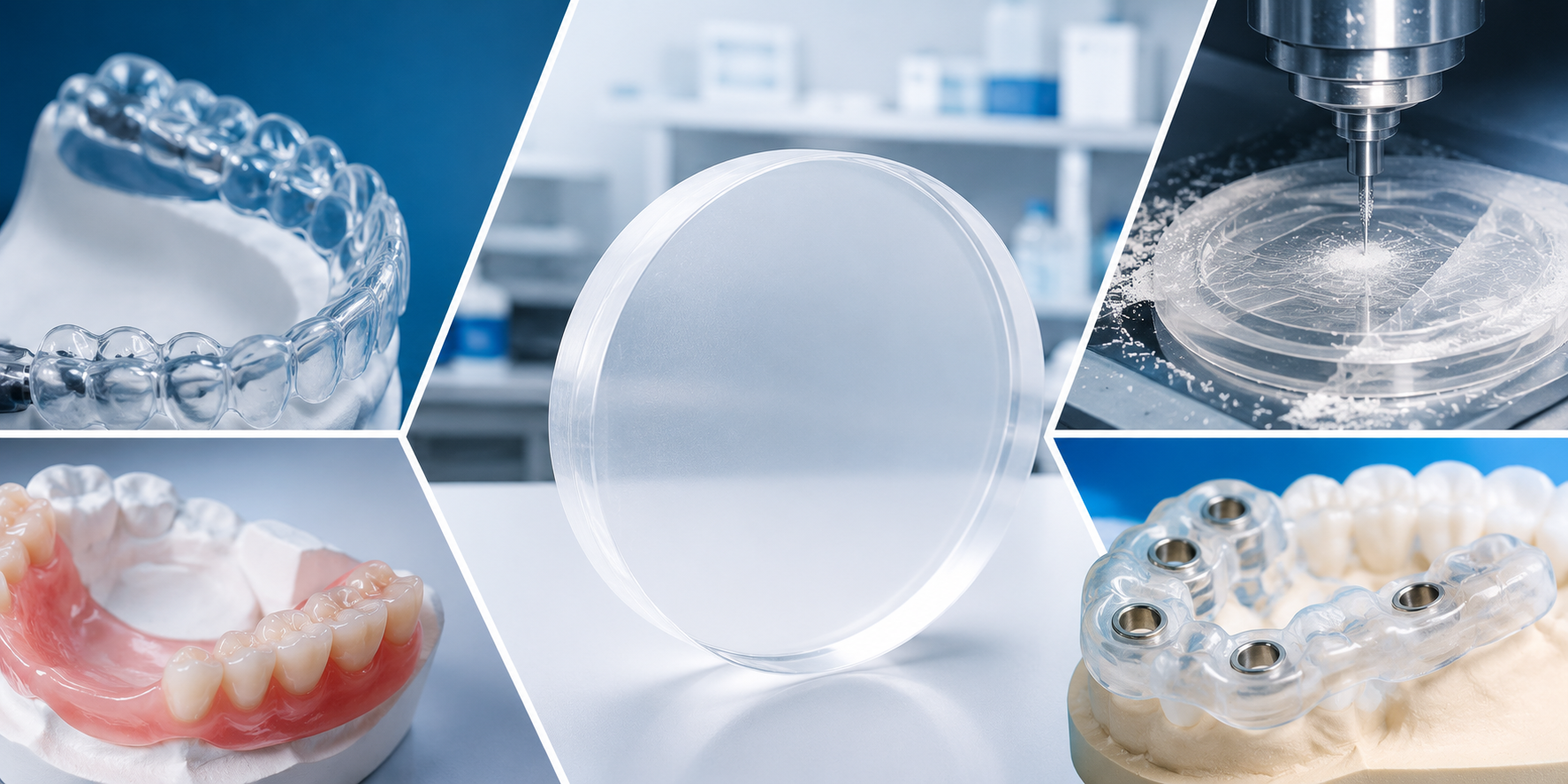
PMMA polymethyl methacrylate is the most widely used CAD/CAM milling material in dental laboratories outside of zirconia. It machines quickly, finishes cleanly, costs a fraction of ceramic per disc, and covers a broad range of applications that no other single material class can match. Yet despite its ubiquity, most discussions of PMMA reduce it to "temporary crowns" and leave the rest of the story untold.
The full picture is significantly more useful than that. PMMA discs serve at least six distinct clinical applications in a modern dental lab workflow, each with its own formulation requirements, processing protocols, and performance expectations. Understanding each application and which PMMA format is correct for each is the difference between a material you stock generically and a material you deploy strategically. This guide covers all of it.
What Makes PMMA Suitable for Dental Lab Applications?
Before examining the applications individually, it is worth understanding why PMMA is well-suited to dental use in the first place. Not all PMMA is the same the industrial pre-polymerized PMMA used in CAD/CAM dental discs is a fundamentally different material from bench-mixed acrylic, and the distinction matters clinically.
CAD/CAM PMMA discs are manufactured by polymerizing the monomer under high industrial pressure typically 50 to 200 bar at elevated temperature in controlled autoclaves. This process eliminates most residual monomer from the polymer matrix, reducing residual monomer content to below 0.5% compared to 3–5% in bench-mixed acrylic. The result is a denser, more homogeneous material that is safer for tissue contact, more predictable to mill, and more consistent in mechanical performance than anything produced at the lab bench.
The properties that make pre-polymerized CAD/CAM PMMA suitable for dental applications are: biocompatibility within ISO 20795-1 thresholds, flexural strength in the 80–120 MPa range, ease of milling with standard tooling at production speed, polishability to a high-gloss surface finish, repairability using conventional chairside acrylic techniques, and shade formulation flexibility across gingival tissue tones, tooth shades, and optical clarity. No single material delivers all of these properties together PMMA covers temporary and removable applications in the same way that dental zirconia discs cover permanent fixed restorations. They are complementary materials, not competing ones.
Application 1: Temporary Crowns and Bridge Provisionals
Temporary fixed restorations are the highest-volume PMMA application in most dental labs. Every prepared tooth requires a provisional while the permanent restoration typically a zirconia blank or ceramic crown is being fabricated. The temporary must protect the preparation, maintain the patient's occlusion, and preview the esthetic outcome of the final restoration. Material quality at the PMMA disc level directly determines how well the temporary fulfills all three functions.
For standard anterior and posterior single-unit temporaries, single-shade PMMA discs in tooth shades (A1, A2, A3) cover the majority of cases efficiently. For anterior cases where shade gradient matters particularly in the anterior esthetic zone where the temporary will be visible and evaluated by the patient before the permanent crown is placed multilayer PMMA discs that transition from a dentin-like cervical zone to a more translucent incisal zone deliver significantly better optical results without requiring post-milling staining.
The aidite pmma dental discs range covers both formats offering a consistent, well-documented PMMA formulation that machines cleanly, polishes efficiently, and delivers predictable shade accuracy across production batches. For labs that produce anterior temporaries at volume, the batch-to-batch shade consistency of a branded, well-sourced PMMA is not a luxury it is the difference between a reproducible standard and an unpredictable result on every case.
For multi-unit bridge provisionals, PMMA's repairability is a critical workflow advantage. If a 4-unit bridge temporary fractures at a connector during the provisional phase which is not uncommon, especially in cases with limited preparation height the lab or clinician can repair it with chairside cold-cure acrylic without fabricating a new restoration from scratch. No ceramic material offers this option. This repairability is one of the strongest arguments for PMMA in complex provisional workflows.
Application 2: Long-Term Provisionals in Complex Treatment Cases
Not all PMMA temporaries are worn for two to six weeks. In full-mouth rehabilitation cases, implant-supported reconstructions, cases requiring occlusal vertical dimension changes, or orthodontic-restorative combination treatments, provisionals may be in place for three to twelve months or longer. This extended service demand changes the material requirements significantly.
The aidite pmma multilayer disc format is engineered for exactly this application combining the gradient shade architecture needed for esthetic anterior cases with a pre-polymerization quality that maintains surface integrity over extended intraoral service. Lower-quality PMMA with higher residual porosity will absorb stain, accumulate biofilm, and roughen in surface texture over a multi-month provisional period. The patient notices. The lab gets the call.
Long-term provisionals also serve as diagnostic restorations. The patient wears the provisional for weeks or months and provides feedback on shape, length, phonetics, lip support, and esthetics before the permanent restorations are fabricated. In this workflow, the PMMA temporary is not a placeholder it is a clinical tool for refining the final design. The quality of the PMMA disc used determines whether that tool produces reliable diagnostic information or introduces its own variables through material inconsistency.
For labs working with restorative dentists on complex full-arch cases, stocking a high-quality long-term PMMA format alongside the standard single-shade provisional disc is a direct investment in case quality. The material cost difference between a standard provisional disc and a premium long-term PMMA format is trivial compared to the value of a diagnostic provisional that performs correctly for six months.
Application 3: Full and Partial Denture Bases
PMMA denture base production is the application where CAD/CAM milling has most dramatically improved both quality and efficiency compared to conventional techniques. Traditional flask-and-pack denture base processing is a multi-step, highly operator-dependent workflow that introduces dimensional variability at every stage: mixing, packing, curing, and deflasking. CAD/CAM denture base PMMA eliminates all of those variables.
The lab scans the patient's master model, designs the denture base digitally in exocad or equivalent software, mills the base from a pre-polymerized PMMA disc, polishes it, and delivers a dimensionally accurate, fit-confirmed result. The dimensional accuracy of the milled base is determined by the scan, the design, and the milling parameters not by flask compression or mixing ratio. This is a fundamental quality improvement.
The aidite denture resin blocks are specifically formulated for this application pigmented in gingival tissue shades that match natural oral mucosa across the patient demographic range, with pre-polymerization quality that delivers low residual monomer content for long-term tissue contact biocompatibility. For labs that produce high volumes of CAD/CAM dentures, the polishing behavior of the PMMA disc is as important as the milling behavior Aidite's denture base formulation polishes to clinical-grade gloss in significantly less time than generic alternatives, which translates directly into throughput improvement on a per-case basis.
Partial denture base frameworks in PMMA rather than traditional cobalt-chromium cast metal are also becoming more common in labs that run fully digital workflows. All-acrylic partial frameworks sacrifice some rigidity compared to cast metal, but for patients who require metal-free prosthetics or for cases where a transitional partial is needed before a definitive solution, PMMA partial frameworks milled from denture base discs provide a functional, esthetic, and biocompatible solution.
Application 4: Occlusal Splints and Night Guards
Hard PMMA is the standard material for CAD/CAM-milled occlusal splints and for good reason. Conventional pressure-formed splints are fabricated by heating a thermoplastic sheet over a plaster model under vacuum. The result is a splint of variable thickness, questionable occlusal accuracy, and limited adjustability. Milled PMMA splints are designed digitally from a scanned model to a precise thickness and occlusal scheme, milled to that specification, and delivered with a level of accuracy that vacuum-forming cannot replicate.
The aidite clear dental pmma discs are formulated specifically for this application optimized for optical clarity, smooth milled surface finish, and the hardness required for occlusal splint service. A night guard needs to be hard enough to resist wear from bruxism forces while remaining adjustable with standard acrylic instruments for occlusal equilibration at the delivery appointment. Clear PMMA meets both requirements. The optical clarity also matters clinically patients are more accepting of clear splints than opaque ones, particularly for daytime wear.
Splint applications also extend to sports guards, bite registration devices, and orthodontic retainers all of which are produced more accurately and efficiently from milled clear PMMA than from conventional thermoforming. As dental practices increasingly adopt intraoral scanners and send digital impressions directly to labs, the demand for digitally designed and milled PMMA appliances in this category will continue to grow.
Application 5: Diagnostic Models and Study Casts
PMMA discs in appropriate formulations are used for milling diagnostic models and study casts a less commonly discussed application but one that is growing in labs that have adopted fully digital workflows for complex case planning.
In a digital-first workflow, the lab receives a digital scan rather than a physical impression, designs and mills a diagnostic model in PMMA or resin, and uses that model for wax-up verification, articulation, or patient communication. PMMA models are more durable than conventional plaster casts, do not chip or fracture during handling, and can be archived without degradation. For complex restorative cases involving multiple quadrants, the ability to mill an accurate PMMA model from a digital file and use it as the physical basis for case planning is a significant workflow advantage.
This application uses a different PMMA formulation than crown and bridge or denture base work typically a neutral ivory or beige shade that reproduces model detail clearly under lab lighting. The formulation priority is dimensional accuracy and surface detail reproduction, not shade matching or tissue color accuracy.
PMMA Discs and Zirconia: How They Work Together in a Full-Service Lab
Understanding PMMA applications is incomplete without understanding how PMMA and zirconia divide clinical responsibilities in a full-service CAD/CAM dental lab. PMMA covers every temporary, removable, and appliance application. Zirconia blocks dental and ceramic materials cover every permanent fixed restoration. These material classes are not interchangeable they are designed for different phases of treatment and different performance requirements.
For every case that moves from provisional to permanent, there is a PMMA phase and a zirconia phase. The temporary crown is PMMA. The final crown is milled from zirconia dental blanks 3Y for posterior strength priority, 4Y or 5Y multilayer for anterior esthetic priority. Labs that stock both material classes and use each in its correct application run more efficient workflows, produce better clinical outcomes, and have fewer remakes than labs that try to extend either material beyond its intended indication.
ZirconiaGuys stocks the full Aidite PMMA range denture base, multilayer, and clear formulations alongside Aidite and Upcera zirconia blocks in all grades and formats, from US inventory. As a dedicated zirconia materials distributor USA with no international shipping lead times, ZirconiaGuys provides full batch documentation, technical support for milling and sintering parameters, and consistent supply for labs that need to run both PMMA and zirconia workflows from a single trusted source.


