

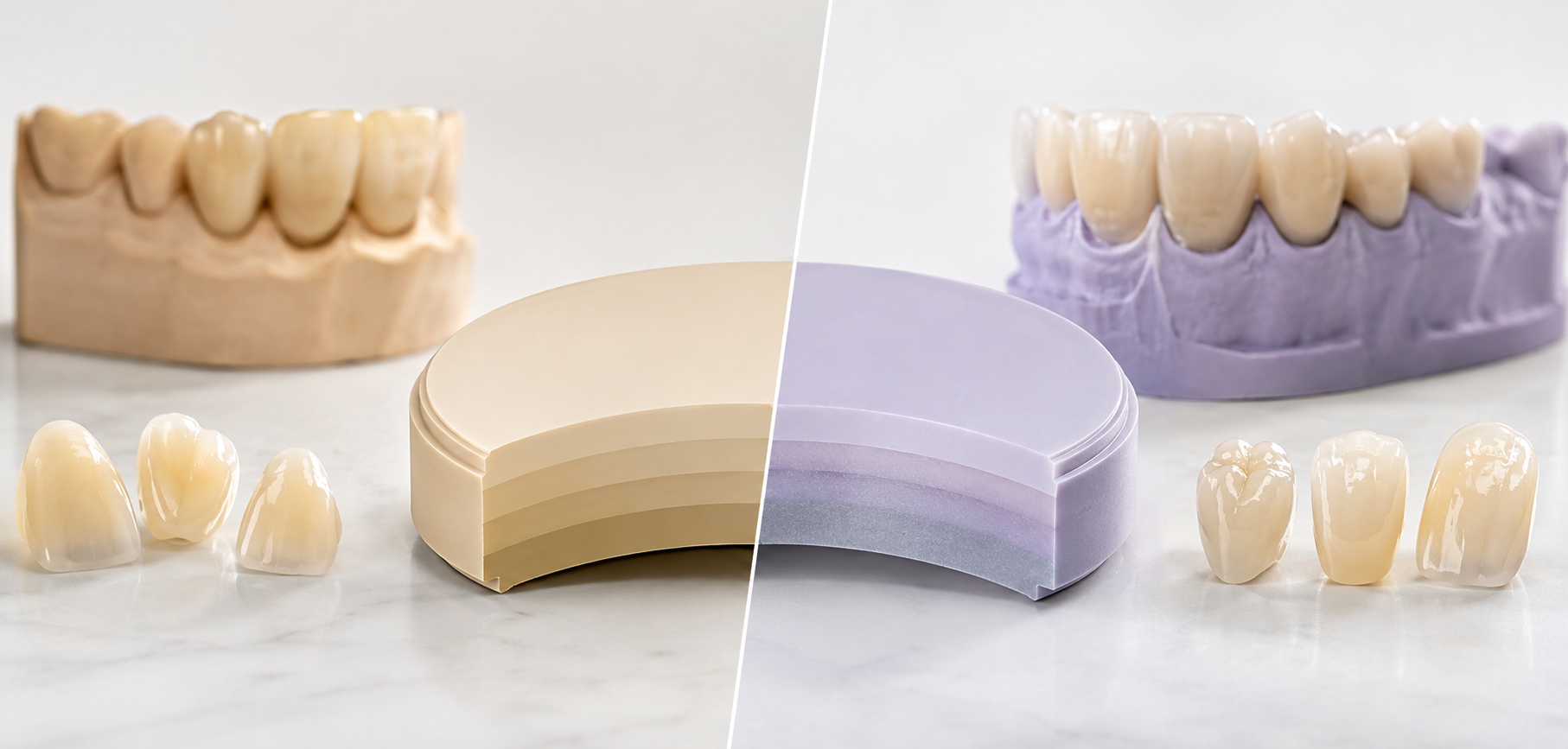
Selecting zirconia for an esthetic zone requires careful consideration because anterior teeth are highly visible. Small differences in shade, translucency, masking, or color transition can affect the final appearance. A material that works well for posterior restorations may not provide the optical properties needed for highly visible anterior cases.
Multilayer zirconia can make the process more practical by combining different shades and translucency levels within a single disc. However, not all multilayer materials are designed in the same way. TT One Multilayer Zirconia and Explore Esthetic take different approaches to balancing strength, translucency, masking, and natural color transitions.
The right choice also depends on the preparation of shade, restoration thickness, desired final shade, functional load, and the technician's finishing process. Zirconia Guys provides dental lab materials for dental professionals and laboratories looking for suitable CAD/CAM materials for different restoration workflows.
TT One Multilayer and Explore Esthetic at a Glance
Both materials are multilayer zirconia, but their material profiles differ.
TT One Multilayer Zirconia is a 4Y-PSZ material with a reported strength of around 1000 MPa and translucency of approximately 47%. Its multilayer structure provides a gradual chroma transition, making it suitable for laboratories looking for a balance between mechanical performance and esthetics.
Explore Esthetic places greater emphasis on optical performance. Its design provides a gradient of strength and translucency, with higher translucency toward the incisal area and greater masking toward the cervical region.
| Feature | TT One Multilayer Zirconia | Explore Esthetic |
|---|---|---|
| Material | 4Y-PSZ multilayer zirconia | Multilayer zirconia |
| Main focus | Strength, esthetics and versatility | Esthetics and translucency |
| Reported strength | Around 1000 MPa | About 727–1000 MPa |
| Translucency | Around 47% | Up to about 48.8% at the incisal area |
| Gradient | Chroma transition | Strength, chroma and translucency |
| Primary advantage | Balanced performance | Strong optical focus |
| Potential applications | Anterior and posterior workflows | Esthetic-focused restorations |
These differences are useful when comparing zirconia blocks dental laboratories may use for anterior and other restoration types. The selection should be based on the clinical indication rather than one specification alone.
Where Explore Esthetic Can Be Useful
Explore Esthetic emphasizes optical properties, with increased translucency in the incisal area and greater masking toward the cervical region. This gradient can help create a more natural transition in highly visible restorations.
The material may be considered for:
- Anterior crowns
- Highly visible restorations
- Cases where natural incisal translucency is a priority
- Restorations requiring a gradual cervical-to-incisal effect
- Cases where optical properties are a major consideration
For technicians working with zirconia dental blanks, the built-in gradient can simplify some aspects of color development. Instead of creating the entire transition manually, the technician can use the different layers within the material as part of the restoration design.
However, the result still depends on preparation of shade, restoration thickness, sintering, staining, glazing, and the position of the restoration within the disc. These factors should be considered alongside the material's optical properties.
Where TT One Multilayer Can Be Useful
TT One Multilayer Zirconia focuses on balancing strength and esthetics, with reported strength of around 1000 MPa and a multilayer structure that provides a natural chroma transition.
This makes it a consideration for laboratories that handle different restoration types and want versatile zirconia blocks within their CAD/CAM workflow.
A zirconia blank with a suitable strength and translucency profile can help laboratories manage different restoration requirements within the same workflow.
A laboratory may consider TT One Multilayer Zirconia when:
- Strength is an important requirement
- The case needs a balance of strength and esthetics
- The laboratory handles both anterior and posterior restorations
- A multilayer color transition is preferred
- The technician wants to reduce extensive manual staining
- Consistency across different restoration types is important
For laboratories using zirconia blocks, having a material that can support a broader range of indications may simplify inventory and production planning.
The final selection should always follow the restoration indication and the manufacturer's recommended use. Material specifications should be evaluated together rather than selecting a zirconia solely because it has a higher strength or translucency value.
TT One Pre-Shaded vs TT One White Zirconia
Shade management is an important part of dental laboratory production. The choice between TT One Pre-Shaded Zirconia and TT One White Zirconia depends largely on how much control the technician wants over color development. For a broader look at how this same pre-shaded-vs-white decision plays out across the CAD/CAM workflow from nesting and milling through sintering and finishing see Pre-Shaded vs White Zirconia Blocks: Impact on CAD/CAM Workflow and Aesthetics.
| Feature | TT One Pre-Shaded Zirconia | TT One White Zirconia |
|---|---|---|
| Base color | Shade is incorporated into the zirconia | White base without a final shade |
| Coloring process | Requires less manual shade development | Allows more control through coloring |
| Workflow | More straightforward for routine cases | Gives technicians greater flexibility |
| Shade consistency | Provides a consistent starting shade | Depends more on the technician's coloring process |
| Customization | Suitable when the available shade is close to the desired result | Better suited when detailed shade adjustment is needed |
| Best suited for | Efficient and predictable production | Cases requiring greater shade characterization |
TT One Pre-Shaded Zirconia can be a practical option when the required shade is available, and the laboratory wants to simplify its workflow. Because the base color is already incorporated, less manual color development may be required before final staining and glazing.
On the other hand, TT One White Zirconia provides greater freedom to build the desired shade. This can be useful when detailed characterization is required or when the technician prefers to control the coloring process.
The choice between TT One Pre-Shaded Zirconia and TT One White Zirconia should therefore depend on the case requirements, available shade, laboratory workflow, and desired level of customization.
What Should You Check Before Selecting the Material?
A material should be selected according to the case rather than simply because it has higher strength or translucency. This is especially important when choosing zirconia dental blanks for anterior restorations.
Before selecting between multilayer zirconia options, consider:
- Restoration location: Anterior cases generally require greater attention to optical properties.
- Preparation shade: Dark preparations may require greater masking.
- Restoration thickness: Available space can influence translucency, shade, and masking.
- Functional load: Expected forces should be compatible with the material's strength.
- Desired shade: Check the available shades before production.
- Finishing methods: Staining, glazing, and polishing can influence the final appearance.
- Laboratory workflow: Milling and sintering requirements should fit existing processes.
- Case volume: Laboratories producing larger numbers of restorations may priorities consistency and availability.
These factors also matter when selecting zirconia dental blanks for regular CAD/CAM production. A zirconia material should fit both the clinical requirements and the laboratory's manufacturing process.
How Multilayer Zirconia Can Simplify the Lab Workflow
Multilayer zirconia can reduce some of the manual work required to create a natural color transition. Selecting the right zirconia blank is still important because the technician needs to match the material's gradient and optical properties to the restoration.
The position of restoration within the disc therefore becomes important. Placing the restoration incorrectly can change the amount of cervical, body, or incisal material used and may affect the final shade and translucency.
This applies to different dental zirconia discs, where the technician must understand the direction and characteristics of the material gradient before milling.
For laboratories using dental zirconia discs, workflow consistency can also depend on:
- Disc dimensions
- Shade availability
- Milling compatibility
- Sintering cycle
- Staining requirements
- Glazing and polishing methods
- Restoration positioning
Choosing suitable dental lab materials can therefore support both production efficiency and consistent results. The material should work with the laboratory's existing equipment and finishing process rather than requiring unnecessary workflow changes.
Which One Is Better for Esthetic Zone Cases?
There is no universal answer because esthetic zone cases can have different requirements.
Explore Esthetic may be the stronger consideration when the primary priority is anterior optical performance. Its gradient is designed to provide higher translucency toward the incisal region while maintaining greater masking toward the cervical area.
TT One Multilayer Zirconia, on the other hand, may be considered when the laboratory wants a broader balance of strength and esthetics across different restoration types.
The decision can be simplified by identifying the main case priority:
| Case Priority | Material to Consider |
|---|---|
| Higher focus on anterior translucency | Explore Esthetic |
| Natural incisal transition | Explore Esthetic |
| Balance of strength and esthetics | TT One Multilayer Zirconia |
| Broader laboratory applications | TT One Multilayer Zirconia |
| Greater shade customization | TT One White Zirconia |
| Convenient base shade | TT One Pre-Shaded Zirconia |
This comparison does not mean that one material is automatically better for every patient or restoration. The final decision should consider the preparation, restoration design, thickness, shade requirements, functional demands, and manufacturer's indications.
A Practical Approach to Zirconia Selection
The best zirconia blank is not necessarily the strongest or most translucent option. It is the one that matches the restoration's clinical and esthetic requirements.
For anterior cases, technicians should assess:
- The shade of the preparation
- The required restoration thickness
- The desired translucency
- The level of masking needed
- The expected functional load
- The finishing and staining process
- The position of the restoration within the multilayer disc
This approach makes material selection more predictable and allows laboratories to use zirconia blocks more effectively. It also reduces the risk of selecting a material based on a single specification without considering the complete restoration workflow.
For laboratories comparing different zirconia blocks dental options, reviewing the material's strength, translucency, gradient, shade availability, and processing requirements together provides a more useful basis for selection.
Making the Right Choice for Your Laboratory
TT One Multilayer Zirconia and Explore Esthetic can both be considered for esthetic zone restorations, but they place emphasis on slightly different priorities. Explore Esthetic focuses strongly on optical performance, while TT One Multilayer Zirconia provides a broader balance of strength, esthetics, and versatility.
For laboratories, the decision should come down to the restoration type, preparation, desired appearance, workflow, and material requirements. TT One Pre-Shaded Zirconia can support a more convenient shade workflow when the available shade is suitable.
Zirconia Guys supplies dental lab materials, including zirconia solutions for dental professionals and laboratories. As a specialized dental lab material supplier, Zirconia Guys can help laboratories explore zirconia options that fit their restoration workflows.
Contact Zirconia Guys to discuss suitable dental zirconia discs, zirconia blocks, and other CAD/CAM materials for your next case.


