

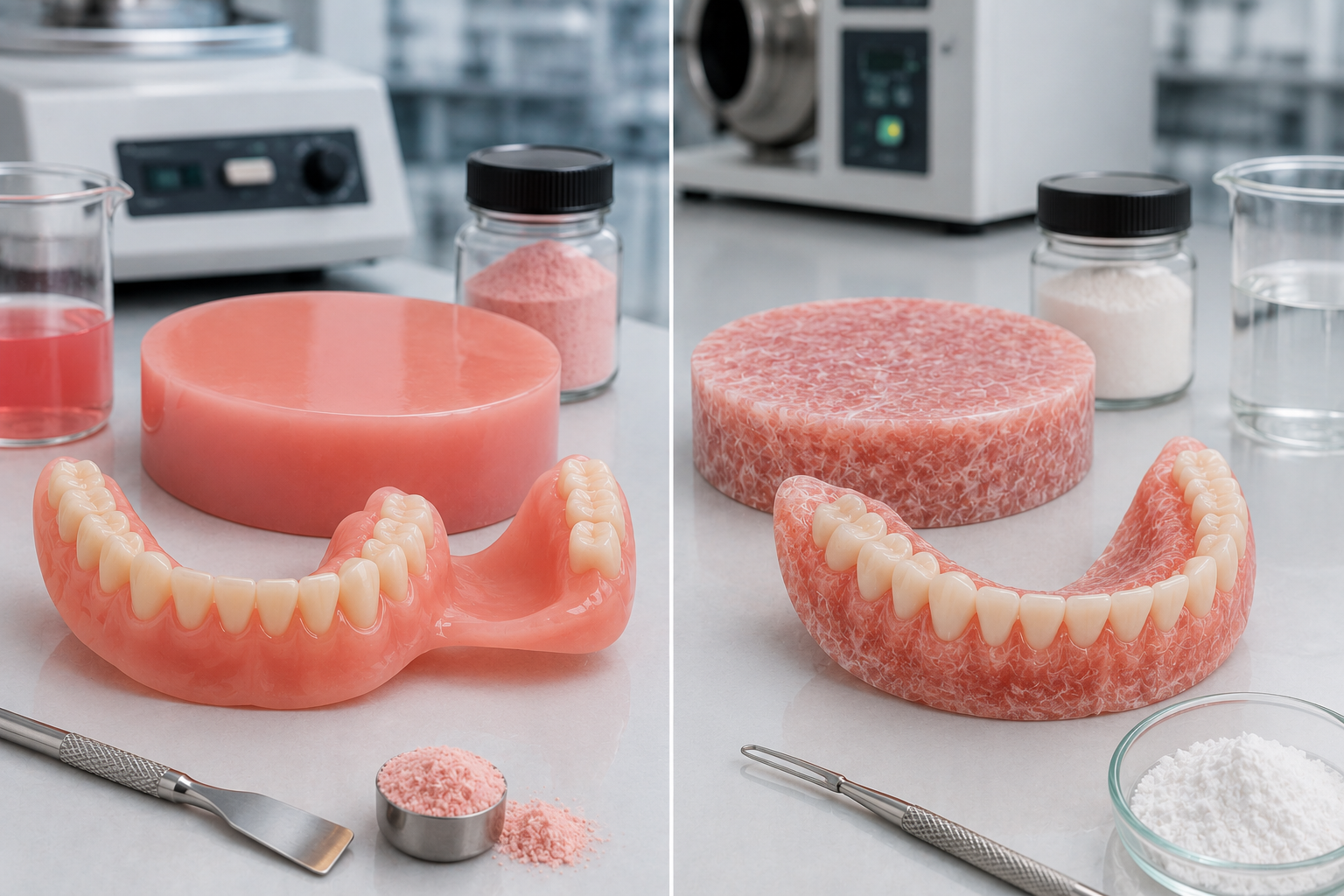
Denture base acrylic has been the foundation of removable prosthetics for over 80 years and despite advances in digital workflows, milled PMMA, and printed resin, the core material chemistry remains a polymethyl methacrylate system. What has changed is how that chemistry is modified and formulated to address the most persistent clinical failure mode in conventional dentures: fracture. Standard denture base acrylic breaks. Patients drop dentures. Patients bite into hard food. Patients with parafunctional habits flex and fatigue the base over time. Every one of these scenarios ends the same way for standard acrylic — a crack through the midline or a fractured flange.
High-impact acrylic resin was developed specifically to address this problem. But the term "high-impact" covers a range of formulation approaches, and not all high-impact acrylics deliver equivalent clinical performance. Understanding exactly what differentiates these two material categories and when each is the right choice is a practical knowledge gap for dental labs producing removable prosthetics at any volume.
The Chemistry Behind the Difference
Both standard and high-impact denture base acrylics are built on the same PMMA polymer backbone. The difference lies in what is added to that backbone to modify its mechanical behavior.
Standard denture base acrylic is a homopolymer or simple copolymer PMMA system. It polymerizes into a rigid, glassy matrix with predictable dimensional stability, good surface finish, and reliable biocompatibility. The weakness of this rigid matrix is brittleness when stress concentrates at a notch, a crack tip, or a thin cross-section, the material fractures without meaningful plastic deformation. It does not bend and recover. It breaks.
High-impact acrylic resin addresses this brittleness through rubber toughening the incorporation of a dispersed elastomeric phase within the PMMA matrix. The most common approach uses butadiene-based rubber particles, cross-linked polybutadiene, or styrene-butadiene rubber (SBR) dispersed through the polymer at the microscale. When a crack propagates through the material and encounters one of these rubber particles, the particle absorbs energy through localized deformation a mechanism called crazing and crack pinning. The crack is arrested or deflected rather than propagating cleanly through the base.
The practical result is a material that fractures at significantly higher applied energy than standard acrylic. Drop test data from manufacturer specifications typically show high-impact formulations withstanding 3–5 times the impact energy of standard acrylic before fracture — the specific figure varies by product and test method, but the improvement is consistent and clinically meaningful.
Mechanical Properties: What Actually Changes
Understanding which mechanical properties change and which don't is critical to matching the material to the clinical indication.
Fracture toughness and impact resistance
Are the primary improvements in high-impact formulations. This is the property that matters when a patient drops their denture on a hard bathroom floor, which is statistically the most common fracture event in removable prosthetics. High-impact acrylic is meaningfully superior here.
Flexural strength
Shows modest improvement in most high-impact formulations. The rubber toughening phase that improves impact resistance can slightly reduce flexural modulus the material becomes slightly less stiff while improving the energy absorbed before fracture. For most clinical applications, this tradeoff is acceptable. For thin, high-stress design areas like thin lingual flanges in full lower dentures, the slightly reduced stiffness is worth noting.
Hardness and wear resistance
Are generally equivalent between standard and high-impact acrylic, or slightly lower in high-impact formulations. The rubber phase introduces softer domains into the matrix. In most clinical scenarios this difference is not measurable as surface wear, but high-impact acrylic is not the correct choice for applications where maximum surface hardness is the primary requirement.
Dimensional stability and fit accuracy
Are equivalent between standard and high-impact formulations when processed correctly. The polymer shrinkage during polymerization is comparable, and fit accuracy depends primarily on processing technique flask design, curing temperature, and pressure rather than material type.
Biocompatibility
Is equivalent. Both standard and high-impact formulations meet ISO 20795-1 requirements for denture base polymers when residual monomer content is within specification. High-impact modification does not introduce new biocompatibility concerns for intraoral use.
When Standard Acrylic Is Sufficient?
Standard acrylic resin dental formulations remain clinically appropriate for a significant proportion of denture production. Not every patient is a high-fracture-risk case, and not every lab needs to upgrade every case to high-impact material.
Standard acrylic is the correct choice when the patient profile presents no elevated fracture risk a light-biting older patient with reduced masticatory force, a patient with careful denture handling habits, or a case where the denture design itself provides inherent structural protection through appropriate thickness and cross-section.
Standard acrylic also remains appropriate for partial denture frameworks where the acrylic saddle is supported by a metal framework that carries the structural load. In these cases, the acrylic is not the primary structural element the metal framework is and the impact resistance of the acrylic saddle is a secondary consideration.
For CAD/CAM milled denture workflows, the selection between standard and high-impact begins at the disc procurement stage. Pre-polymerized PMMA discs for denture bases are available in both standard and high-impact formulations. The aidite denture base pmma disc from Aidite is a pre-polymerized standard denture base formulation reliable, well-documented, and appropriate for the majority of daily denture production cases where patient fracture risk is average.
For a deeper look at the advantages of pre-polymerized PMMA over bench-mixed acrylic in the CAD/CAM workflow, the guide to Why Dental Labs Prefer Aidite PMMA for Denture Bases covers machinability, biocompatibility, and production efficiency in full detail.
When High-Impact Acrylic Is the Right Specification
High-impact acrylic resin becomes the correct material specification when patient history or design factors place the denture at elevated fracture risk. Labs should consider specifying high-impact formulations in the following scenarios:
History of denture fracture.
If the patient has fractured a previous denture particularly a midline fracture, which is the most common pattern the clinical cause is usually a combination of design, occlusal forces, and material. Upgrading to high-impact acrylic for the replacement denture addresses the material variable directly.
Parafunctional habits.
Patients with bruxism, clenching, or heavy masticatory habits generate cyclical fatigue loading in the denture base that standard acrylic handles poorly over time. High-impact formulations absorb this cyclical energy more effectively.
Implant-supported overdentures.
Implant-retained overdentures are subjected to higher and more concentrated occlusal forces than conventional tissue-borne dentures. The attachment mechanism transfers vertical and lateral forces directly into the denture base high-impact acrylic is the preferred base material for this indication.
Young or active patients.
Younger patients requesting removable prosthetics for aesthetic or transitional reasons are more likely to handle their dentures under conditions that create impact risk. High-impact acrylic is worth specifying as a standard upgrade for this patient demographic.
Thin cross-section designs.
Where aesthetics or phonetics require thin flanges, reduced palatal coverage, or other design features that reduce the structural cross-section of the base, high-impact material compensates for the reduced geometry.
For 3D printed denture base workflows specifically, the key denture base resin for dental labs from Keystone is formulated for printed denture base production with documented biocompatibility for long-term tissue contact an important consideration as labs evaluate printed versus milled denture workflows for specific patient indications.
CAD/CAM Workflow: How Material Selection Works at the Disc Stage
In a digital denture production workflow, the material selection decision is made at disc procurement before any scanning, design, or milling begins. Understanding which disc formulation corresponds to which clinical indication is therefore a lab management decision as much as a clinical one.
The full range of pmma denture base materials available through ZirconiaGuys includes both standard pre-polymerized PMMA discs for daily volume production and specialized formulations for elevated-risk cases. Stocking both formats in inventory and building a clear internal protocol for which patient profile triggers a high-impact specification is how labs consistently match material to indication without relying on ad-hoc case-by-case decisions that create variation.
Practical stocking strategy for a full-service dental lab:
- Standard PMMA denture base discs as the default for routine complete and partial denture cases
- High-impact formulation as a defined upgrade for cases meeting the fracture-risk criteria above
- Clear documentation in the work order about which formulation was used enabling traceability and supporting remake analysis if fractures occur
The Conventional Acrylic Comparison: Flask-and-Pack vs CAD/CAM
The high-impact vs standard distinction applies to both conventional flask-and-pack acrylic and pre-polymerized CAD/CAM discs, but the performance gap between the two processing methods is worth understanding alongside the formulation difference.
Conventional flask-and-pack acrylic regardless of whether it is standard or high-impact has higher residual monomer, more porosity, and more dimensional variability than pre-polymerized CAD/CAM PMMA. For labs that still run conventional processing for specific cases, high-impact conventional acrylic is a meaningful upgrade for fracture-prone cases. But for labs that have transitioned to CAD/CAM milled dentures, the baseline performance of pre-polymerized PMMA is already superior to conventional acrylic in residual monomer, porosity, and dimensional accuracy before the high-impact modifier is even considered.
For labs sourcing acrylic resin for dentures across both conventional and digital workflows, ZirconiaGuys stocks formulations covering both production methods from US inventory, with full batch documentation and technical support for material selection questions.
The choice between high-impact and standard acrylic resin dental formulations is not a question of one being universally better it is a question of matching material properties to the specific fracture risk profile of each patient case. Standard acrylic remains appropriate for the majority of routine denture production. High-impact formulations are the correct upgrade for cases with documented fracture risk, parafunctional habits, implant support, or thin design cross-sections.
Building a clear internal protocol that identifies which cases trigger a high-impact specification and stocking both formulations from a reliable US supplier with consistent batch documentation is how dental labs eliminate avoidable denture fractures without inflating material costs across their entire production volume. The gap between zirconia dental blanks, dental zirconia discs, and zirconia blocks dental procurement decisions and denture base material selection is narrower than it looks: both come down to matching the right formulation to the right clinical demand, sourced from a supplier whose documentation and inventory reliability you can build a production workflow around. Consistent supply of zirconia blank stock and zirconia blocks alongside denture acrylic from a single US distributor simplifies that equation considerably.


