

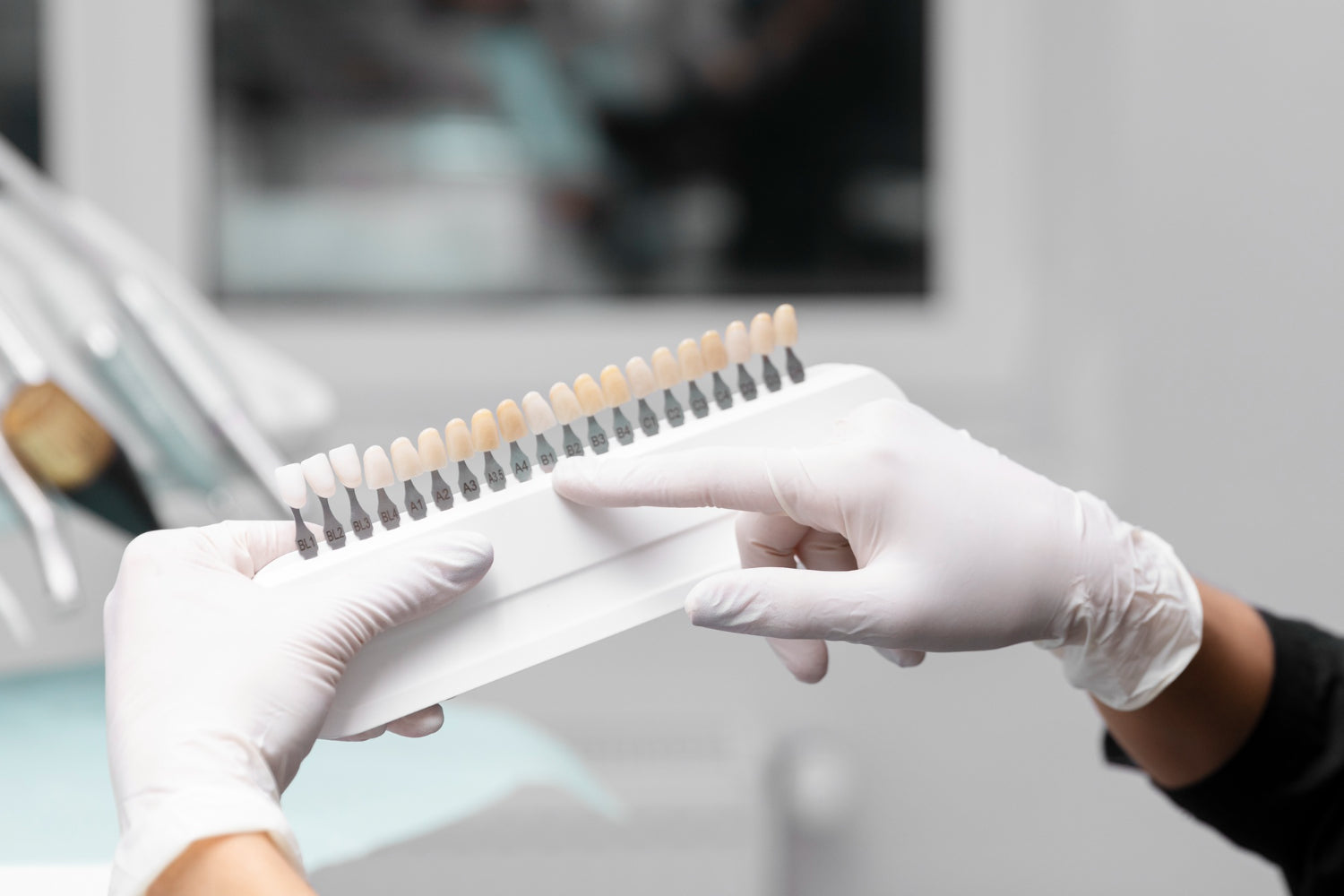
The choice between pre-shaded and white zirconia blocks sits at the intersection of workflow efficiency and aesthetic control two things that rarely point in the same direction. Pre-shaded material saves bench time on standard cases. White material preserves maximum characterisation control for complex cases. Neither is universally better, and labs that default to one without understanding the other are leaving either efficiency or aesthetic capability on the table.
This guide covers how the choice between pre-shaded and white zirconia affects every stage of the CAD/CAM workflow design, nesting, milling, sintering, and finishing and what the practical implications are for batch consistency, shade predictability, and final aesthetics. It's written for lab technicians who work with these materials daily, not for dentists making chairside purchasing decisions.
What pre-shaded and white zirconia actually are?
Both pre-shaded and white zirconia blanks are pre-sintered zirconium dental material manufactured from the same base chemistry. The zirconia dental material itself yttria-stabilised zirconium dioxide is identical between the two configurations. What differs is whether pigment is incorporated into the blank during manufacture.
Pre-shaded zirconia has metal oxide pigments iron, praseodymium, and other rare earth oxides in calibrated concentrations distributed through the blank during the powder pressing stage. These pigments are stable through the sintering cycle, producing a post-sintering shade that corresponds to a specified VITA classical shade. In multilayer configurations, the pigment concentration gradient produces the cervical-to-incisal colour transition in the sintered blank without any external liquid staining.
White zirconia blanks contain no pigment the blank sinters to a uniform off-white or slightly translucent appearance. All shade characterisation is applied externally by the technician, either as liquid shade solution applied before sintering, or as surface stain and glaze applied to the sintered crown. White blanks give the technician complete control over the final shade which is both their primary advantage and the source of their efficiency limitation.
How the choice affects the CAD/CAM design stage?
The CAD/CAM design stage is largely unaffected by shade configuration the geometry, margins, occlusal morphology, and contact points are identical regardless of whether the blank is pre-shaded or white. Where the configuration matters at design stage is in multilayer pre-shaded discs, which require attention to nesting orientation.
A pre shaded zirconia multilayer disc has a defined orientation the cervical region of the gradient is at one end of the disc, the incisal region at the other. Nesting software must be set to respect this orientation so that the incisal translucency of each crown aligns with the incisal region of the blank gradient, not the cervical. A crown nested upside-down in a multilayer pre-shaded disc will have the correct shade structure in reverse — more saturated and opaque at the incisal, lighter and more translucent at the cervical which produces an unnatural-looking result that requires correction.
Most nesting software supports multilayer orientation lock a setting that constrains unit placement to maintain the correct vertical orientation within the disc. Labs switching from white to pre-shaded multilayer for the first time should verify this setting is active in their workflow before running the first production batch. A test run on a single unit before committing to a full disc is a sensible protocol when evaluating a new pre-shaded product.
White blanks have no orientation constraint units can be placed in any orientation within the disc without affecting shade outcome. This gives nesting software more freedom to optimise material utilisation, which can produce marginally better disc yield on complex multi-unit nesting layouts.
Milling: where the two configurations behave identically
At the milling stage, pre-shaded and white zirconia behave identically. Both are milled in the pre-sintered ("green") state at the same hardness and density for equivalent grade and manufacturer. Cutting parameters spindle speed, feed rate, bur type should be set the same for both configurations from the same product line. The pigment content in pre-shaded blanks does not meaningfully affect machinability or bur wear.
What does affect milling performance is grade and pre-sintered density variables that are consistent within a product line regardless of shade configuration. A pre-shaded 3Y-TZP disc and a white 3Y-TZP disc from the same manufacturer will mill identically.
Sintering: the critical difference in pre-shaded workflow
Sintering is where the pre-shaded and white workflows diverge most practically. Both follow the same temperature profile 1,450–1,550°C depending on the product but the pre-sintered processing steps before the furnace differ.
With white blanks, the technician applies liquid shade solution to the milled crown before sintering. The application method brush, dip, or spray and the number of coats determine the post-sintering shade. This step requires skill and calibration: liquid shade concentrations vary between brands, the shade result is affected by how thoroughly the liquid penetrates the pre-sintered structure, and the outcome can vary between technicians applying the same product. Getting consistent shade results from white blanks requires standardised technique and regular verification against a shade guide.
With pre-shaded blanks, the milled crown goes directly to the furnace with no liquid shade application step. The post-sintering shade is determined entirely by the blank's pigment formulation the technician has no ability to modify it before sintering. What comes out of the furnace is the shade. This removes one variable from the process and eliminates technician-to-technician shade inconsistency on standard prescriptions.
The tradeoff is that pre-shaded sintering behaviour must be validated more carefully when switching sintering furnaces. The colour development of metal oxide pigments is temperature-sensitive a furnace running 20–30°C cooler or hotter than specified can produce shade shift in pre-shaded blanks that wouldn't be visible in an equivalent white blank. Calibrating the sintering furnace against the pre-shaded product's specified temperature profile, and verifying shade outcomes after furnace servicing, is good practice that matters more for pre-shaded than for white.
Bench time: the efficiency argument for pre-shaded
The most concrete workflow argument for pre-shaded zirconia is bench time per unit. For a standard posterior crown in A2 or A3 the two shades that cover the majority of cases in most labs a pre-shaded blank eliminates the liquid shade application step entirely and reduces post-sintering characterisation to glazing only.
A realistic bench time comparison for a standard posterior crown in a high-volume lab looks approximately like this:
| Step | White blank | Pre-shaded blank |
|---|---|---|
| Post-milling shade application | 3–6 minutes (liquid shade, dry, verify) | 0 minutes |
| Sintering | Same duration | Same duration |
| Post-sintering characterisation | 5–10 minutes (stain + glaze) | 2–4 minutes (glaze only, standard cases) |
| Shade verification | Required per unit | Batch verification, not per unit |
At ten units per day, the pre-shaded workflow recovers 60–120 minutes of bench time compared to equivalent white blank production. Across a five-day week, that's five to ten hours of recovered capacity — the equivalent of adding half a working day to the production schedule without hiring additional staff.
This is why most high-volume labs running standard shade prescriptions have standardised on pre-shaded material for posterior production. The zirconia blocks price difference between pre-shaded and white (pre-shaded typically carries a modest premium) is offset multiple times over by the labour efficiency at scale.
Shade stability and batch consistency: the real risk of pre-shaded
The efficiency argument for pre-shaded is compelling, but it depends entirely on one condition: batch-to-batch shade stability. If the post-sintering shade of a pre-shaded blank shifts between deliveries producing A2.5 from a batch that should produce A2 the efficiency advantage disappears immediately. The lab is now verifying every batch and adjusting staining accordingly, which takes more time than liquid shade application from white would have.
Shade stability in pre-shaded zirconia is a function of raw material consistency and manufacturing process control. Labs evaluating a new pre-shaded product should run at least three consecutive batches before committing to full production quantities checking post-sintering shade accuracy against a Vita Linearguide or spectrophotometer at the same furnace settings each time.
The HonorZir pre-shaded zirconia blocks from Aidite are manufactured from TOSOH powder a Japanese-sourced base material known for tighter particle size and purity tolerances that directly support shade stability across batches. Labs that have made the switch to Aidite pre-shaded products for standard posterior production typically report consistent shade outcomes without per-batch verification adjustments, which is the operational behaviour that justifies pre-shaded adoption.
When white zirconia is the right choice?
Pre-shaded efficiency is compelling for standard production but there are clinical situations where white blanks remain the correct specification and where attempting to force a pre-shaded product into the case creates more problems than it solves.
Complex or unusual shade prescriptions — cases outside standard VITA A, B, C, D shades, or cases requiring specific bleach or master shades not covered in the pre-shaded range, require white blanks. No pre-shaded product covers every possible shade prescription. White gives the technician complete control.
High characterisation cases — anterior restorations where the technician needs to build internal shade effects, stump shade masking, or complex gradient work benefit from the blank-canvas control of white zirconia. Starting from a pre-shaded base limits the degree to which internal shade can be modified.
Labs with specific staining expertise — some labs have developed highly refined liquid shade techniques that produce better aesthetic results than the pre-shaded equivalent. For those labs, the efficiency gain of pre-shaded is outweighed by the aesthetic quality achievable from white.
The UPCERA dental zirconia blank range — including the HT White, ST White, TT White, and TT One White lines — covers white zirconia in high-strength, moderate, and high-translucency formulations for labs running custom characterisation workflows.
Multilayer zirconia: where pre-shaded and white diverge most in aesthetics
The aesthetic impact of pre-shaded vs. white is most pronounced in multilayer zirconia products and this is where the decision has the most clinical consequence.
A zirconia multilayer disc that is pre-shaded produces its gradient entirely from the pigment concentration built into the blank. The incisal translucency and cervical saturation are fixed by the manufacturing process. A skilled technician can enhance with surface stain and glaze, but cannot fundamentally alter the internal shade gradient established in the blank.
A white multilayer disc provides the translucency gradient from the yttria concentration gradient, but the colour gradient must be created entirely through liquid shade application which requires more technical skill to achieve a result that matches the natural, pre-distributed pigment of a good pre-shaded blank. In the hands of an experienced technician with calibrated technique, white multilayer can match or exceed the aesthetic depth of pre-shaded. In a high-volume production environment where technique consistency across technicians is variable, pre-shaded multilayer produces more reliable anterior aesthetics.
For most labs, the practical recommendation is: pre-shaded multilayer for standard anterior production volume, white multilayer for complex or highly customised anterior cases. That combination covers the full aesthetic range without over-indexing on either efficiency or control.
Building a practical zirconia inventory: how most labs solve this
The labs that manage this decision most effectively don't choose one configuration for everything — they stock both strategically. A practical inventory approach for a mid-to-high-volume digital dental lab looks like:
- Pre-shaded multilayer disc — A2 and A3 in a reliable multilayer formulation, covering standard anterior and premolar prescriptions for the majority of the week's caseload. This is where the efficiency gains compound most meaningfully.
- White zirconia in high-strength 3Y — for posterior implant crowns, bridges, and full-arch cases where shade is controlled by the technician and strength is the primary concern. White 3Y is appropriate here because the posterior aesthetic requirement is lower and the custom staining control is less critical.
- White multilayer in high-translucency — a smaller inventory for complex anterior cases, bleach shades, and custom characterisation work where the pre-shaded range doesn't cover the prescription.
As a dental lab material supplier serving North American labs, Zirconia Guys carries both Aidite and UPCERA zirconia dental lab materials in pre-shaded and white configurations across all grades and thicknesses so labs can build this kind of mixed inventory from a single supplier relationship without managing multiple sourcing channels. Get in touch with the team to discuss which pre-shaded and white products suit your milling system, furnace, and case mix.


