

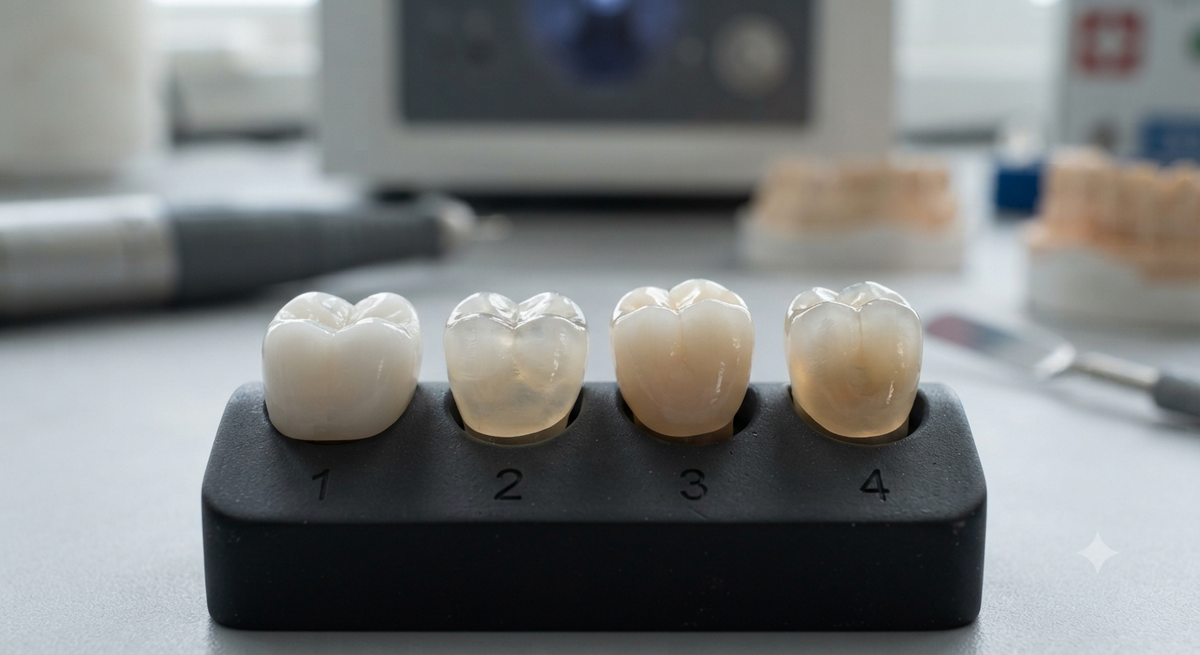
Ask five technicians how to pick a zirconia and you will hear five opinions, but most will start with the same word: translucency. It decides whether a crown blends into the smile or looks like a flat white cap, and it also affects how strong the restoration is. Whether you work with multilayered zirconia or single-shade discs, this guide explains what translucency really means and how to choose the right level for each case.
Why Zirconia Is Not Just One Material
Early dental zirconia was very strong but fairly opaque, which was fine for frameworks hidden under porcelain. As monolithic restorations took off, manufacturers changed the formula to let more light pass through. The main lever is yttria, a stabilizing oxide added to the zirconia. More yttria creates more of the cubic crystal phase, which lets light through but gives up some strength.
That trade-off is at the heart of every decision you make. The more translucent the material, the lower its flexural strength. Neither end of the scale is better, they simply suit different jobs.
Reading the Yttria Numbers: 3Y, 4Y and 5Y
• 3Y (about 3 mol% yttria): the strongest and most opaque. A reliable pick for long-span bridges, molars and cases with discolored stumps.
• 4Y: a middle path. 4Y zirconia offers noticeably better translucency than 3Y while keeping enough strength for most single crowns and short bridges.
• 5Y: the most translucent of the three, ideal for anterior crowns, but with lower strength, so keep it away from long spans and heavy-load areas.
Exact strength values vary by brand and sintering protocol, so check the manufacturer's data sheet instead of relying on a general number.
Matching Translucency to the Tooth
Three questions usually settle the choice: where is the tooth, how hard will it work, and what color is the prepared tooth underneath?
• Location: front teeth are seen up close, so they benefit from higher translucency. Back teeth are seen from a distance, so strength wins.
• Load: patients who grind or clench need extra strength, even on visible teeth.
• Background: a dark stump will show through a very translucent crown. A more opaque material, or a thicker layer, hides it better.
How Multilayer Discs Shape the Final Color
A multilayered zirconia disc changes both shade and translucency from one end of the block to the other, so a single crown can move from a deeper cervical color to a brighter, clearer incisal edge. That gradient saves staining time and gives a lifelike result straight out of the furnace.
Some designs even combine different yttria levels in the same block, such as a 4Y 5Y multilayered disc with a stronger base and a more translucent top. Where you nest the crown within the disc decides where that gradient lands, so placement matters.
Aidite has several lines built on this idea. Labs chasing lifelike depth often look for natural look zirconia Aidite grades, and for single front teeth a super translucent zirconia Aidite option is worth a closer look. If you would like a ready-made gradient, the translucent multilayer zirconia Aidite range is a good place to start.
Does Higher Translucency Always Look Better?
Not always. A highly translucent crown placed on a dark or discolored abutment can look gray, because the underlying color shows through instead of being masked. Very translucent material can also look too glassy next to older, more opaque natural teeth. The goal is not maximum translucency but a crown that matches its neighbors. In many cases, a mid-level material with careful staining looks more natural than the most translucent option available. Photos of the adjacent teeth, taken in natural light, help your lab judge how much translucency the case really needs.
Common Translucency Mistakes Labs Make
• Using a highly translucent disc over a dark stump without adjusting the plan.
• Choosing translucency by shade alone and ignoring bite load.
• Skipping the manufacturer's sintering program, which can reduce translucency.
• Over-thinning a translucent crown, which risks chipping or fracture.
A Simple Way to Make the Final Call
When you are unsure, ask yourself three things. How strong does this restoration need to be? How visible will it be? How dark is the prepared tooth? Answer those and the right material usually becomes obvious.
Keep a few grades on your shelf so you are never forced to compromise: a strong base grade, a mid-range option for everyday crowns, and multilayered zirconia for front teeth where aesthetics come first.


