

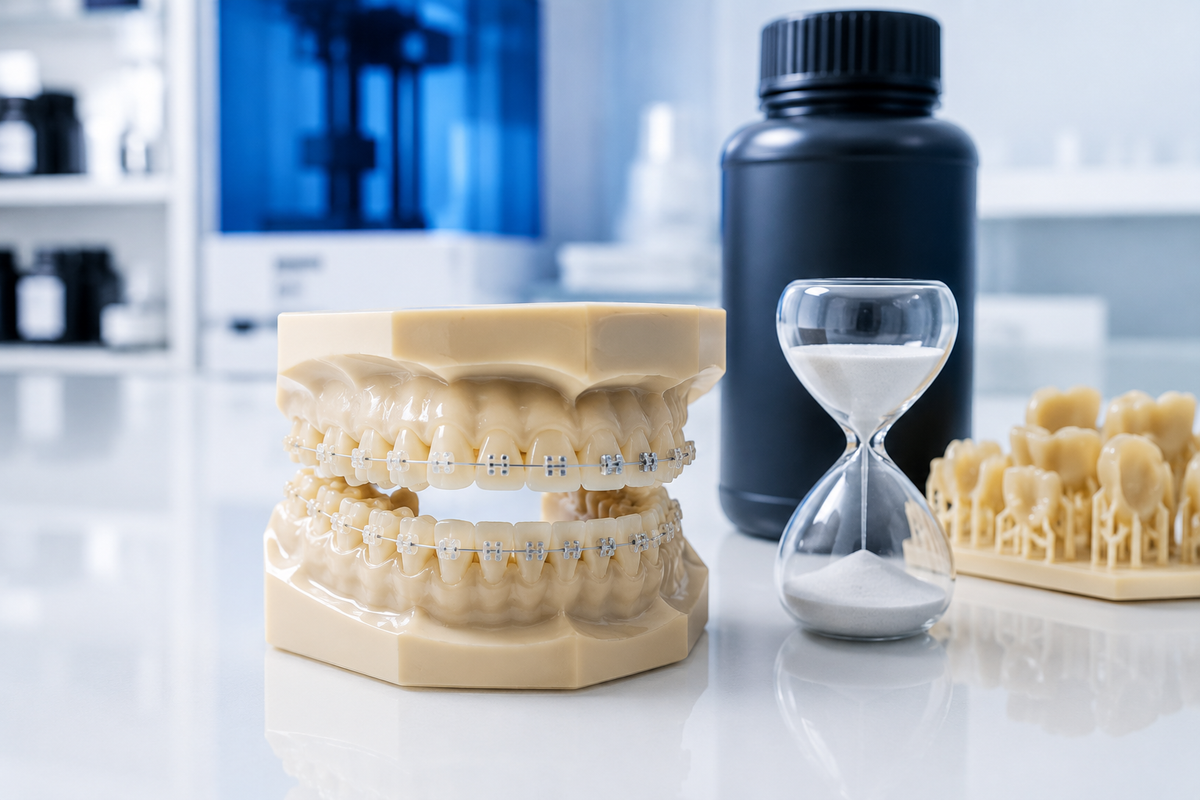
The shelf life of orthodontic model resin is crucial for dental labs, as it impacts print quality, accuracy, surface detail, and curing. Proper storage and handling during its usability to support consistent results. The expiry date and storage instructions from the manufacturer should be the main guide for resin suitability.
For laboratories researching Verimodel Ortho White, the product information lists a 3-year shelf life and describes it as a material for precision orthodontic and presentation models. It is compatible with DLP and LCD printers using 385 nm or 405 nm wavelengths.
Zirconia Guys supplies dental lab materials for dental professionals and laboratories, including orthodontic printing resins and CAD/CAM materials. Its product range can help labs source materials suited to different laboratory workflows.
Why Does the Shelf Life of Orthodontic Model Resin Matter?
Shelf life is the period a material maintains its properties when stored as instructed. For orthodontic model resin, this is crucial because printed models are used for aligner creation, bonding, progress tracking, and other orthodontic tasks.
Material that is stored incorrectly or used beyond its stated shelf life may show inconsistent printing performance.
Key areas that can be affected include:
- Dimensional accuracy
- Surface detail
- Layer formation
- Curing performance
- Model strength
- Surface finish
- Consistency between prints
A reliable orthodontic model resin should therefore be managed as carefully as other specialized dental lab materials.
How Long Does Orthodontic Model Resin Typically Last?
There is no universal shelf life for orthodontic model resin. Different formulations can have different stability requirements, so laboratories should always follow the expiry date stated by the manufacturer.
For example, Verimodel Ortho White currently lists a shelf life of 3 years. This should not be treated as the standard shelf life for every resin model.
Before using stored resin, laboratories should check:
| Check | What to Review |
|---|---|
| Expiry date | Manufacturer's stated shelf life |
| Container | Damage, leakage, or poor sealing |
| Resin appearance | Unusual color, particles, or separation |
| Storage | Exposure to heat, light, or unsuitable conditions |
| Printer compatibility | Supported printer technology and wavelength |
| Print performance | Accuracy, surface detail, and curing |
An unopened bottle usually has a predictable storage history. Once opened, exposure to air, light, heat, and contamination can affect handling. Hence, the age of an orthodontic model resin should be considered alongside its storage history.
What Factors Can Shorten Resin Shelf Life?
Several environmental and handling conditions can affect the stability of resin. Proper storage can help laboratories protect their material inventory.
Light Exposure
Photopolymer resins can be sensitive to light exposure. Direct sunlight or unnecessary exposure to UV sources may affect the material before it reaches its stated expiry date.
Keep the container closed and out of direct light when it is not in use.
Heat
High temperatures can affect material stability. Resin should be stored within the temperature conditions recommended by the manufacturer.
Avoid leaving resin near printers, curing equipment, windows, or other heat sources.
Moisture
Moisture exposure can become a concern when bottles are repeatedly opened or not properly sealed. Keeping the container closed helps limit unnecessary environmental exposure.
Contamination
Dust cured resin particles, and other contaminants can affect print consistency. Clean handling is important when pouring, transferring, or preparing orthodontic model resin for printing.
Poor Container Sealing
An improperly closed bottle can expose the resin to environmental conditions that may affect its quality over time.
These factors are relevant whether a laboratory uses a general-purpose model resin or a specialized key ortho model resin for orthodontic applications.
How Should Orthodontic Model Resin Be Stored?
Correct storage helps preserve material quality throughout its stated shelf life. Laboratories should always follow product-specific storage instructions rather than relying on general assumptions.
Good storage practices include:
- Keep the container tightly closed when not in use.
- Store resin away from direct sunlight and UV exposure.
- Avoid excessive heat.
- Keep the storage area clean and dry.
- Prevent dust and contaminants from entering the bottle.
- Follow the manufacturer's handling instructions.
- Check the expiry date before use.
A consistent storage routine also makes troubleshooting easier. If a previously reliable orthodontic model resin begins producing inconsistent models, the laboratory can review storage conditions, printer settings, and post-processing procedures.
How Can You Tell If Orthodontic Model Resin Has Degraded?
A resin bottle should not be considered suitable simply because it looks acceptable. The material should remain within its stated shelf life and meet the manufacturer's requirements.
Possible warning signs include:
- Unusual color changes
- Visible particles
- Unexpected separation
- Changes in viscosity
- Poor layer formation
- Incomplete curing
- Reduced surface detail
- Brittle printed models
- Dimensional inconsistencies
If a key ortho model resin suddenly produces poor results, the laboratory should review several possible causes before continuing production.
These may include:
- Material age
- Storage conditions
- Resin preparation
- Printer settings
- Build platform condition
- Washing
- Post-curing
This prevents laboratories from assuming that every print failure is caused by the resin itself.
What Should Dental Labs Check Before Using Stored Resin?
A short pre-use inspection can help identify potential problems before material enters regular production.
Before using stored orthodontic model resin, check:
- Expiry date: Confirm that the material is within its stated shelf life.
- Storage history: Consider whether it was exposed to excessive heat or light.
- Bottle condition: Look for damage, leakage, or poor sealing.
- Resin appearance: Check for unexpected changes or contamination.
- Printer compatibility: Confirm that the resin is compatible with the printer.
- Print parameters: Use the manufacturer's recommended settings.
- Test print: Consider a test print when the material has been stored for an extended period.
When purchasing replacement stock, a reliable dental lab material supplier can also provide product information that helps laboratories verify storage, handling, and compatibility requirements before use.
This process is particularly useful when laboratories maintain large inventories of dental lab materials.
Orthodontic Model Resin vs Other Dental CAD/CAM Materials
Resin and zirconia are different material categories with different applications and processing requirements. Understanding this distinction is useful when laboratories compare dental lab materials for different workflows.
| Material | Common Application | Main Considerations |
|---|---|---|
| Orthodontic model resin | Orthodontic and presentation models | Shelf life, curing, accuracy, and storage |
| Zirconia dental material | Dental restorations | Strength, translucency, and sintering |
| Zirconia blanks | CAD/CAM restorations | Material grade and milling |
| Zirconium block | CAD/CAM applications | Composition and processing |
| Zirconia multilayer | Esthetic restorations | Shade and translucency gradients |
A zirconia dental material is processed differently from resin and is generally selected based on factors such as strength, translucency, shade, and the indication for the restoration. If you're also comparing zirconia materials for CAD/CAM restorations, you can read our guide to understanding zirconia, its types, and common dental applications.
Likewise, zirconium dental products can include different material grades designed for specific CAD/CAM applications. The zirconium block should therefore be evaluated according to its intended restoration and processing requirements.
The same principle applies to zirconia blanks. Their suitability depends on the material composition, strength, translucency, dimensions, and intended use.
How Can Labs Manage Resin Inventory More Effectively?
Good inventory management can help laboratories use resin within its stated shelf life and avoid unnecessary material waste. Working with a reliable dental lab material supplier can also help laboratories maintain a steady supply of commonly used materials without unnecessary overstocking.
A practical approach includes:
- Use older stock before newer stock when appropriate.
- Check expiry dates during routine inventory reviews.
- Record opening dates were useful.
- Avoid purchasing more resin than the laboratory can reasonably use.
- Keep storage conditions consistent.
- Separate materials intended for different printers.
- Inspect bottles before moving them into active production.
The same inventory planning can be applied to materials such as zirconia multilayer products, where proper storage and stock rotation are also important.
When purchasing zirconia blocks, prices may be one factor in inventory planning, while resin purchasing may depend more on print volume, workflow requirements, and expected consumption.
Similarly, laboratories comparing zirconia blocks price across products should evaluate material specifications and intended applications rather than price alone.
What Should Labs Consider When Selecting Model Resin?
Shelf life is only one factor when selecting an orthodontic model resin. The material should also be compatible with the laboratory's printer, workflow, and intended application.
A knowledgeable dental lab material supplier can also help laboratories compare available materials based on printer compatibility, intended application, and workflow requirements.
Important considerations include:
- Printer wavelength compatibility
- Dimensional accuracy
- Surface detail
- Model durability
- Washing requirements
- Post-curing requirements
- Color and visibility
- Intended orthodontic application
- Manufacturer-supported print parameters
- Storage requirements
A key ortho model resin should support the laboratory's actual workflow. Product documentation should be reviewed before purchasing or changing materials.
For example, verimodel ortho white is listed as compatible with 385 nm and 405 nm DLP and LCD printers, while the manufacturer-recommended print parameters should be followed for the specific printer model.
The same selection principle applies to zirconia dental material. Strength or translucency alone does not determine whether a material is appropriate. The restoration type, processing method, and laboratory requirements also matter.
The shelf life of orthodontic model resin depends on the specific formulation and the manufacturer's stated requirements. Laboratories should check the expiry date, maintain suitable storage conditions, inspect the material before using, and follow recommended printing, washing, and curing procedures.
For verimodel ortho white, the listed shelf life is three years, and the material is intended for precision orthodontic and presentation models.
Zirconia Guys supplies dental lab materials for dental professionals and laboratories, including orthodontic model resin and CAD/CAM materials. Laboratories researching verimodel ortho white or other key ortho model resin options can review products according to their printer and workflow requirements.
For laboratories looking for orthodontic model resin, dental lab materials, or other CAD/CAM solutions, explore the available options from Zirconia Guys and contact the team to discuss the right material for your workflow.


