

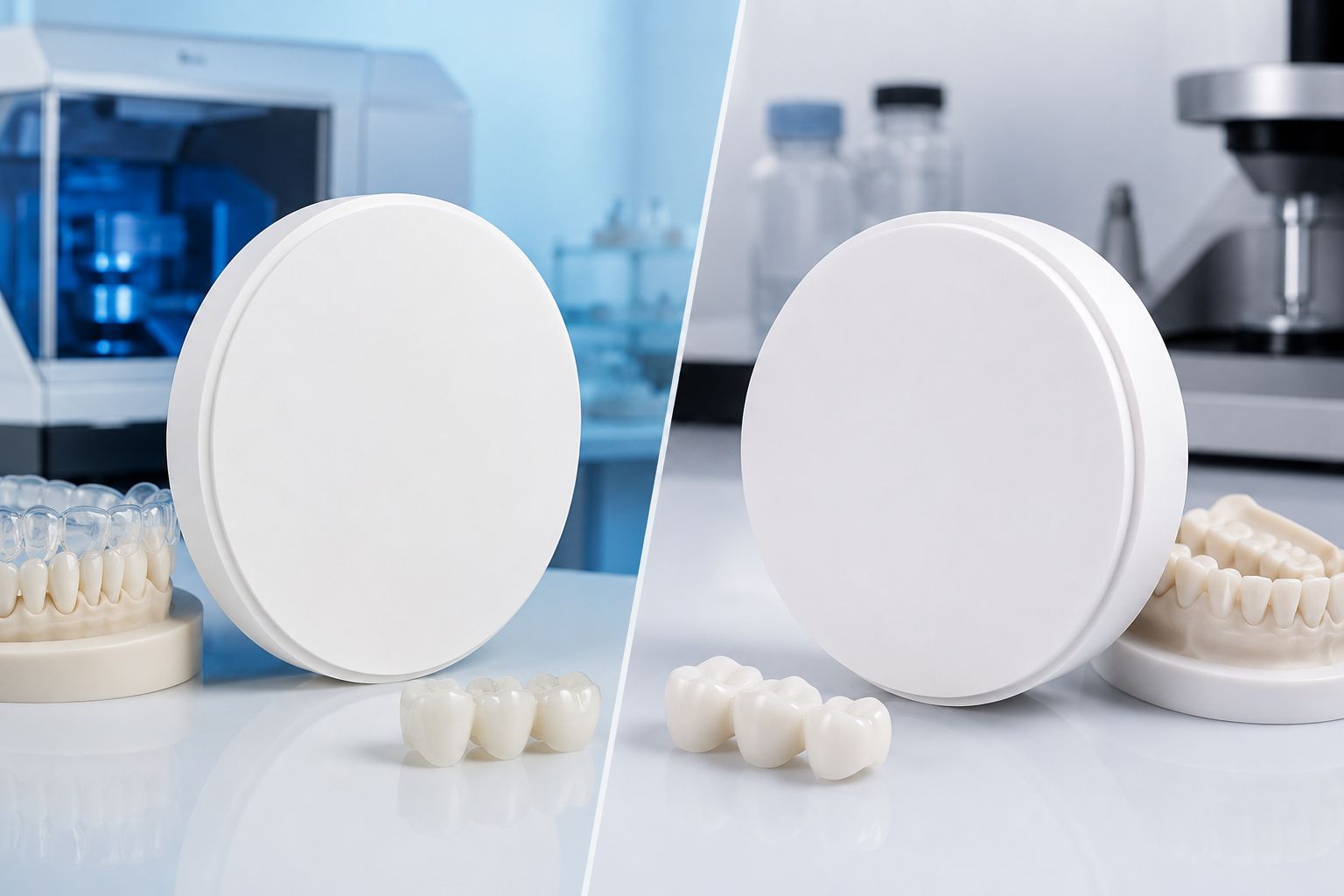
When dental labs evaluate Upcera ST White zirconia discs, the 10mm vs 12mm question comes up consistently and it is more consequential than it might appear. At first glance, a 2mm difference in disc thickness sounds like a minor spec variation. In clinical practice, that 2mm determines whether the disc has adequate material reserve for the restoration being milled, whether the connector dimensions on a bridge design are structurally safe, and whether the lab is optimizing material cost per case or over-specifying stock for indications that don't require it. Getting this decision right matters for both clinical outcomes and production economics.
This guide explains exactly what separates the 10mm and 12mm formats of Upcera ST White, which clinical indications each is designed for, and how dental labs should be stocking and using both thicknesses in a properly organized zirconia material inventory.
What Is Upcera ST White Zirconia?
Before the thickness comparison, it is worth establishing what ST White means in Upcera's product classification because the ST designation carries clinical information that affects both the thickness decision and the indication decision.
ST stands for super-translucency. In Upcera's zirconia range, the ST grade sits between standard high-strength 3Y-TZP and the higher-translucency TT (total translucency) grades. ST White zirconia delivers a meaningfully higher translucency than standard 3Y-TZP while maintaining strong enough flexural strength for posterior crowns and short-span bridges. The White designation means the disc is unshaded it leaves the manufacturer without pigmentation, giving the lab full control over shade application through external staining after milling.
This combination — elevated translucency plus white starting point makes ST White the format of choice for labs that handle custom shade cases, unusual chroma requests, or cases where the technician needs to build precise characterization effects that a pre-shaded gradient cannot deliver. The st white zirconia disc from Upcera is available in both 10mm and 12mm thicknesses, and the clinical role of each thickness is distinct.
The 10mm Format: What It Is Designed For
The 10mm disc thickness is the minimum viable format for most crown and bridge indications in the ST White range. It is not a thin disc by absolute measurement — 10mm provides adequate material depth for single-unit crowns across both the anterior and posterior zones, and for short-span anterior bridge cases where connector dimensions fit within the available material depth.
st white dental zirconia blocks in the 10mm format are optimized for three specific production scenarios:
- Single-unit anterior crowns. In the anterior zone, the occlusal depth of a full-coverage crown is typically 1.5–2mm. The 10mm disc provides more than adequate material reserve for this depth, with clearance remaining for the milling chuck and sprue attachment. For labs producing high volumes of anterior single units, the 10mm format reduces material cost per disc and per case you are not paying for 12mm of disc when 10mm is sufficient for the anatomy being milled.
- Single-unit premolar and second premolar crowns. Premolar crown anatomy has slightly more occlusal depth requirement than anteriors, but still comfortably within 10mm's structural reserve. The ST grade's flexural strength typically in the 700–900 MPa range for well-sintered ST-grade zirconia provides adequate mechanical performance for premolar single units under standard occlusal load.
- Short-span anterior bridges (3-unit). For anterior 3-unit bridges where the connector height falls within the available disc depth, 10mm ST White is appropriate. Connector dimensions must be verified against the manufacturer's minimum cross-section requirements for the disc's specific flexural strength. Labs designing anterior bridges in 10mm discs should confirm that the gingival connector height plus the occlusal clearance of the pontic fit within the usable milling depth, accounting for sprue placement.
- Cases where anterior esthetic zone depth is the only consideration. When the referring clinician specifies a preparation with minimal occlusal reduction a common scenario in anterior cases with limited interocclusal space the 10mm disc's smaller depth can actually be an advantage in CAM software, as it simplifies blank positioning and orientation.
The 12mm Format: What It Is Designed For
The 12mm disc format adds 2mm of material depth, which sounds incremental but is clinically significant in several production scenarios. That additional depth is what makes the difference between a design that fits within the disc and one that cannot be safely milled without compromising connector cross-section or sprue integrity.
For a comprehensive understanding of how disc thickness interacts with zirconia grade selection and strength requirements across different clinical indications, the Guide to Materials & Strengths of Zirconia Dental Restorations covers the full decision framework in detail — useful context before making thickness stocking decisions for your lab.
- Posterior single-unit crowns with normal to high occlusal depth. Posterior molar crowns have significantly more occlusal anatomy than anterior restorations cusp height, fossa depth, and marginal ridge geometry all add to the required disc depth. In cases with normal to generous occlusal reduction (2–2.5mm), the 10mm format can leave insufficient material between the deepest milled point and the disc surface, risking thin walls or incomplete milling. The 12mm format provides the reserve needed for full-anatomy posterior molar crowns without design compromises.
- 3-unit posterior bridge cases. Posterior bridge connectors require more cross-section area than anterior bridges due to the higher occlusal loads in the posterior zone. The 12mm disc provides the connector height needed to meet minimum cross-section requirements for posterior 3-unit spans safely. Labs attempting to mill posterior bridges in 10mm ST White discs regularly encounter connector dimension constraints that require design compromises reducing the pontic height, thinning the connector, or splitting the case into individual crowns. The 12mm format eliminates these constraints.
- Full-contour molar crowns with high interocclusal clearance. In full-mouth rehabilitation cases or implant-supported posterior restorations where the interocclusal space is larger than average, the milled crown has more occlusal height pushing the design deeper into the disc. The 12mm format handles this without requiring the technician to reposition the blank or modify the design to fit the available depth.
- Cases requiring multilayer-format alternatives to be milled from white stock. When a lab needs to produce a posterior case in white (unshaded) format rather than pre-shaded for complex shade customization or unusual shade specification the 12mm white disc is the correct format for posterior full-anatomy cases where a pre-shaded multilayer disc would normally be used.
Side-by-Side Comparison
| Property | ST White 10mm | ST White 12mm |
|---|---|---|
| Disc thickness | 10mm | 12mm |
| Material | Upcera ST-grade zirconia | Upcera ST-grade zirconia |
| Shade format | White — unshaded | White — unshaded |
| Translucency grade | Super-translucency | Super-translucency |
| Flexural strength | 700–900 MPa (grade typical) | 700–900 MPa (grade typical) |
| Best for anteriors | Optimal — full material reserve | Acceptable — slight over-spec |
| Best for premolars | Optimal | Acceptable |
| Best for posterior molars | Marginal — verify design depth | Correct format |
| Best for posterior bridges | Verify connector dimensions | Correct format |
| Material cost per disc | Lower | Higher |
| Cases per disc | More (shallower anatomy) | Fewer (deeper anatomy) |
| Stocking priority | Anterior-focused labs | Full-service posterior labs |
The Multilayer Alternative: When ST White Is Not the Right Format
Understanding the ST White 10mm vs 12mm decision also requires knowing when neither format is the correct choice — specifically, when a pre-shaded multilayer disc serves the case better than a white unshaded disc regardless of thickness.
White discs require external staining after milling. For standard A1–D4 shade cases the significant majority of everyday crown and bridge production that staining step is an unnecessary addition to bench time when a pre-shaded disc delivers the same clinical result without it. The st multilayer zirconia disc format offers the same ST-grade translucency and strength as ST White, with a built-in VITA-compatible shade gradient that eliminates external staining on standard cases.
The practical stocking strategy for most full-service labs: use ST White (10mm and 12mm) for custom shade cases, complex characterization requirements, and unusual shade specifications. Use ST multilayer pre-shaded as the default format for standard anterior and posterior production volume. The white format and the pre-shaded multilayer format are not competing products they are complementary tools for different case types within the same production workflow.
Which Thickness Should Your Lab Stock?
The stocking decision depends entirely on your case mix:
- Stock 10mm as your primary format if your lab handles predominantly anterior cases, premolar crowns, and short-span anterior bridges. The 10mm disc covers these indications efficiently at a lower material cost per disc, and most anterior labs do not regularly produce the posterior full-anatomy cases that require the additional depth of 12mm.
- Stock 12mm as your primary format if your lab handles significant posterior single-crown and bridge volume. Posterior molar cases and posterior bridges require the 12mm format for safe, uncompromised designs. Labs that stock only 10mm for posterior work either accept design constraints or produce restorations with thinner-than-ideal margins and connector dimensions.
- Stock both if you run a full-service lab handling the complete range of anterior and posterior fixed restorations. This is the correct approach for any lab that does not want to impose disc-thickness limitations on the clinical designs coming through the door. The cost difference between 10mm and 12mm per disc is modest significantly less than the cost of a remake on a posterior bridge connector that fractured because the design was depth-constrained into an under-dimensioned cross-section.
For the full upcera zirconia range including ST White in both 10mm and 12mm alongside ST Multilayer, TT, and the Explore Esthetics and Explore Functional lines, ZirconiaGuys stocks the complete Upcera lineup from US inventory with same-day shipping on in-stock items.
The difference between Upcera ST White 10mm and 12mm is not a trivial spec distinction it is a clinical design decision that determines whether your zirconia blank has adequate material depth for the restoration being produced. For anteriors and premolars, 10mm dental zirconia discs are the correct and cost-efficient format. For posterior molars and bridges, 12mm is the format that eliminates design constraints and connector dimension compromises.
Labs that stock only one thickness for both applications are either over-specifying on anterior cases or under-specifying on posterior cases both of which represent avoidable inefficiency. The correct answer is matching the zirconia blocks dental thickness to the anatomy of the restoration, which means having both formats available and using each in its correct indication. Both zirconia dental blanks thicknesses are in stock at ZirconiaGuys from US inventory alongside the full zirconia blocks range from Upcera and Aidite.


