

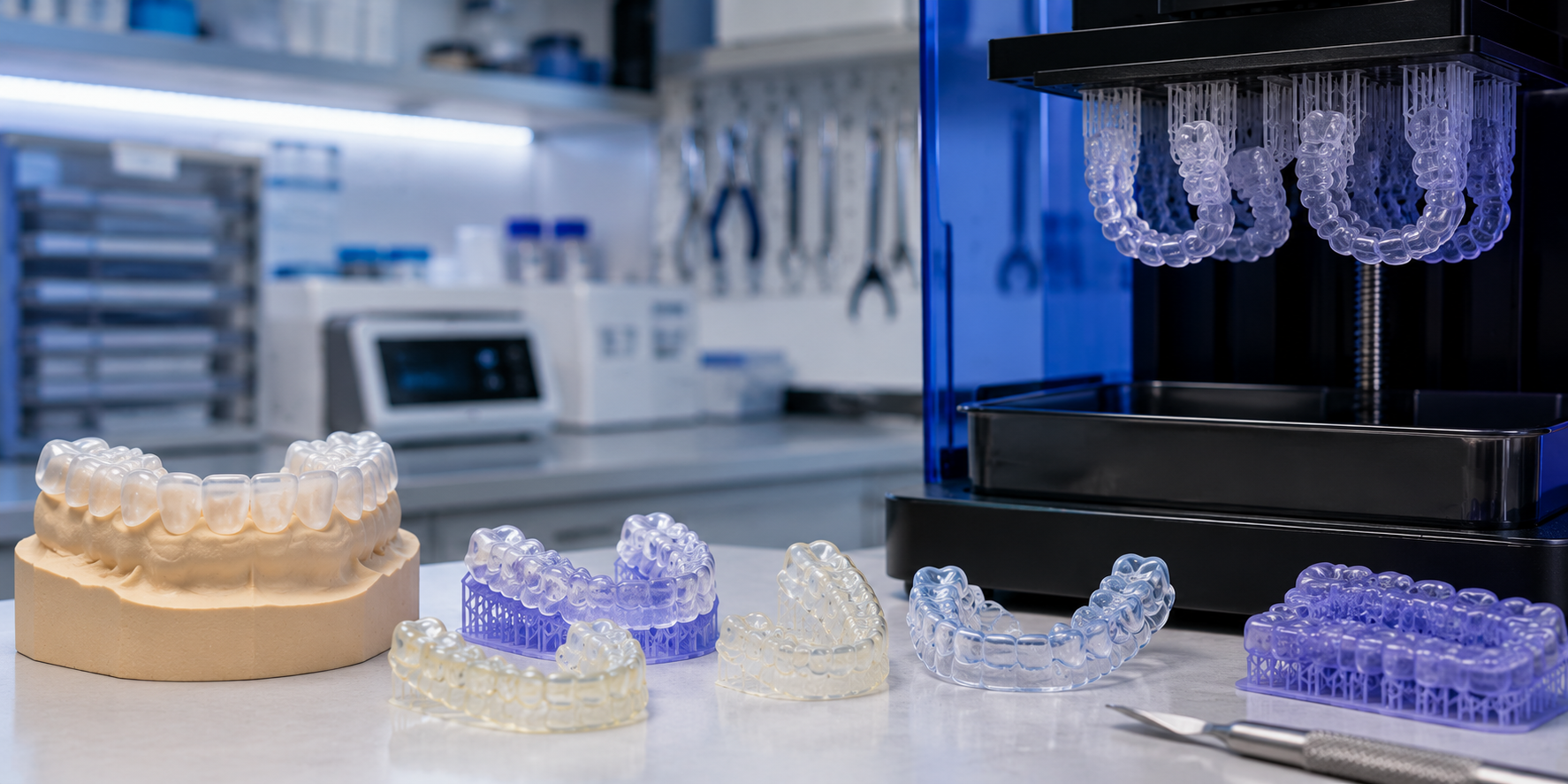
Occlusal splints are one of the most prescribed dental appliances in general practice bruxism management, TMD therapy, post-restorative occlusal protection, and sports guard applications all generate consistent lab demand. For labs running 3D printing workflows, the splint category also represents one of the clearest material selection challenges: unlike model resins or surgical guide resins, which have relatively defined clinical requirements, splint resins must be matched to the specific mechanical and biological demands of the intended appliance. A soft night guard and a hard bruxism splint are worn by the same patient in the same oral environment, but they require fundamentally different material properties to perform correctly.
Keystone Industries' Key Splint range addresses this problem by offering distinct formulations for distinct splint applications. This guide explains the clinical and material differences between the three products in the range Key Splint Hard, Key Splint Soft, and Key Splint Hard Clear and gives labs a clear framework for matching each product to the right case type.
Why Splint Resin Is Not Interchangeable with Other Dental Resins?
Before comparing the three Keystone products, it is worth establishing why dental splint printing resin is a distinct material category not a marketing distinction, but a genuine formulation difference that affects clinical outcomes.
The two properties that define a splint resin are flexural behavior and surface hardness. These properties determine whether the appliance functions as intended under occlusal load, whether it resists wear over months of nightly use, and whether it is comfortable against gingival tissue during extended contact.
Model resins are formulated for dimensional accuracy and surface detail resolution. They are brittle which is appropriate for a diagnostic model that never enters the mouth, but completely inappropriate for an appliance that must absorb repeated biting forces without fracturing at thin margins.
Temporary crown resins are formulated for tooth-shade esthetics and short-term wear (weeks, not months). Their surface hardness and wear resistance are insufficient for the extended nightly wear an occlusal splint is expected to provide.
Splint resins are specifically engineered for the mechanical profile of occlusal appliances-controlled flexibility or hardness depending on the indication, surface hardness adequate for long-term wear resistance, and biocompatibility documentation for extended mucosal contact under ISO 10993. Using the wrong resin category for a splint case is not a minor shortcut it is a clinical failure waiting to happen.
The Three Key Splint Products: What Each One Is
Keystone offers three distinct formulations under the Key Splint line. Each is designed for a specific splint application and carries different mechanical properties, optical character, and clinical indications.
Key Splint Hard - Is a rigid photopolymer resin formulated for hard occlusal splints bruxism guards, Michigan-style splints, and any application where maximum surface hardness and wear resistance are the primary requirements. The cured material delivers high flexural modulus, meaning it resists deformation under occlusal load and maintains its occlusal surface geometry over extended wear. It is available in a standard opaque formulation.
Key Splint Soft - Is a flexible photopolymer resin formulated for soft night guards and sports guards applications where the appliance must absorb and dissipate occlusal energy rather than resist it. The cured material has a lower flexural modulus than Key Splint Hard, meaning it deflects under biting pressure in a way that mimics the compliance of traditional vacuum-formed EVA guards, while delivering better fit accuracy and more consistent thickness than vacuum-forming can achieve.
Key Splint Hard Clear - Is a rigid, optically transparent formulation that combines the mechanical properties of Key Splint Hard with a clear, translucent esthetic character. It is the appropriate choice for cases where a hard splint is clinically indicated but patient esthetic preference or clinician preference for intraoral visibility during examination favors a clear appliance.
When to Use Key Splint Hard?
Key Splint Hard is the correct choice when maximum durability and surface hardness are the clinical priority. The primary indication is bruxism management patients who grind heavily generate occlusal forces that would deform or abrade a soft splint rapidly. A hard splint on a heavy bruxer maintains its polished occlusal surface, preserves the designed occlusal scheme, and lasts significantly longer than any flexible alternative.
Secondary indications include TMD therapy splints that are designed to change the mandibular position these require a rigid material to maintain their geometric accuracy under repeated loading and post-restorative occlusal protection splints where dimensional stability of the appliance directly affects the protection it provides to the underlying restorations.
The key splint hard resin is available from ZirconiaGuys from US inventory. For labs already running Key Splint Hard in clinical production, the workflow is well-documented by Keystone with validated exposure and post-cure parameters for the most common open-system printers.
Key Splint Hard is not the right choice when:
- The patient has a light or moderate parafunction pattern and has previously reported discomfort with hard splints.
- The indication is sports protection rather than nocturnal bruxism management.
- The prescribing dentist has specifically requested a flexible appliance for the case.
When to Use Key Splint Soft?
Key Splint Soft is the correct choice for soft night guard and sports guard applications cases where flexibility is a clinical requirement, not a compromise. Patients who cannot tolerate hard splints due to temporomandibular sensitivity, patients transitioning from vacuum-formed EVA guards, and sports guard cases where energy absorption under impact is the primary function are all appropriate indications for Key Splint Soft.
The printed Key Splint Soft night guard outperforms vacuum-formed EVA in two significant ways: fit accuracy and consistent thickness. Vacuum-formed guards stretch thin over cusp tips and accumulate material thickness in undercut areas producing uneven cushioning across the arch. A 3D printed Key Splint Soft guard is designed to a consistent, prescribed thickness throughout, delivering more predictable occlusal loading distribution.
For the complete production workflow for this material, the guide to How to Print a Night Guard with Key Splint Soft Resin covers printer settings, orientation, post-cure protocol, and finishing in full step-by-step detail.
For labs sourcing key splint soft resin for night guards from a US-stocked supplier, ZirconiaGuys carries the Keystone splint range with same-day shipping on in-stock items.
Key Splint Soft is not the right choice when:
- The patient is a confirmed heavy bruxer where hard splint durability is critical.
- The prescription specifies a rigid repositioning or Michigan-style splint.
- The case requires a clear esthetic character Key Splint Soft is not a clear formulation.
When to Use Key Splint Hard Clear
Key Splint Hard Clear occupies the specific intersection of rigid mechanical performance and optical clarity. The indications overlap with Key Splint Hard hard splints for bruxism management, TMD therapy, and occlusal protection but with the added esthetic benefit of a clear, translucent appearance.
The clinical case for clear over opaque hard splints comes from two directions. Some patients refuse opaque hard splints on esthetic grounds they are visible during social interactions and conversations in a way that a clear appliance is not. Some clinicians prefer clear hard splints because they allow intraoral examination of the dentition through the appliance, revealing wear patterns and tissue changes without removing it.
As a key splint hard clear resin supplier, ZirconiaGuys stocks the Keystone formulation with full batch documentation available on request important for labs maintaining ISO-compliant material traceability records for extended-contact oral appliances.
Key Splint Hard Clear is not the right choice when:
- The indication calls for flexibility rather than rigidity clear does not mean soft.
- Labs occasionally confuse the optical character of the clear formulation with the flexible behaviour of Key Splint Soft.
- If the prescription is for a soft guard, Key Splint Hard Clear is not the correct material regardless of its appearance.
Side-by-Side Comparison
| Property | Key Splint Hard | Key Splint Soft | Key Splint Hard Clear |
|---|---|---|---|
| Flexibility | Rigid | Flexible | Rigid |
| Optical character | Opaque | Translucent | Clear |
| Primary indication | Heavy bruxism, TMD | Soft night guards, sports | Hard splint + esthetic |
| Wear resistance | High | Moderate | High |
| Patient tolerance | Moderate | High | Moderate |
| Biocompatibility | ISO 10993 long-term contact | ISO 10993 long-term contact | ISO 10993 long-term contact |
| Post-cure requirement | Full protocol mandatory | Full protocol mandatory | Full protocol mandatory |
| Suitable for heavy bruxers | Yes | No | Yes |
| Clear esthetic | No | No | Yes |
Building a Splint Resin Inventory: What to Stock
For most full-service dental labs producing a range of splint cases, the practical stocking recommendation is to carry all three formulations but in different quantities based on your case mix.
Key Splint Hard should be your highest-volume stock if your lab serves general practice accounts with significant bruxism case referrals. Hard splints represent the majority of prescribed occlusal appliances in most practices.
Key Splint Soft should be your secondary stock for soft night guard and sports guard cases. Volume is lower than hard splints in most lab mixes but consistent enough to warrant keeping on hand rather than ordering case-by-case.
Key Splint Hard Clear is the specialty stock order based on demand from specific accounts where clear hard splints are regularly prescribed. Some practices and patient demographics generate consistent demand for clear splints; others almost never prescribe them.
For labs that also run dental resin 3d printing across model, surgical guide, and tray applications alongside the Key Splint range, consolidating the full Keystone product line through ZirconiaGuys simplifies procurement, reduces minimum order fragmentation, and provides a single source for batch documentation across the entire resin inventory.
The Post-Cure Principle That Applies to All Three
One operational note that applies equally across all three Key Splint formulations: post-cure protocol is not optional and cannot be shortened without clinical consequence.
All three formulations require full post-cure to complete polymerization, achieve their specified mechanical properties, and meet ISO 10993 residual monomer thresholds for extended mucosal contact. An under-cured hard splint will have lower surface hardness and higher residual monomer than the specification. An under-cured soft splint will have elevated surface tack and potentially insufficient flexibility at the margins. An under-cured clear splint will appear cloudy rather than optically transparent.
Run the manufacturer's full post-cure protocol for the specific formulation not a generic splint resin protocol, and not the same protocol you use for model or guide resins. Each formulation has distinct photoinitiator chemistry that requires matched post-cure conditions to complete correctly.
The key splint product decision is not a difficult one once the clinical indication is clear. Rigid bruxism management goes to Key Splint Hard or Hard Clear. Flexible night guard and sports guard cases go to Key Splint Soft. The esthetic preference for clear or opaque determines which rigid formulation is appropriate.
Where labs run into problems is when they try to use one formulation for all splint resin applications using Key Splint Hard for a prescribed soft guard case, or using Key Splint Soft for a heavy bruxer who needs the durability of the rigid formulation. Match the material to the prescription, validate your post-cure protocol for each formulation, and source from a dental splint printing resin supplier with consistent US inventory and biocompatibility documentation.
For labs building their full dental zirconia discs, zirconia blocks, and resin inventory from a single US supplier, ZirconiaGuys stocks the complete Keystone Key Splint range alongside Upcera and Aidite zirconia dental blanks, zirconia blank formats, and zirconia blocks dental production stock one order, one delivery, consistent batch documentation across your full material range.


