

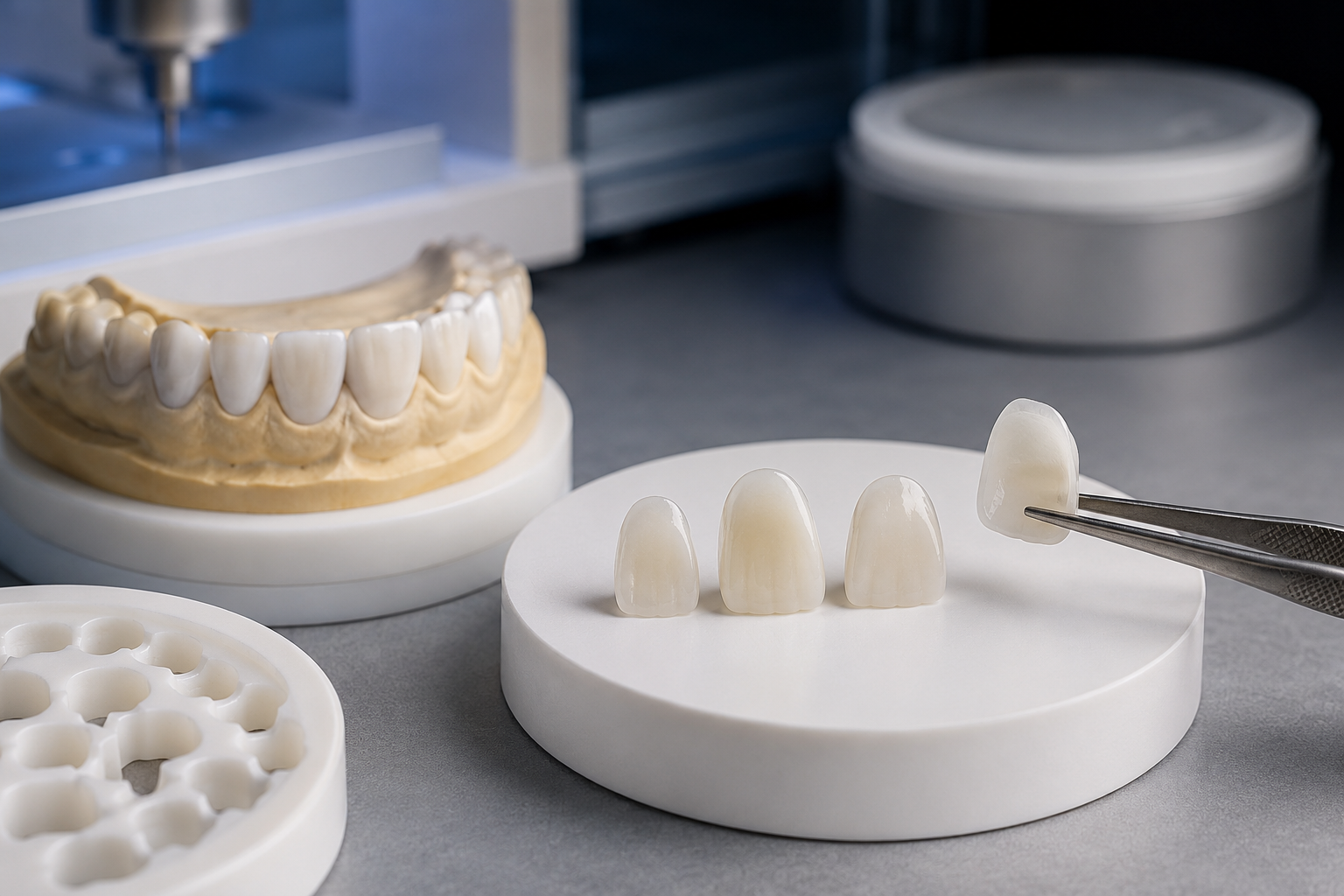
Dental veneers represent the most optically demanding application in fixed prosthodontics. They are thin, they sit in the most visible part of the mouth, and they must blend with adjacent natural dentition under every lighting condition a patient encounters clinical lighting, natural daylight, fluorescent office light, and the unforgiving combination of flash photography. The material chosen for a veneer case carries more of the esthetic burden than in almost any other restoration, which is why the question of whether a given zirconia grade is appropriate for veneers deserves a careful, technically honest answer rather than a marketing one.
ST white zirconia super-translucent white zirconia in its unshaded form is one of the most widely stocked formats in US dental labs. Labs that produce veneers regularly ask whether their ST white stock can cover veneer cases or whether a different material is required. This guide gives a direct answer grounded in material science, clinical requirements, and the specific optical properties of ST grade zirconia.
What ST White Zirconia Actually Is?
ST in zirconia terminology stands for super-translucent a grade designation that indicates higher translucency than standard high-strength 3Y-TZP, achieved through yttria content adjustment and optimized sintering conditions that increase the cubic phase fraction in the crystal microstructure. ST grade zirconia typically falls in the 4Y range or a mixed formulation that delivers translucency values meaningfully higher than conventional 3Y-TZP while retaining flexural strength above the 600 MPa threshold.
The white designation means the disc is unshaded no pigmentation has been added during manufacturing. The lab applies all shade through external liquid staining or surface stain firing after milling. White format gives the technician full control over the shade outcome, which is why it is the preferred format for complex esthetic cases where standard pre-shaded gradients cannot cover the required shade target.
ST white zirconia is therefore a material defined by two properties: higher-than-standard translucency within the zirconia family, and complete shade flexibility through manual staining. Both of these properties are relevant to veneer applications but they do not by themselves determine whether the material is clinically appropriate for veneers. That determination requires evaluating three additional factors: absolute translucency levels, achievable thickness, and preparation requirements.
The st white zirconia disc from Upcera delivers consistent super-translucent performance with batch-documented optical properties — available from ZirconiaGuys in US inventory across multiple thicknesses for labs evaluating it against their veneer case requirements.
The Translucency Question: Is ST White Translucent Enough for Veneers?
This is the central technical question, and the honest answer is: it depends on the case but ST white zirconia has real optical limitations that matter in demanding veneer situations.
Natural enamel in the anterior zone has high optical translucency, particularly at the incisal third. The best-matching zirconia material for this optical character is 5Y high-translucency formulation, which produces light transmission values that approximate natural enamel behavior. ST grade zirconia sitting in the 4Y range has meaningfully higher translucency than 3Y-TZP but does not match the optical depth of 5Y material.
In veneer applications at 0.3–0.5 mm thickness, this difference becomes clinically visible in specific patient scenarios:
Cases where ST white zirconia performs acceptably for veneers:
- Patients with moderately translucent natural dentition in the standard A–B shade range.
- Cases where the preparation allows 0.5–0.8 mm veneer thickness the thicker the veneer, the less critical absolute translucency becomes.
- Patients where shade masking is the primary esthetic goal covering tetracycline staining, discolored preps, or heavily restored anterior teeth where the opacity of a less translucent material is actually an advantage.
- Cases where the referring dentist has specified a standard VITA shade and the adjacent teeth are not highly translucent.
Cases where ST white zirconia falls short for veneers:
- Young patients with highly translucent, opalescent natural dentition where 5Y-grade material is needed to match incisal optical character.
- Ultra-thin veneer cases (0.3 mm or less) where material translucency at minimal thickness is the primary material selection criterion.
- Cases where veneers are adjacent to pressed lithium disilicate veneers or e.max restorations the optical character of ST zirconia will not match these materials convincingly under mixed lighting.
- High-profile cosmetic cases where the patient and clinician have high optical expectations and any visible difference between the veneer and adjacent natural teeth is unacceptable.
The st white zirconia discs cover the majority of standard veneer cases where preparation depth allows adequate thickness. Where the case demands maximum translucency, 5Y or HT-grade material is the technically correct choice.
Preparation Requirements for Zirconia Veneers
Preparation design is where zirconia veneers differ most significantly from conventional pressed ceramic veneers, and where the material's minimum thickness requirements become the practical limiting factor.
Pressed lithium disilicate veneers can be fabricated at 0.3–0.5 mm and bonded adhesively onto minimal or even no-prep preparations. Zirconia veneers require more material for structural integrity the clinical minimum for a milled zirconia veneer is generally 0.5 mm, with 0.7–0.8 mm preferred for reliable marginal integrity and resistance to fracture during finishing and seating.
This means zirconia veneer cases require:
More preparation than lithium disilicate veneers.
A 0.5–0.8 mm facial reduction is typically necessary. For patients with thin natural enamel, this may not be appropriate the preparation would extend into dentine before reaching adequate depth for the veneer thickness required by zirconia.
Preparation design considerations.
A chamfer or light shoulder finish line is preferred over a feather edge for zirconia veneers. Feather-edge margins create fragile, thin ceramic at the margin that is prone to chipping during polishing and seating. The chamfer provides adequate material thickness at the margin for the material to survive both the milling process and the handling forces of laboratory and clinical seating.
Cementation protocol.
Zirconia veneers are cemented with resin cement using a phosphate monomer primer (MDP-based) that creates a durable chemical bond between the resin and the zirconia surface. Unlike lithium disilicate, zirconia does not respond to HF acid etching the bonding protocol is different and specific to zirconia surface chemistry. Labs producing zirconia veneers should confirm that the referring dentist's cementation protocol is appropriate for zirconia, not just ceramic in general.
For labs evaluating the full range of white zirconia formats for veneer and anterior restoration applications, the guide to How to Choose Between HT White Zirconia and Pre-Shaded Zirconia Discs covers the format decision in detail including which cases benefit from white disc shade flexibility versus pre-shaded gradient formats.
ST White vs. Alternatives for Veneer Cases
Understanding where ST white sits relative to other materials clarifies when to specify it and when to reach for something else.
ST white zirconia vs. lithium disilicate:
Lithium disilicate remains the most widely used material for conventional adhesively bonded veneers at minimal preparation thickness. Its ability to be pressed to 0.3 mm, its excellent bonding characteristics with HF etching and silane, and its natural-looking optical translucency make it the default choice for minimally invasive anterior veneer cases. ST white zirconia is not a substitute for lithium disilicate in these cases it requires more preparation and does not match the optical character of pressed lithium disilicate at equivalent thickness.
Where ST white zirconia outperforms lithium disilicate: cases requiring shade masking, cases with higher occlusal load on anterior teeth, and cases where the preparation is already at sufficient depth that the additional thickness required for zirconia is not a drawback.
ST white zirconia vs. 5Y high-translucency zirconia:
For veneer cases within zirconia material selection, 5Y high-translucency grade is optically superior to ST grade. The st pre shaded zirconia format covers standard shade cases efficiently, but for the most demanding anterior esthetic veneer cases where maximum translucency is the clinical requirement, 5Y grade is more appropriate.
ST white zirconia vs. feldspathic porcelain:
Feldspathic porcelain veneers offer exceptional optical depth and can be fabricated extremely thin, but require a demanding manual layering technique with higher fracture risk than either lithium disilicate or zirconia. For labs running digital CAD/CAM workflows, zirconia and lithium disilicate have substantially displaced feldspathic porcelain veneer production.
When ST White Is the Right Veneer Material?
Based on the clinical and material analysis above, ST white zirconia is the appropriate veneer material in a defined set of clinical scenarios:
Shade masking cases.
When the preparation is significantly discolored tetracycline staining, metal post, or heavily restored tooth the higher opacity of ST white relative to 5Y material is an advantage. The lab needs the veneer to block the underlying shade before building the final esthetic result through staining, and ST white provides that masking ability while still delivering adequate translucency at adequate thickness.
Higher-load anterior cases.
Canine and lateral incisor cases in patients with guidance that places meaningful lateral load on anterior teeth benefit from ST white's superior flexural strength relative to 5Y grade. The strength advantage is real, and in functional cases it matters.
Standard A-shade cases with adequate preparation depth.
For the majority of everyday anterior veneer cases in standard A1–B2 shades where preparation depth allows 0.6–0.8 mm veneer thickness, ST white zirconia delivers a fully acceptable esthetic outcome with complete shade flexibility through manual staining. This is the best white zirconia format for this case type in terms of the balance between optical performance, shade control, and structural reliability.
Full-coverage anterior veneers transitioning to crowns.
In cases where the veneer extends to cover a significant portion of the labial and incisal surfaces effectively functioning as a partial crown the additional strength of ST white over 5Y material is clinically relevant.
For labs evaluating the ht white zirconia format as an alternative for the most demanding anterior esthetic cases, HT grade pushes translucency higher than ST while retaining better shade masking ability than 5Y it occupies a useful middle position for labs that find 5Y optically correct but need more masking capability than 5Y delivers.
Practical Stocking Guidance
For labs producing veneer cases across a range of clinical scenarios, the correct inventory approach is not to standardize on a single material but to stock two to three white zirconia grades and apply each to the cases where it performs best.
- ST white zirconia dental blanks — primary stock for everyday veneer cases, shade masking cases, and higher-load anterior applications. ST white zirconia blocks dental labs run as their production standard covers the majority of clinical veneer volume.
- HT or 5Y white zirconia — secondary stock for demanding esthetic cases where the patient has high natural translucency and ST grade cannot match the adjacent optical character convincingly.
- Lithium disilicate — for minimally invasive no-prep or minimal-prep veneer cases where preparation depth is insufficient for zirconia's minimum thickness requirements.
As a st white zirconia for dental restorations and veneer material, ST white zirconia handles the bulk of clinical veneer production in most dental labs when applied correctly to the cases it suits. The key is case selection not every veneer case is appropriate for zirconia, and not every zirconia veneer case is appropriate for ST grade specifically. Understanding those boundaries is what produces consistently excellent outcomes rather than occasional remakes when the wrong material is specified for the wrong case.
For US labs sourcing dental zirconia discs, zirconia blank stock, and zirconia dental blanks in ST white, HT white, and pre-shaded formats, ZirconiaGuys carries the full Upcera range from US inventory with consistent batch documentation and same-day shipping on in-stock items.
ST white zirconia can be used for dental veneers within a defined set of clinical indications that align with the material's optical and mechanical properties. It is not the universal veneer material, and it is not appropriate for every anterior esthetic case. Where it excels shade masking, standard A-shade cases with adequate preparation, functional anterior cases it delivers reliable results with the shade flexibility that only a white disc format provides. Where it falls short ultra-thin cases, patients with highly translucent natural dentition, cases adjacent to lithium disilicate veneers specifying a higher-translucency grade or a different material class is the correct clinical decision. The labs producing the best veneer outcomes are the ones making that distinction case by case rather than defaulting to a single material for every anterior esthetic prescription.


