

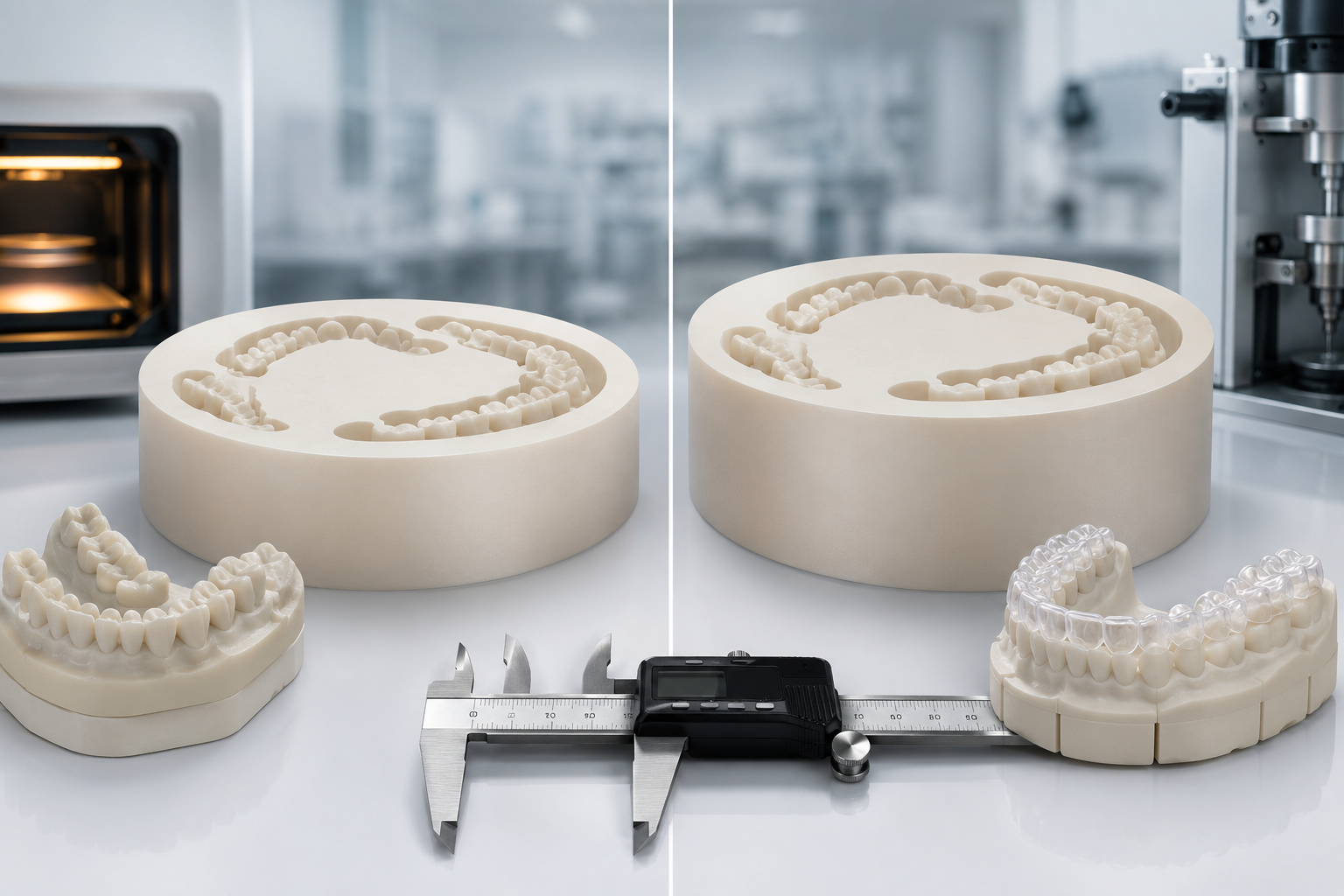
Disc thickness is one of the most frequently misunderstood variables in zirconia procurement. Many labs default to a single thickness for all cases, either because no one has explained what the difference actually means clinically, or because the procurement decision was made on price rather than indication fit. The result is either over-engineered restorations that waste disc material on cases that didn't need the structural reserve, or under-specified restorations where the available milling depth compromised the restoration design particularly in posterior cases with deep preparations or full-contour bridge frameworks.
The Upcera ST Multilayer disc is available in both 10mm and 14mm thickness formats, and the choice between them is not arbitrary. It is a clinical and workflow decision with direct implications for which cases each format can reliably handle, how efficiently your lab uses disc material, and what the real cost per restoration looks like across your production volume. This guide explains the difference between the two formats and gives labs a clear decision framework for stocking and using each.
What ST Multilayer Actually Means?
Before addressing the thickness question, it helps to be precise about what the ST Multilayer designation means in Upcera's product range because the grade matters as much as the thickness in determining correct clinical application.
ST stands for super-translucent. It indicates a zirconia formulation with elevated translucency relative to standard HT (high-translucency) grades, achieved through an increased cubic phase fraction in the crystal microstructure. In practical terms, ST grade zirconia transmits more light than HT grade, producing restorations that more closely approximate the optical behavior of natural enamel particularly in the incisal zone of anterior teeth.
The multilayer designation means the disc is manufactured with a gradient composition from cervical to incisal. The cervical end of the disc has higher chroma, warmer tone, and slightly more opacity simulating natural dentin. The incisal end has higher translucency and cooler optical character simulating natural enamel. This built-in gradient is what allows labs to produce natural-looking anterior restorations from a pre-shaded disc without extensive external staining.
The st multilayer zirconia from Upcera is positioned specifically for esthetic anterior and premolar cases where shade accuracy, translucency, and workflow efficiency are the primary production requirements. Understanding this context is what makes the 10mm vs 14mm decision straightforward it becomes a question of which case types each thickness can physically and structurally accommodate.
The 10mm Format: What It Can and Cannot Do
The 10mm disc is the thinner of the two formats. Available milling depth in a 10mm disc accounting for disc holder clamping, collet engagement, and minimum residual disc thickness to prevent cracking is typically in the range of 7.5–8.5mm depending on the milling system. This usable depth determines which restoration designs the 10mm format can reliably produce.
What 10mm handles well:
Single-unit anterior crowns are the primary indication for the 10mm ST Multilayer format. Standard preparation depths for anterior crowns upper centrals, laterals, canines, and lower anteriors typically require 6–8mm of milling depth in the disc, which falls comfortably within the 10mm format's usable range. The thinner disc also positions the preparation more consistently within the disc's gradient layers, helping ensure that the incisal zone of the crown lands in the high-translucency incisal zone of the disc rather than the more opaque cervical zone.
Upper and lower premolar single crowns with standard preparation depths are also well-suited to the 10mm format. Premolar crown height requirements are generally compatible with the disc's usable depth without requiring design compromises.
Where 10mm has limitations:
Deep preparations cases with elongated clinical crowns, cases involving teeth with significant supereruption, or implant-supported restorations where the emergence profile adds to the total crown height can push beyond the reliable milling depth of a 10mm disc. Attempting to mill a restoration that approaches the disc's maximum depth risks toolpath collisions with the disc holder and marginal inaccuracy at the deepest points of the preparation.
Posterior bridge frameworks, even short-span 3-unit bridges, require connector depth and pontic design that typically exceeds the structural reserve available in a 10mm disc at the grades used in ST multilayer formulations. The 10mm format is not the correct choice for posterior bridge production.
Understanding this connects directly to the difference between 3Y, 4Y, and 5Y zirconia the ST grade sits in the 4Y-5Y range where translucency is elevated at a measured cost to flexural strength, which is an additional reason to keep this format in anterior single-unit applications where structural demands are moderate.
The 14mm Format: What It Adds
The 14mm disc provides a usable milling depth of approximately 11–12mm depending on the milling system. This additional depth unlocks a meaningfully wider range of clinical indications without changing the material formulation the ST Multilayer grade and gradient architecture are identical between the two thicknesses.
What 14mm handles well:
Everything the 10mm handles, plus the cases that push beyond its depth limit. The 14mm format's most clinically important advantage is its suitability for posterior single-unit full-contour crowns with deeper preparations. Upper molar full-contour crowns frequently require 9–11mm of usable disc depth to capture the full preparation with adequate occlusal surface thickness a range the 14mm format covers confidently and the 10mm does not.
Long-span anterior bridges of 3 units upper anterior 3-unit bridges spanning the central to lateral to canine region benefit from the 14mm format's structural reserve. While ST multilayer grade is not recommended for posterior bridges of 3+ units due to the strength considerations of the grade, anterior 3-unit bridges under normal guidance loading can be produced in ST multilayer 14mm when connector cross-sections are verified against the manufacturer's published flexural strength data.
Implant-supported single crowns, where the total restoration height from implant platform to occlusal surface is greater than on tooth-supported cases, are more consistently producible in the 14mm format.
Where 14mm has its own consideration:
The additional 4mm of disc material comes at a higher disc acquisition cost. For labs whose case mix is predominantly standard-depth anterior single units, the 14mm format's additional capacity goes unused on the majority of cases meaning the per-restoration material cost is higher without a corresponding clinical benefit. This is why stocking strategy matters: the correct answer is not one thickness for everything, but the right thickness for the case type.
The st multilayer dental blocks format at 12mm available alongside the 10mm and 14mm represents a middle-ground option that many labs find covers the widest range of their case mix at a per-disc cost between the two extremes.
Side-by-Side Comparison
| Factor | ST Multilayer 10mm | ST Multilayer 14mm |
|---|---|---|
| Usable milling depth | ~7.5–8.5mm | ~11–12mm |
| Anterior single crowns | Ideal | Suitable |
| Standard premolar crowns | Good | Good |
| Deep preparation crowns | Verify case by case | Reliable |
| Posterior full-contour molars | Typically insufficient | Suitable |
| Anterior 3-unit bridges | Verify connector depth | Suitable |
| Posterior bridges (3+ unit) | Not recommended (grade) | Not recommended (grade) |
| Implant-supported crowns | Check total height | Reliable |
| Material cost per disc | Lower | Higher |
| Real cost per case (anterior single) | Lower | Higher |
| Real cost per case (posterior/deeper) | N/A wrong format | Lower (avoids remakes) |
How to Stock Both Formats Correctly?
The most efficient stocking approach for a full-service lab running ST Multilayer as part of its esthetic disc inventory is to stock both thicknesses with clear case-type protocols:
-
10mm as default for standard anterior single-unit production.
The majority of upper central, lateral, canine, and premolar single-unit cases fall within the 10mm format's usable depth range. Using 10mm for these cases delivers the lowest material cost per restoration while maintaining the full esthetic benefit of the ST Multilayer gradient. -
14mm as the standard for posterior single units, deeper preparations, and anterior bridges.
Any case where total crown height exceeds 8.5mm, any posterior full-contour molar, and any multi-unit anterior case defaults to 14mm. The slightly higher per-disc cost is fully offset by avoiding the design compromises and remake risk that come from forcing deep cases into an undersized disc. -
Build the protocol into your case intake process.
When a case prescription arrives, the disc format decision should be made at intake not at the milling station when a technician discovers the 10mm disc cannot accommodate the crown height. A simple case-type → disc format lookup takes ten seconds and eliminates this problem entirely.
For labs building a complete ST format inventory, the st pre shaded zirconia option from Upcera provides an additional pre-shaded format for cases where the standard multilayer gradient needs to be supplemented with a fixed single-shade pre-shaded disc useful when your case mix includes a high volume of one specific shade value that the multilayer gradient consistently overshoots or undershoots. All ST format variants are available from ZirconiaGuys from US inventory with same-day shipping on in-stock items.
Where ST Multilayer Fits in the Broader Upcera Range?
The ST Multilayer disc is one product within a broader upcera zirconia range that covers the full spectrum of clinical indications from high-strength 3Y formats for posterior bridge production to total-translucency 5Y formats for maximum anterior esthetic priority. Understanding where ST Multilayer sits in that range helps labs make the right choice when a case doesn't fit the ST grade's indication profile.
ST Multilayer in 10mm or 14mm is the correct choice when: the indication is an anterior or premolar single crown or short-span anterior bridge, shade accuracy and translucency are the primary requirements, and the case falls within a standard VITA shade range that the pre-shaded gradient covers without supplementary staining.
It is not the correct choice when: the case is a posterior bridge of 3+ units (use 3Y HT for structural reliability), the shade request is highly unusual or requires full custom characterization (use white HT blank for manual staining control), or the case is a high-load posterior crown where maximum strength takes precedence over translucency (use 3Y grade).
The difference between Upcera ST Multilayer 10mm and 14mm is a clinical depth question, not a material quality question. The formulation, gradient architecture, and shade performance are identical. What changes is the range of cases each format can reliably produce without design compromise. Zirconia blank selection at the thickness level is as important as grade selection a correctly graded disc in the wrong thickness produces the same poor outcome as the wrong grade in the right thickness.
Stock both formats, apply them to the correct case types, and the ST Multilayer range covers the significant majority of anterior esthetic single-unit and short-span anterior bridge production your lab runs. For zirconia blocks dental labs evaluating the full Upcera range including dental zirconia discs in 3Y, 4Y, ST, and TT grades across multiple thicknesses ZirconiaGuys stocks the complete lineup from US inventory with full batch documentation. Zirconia dental blanks and zirconia blocks across all Upcera grades ship same-day on in-stock items with no minimum order requirement.


