

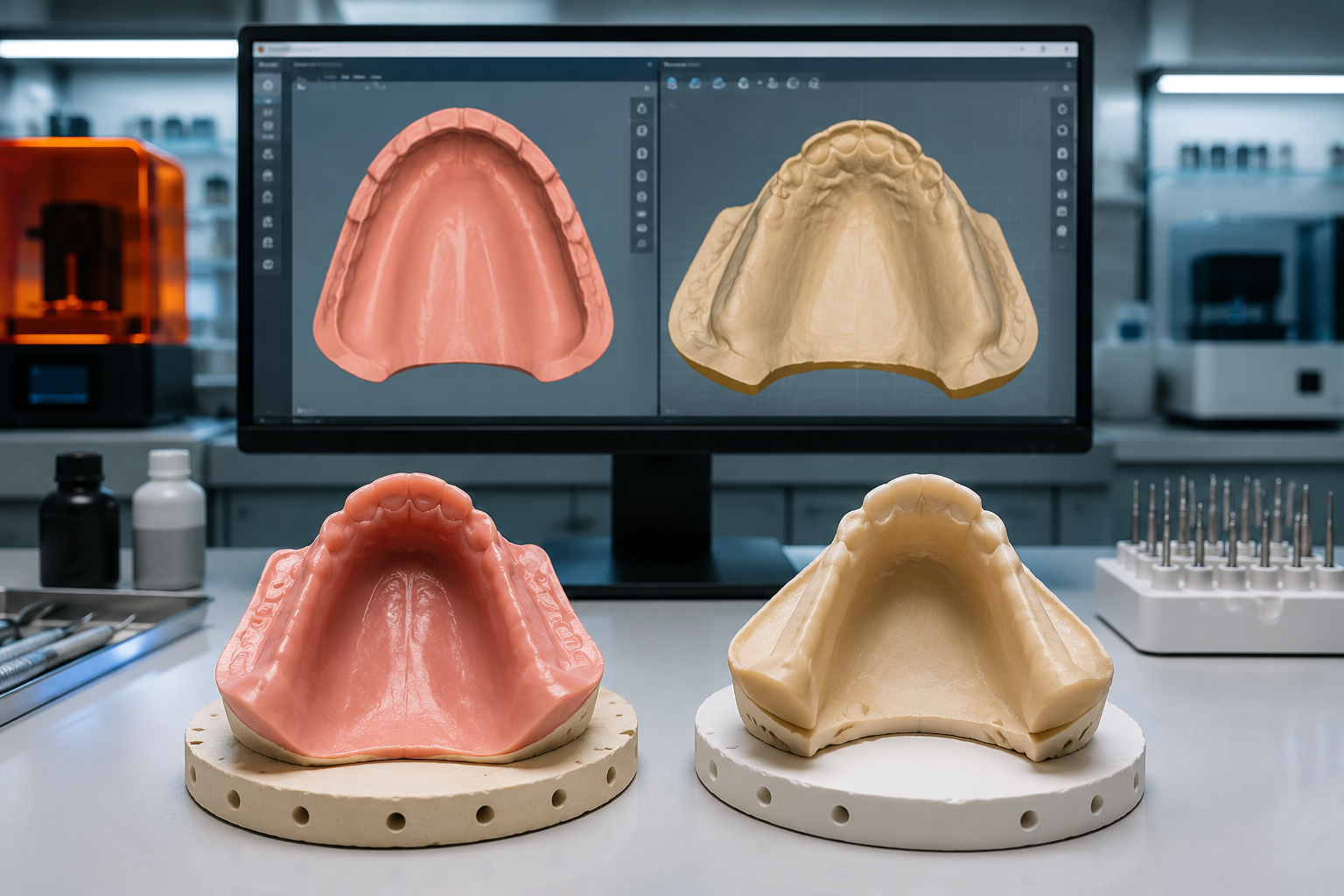
CAD/CAM denture production has made digital workflows the standard in modern dental labs but digital design does not automatically produce clinical accuracy if the technician treats every denture base as the same design problem. A full conventional denture base and an immediate denture base look similar on screen, share the same material, and are produced on the same equipment. The design logic behind each one, however, is fundamentally different and applying the wrong design approach to either case produces a denture that fits poorly from the moment of delivery.
This guide breaks down exactly what distinguishes full and immediate denture base CAD design the anatomical inputs each relies on, the relief and border extension decisions each requires, the tooth positioning logic specific to each case type, and the PMMA Denture Base material selection considerations that apply to both.
Why the Design Distinction Matters More in CAD Than in Conventional Production?
In conventional flask-and-pack denture production, experienced technicians compensate for many design variables through tactile feedback, manual adjustments, and chairside relines. The physical wax-up process has inherent flexibility that the digital environment does not replicate by default.
In CAD/CAM denture production, the design file is executed exactly as drawn. There is no tactile feedback from the milling process and no manual adjustment during fabrication. Every tissue relief decision, every border extension, and every tooth position is committed the moment the design is sent to the mill. This makes the design intelligence specifically the technician's understanding of why full and immediate cases require different design logic the single most important variable in CAD denture quality.
Labs that treat the two case types interchangeably in the design software produce two categories of remakes: immediate dentures that don't seat because tissue relief is insufficient for post-extraction healing, and full conventional dentures with unnecessary relief that compromises suction and retention. Both are avoidable with correct design logic applied from the start.
Full Denture Base Design: What the Scan Represents and How to Use It
A full conventional denture case is designed from a scan of healed, stable edentulous ridges. The tissue scan in this case represents the actual tissue topography the denture will contact on the day of delivery the ridges have fully remodeled, the tissue is mature, and there is no anticipated change in ridge anatomy over the immediate post-delivery period.
This is the design environment that CAD denture software is optimized for. The tissue surface of the denture base is designed to intimately follow the scanned ridge anatomy the goal is maximum tissue contact area, which drives the retention through mucosal suction and distributes occlusal load across the broadest possible tissue base.
Key design parameters for full conventional denture bases:
- Tissue surface offset: In a full conventional case on a mature, healed ridge, the tissue surface offset should be minimal typically 0.0 to 0.05 mm. This near-zero offset is what enables the intimate mucosal contact that creates retention. Any unnecessary positive offset reduces suction and loosens the appliance immediately on delivery.
- Border extensions: Design borders to the full functional depth of the vestibule as captured in the border-molded impression. In digital design, this means following the scanned anatomy to its peripheral termination without arbitrary truncation. Borders that are under-extended in a full conventional case are one of the most common sources of poor retention complaints the peripheral seal is broken, and suction is lost regardless of how well the tissue surface fits.
- Posterior palatal seal (maxillary): The PPS area requires a specific designed-in positive tissue displacement typically 0.5–1.0 mm depth, tapered anteriorly to zero to create the posterior seal that prevents air entry during function. This is not automatically generated by the scan it must be manually applied in the design software as a deliberate relief zone at the posterior border.
- Frenum reliefs: Design adequately sized frenum notches at the labial and buccal frenum attachment sites. Under-relieved frenum areas break the peripheral seal under lip movement and produce sore spots within the first week of wear.
aidite denture base pmma is the material of choice for milling full conventional denture bases in CAD/CAM workflows its pre-polymerized formulation delivers the dimensional stability and low-porosity surface that intimate tissue-contact fit requires. For a detailed breakdown of why this formulation performs consistently across production batches, the guide to Why Dental Labs Prefer Aidite PMMA for Denture Bases covers the material science and workflow benefits in full.
Immediate Denture Base Design: The Fundamental Difference
An immediate denture is delivered on the same appointment as the extraction of the remaining natural teeth. The design scan for an immediate denture is taken before extraction meaning the scan includes the roots of the teeth that will be removed, the alveolar bone that surrounds those roots, and tissue contours that will change significantly within hours of extraction and continue changing over the following weeks and months as the socket heals and the ridge remodels.
This is the core design challenge of immediate dentures: the denture is designed from anatomy that will not exist on the day of delivery. The tissue the denture will contact post-extraction is different sometimes dramatically different from the tissue captured in the pre-extraction scan.
CAD design for immediate dentures must account for this fundamental mismatch through a series of deliberate design decisions that have no equivalent in full conventional denture design.
- Extraction site relief: In the digital design, the tooth roots visible in the pre-extraction scan must be removed and the ridge contour must be virtually modified to simulate the post-extraction anatomy. Most denture design software includes a virtual tooth removal or ridge simulation tool for this purpose. The technician must design a relief zone over each extraction site that provides clearance for the blood clot, swelling, and tissue irregularity that characterizes the immediate post-extraction socket typically 1.0–2.0 mm of positive tissue offset over each extraction site, tapering to minimal offset over the preserved bony anatomy between sites.
- Tissue offset over the entire ridge: Unlike full conventional cases where near-zero tissue offset is the goal, immediate denture bases are designed with a moderate positive offset across the full ridge typically 0.3–0.5 mm to accommodate the tissue swelling that accompanies extraction. This offset is what allows the denture to seat in the immediate post-extraction environment without blanching the tissue or creating focal pressure points over inflamed sockets.
- Border extension adjustment: Because the vestibular depth changes after extraction tissue swelling reduces functional depth temporarily immediate denture borders are designed slightly shorter than the full functional depth that a conventional case would use. Over-extended borders on an immediate denture create soft tissue pain within hours of delivery, when the swelling is at its peak.
- Tooth positioning: In immediate dentures, the vertical dimension and tooth positions are established from the natural teeth still present in the scan at the time of design. The technician sets up the denture teeth to match the position and vertical dimension of the natural teeth being replaced creating the immediate post-extraction esthetic and functional result the patient expects. This is fundamentally different from full conventional cases where tooth position is determined from a wax try-in with an edentulous patient.
The pmma denture material aidite formulation is equally appropriate for immediate denture bases its dimensional stability during and after milling ensures that the designed-in relief dimensions are reproduced accurately in the finished denture, which is critical when the tolerances between designed relief and actual post-extraction anatomy are tight.
The Reline Inevitability: Designing for What Comes Next
Every experienced dental technician and clinician knows that immediate dentures require relining typically at 3–6 months post-extraction when initial ridge remodeling has stabilized, and again at 12 months when the final remodeled ridge contour is established. The denture base that fit adequately on delivery day fits progressively less well as the ridge resorbs away from it.
This reline requirement should influence CAD design from the outset in two ways:
- Design the base for relining, not against it. The tissue surface of an immediate denture base should have adequate base thickness minimum 2.5–3.0 mm to allow conventional cold-cure acrylic or laboratory reline material to be added without perforating the base. Thin immediate denture bases that are designed for visual lightness at the expense of material thickness cannot be relined and must be remade a significantly more expensive outcome for both the lab and the patient.
- Document your design offsets. When you complete the CAD design for an immediate denture, record the tissue offset values you used over each extraction site and across the general ridge. This documentation gives the clinician and the lab a reference point for the reline appointment understanding what the original design tolerance was helps predict how much tissue change has occurred and how much reline material will be needed.
Material Selection: What Changes Between the Two Cases
The pmma dental material category covers a range of formulations, and both full conventional and immediate denture cases use the same base PMMA chemistry but the processing and finishing considerations differ in ways that affect material selection decisions.
For full conventional dentures where intimate fit is the primary requirement, high-quality pre-polymerized PMMA with documented dimensional stability and low-porosity surface finish is the correct specification. Batch-to-batch consistency matters for shade matching, particularly in multi-unit cases.
For immediate dentures where relining is anticipated, labs sometimes choose a slightly thicker disc format to ensure adequate base depth for future reline procedures. The multilayer pmma disc format while primarily used for crown and bridge provisional applications is relevant in immediate denture cases where the lab also needs to produce temporary crowns for the anterior region alongside the immediate denture base in the same case workflow.
Comparing the Two Design Approaches Side by Side
| Design Parameter | Full Conventional Denture | Immediate Denture |
|---|---|---|
| Scan represents | Healed, stable ridge | Pre-extraction anatomy (teeth present) |
| Tissue offset general | 0.0–0.05 mm | 0.3–0.5 mm |
| Extraction site relief | Not applicable | 1.0–2.0 mm per socket |
| Border extension | Full functional depth | Slightly shorter accounts for swelling |
| Tooth position reference | Wax try-in / edentulous | Natural teeth in pre-extraction scan |
| Reline expectation | Occasional / as needed | Planned at 3–6 months |
| Base thickness minimum | 2.0 mm acceptable | 2.5–3.0 mm recommended |
| Design complexity | Moderate | Higher requires virtual ridge modification |
Stocking the Right PMMA for Denture Base Production
For US dental labs running both full conventional and immediate denture workflows in CAD/CAM production, having consistent, well-documented pmma denture base materials in stock is the foundation of a reliable production schedule. Batch inconsistency in PMMA shade or density is more disruptive in denture base production than in almost any other lab application because denture patients wear their prosthesis every day and notice shade drift, surface roughness, and fit changes immediately.
ZirconiaGuys stocks the full Aidite PMMA denture base range from US inventory alongside dental zirconia discs, zirconia blocks dental grades, zirconia dental blanks, and zirconia blank formats enabling labs running both removable and fixed CAD/CAM workflows to consolidate material supply through a single domestic source with consistent documentation and same-day shipping.
The design difference between a full conventional and an immediate PMMA Denture Base in CAD is not a minor technical detail it is the difference between a denture that seats, retains, and functions correctly on delivery day and one that requires immediate adjustment or remake. Full conventional cases reward intimate tissue contact and maximum border extension. Immediate cases require deliberate relief, conservative borders, and a design philosophy that anticipates the anatomy that will exist after extraction rather than the anatomy captured in the scan.
Getting this distinction right in the design software is what separates dental labs producing consistent, low-remake denture workflows from labs treating every case as the same design problem with different teeth.


