

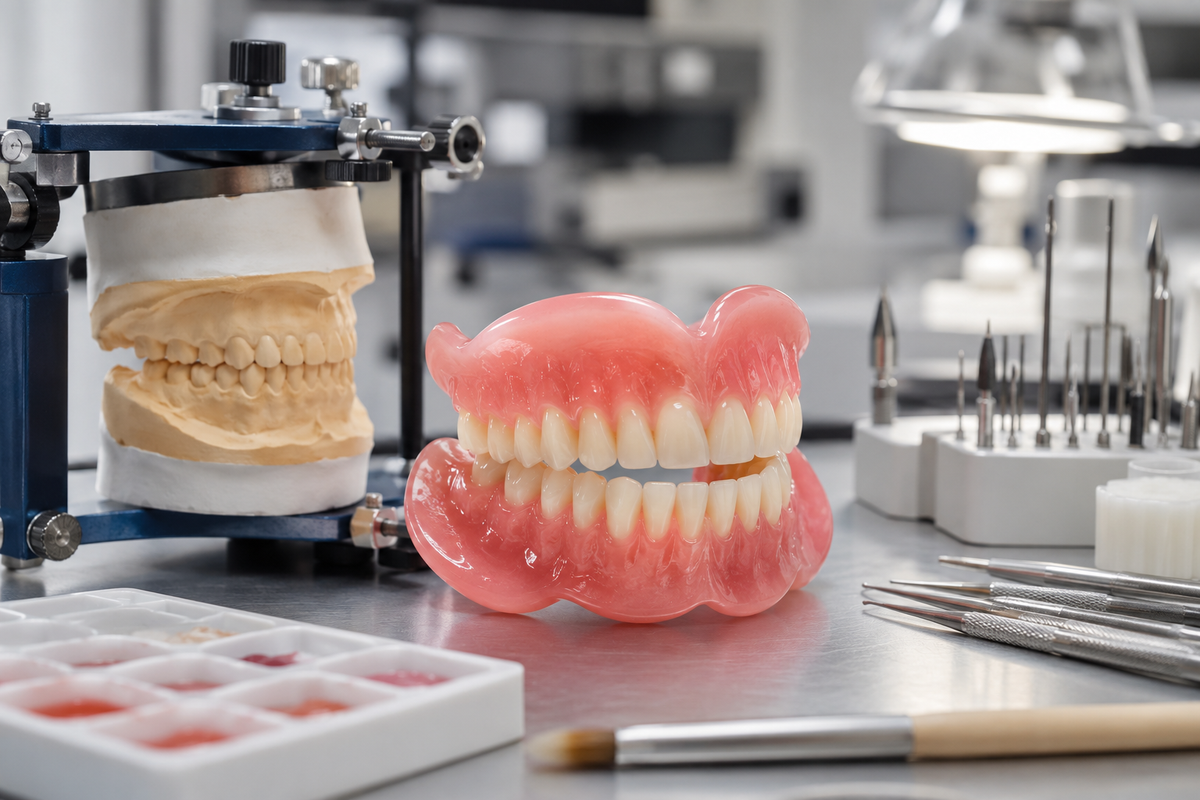
The lifespan question is one of the most common conversations dental labs have with referring practitioners and one of the least consistently answered.
Patients want to know how long their denture will last. Dentists want to set accurate expectations. And dental labs need to understand what material and production decisions directly affect that timeline, because the answer changes significantly depending on how the denture was made, what material was used, and how the patient uses and maintains it.
A PMMA denture produced in a CAD/CAM digital workflow is a fundamentally different product than a conventionally flask-and-packed acrylic denture, and its lifespan characteristics are different too. This guide covers the real-world replacement timeline for milled PMMA dentures, the clinical and material factors that shorten or extend that timeline, and what dental labs can do at the production stage to maximize the useful life of every denture they deliver.
The Baseline: What Clinical Evidence Says About PMMA Denture Lifespan
Clinical studies on complete denture longevity consistently report functional service lives of 5–10 years for well-made, well-maintained dentures in cooperative patients. That range is wide because the variables that determine lifespan are numerous and most of them are either directly or indirectly influenced by material quality and production method.
The 5-year end of that range typically reflects dentures with one or more of the following: conventional acrylic processing with higher residual porosity, significant ridge resorption that has degraded fit, patient habits that accelerate material wear, or inadequate maintenance compliance. The 10-year end reflects dentures made from high-quality pre-polymerized PMMA with excellent initial fit, patients with stable ridges and good oral hygiene, and regular recall visits that catch and address fit issues before they cause mucosal damage or accelerated wear.
For pmma teeth specifically the acrylic denture teeth set into the base, the wear timeline can differ from the base itself. Acrylic denture teeth are generally considered to require evaluation for replacement at 5–7 years as they wear occlusally, reducing vertical dimension and affecting masticatory efficiency. High-quality cross-linked acrylic teeth wear more slowly and extend this timeline. The base, when made from industrial pre-polymerized PMMA, typically outlasts the teeth in terms of structural integrity.
The practical answer to how long a milled PMMA denture lasts is therefore: 5–8 years as a functional range for most patients, with well-made dentures on stable ridges in compliant patients reaching 10 years before requiring replacement rather than reline or repair.
Material Quality Is the Most Controllable Lifespan Variable
Of all the factors that determine how long a PMMA denture lasts, material quality is the one dental labs control most directly. The clinical behavior of a denture over its service life is largely determined by what happens in the manufacturing of the disc before it ever enters the lab.
Industrial pre-polymerized PMMA discs, like aidite denture base pmma, are manufactured under high pressure and elevated temperature that drives residual monomer below 0.5% and produces a dense, near-zero-porosity polymer matrix. This matters for lifespan in three specific ways.
Porosity and staining.
Higher residual porosity in conventionally processed acrylic creates microscopic channels where oral fluids, food colorants, and bacteria penetrate the base material. This produces the gradual staining, odor accumulation, and surface degradation that patients describe as their denture "wearing out." Pre-polymerized PMMA with near-zero porosity resists this penetration the surface remains cleaner, brighter, and more resistant to staining over the years of service.
Dimensional stability over time.
A dense, homogeneous polymer matrix undergoes less post-delivery dimensional change than conventionally processed acrylic. Conventional acrylic can exhibit creep under prolonged occlusal loading gradual dimensional change that affects fit over years of use. Pre-polymerized PMMA maintains its dimensional characteristics more reliably, which means the fit degradation that triggers reline or replacement requests occurs more slowly.
Fracture resistance under impact.
The most common cause of acute denture failure is dropping. Pre-polymerized PMMA delivers better impact resistance than bench-mixed acrylic at equivalent thickness, due to the more homogeneous polymer matrix. Labs that have switched from conventional processing to milled pre-polymerized PMMA consistently report lower repair and remake rates from drop fractures.
For a detailed breakdown of how Aidite PMMA compares to generic alternatives on each of these properties, Why Dental Labs Prefer Aidite PMMA for Denture Bases covers the comparison in full.
The Five Factors That Shorten a PMMA Denture's Lifespan
Understanding what shortens a denture's life helps labs communicate replacement expectations accurately to referring practitioners and helps practitioners counsel patients on the maintenance behaviors that protect their investment.
1. Ridge resorption.
This is the factor labs have the least control over. After tooth extraction, the alveolar bone that supported the teeth gradually resorbs. In edentulous patients, this resorption continues throughout life, changing the shape of the ridge the denture rests on. As the ridge changes, the denture fit deteriorates. A denture that fit well at delivery becomes progressively looser, ultimately requiring reline or replacement. The rate of resorption varies significantly between patients rapid resorbers may require reline within 2–3 years of delivery; stable-ridge patients may go 7–10 years without significant fit change. Labs cannot control resorption rate, but producing a well-fitting initial denture with accurate tissue-side reproduction delays the onset of fit deterioration.
2. Occlusal wear.
All acrylic denture teeth wear under masticatory load. As the teeth wear, the vertical dimension of occlusion decreases, altering the patient's bite and facial support. Significant occlusal wear visible flattening of the posterior cusp morphology triggers replacement or at minimum tooth replacement. High-quality cross-linked denture teeth wear more slowly. Patients who are heavy grinders or clenchers accelerate wear significantly. Labs should note bruxism history in case documentation as a flag for shortened tooth replacement timeline.
3. Poor maintenance compliance.
PMMA denture bases are not indestructible. Patients who clean their dentures with abrasive household cleaners, brush with stiff bristle brushes, or soak in bleach solutions at excessive concentration accelerate surface degradation. Bleach exposure at concentrations above 0.5% damages the polymer matrix surface of PMMA, accelerating staining absorption and reducing surface gloss permanently. Labs should provide written cleaning instructions at delivery specifying approved cleansers and prohibiting household bleach.
4. Storage errors.
Patients who leave their dentures out of water for extended periods allow the PMMA to dry out, which can cause warping, crazing, and dimensional change. Patients who store dentures in hot water (above 60°C) risk heat distortion of the base. These are preventable failures that shorten lifespan significantly but have nothing to do with material or production quality.
5. Low-quality disc material.
Labs that source PMMA from unverified or low-quality suppliers introduce variability in residual monomer, porosity, and mechanical properties that directly affects lifespan. Using pmma denture material aidite from a verified US-stocked source with full batch documentation eliminates this variable the material properties are consistent from batch to batch, and the lab can rely on predictable performance across all cases rather than compensating for material inconsistency on an order-by-order basis.
Digital Workflow Advantages That Extend Lifespan
One of the most significant but underappreciated lifespan advantages of milled PMMA dentures over conventionally processed alternatives is the archival of the digital design file. When a conventional denture fractures or requires replacement, the fabrication process starts from scratch new impressions, new records, new processing. When a milled PMMA denture requires replacement, the digital design file allows the lab to remill an identical denture from the archived file with minimal new clinical records, producing a replacement that matches the original fit and occlusal scheme.
This archiving capability does not extend the physical lifespan of the denture, but it dramatically reduces the clinical and laboratory time required for replacement and allows replacement to be triggered earlier, when fit degradation is first detected at recall, rather than waiting until the patient presents with a broken or unwearable appliance.
When to Reline vs. When to Replace
Not every fit problem requires replacement. Labs advising practitioners on the reline vs. replace decision should consider three criteria:
Reline is appropriate when: The denture base structure is intact with no cracks or stress fractures, the teeth retain adequate occlusal morphology and vertical dimension, and the fit issue is limited to tissue surface adaptation to changed ridge anatomy.
Replacement is indicated when: The occlusal vertical dimension has been lost due to tooth wear, the base shows stress cracks or signs of structural fatigue, the patient's ridge anatomy has changed so significantly that a reline would produce a base that is excessively thick and poorly proportioned, or the patient requests updated esthetics.
For labs evaluating their PMMA product range, the aidite multilayer pmma disc extends Aidite's PMMA offering into crown and bridge provisional applications alongside the denture base formulation relevant for full-service labs that want to standardize on a single brand across both denture and temporary crown PMMA workflows.
For the denture base application specifically, the multilayer pmma disc range at ZirconiaGuys covers multiple gingival shades and thicknesses from US inventory, enabling labs to stock the full format range without managing multiple supplier relationships.
Setting Accurate Replacement Expectations: A Framework for Labs
When communicating lifespan expectations to referring practitioners, use this framework rather than quoting a single number:
- Average patient, average conditions: 5–8 years to replacement, with reline likely at 3–5 years as ridge resorption progresses.
- Stable-ridge patient, compliant maintenance, high-quality material: 8–10 years with reline at 5–7 years.
- Active bruxer, rapid resorber, or poor maintenance compliance: 3–5 years to replacement, with earlier reline likely.
Document the material used specifically the disc brand and batch in the lab record for every denture case. This documentation supports the lifespan claim if a practitioner questions early failure, and enables the lab to identify batch-level quality issues if multiple cases from the same period show abnormal wear or staining.
A milled pmma denture from high-quality pre-polymerized material, produced with accurate digital fit, and maintained correctly by a compliant patient should deliver 7–10 years of functional service in favorable conditions with relining at the midpoint to address ridge changes. The lab's contribution to that lifespan is concentrated at the production stage: material selection, disc quality, digital fit accuracy, and surface finish at delivery. These are the variables within the lab's control, and they matter more than any other single factor in determining how long the denture performs before replacement.
For labs sourcing zirconia blocks dental, dental zirconia discs, zirconia blank stock, and PMMA alongside each other from a single US supplier, ZirconiaGuys carries the full Aidite PMMA range and zirconia dental blanks from US inventory consistent documentation, same-day shipping, and no minimum order requirements that force unnecessary stock accumulation.


