

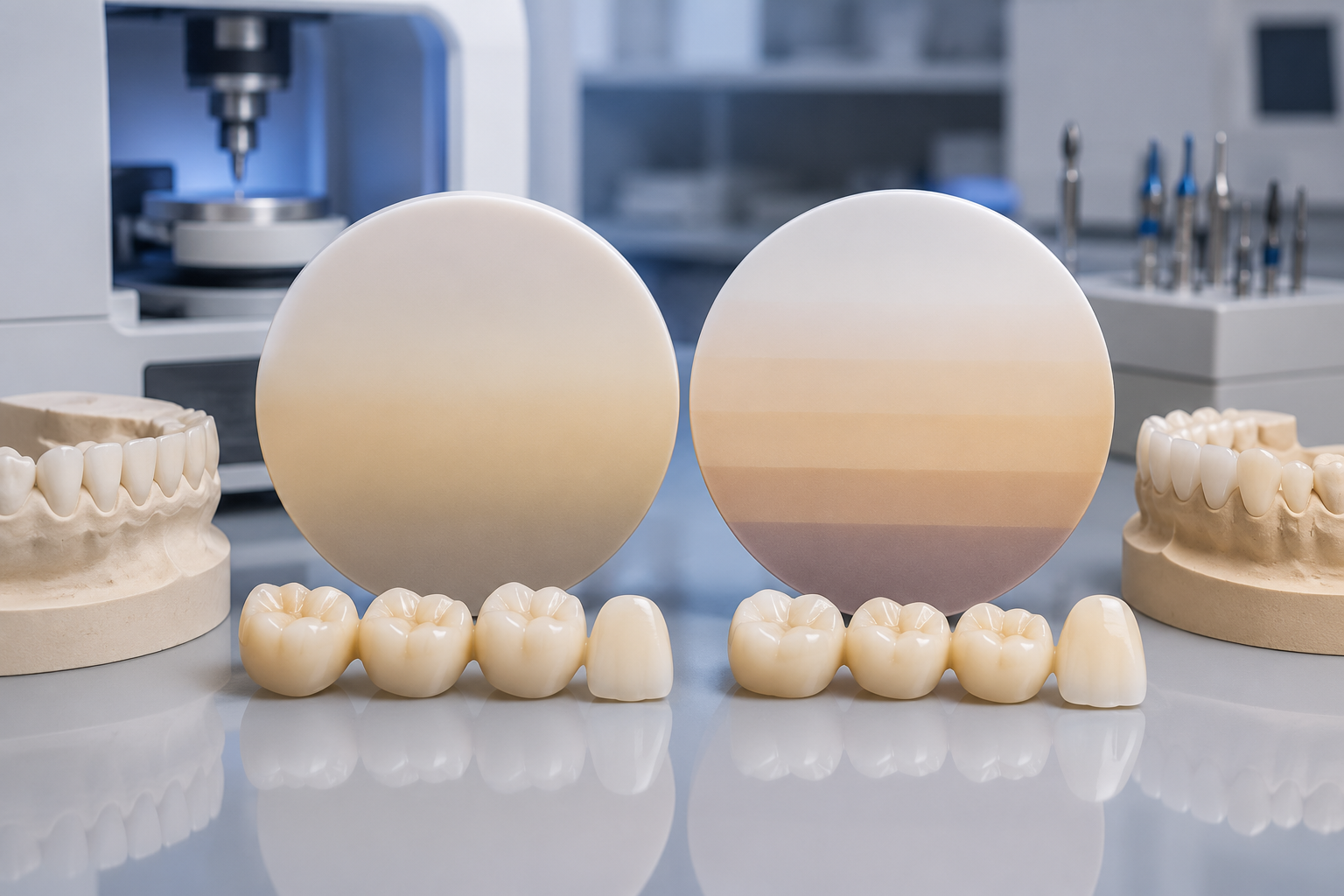
When Aidite introduced the 3D Pro Zir multilayer disc, the marketing language emphasized a more refined gradient architecture compared to standard multilayer zirconia. For labs that have been running standard multilayer discs reliably for years, that claim raises a practical question: is the difference actually visible in the finished crown, or is it a specification improvement that matters on paper but not in the operatory? The answer has real workflow implications — if the difference is visible and clinically meaningful, it justifies the product change and the re-validation of sintering parameters. If it is not, the standard multilayer disc remains the more rational stock choice for high-volume production.
This guide examines that question directly comparing the gradient architecture of 3D Pro Zir against standard multilayer zirconia on the criteria that actually matter: visible translucency distribution, shade accuracy under clinical lighting, layer transition sharpness, and the cases where each format is the correct choice.
What "Gradient" Actually Means in Multilayer Zirconia Manufacturing?
To evaluate whether the 3D Pro gradient is visibly different, you first need to understand what gradient architecture means at the manufacturing level because not all multilayer discs are built the same way.
A standard multilayer zirconia disc is manufactured by pressing multiple layers of zirconia powder with different yttria concentrations into a single green body before sintering. Each layer has a distinct composition a lower-yttria, higher-strength layer at the cervical end, transitioning to a higher-yttria, more translucent layer at the incisal end. The number of layers, the sharpness of transitions between them, and the total gradient span across the disc thickness all vary by manufacturer and product line.
In most standard multilayer discs, the transition between layers is relatively abrupt the composition changes step-by-step at defined boundaries. Under clinical lighting on most crowns in most shade ranges, these stepped transitions are not visible. But in cases requiring maximum incisal translucency thin anterior crowns, high-translucency esthetic cases, or situations where the crown is directly adjacent to highly translucent natural dentition the stepped character of a standard multilayer gradient can produce a slightly artificial-looking incisal zone that lacks the continuous optical depth of natural enamel.
The 3D Pro Zir architecture addresses this specifically. Rather than discrete pressed layers with defined boundaries, the 3D Pro manufacturing process creates a continuous gradient the yttria content transitions smoothly and progressively from the cervical zone to the incisal zone without sharp compositional boundaries between layers. The result, in principle, is a more naturalistic optical transition across the restoration.
The 3D Pro Gradient: What Changes at the Material Level
The practical differences between 3D Pro Zir and standard multilayer discs at the material level are measurable in three ways: gradient continuity, incisal translucency peak, and chroma depth at the cervical zone.
Gradient continuity. In the 3D Pro disc, the transition from body to incisal zone is continuous rather than stepped. When you mill a crown from the incisal zone of the disc and examine it against a standardized background under a dental light, the translucency builds progressively from the margin toward the incisal tip rather than stepping up in visible increments. In thin crown sections (0.5–0.8 mm) this difference is visually apparent. In full-contour crowns with standard wall thickness, the difference is subtle but present particularly in direct lateral lighting.
Incisal translucency peak. The 3D Pro formulation pushes the maximum incisal translucency higher than most standard multilayer products by using a 5Y-equivalent composition at the incisal pole. This produces an opalescent quality in the incisal one-third that standard 4Y multilayer discs cannot fully replicate regardless of orientation. Under mixed lighting natural daylight plus dental operatory light simultaneously this opalescence is the most visible differentiator between 3D Pro and standard multilayer crowns placed adjacent to natural teeth.
Cervical chroma depth. The cervical zone of the 3D Pro disc is formulated with higher chroma saturation than most standard multilayer products. This means the dentin character at the cervical third of the crown has more optical depth it reads warmer and more saturated in a way that mimics the effect of natural dentin seen through enamel. In full-coverage crowns where the cervical third is visible at the gingival margin, this chroma depth contributes measurably to the natural appearance of the restoration.
For labs specifically evaluating the aidite 3d pro multilayer zirconia blocks usa product, these material-level differences translate to: more natural incisal haze, richer cervical character, and a smoother visual transition between the two zones all without any additional staining or finishing steps.
Is the Difference Visible in the Operatory?
This is the question that matters for the material selection decision. The honest answer is: yes, in specific cases and not meaningfully, in others.
Cases where the 3D Pro gradient produces a visible improvement:
- Anterior single crowns in the esthetic zone, particularly maxillary centrals and laterals, where the crown is viewed in direct comparison to adjacent natural teeth at close range. In this scenario, the continuous gradient and elevated incisal translucency of the 3D Pro disc produce restorations that blend more naturally with the incisal halo of adjacent teeth. The difference is visible to the trained eye under mixed lighting and perceptible to patients and dentists who are paying close attention.
- Full-arch anterior cases where multiple crowns are produced from the same disc. In these cases, shade and translucency consistency across all units is the primary challenge. The continuous gradient of the 3D Pro disc produces more consistent incisal character across the full case compared to standard multilayer products where positional variation within the disc affects the translucency result unit to unit.
- Cases adjacent to e.max or pressed ceramic restorations. Natural-looking pressed ceramics have a continuous internal gradient that standard multilayer zirconia does not fully match. The 3D Pro architecture closes that gap not completely, but meaningfully enough that placing a 3D Pro zirconia crown adjacent to an e.max veneer is a more defensible material choice than placing a standard multilayer disc in the same scenario.
Cases where the standard multilayer is sufficient:
- Posterior single crowns and short-span posterior bridges. In these cases, occlusal load requirements dominate the material selection decision and the viewing angle for the restoration means incisal translucency is not a primary esthetic concern. Standard tt multilayer zirconia delivers excellent posterior esthetic results at a lower per-disc cost, and the continuous gradient of 3D Pro provides no clinical benefit in this application.
- High-volume anterior cases in standard A-shade range where the adjacent dentition has moderate translucency. For A2 or A3 shade cases in patients with average translucency teeth, a well-oriented standard multilayer disc produces results that are clinically indistinguishable from 3D Pro at normal viewing distances. The continuous gradient becomes meaningful primarily at the extremes maximum translucency requirements, or thin anterior sections where every optical layer counts.
For a deeper understanding of why gradient architecture matters in anterior esthetic cases, the guide to Why Esthetic Zirconia Discs Are Ideal for Layered Dental Restorations covers the material science of multilayer disc gradients and their clinical impact in full detail.
Toolpath Alignment: Why It Matters More with a Continuous Gradient
One important practical implication of the 3D Pro continuous gradient is that toolpath alignment becomes more critical and more rewarding than with standard multilayer discs.
In a stepped multilayer disc, the gradient zones are relatively forgiving. If the toolpath places the crown body 1–2 mm off the ideal zone center, the result still captures a reasonable body-to-incisal transition because the layers have defined widths. In a continuous gradient disc, the translucency increases progressively which means precise alignment delivers the full intended optical result, while misalignment produces a crown that is either too opaque (positioned too cervical) or too translucent throughout (positioned too incisal).
The practical instruction: when running 3D Pro Zir, use your CAM software's blank orientation mapping tool for every anterior case. In exocad and 3Shape, the blank orientation tool allows you to visualize exactly where the crown body sits within the gradient before committing the toolpath. This adds approximately 2 minutes per case and is the single most impactful step for extracting the full esthetic potential of the continuous gradient architecture.
For the high translucency multilayer zirconia aidite supplier product at ZirconiaGuys, technical documentation including the gradient zone map and recommended toolpath alignment guidance is available on request use it when validating the product for your first anterior cases.
Sintering: Does 3D Pro Require Different Parameters?
This is a frequent question from labs considering the switch. The short answer is: use the manufacturer's published sintering profile and do not assume compatibility with your existing standard multilayer profile.
The 3D Pro continuous gradient formulation uses a gradient of yttria content that spans from approximately 3Y at the cervical to 5Y at the incisal across the disc thickness. This span means the disc contains material with meaningfully different sintering behavior at each end. The manufacturer's sintering profile is engineered to balance the densification requirements of both zones simultaneously.
Running a 3D Pro disc on an aggressive fast-fire profile optimized for 3Y monolithic zirconia will undershoot the hold time needed for complete densification of the 5Y incisal zone producing a slightly cloudier incisal result and potentially introducing micro-warping at the incisal tip on thin-walled anterior crowns. Run the recommended profile: ramp rate ≤5°C/min, peak hold at the manufacturer's specified temperature (typically 1500–1530°C), standard cool-down.
How to Decide Which Format to Stock
The decision between 3D Pro and standard multilayer as your primary anterior stock comes down to your case mix and the esthetic standards your referrals require.
| Factor | 3D Pro Gradient | Standard Multilayer |
|---|---|---|
| Anterior esthetic priority cases | First choice | Acceptable with correct staining |
| Adjacent to natural high-translucency teeth | First choice | May require supplementary staining |
| High-volume standard A-shade anterior | Justified but not essential | Fully adequate |
| Posterior crowns and bridges | Unnecessary cost premium | Correct choice |
| Full-arch anterior cases | First choice for consistency | Variable unit-to-unit results |
| Labs with strict toolpath alignment protocol | Full benefit realized | Benefit limited by toolpath precision |
The correct stocking strategy for most full-service labs: run 3D Pro as your primary anterior esthetic disc for demanding cases and full-arch work, and maintain standard multilayer stock for posterior and standard anterior volume. This gives you the right material for each indication without the cost of running premium disc stock on every posterior case.
Other zirconia blocks with natural gradient formats from Aidite including the Superfect Zir SHT pre-shaded line offer a middle ground between standard multilayer and 3D Pro for labs looking for improved gradient performance without the full step to 3D Pro pricing. These are worth evaluating if your case mix sits between standard volume and demanding esthetic work.
The 3D Pro gradient does produce a visibly different crown in the cases where it matters demanding anterior esthetic work, cases adjacent to highly translucent natural dentition, and full-arch anterior production where unit-to-unit consistency is the primary quality challenge. In standard anterior volume and all posterior applications, the difference is not meaningful enough to justify the additional cost over standard multilayer stock.
For US labs sourcing dental zirconia discs, zirconia blocks dental, zirconia blank, and zirconia dental blanks across both standard and premium multilayer formats ZirconiaGuys stocks the full Aidite multilayer range from US inventory, including 3D Pro Zir and standard multilayer options in multiple thicknesses, with same-day shipping and full technical documentation on request. The right zirconia blocks for your case mix are in stock and ready to evaluate.


