

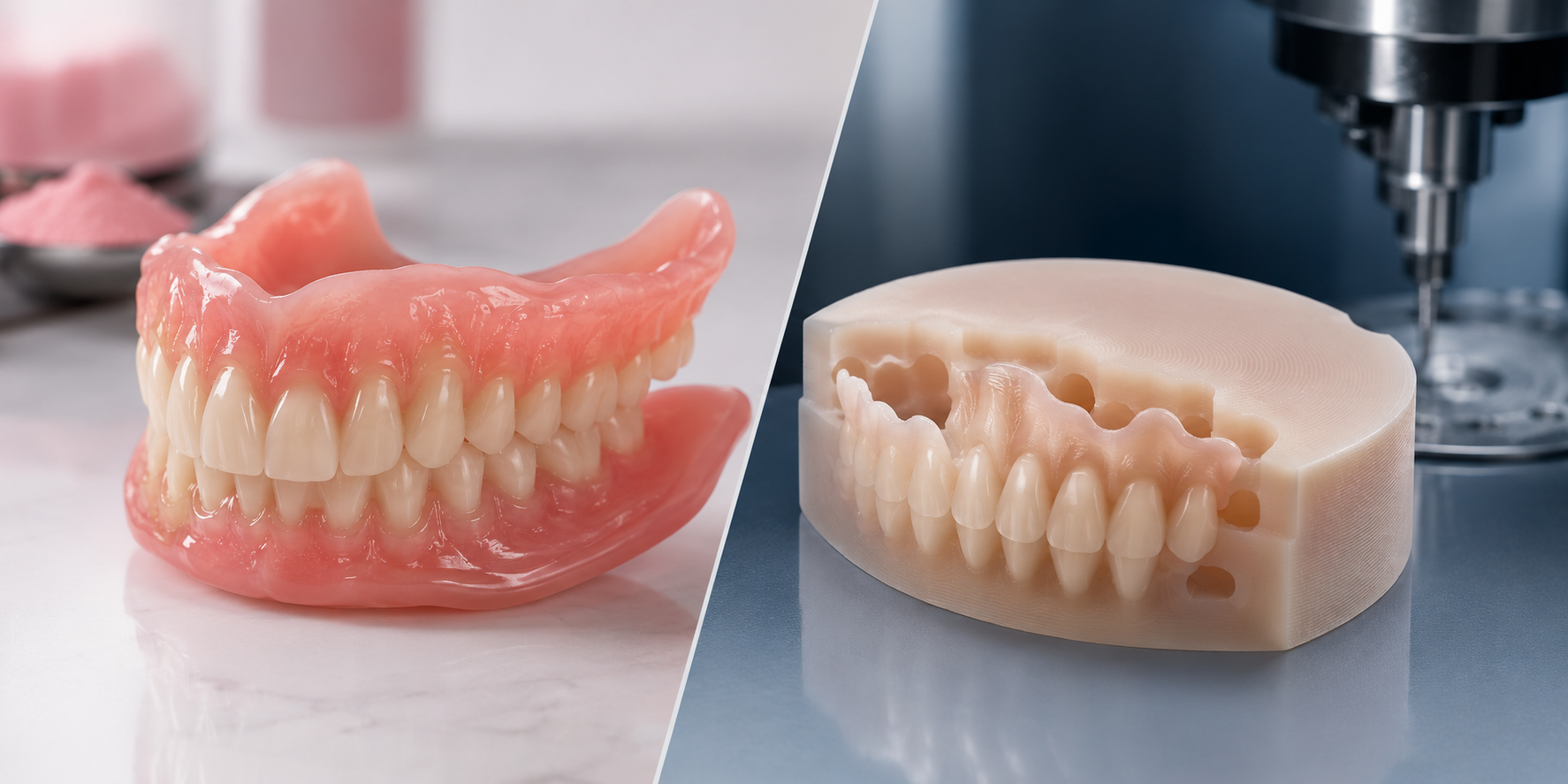
Dental labs producing full and partial dentures today have more material options than at any previous point in the industry's history and that variety creates a genuine decision problem. Two formats dominate the modern CAD/CAM denture base workflow: 3D printable resins formulated specifically for denture applications and milled PMMA discs. Both produce denture bases. Both are used in digital workflows. But they are different materials with different production requirements, different clinical performance profiles, and different cost structures. Choosing between them without understanding those differences leads to production inefficiencies and clinical outcomes that could have been better.
This guide explains exactly what Key Denture Base Resin is, how it works in a 3D printing workflow, and how it compares to milled PMMA across every criterion that matters to a dental lab running daily denture production.
What Is Key Denture Base Resin?
Key Denture Base Resin is a photopolymer resin from Keystone Industries formulated specifically for 3D printed full and partial denture bases. Unlike generic dental resins that are adapted from broader engineering applications, Key Denture Base Resin is engineered from the ground up for the clinical requirements of tissue-contact denture applications gingival shade accuracy, biocompatibility under extended mucosal contact, and the mechanical properties needed to survive daily denture function.
The material cures via photopolymerization liquid resin exposed to UV or visible light at 385 or 405 nm solidifies layer by layer as the 3D printer builds the denture base geometry from a digital design file. The result is a denture base that matches the digital prescription precisely, without the dimensional variability of conventional flask-and-pack processing.
The key denture base resin for dental labs is formulated to meet ISO 20795-1 requirements for denture base polymers the same standard that governs milled PMMA covering biocompatibility, flexural strength, and residual monomer thresholds. This ISO compliance is what makes it a clinically appropriate material for long-term tissue contact, not just a printing resin that happens to be pink.
What Is Milled PMMA for Dentures?
Milled PMMA polymethyl methacrylate in pre-polymerized disc form is the other dominant CAD/CAM denture base format. PMMA discs are manufactured through industrial pre-polymerization at high pressure and temperature, producing a dense, homogeneous polymer matrix that is then substractively milled in a CAD/CAM mill to produce the denture base geometry.
The key clinical advantage of pre-polymerized PMMA is its material consistency. Because polymerization is completed during manufacturing under controlled industrial conditions, the residual monomer content is driven below 0.5% well within biocompatibility thresholds. The dense, non-porous matrix produces a material that mills cleanly, polishes to a high gloss, and maintains dimensional stability across the service life of the denture.
Understanding what PMMA does in the full context of dental restorations not just denture bases but temporary crowns, splints, and long-term provisionals is covered in depth in our guide to the Role of Dental PMMA in Temporary and Long-Term Restorations. For labs that handle both denture production and crown and bridge workflows, that broader material context matters for inventory decisions.
A common question from labs new to CAD/CAM denture workflows is what is pmma dental material exactly and the answer relevant to denture production is: pre-polymerized PMMA disc is industrial-grade acrylic that has already completed its polymerization cycle before it reaches your mill. You are milling a finished polymer, not curing one. That distinction is what drives its material advantages over both bench-mixed acrylic and 3D printed alternatives for certain applications.
Key Denture Base Resin vs Milled PMMA: Direct Comparison
The choice between these two formats is not a question of which material is better it is a question of which material is better suited to your lab's specific workflow, equipment, and production volume. Here is how they compare across the criteria that matter most.
Production workflow
Milled PMMA requires a dental milling machine Roland, Amann Girrbach, VHF, Zirkonzahn, or equivalent open-system mill. The workflow is: scan → design → mill → separate → polish → deliver. Workflow steps are few, each is fast, and the process integrates seamlessly with existing CAD/CAM infrastructure most labs already have for zirconia and crown production.
Key Denture Base Resin requires a compatible 3D printer an MSLA or DLP system with the correct light wavelength (385 or 405 nm) and sufficient build volume for full-arch denture bases. The workflow is: scan → design → orient and support → print → wash → post-cure → finish → deliver. More steps, more equipment dependencies, and a more complex post-processing protocol.
Geometry complexity
This is where 3D printing holds a clear advantage. Printed denture bases can incorporate undercuts, thin flanges, complex tissue surface anatomy, and internal features that milling cannot produce without multi-axis machining or manual finishing. For full-arch immediate dentures with complex ridge anatomy, or for digital dentures requiring precise tissue surface reproduction, printing offers geometric capabilities that milling cannot match.
Milled PMMA is well-suited to standard denture base geometries full arch bases with conventional flange anatomy but geometric complexity has practical limits determined by tool access and cutting direction.
Surface quality and polishing
Milled PMMA consistently produces smoother surfaces directly from the mill than printed resins produce directly from the printer. The subtractive milling process cuts a homogeneous material with predictable surface finish. Printed surfaces have inherent layer lines from the additive process that require more post-processing to achieve equivalent clinical smoothness.
For tissue-surface accuracy the intaglio surface of the denture that contacts the ridge milled PMMA requires less post-processing to reach clinical acceptability. Printed bases typically require more careful surface finishing on the tissue side to ensure patient comfort.
Biocompatibility
Both materials, when properly processed with ISO 20795-1 compliant formulations, meet the biocompatibility requirements for extended mucosal contact. The critical variable for printed resin is post-cure completeness under-cured printed resin has significantly higher residual monomer than fully post-cured material. Milled PMMA's residual monomer is fixed by industrial manufacturing and does not depend on lab post-processing.
For labs where post-cure protocol consistency across technicians and shifts is difficult to control, milled PMMA offers more predictable biocompatibility outcomes.
| Property | Key Denture Base Resin | Milled PMMA |
|---|---|---|
| Production method | 3D printing (additive) | CAD/CAM milling (subtractive) |
| Equipment needed | 3D printer + post-cure unit | Dental milling machine |
| Geometry capability | Complex — undercuts, thin walls | Standard — limited by tool access |
| Tissue surface quality | More finishing required | Cleaner direct from mill |
| Residual monomer | Post-cure dependent | Fixed by manufacturing |
| Biocompatibility standard | ISO 20795-1 compliant | ISO 20795-1 compliant |
| Shade options | Standard gingival shades | Multiple gingival shades |
| Repair/reline | Standard acrylic protocols | Standard acrylic protocols |
| Per-unit material cost | Lower | Moderate |
| Per-unit total cost | Depends on post-processing | Predictable |
When to Choose Key Denture Base Resin?
Key Denture Base Resin is the right production choice when your lab has 3D printing infrastructure in place and the case type benefits from printing's geometric advantages. Specifically:
-
Immediate dentures with complex tissue anatomy.
The printing workflow can reproduce complex ridge topography from a digital scan with a level of tissue surface detail that milling cannot match on complex anatomical geometries. For patients requiring immediate dentures post-extraction with irregular ridge anatomy, printed bases often deliver better initial tissue adaptation. -
High-volume labs with dedicated printing capacity.
Once 3D printing workflow is optimized with validated printer settings, consistent wash and post-cure protocols, and reliable batch quality, printed denture bases can be produced at a lower per-unit material cost than milled PMMA. For labs running 20 or more denture cases per month, the material cost differential compounds meaningfully. -
Labs already running 3D printing for other applications.
If your lab already prints surgical guides, models, or splints, adding denture base resin to your material inventory requires no additional equipment investment just a validated print profile and the correct resin.
When to Choose Milled PMMA?
Milled PMMA is the right choice when material consistency, minimal post-processing, and integration with existing milling infrastructure are the priorities.
-
Labs running milling-only workflows.
For labs that do not have 3D printing equipment, milled PMMA is the correct denture base format it requires no new capital equipment, integrates with existing mills, and uses the same design software and digital workflow already in place for crown and bridge production. -
Cases requiring minimal chairside adjustment.
The dimensional accuracy of milled PMMA on standard denture geometries is high, and the tissue surface finish requires less post-processing before delivery. For straightforward full-arch cases on cooperative patients, milled PMMA consistently delivers a result with minimal chairside adjustment. -
Labs where post-processing consistency is a concern.
The biocompatibility and mechanical properties of milled PMMA are fixed by manufacturing and do not vary based on technician protocol adherence. In multi-technician environments where post-cure consistency is difficult to enforce, milled PMMA eliminates a significant variable.
Where to Source Key Denture Base Resin in the US?
For US dental labs evaluating key denture base resin price against milled PMMA disc cost, the per-unit material cost of printed resin is typically lower but total cost per case depends on post-processing labor, post-cure equipment amortization, and print failure rate. Evaluate total case economics, not just resin acquisition cost.
Labs that buy key denture base resin online from ZirconiaGuys receive the full Keystone Industries Key Denture Base Resin from US inventory no international lead times, consistent batch quality, and full technical documentation for post-cure protocols and biocompatibility compliance. Same-day shipping on in-stock items.
ZirconiaGuys also stocks milled PMMA discs, dental zirconia discs, zirconia blocks, and the full range of zirconia dental blanks and zirconia blocks dental labs use for crown and bridge production enabling labs to consolidate their full CAD/CAM material supply through a single US-based source regardless of whether they run milling-only, printing-only, or hybrid production workflows.
Key Denture Base Resin and milled PMMA are complementary production formats, not competing ones. Labs with 3D printing infrastructure benefit from the geometry flexibility and material cost of printed resin for complex cases and high-volume production. Labs running milling-only workflows benefit from the surface quality, processing simplicity, and biocompatibility consistency of milled PMMA. The zirconia blank and dental zirconia discs range that ZirconiaGuys stocks alongside these denture materials reflects the same principle the right material for the right application, sourced from a single reliable US supplier.


