

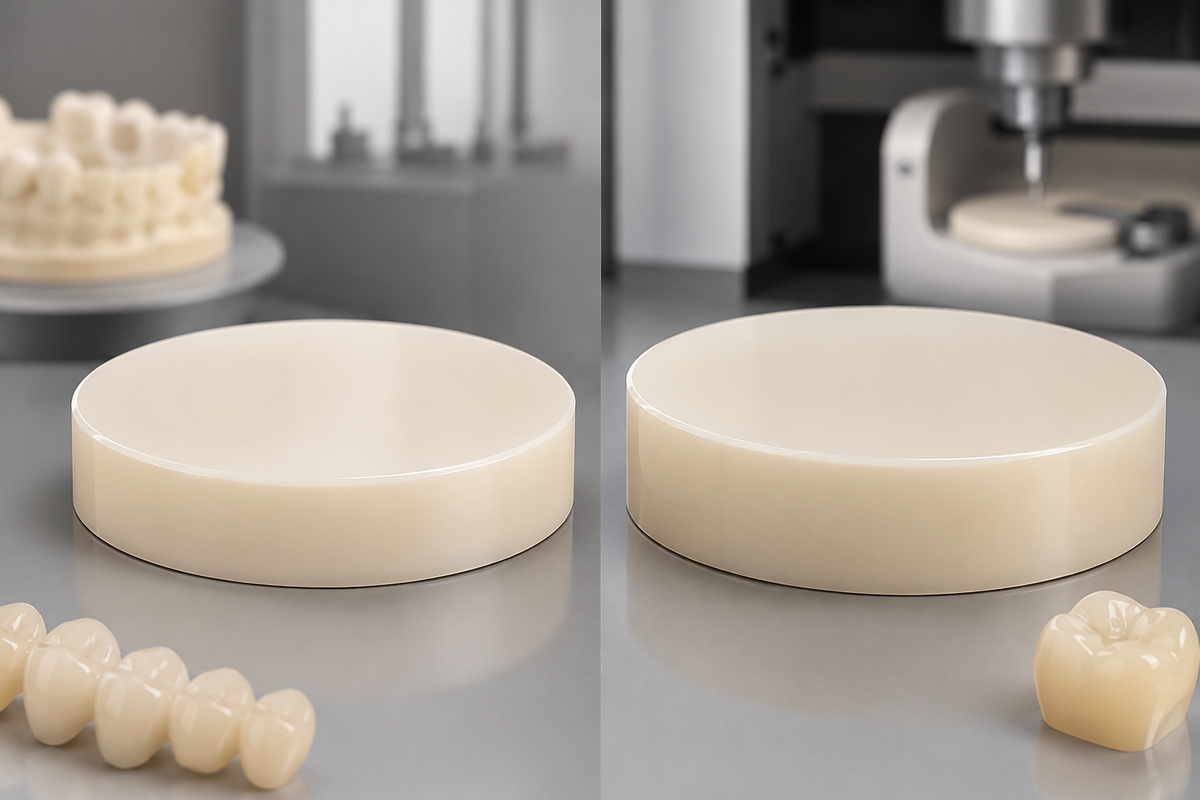
Disc thickness is one of those ordering decisions that looks simple on the surface and then causes problems the moment a case comes back from the mill undersized or a bridge connector fails strength review because the wrong stock was used. For HonorZir SHT Pre-Shaded zirconia, Aidite offers two thickness options: 10mm and 12mm. Both are the same material formulation. The difference is purely dimensional and that dimension determines which clinical cases each thickness can safely and reliably handle.
This guide gives dental labs a clear, practical answer to the 10mm vs 12mm question. It covers the clinical indications for each thickness, the milling geometry considerations that drive the decision, and how to stock both correctly so you are never choosing the wrong disc for a case under production pressure.
Why Disc Thickness Matters More Than Most Labs Realize?
The thickness of a zirconia disc is not just a specification on a data sheet it is the material reserve available between the deepest point of the milled restoration and the back face of the disc. That reserve determines three things: maximum restoration height, connector depth in bridge cases, and the structural margin on full-contour posterior units where occlusal anatomy requires depth to achieve the specified wall thickness.
In pre shaded zirconia discs specifically, thickness also interacts with the internal shade gradient. HonorZir SHT Pre-Shaded is manufactured with a shade gradient built in from the cervical end to the incisal end of the disc. The gradient is calibrated to deliver VITA-compatible shade transitions across the full restoration height. When a restoration is milled from a disc that is too thin for its anatomy, the toolpath cuts into gradient zones that were not intended to be exposed at the surface producing shade outcomes that do not match the intended VITA specification.
This is not a concern most labs encounter when ordering standard monolithic white zirconia blocks. But with pre-shaded gradient discs, getting the thickness right is part of getting the shade right.
HonorZir SHT Pre-Shaded: What the Disc Is Designed For
Before comparing 10mm and 12mm, it is worth being clear about what makes aidite honorzir sht pre-shaded the specific product choice it is because the thickness decision only makes sense in the context of the material's clinical purpose.
HonorZir SHT is Aidite's super-high-translucency pre-shaded zirconia in the HonorZir line. SHT indicates the elevated cubic phase content in the incisal zone that produces the high translucency needed for esthetic anterior cases. The pre-shaded format embeds VITA Classic-compatible shade gradients into the disc during manufacturing eliminating the external staining step on standard A-shade cases and producing consistent shade gradients that are not dependent on technician staining skill or batch-to-batch stain consistency.
The clinical target for HonorZir SHT Pre-Shaded is anterior and premolar crown and bridge production in standard VITA shade ranges. The SHT translucency grade makes it particularly well suited to cases where the adjacent natural dentition is moderately to highly translucent younger patients, lateral incisors, upper centrals in high-esthetic cases where standard HT zirconia would appear flat by comparison.
For labs deciding between HonorZir SHT Pre-Shaded and white zirconia dental blanks for the same case types, the guide to choosing between HT white and pre-shaded zirconia discs covers that decision framework in detail. The short answer: pre-shaded is the correct default for standard A-shade production volume; white is the correct choice for complex custom shade cases.
The 10mm Thickness: Clinical Indications and Correct Use Cases
The 10mm disc is the correct choice for anterior single crown and short-span anterior bridge cases where the restoration geometry fits within the milling depth that 10mm of material provides.
For honorzir pre-shaded zirconia blocks wholesale ordering, the 10mm format is the most commonly specified thickness for the following case types:
Anterior single crowns (incisors and canines).
Upper and lower anterior crowns in standard preparation cases where the prepared tooth height and the full-contour restoration anatomy fit comfortably within 10mm of milling depth are the primary indication for the 10mm disc. The restoration height of a typical anterior single crown in a standard preparation falls in the 8–9.5mm range, leaving adequate material reserve in a 10mm disc for the toolpath to complete the anatomy without bottoming out.
Short-span anterior bridges (3-unit, all-anterior).
Three-unit anterior bridges where all units fall within the anterior zone and the pontic height requirements stay within the 10mm constraint. The connector depth of a 3-unit anterior bridge in standard anatomy is typically 6–7mm well within 10mm material depth.
Premolar single crowns in reduced-height preparations.
Premolar crowns where the clinical crown height is modest short clinical crown preparations can be milled from 10mm stock without geometry issues.
Where 10mm becomes the wrong choice:
Any case where the full-contour anatomy at the deepest point of the milled restoration plus the minimum material reserve required by the manufacturer exceeds 10mm total depth. This typically arises in posterior single crowns with tall clinical crown heights, posterior bridges, and any case involving a patient with a deep bite or high cusp anatomy that requires additional occlusal depth to achieve the specified wall thickness at the cusp tip.
The 12mm Thickness: When the Extra 2mm Changes the Outcome
Two millimeters of additional disc thickness sounds marginal. In anterior crown production on standard cases, it is. In the case types where it matters, it is the difference between a correctly milled restoration and a remake.
Pre-shaded zirconia blocks aidite in 12mm thickness are the correct specification for:
Posterior single crowns with full occlusal anatomy.
Posterior crowns particularly upper and lower molars require full cusp anatomy that can push total restoration height to 9.5–11mm in standard cases and higher in patients with tall clinical crowns. A 10mm disc does not provide sufficient milling depth for these cases. The 12mm disc provides the 2mm additional reserve that keeps the toolpath within the material for the full anatomy without encroaching on minimum wall thickness at the cusp tip.
Premolar crowns in standard to deep preparations.
Premolars with standard or deeper preparation heights require 12mm stock when the full-contour anatomy pushes past the 9mm effective milling depth threshold that a 10mm disc realistically supports when minimum material reserve is accounted for.
3-unit bridges involving a posterior unit.
Any bridge case with a posterior component including premolar-to-premolar spans or anterior-to-premolar spans where one or more units require the additional depth that posterior anatomy demands. Bridge cases with posterior units should default to 12mm unless the specific unit geometry has been verified to fit within 10mm.
Cases with deeper bite relationships.
Patients with deep vertical overlap or high cuspal anatomy require greater occlusal depth to produce a correctly dimensioned restoration. These cases should default to 12mm regardless of tooth position.
The Shade Gradient Consideration: How Thickness Affects Color Outcome
This point is specific to pre-shaded discs and does not apply to white zirconia blocks dental stock which is why it is worth calling out explicitly.
In a pre-shaded gradient disc like HonorZir SHT Pre-Shaded, the shade zones are calibrated to span the full disc thickness. The manufacturer designs the gradient assuming the restoration will be milled from a disc of the specified thickness. When a posterior case with deeper anatomy is milled from a 10mm disc using the full available depth the toolpath can cut through gradient zones in a way that the shade design did not anticipate. The result can be a shade mismatch where the occlusal surface exposes a gradient zone intended to sit deeper in the disc, producing a cervical-shade appearance at the cusp tip.
This is the mechanism behind one of the most commonly misdiagnosed shade problems in pre-shaded production: labs assume the issue is staining or sintering, when the actual root cause is milling a deeper-anatomy case from a disc that was too thin for that specific geometry. Ordering the correct thickness for the case type eliminates this problem entirely.
Stocking Both Thicknesses: The Practical Approach
The most efficient stocking strategy for most dental labs running HonorZir SHT Pre-Shaded is to maintain both 10mm and 12mm stock and allocate cases to thickness based on a simple clinical decision rule:
| Case Type | Correct Thickness |
|---|---|
| Anterior single crowns (incisor, canine) | 10mm |
| Anterior 3-unit bridges (all-anterior) | 10mm |
| Premolar crowns (reduced height prep) | 10mm |
| Premolar crowns (standard to deep prep) | 12mm |
| Posterior single crowns (premolar-molar) | 12mm |
| Posterior bridges / any posterior unit | 12mm |
| Cases with deep bite / tall cusp anatomy | 12mm |
The 10mm disc covers high-volume anterior cases efficiently and at slightly lower per-disc cost. The 12mm disc handles the broader indication range for posterior and mixed-arch cases where anatomy demands the additional depth.
For labs that run predominantly anterior esthetic cases with occasional posterior work, a 2:1 stock ratio of 10mm to 12mm is a reasonable starting point adjustable based on your actual case mix over the first 60 days.
For the full Aidite pre-shaded and multilayer range alongside HonorZir, aidite multilayer shaded zirconia at ZirconiaGuys covers the complete Aidite disc lineup all from US inventory with no international lead times and same-day shipping on in-stock items.
The 10mm vs 12mm decision for dental zirconia discs like HonorZir SHT Pre-Shaded is not arbitrary it is a clinical geometry decision that directly affects whether the milled restoration fits the anatomy, maintains minimum wall thickness, and delivers the shade outcome the pre-shaded gradient was designed to produce. Anterior cases belong on 10mm. Posterior cases and any case with deeper anatomy belong on 12mm. Stocking both and using each correctly is a straightforward workflow standardization that eliminates a common and avoidable source of production error.
The aidite honorzir sht pre-shaded query is already showing impressions in GSC at position 4 this blog is designed to capture that traffic and convert it. Similarly, pre shaded zirconia at 30 impressions and position 19 is a query this content directly addresses, targeting labs actively researching pre-shaded disc options before ordering.


