

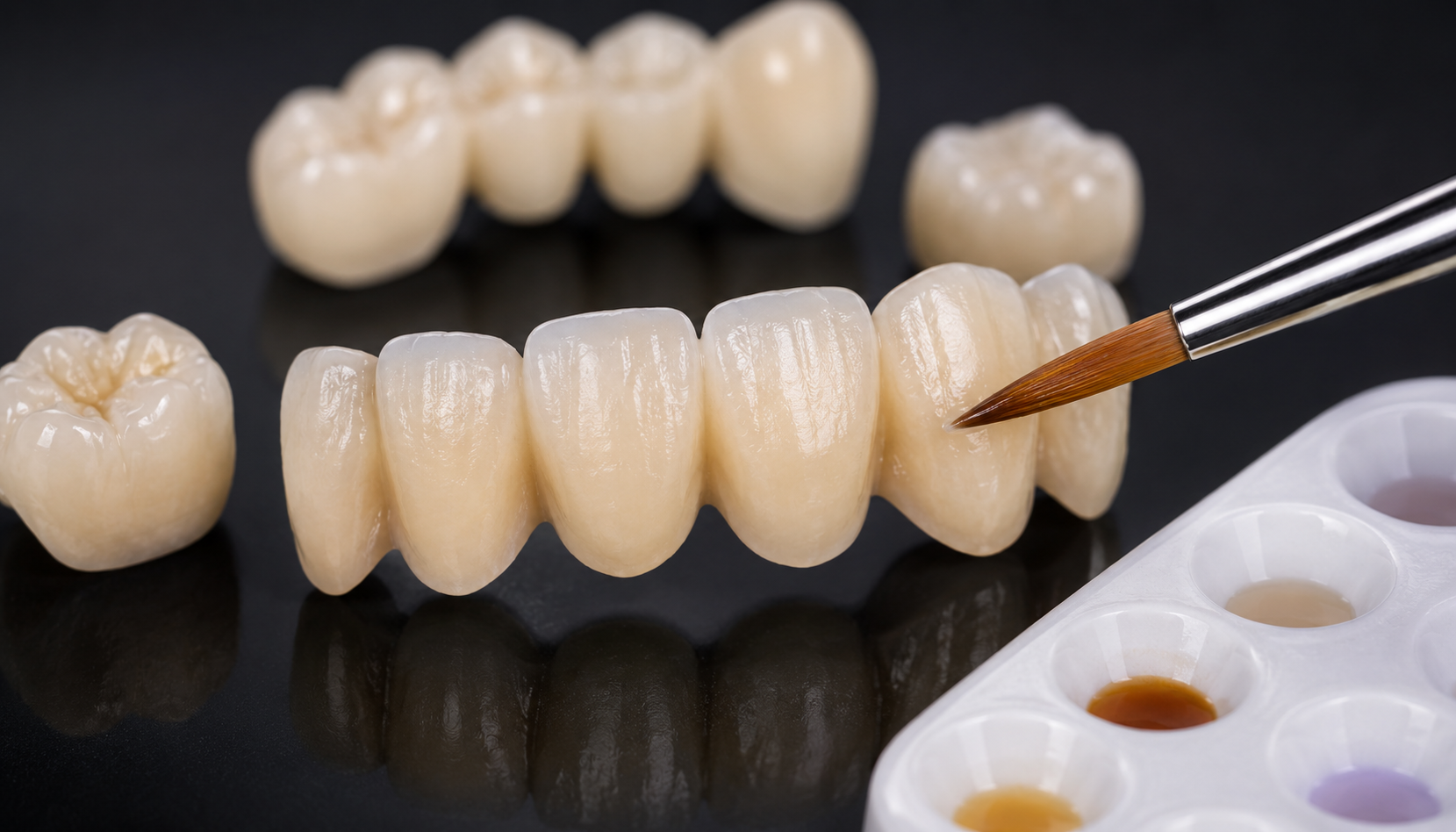
Zirconia has solved most of the problems that made metal and PFM restorations clinically frustrating the dark gumline margins, the metal ion leaching, the porcelain chipping. What it introduced in exchange was a finishing challenge that every dental lab working with the material encounters daily: milled zirconia, even in premium multilayer grades, exits the sintering furnace looking like zirconia. Getting it to look like a tooth requires deliberate surface finishing work. Stain and glaze is where that transformation happens.
The surface finishing step is where the difference between a technically acceptable restoration and one that is clinically invisible is made. Dental zirconia discs in pre-shaded multilayer formats handle the internal shade gradient automatically, but surface character the micro-optical details of natural tooth anatomy still needs to be applied by a skilled technician using the right materials. This guide covers exactly how stain and glaze achieves that transformation and what labs need to know to do it reliably.
Why Zirconia Needs Surface Finishing at All?
Understanding why stain and glaze matters requires understanding what sintered zirconia looks like without it. A freshly sintered zirconia blank is uniformly smooth, uniformly bright, and optically flat. Natural teeth are none of these things. They have surface texture variations that scatter light in direction-specific ways. They have internal shade gradients that shift under different lighting conditions. They have surface characterization effects translucent incisal edges, subtle chroma intensification in developmental grooves, hypocalcification spots, craze lines that are unique to each tooth and visible to anyone looking at the restoration in conversation.
A sintered zirconia crown without surface finishing will be detected as artificial by anyone who looks at it critically under normal lighting. The restoration fits correctly, functions correctly, and is structurally sound but it fails the esthetic integration test that patients and referring dentists increasingly expect as a standard outcome.
Stain and glaze addresses this in two distinct ways. Stain adds colorimetric correction and surface characterization. Glaze adds the surface texture and light-scattering properties that make the restoration optically behave like enamel rather than polished ceramic. The two work together, and shortcutting either one compromises the result.
The decision about how much staining is needed also depends on which disc format was used. Labs using white zirconia dental blanks need full stain protocols on every unit. Labs using pre-shaded discs need less correction work. For a full breakdown of how disc format affects the finishing workflow, our guide to HT white vs pre-shaded zirconia discs covers the clinical and workflow implications in detail.
What Stain Actually Does to Zirconia?
Stain for zirconia is not the same as paint or surface coating. Quality ceramic stains penetrate the surface micro-porosity of sintered zirconia and bond at a structural level during the firing cycle typically at 750–850°C depending on the specific product. This fired bond is what makes stain durable in the oral environment rather than susceptible to dissolution or wear.
The colorimetric function of stain is to shift the apparent shade of the restoration toward the target shade value in zones where the sintered material deviates from the desired outcome. On a white zirconia blank, this means applying full chroma mapping across the entire crown surface cervical warmth, body saturation, incisal cooling. On a pre-shaded disc, it means fine-tuning where the pre-shaded gradient falls short of the prescription.
Beyond colorimetric correction, stain enables surface characterization the effects that are not about shade value but about optical complexity. A natural tooth's mesial incisal line angle has a different translucency character than its mid-facial surface. The developmental grooves carry subtle chroma intensification. The gingival third has a slightly different surface texture than the body. These details are what make a natural tooth optically dynamic under changing light conditions. Stain applied with precision replicates this optical complexity on a ceramic surface.
The aidite stain and glaze product line is formulated specifically for zirconia surface finishing with firing temperatures calibrated to bond correctly to zirconia's specific surface chemistry rather than to feldspathic porcelain. Using stain products formulated for porcelain on zirconia produces unpredictable results, as the firing range required for porcelain stains does not always produce optimal bonding on zirconia surfaces.
The Role of Glaze in Esthetic Integration
Glaze serves a different function than stain. Where stain corrects colorimetry, glaze controls surface optical behavior specifically, how the restoration scatters and reflects light across its surface topography.
Natural enamel is not a mirror. It has microscopic surface texture that scatters light in multiple directions simultaneously, producing the soft, diffuse reflectance that makes teeth appear alive rather than plastic. A highly polished ceramic surface reflects light specularly like a mirror producing the high-gloss, artificial appearance that patients describe as "too shiny" or "fake-looking."
The correct glaze application replicates the natural enamel surface behavior: enough surface texture to scatter light diffusely, enough smoothness to provide the clean, biocompatible surface that resists plaque accumulation. The zirconia glaze and stain aidite formulation is calibrated to achieve this balance a fired glaze layer that adds surface character without the mirror-like over-glossed appearance that low-viscosity glazes can produce.
Glaze application variables that affect outcome:
Viscosity determines how the glaze flows across surface topography during firing. Too thin a consistency fills in the surface relief applied during staining and characterization. Too thick a consistency produces uneven buildup that looks like a coating rather than a surface property.
Firing temperature affects the final gloss level and bond strength. Under-fired glaze remains slightly porous and dull. Over-fired glaze flows excessively, rounding surface textures and producing an over-glossed result. Following the manufacturer's specific firing profile exactly not approximating it based on experience with other glaze products is the most reliable way to produce consistent results.
Layer thickness in combination with surface texture determines the final esthetic character. A glaze layer applied over a properly textured surface delivers a different result than the same glaze applied over a flat, untextured surface. Surface texturing before glazing is not optional it is part of the finishing protocol.
Staining Protocols for White vs. Pre-Shaded Discs
The staining protocol differs significantly depending on whether the lab is working from white or pre-shaded dental zirconia discs.
The aidite surface finishing solutions range supports both workflows with stain concentrations and application methods optimized for full-coverage protocols on white discs and correction-only protocols on pre-shaded surfaces.
Protocol for white zirconia blocks:
Full chroma mapping is required. Begin with the cervical third apply warm, saturated stain in the dentin body shade value. Transition through the mid-body zone with reduced intensity. Apply incisal stain with cooler, more translucent character in the incisal third. Fire the first staining pass, evaluate under multiple light sources, then apply characterization effects in a second pass before final glaze firing. Most standard cases on white zirconia blocks dental require two firing cycles before glaze: one for base shade mapping, one for characterization.
Protocol for pre-shaded zirconia blanks:
The internal gradient handles base shade. The staining protocol focuses on correction and characterization only intensifying cervical chroma where the pre-shaded gradient undershoots, adding incisal halo or translucency effects where the enamel zone needs optical refinement, and applying any surface characterization effects the case requires. Most standard pre-shaded cases need only one light staining pass before glaze and many A-shade standard cases require only glaze with minor spot characterization.
Common Staining Mistakes and How to Avoid Them
Over-saturation of the cervical zone.
The most common staining error is applying cervical stain too heavily, producing a dark orange-brown band at the gumline that looks like stain rather than tooth anatomy. The cervical zone should be warmer and more saturated than the body, not dramatically darker. Use a concentration that shifts the chroma by 0.5–1 shade step, not 2–3.
Skipping surface texturing before glaze.
A smooth, untextured zirconia surface glazed directly produces an over-glossed, plastic-looking result. Always add surface texture developmental grooves, facial lobes, incisal surface variation before applying glaze. The texture creates the directional light scattering that makes the restoration optically realistic.
Using the wrong firing temperature for the product.
The aidite zirconia stain and glaze range has specific firing profiles that differ from generic ceramic stain products. Apply the manufacturer's exact ramp rate, peak temperature, and hold time. Approximating these parameters based on experience with other products is a consistent source of unpredictable shade outcomes and glaze failures.
Evaluating shade only under fluorescent lab lighting.
Fluorescent light emphasizes certain shade ranges and flattens others. Evaluate every finished restoration under at minimum three light sources: fluorescent lab light, incandescent light, and natural daylight or a daylight-balanced light box. A restoration that looks correct under one light source and fails under another is a remake waiting to happen.
Stain and glaze is not a corrective step for material deficiencies it is the finishing layer that elevates technically correct zirconia dental blanks into clinically invisible restorations. The distinction matters because it changes how labs approach the surface finishing workflow: not as a remediation of what the milling process missed, but as the deliberate application of esthetic detail that no milling process can produce.
As a reliable zirconia materials distributor USA labs source from for both disc materials and finishing products, ZirconiaGuys stocks the full Aidite stain and glaze range alongside the complete zirconia blocks lineup white and pre-shaded, all grades, US inventory, same-day shipping. The goal is for labs to source the full workflow disc, stain, glaze from one consistent supplier with documented batch quality across every product in the chain.


