

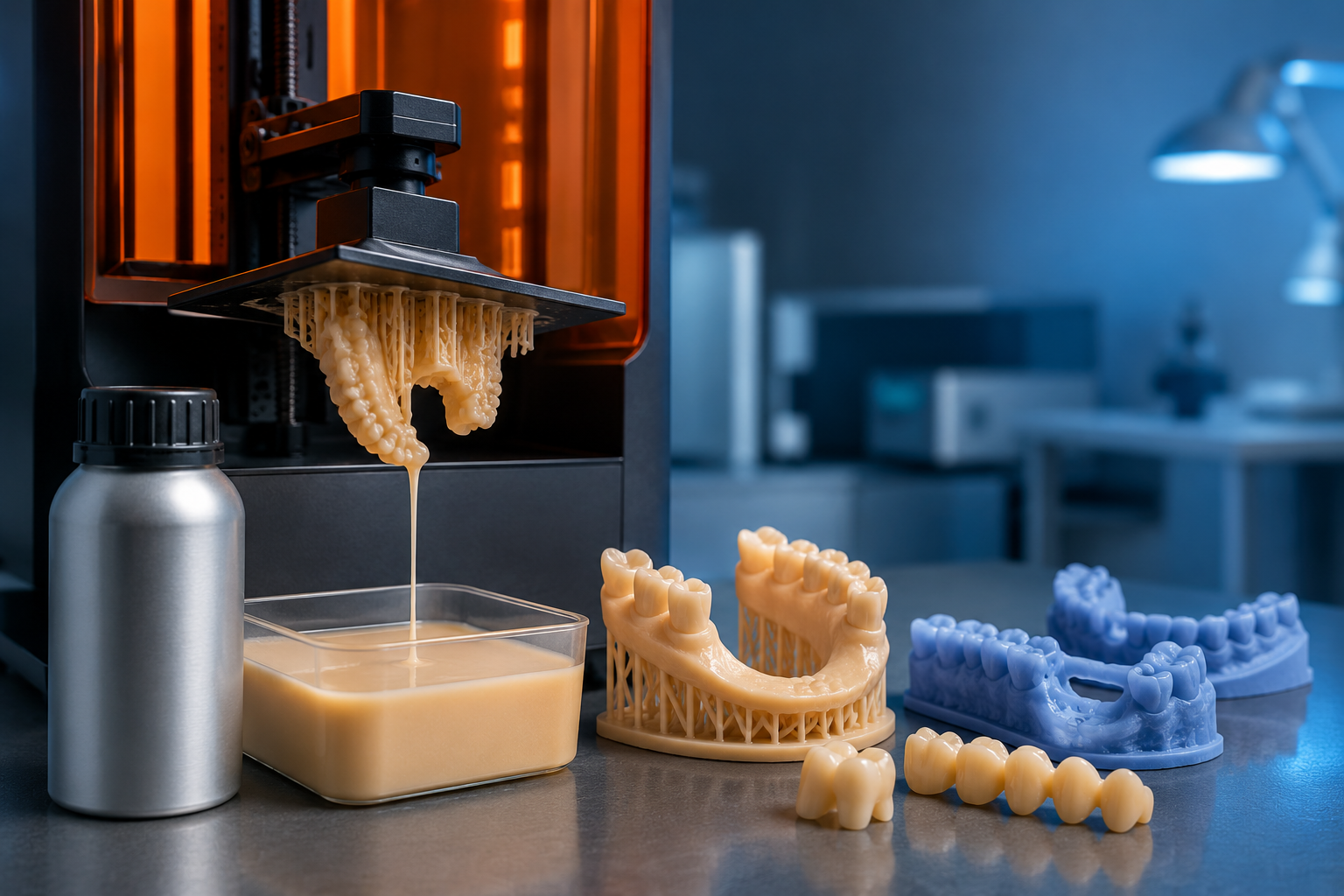
Dental 3D printing has shifted from a niche technology to a core production tool in modern dental labs. The hardware has matured, the workflows are established, and the clinical applications have expanded well beyond study models into splints, surgical guides, denture bases, orthodontic appliances, and temporary restorations. What drives the quality of every single one of those outputs is the resin its formulation, its biocompatibility, its compatibility with the printer and the application, and how consistently it performs across production batches.
Most content on dental 3D printing resin stays generic. It explains what photopolymerization is and lists application categories without giving dental labs the practical guidance they need to select the right resin for each use case, troubleshoot output quality, and build a reliable production workflow. This guide goes further — covering the material science, the application-specific selection criteria, and the production tips that separate consistent high-quality output from the variable results that plague labs working without clear resin protocols.
How Dental 3D Printing Resin Works?
Dental 3D printing resins are photopolymer materials liquid formulations that cure into solid form when exposed to UV or visible light at specific wavelengths, typically 385 nm or 405 nm depending on the printer system. The curing process is layer-by-layer: the printer projects or traces a light pattern onto a thin layer of liquid resin, solidifying it, then moves to the next layer. The accumulation of cured layers builds the three-dimensional restoration or appliance.
The clinical performance of the final part depends on three variables in the resin formulation: monomer chemistry, photoinitiator system, and filler content. The monomer chemistry determines mechanical properties hardness, flexibility, fracture resistance. The photoinitiator system determines how the resin responds to the printer's light source and exposure settings. Filler content (typically glass or silica micro-particles) increases strength, reduces polymerization shrinkage, and improves wear resistance in clinical applications.
What separates dental lab materials grade photopolymer resin from generic 3D printing resin is not just biocompatibility certification it is the precision of formulation for specific clinical applications. A resin designed for dental diagnostic models is formulated for dimensional accuracy and surface detail resolution. A resin designed for occlusal splints is formulated for hardness and polishability. A resin designed for surgical guides is formulated for sterilizability and dimensional stability under autoclave conditions. These are not the same material with a different label they are distinct formulations with distinct clinical performance requirements.
The Seven Main Application Categories and What Each Requires
Understanding resin selection requires understanding the specific demands of each clinical application. The following seven categories represent the complete range of dental 3D printing applications, each with distinct material requirements.
Diagnostic and study models
The primary requirement is dimensional accuracy the model must faithfully reproduce the anatomy captured in the digital scan, with fine detail resolution in margin areas and contact points. The resin formulation needs high rigidity after curing (to prevent distortion during articulation and crown try-in), consistent layer adhesion, and a surface that accepts die spacer without absorption. Color matters too: most labs prefer tooth-colored or stone-colored models that read clearly under direct lighting.
The dental 3d printing key mak resin from Keystone is a proven format for this application formulated specifically for dental model accuracy with the surface hardness and detail resolution that diagnostic workflows require.
For labs running high volumes of diagnostic models, the dental key model 3d printing resin delivers the same accuracy with optimized throughput characteristics — faster cure times and more predictable layer adhesion across large print beds, making it the right choice for production-volume model printing.
Surgical guides
Implant surgical guides have the most demanding biocompatibility and dimensional stability requirements of any 3D printed dental application. The guide contacts oral tissue during surgery, so it must meet ISO 10993 biocompatibility standards for short-term mucosal contact. It must be dimensionally stable enough to maintain sleeve positioning accuracy after sterilization most surgical protocols require autoclave sterilization at 121–134°C, and many resins warp or soften under these conditions. Guide resin must also be optically translucent to allow visual confirmation of guide seating against the tissue.
Occlusal splints and night guards
Splint resin must be hard enough to resist wear under occlusal forces, smooth enough to polish to a friction-reducing surface finish, and biocompatible for nightly mucosal contact. The mechanical requirement differs significantly from model resin splints need flexibility that prevents brittle fracture under clenching forces while maintaining enough hardness to resist surface abrasion.
The key splint hard resin from Keystone is formulated specifically for this balance delivering the hardness and surface polishability that CAD/CAM occlusal splint production requires, with ISO-compliant biocompatibility for extended oral contact. Labs that have switched from milled PMMA splints to printed splints using application-specific resin like Key Splint Hard report equivalent clinical outcomes with faster per-unit production times.
Denture bases
Printed denture bases require tissue-shade pigmentation, low residual monomer for long-term mucosal biocompatibility, and the dimensional accuracy to produce a base that seats correctly on the patient model without adjustment. The resin must also accept denture teeth bonding with conventional adhesive protocols and support the same repair and reline procedures used with milled PMMA bases.
The key denture base resin for dental labs is formulated for this application gingival shade pigmentation, biocompatibility documentation for long-term tissue contact, and mechanical properties that meet ISO 20795-1 requirements for denture base materials. For labs running both milled PMMA and printed denture workflows, it is worth reading our guide to the Role of Dental PMMA in Temporary and Long-Term Restorations which covers where printed resin and milled PMMA overlap and where each is the correct production choice.
Temporary crowns and bridges
Printed temporary resins must match tooth shades in the VITA range, resist the staining and surface degradation of the oral environment for the duration of the provisional period (typically 2–8 weeks), and be biocompatible for direct mucosal and occlusal contact. Unlike milled PMMA temporaries which have defined mechanical performance derived from industrial pre-polymerization printed temporaries are only as good as the post-cure protocol used. Under-cured printed temporaries have poor mechanical properties and elevated residual monomer.
Orthodontic models and appliances
Clear aligner workflows require models with exceptional surface accuracy aligner fit depends directly on model dimensional fidelity. Clear aligner and retainer applications also require transparent or translucent resin that does not discolor under oral conditions. Indirect bonding tray (IBT) resin is a separate subcategory with its own requirements: dimensional stability under bracket bonding pressure and adequate flexibility for removal without distortion.
Custom impression trays
Printed custom trays are replacing vacuum-formed trays in digital labs for final impression workflows. The resin must have adequate rigidity to resist distortion under impression material loading, sufficient edge strength to withstand removal from the mouth, and surface energy properties that allow impression material adhesive to bond reliably.
Biocompatibility: The Non-Negotiable Requirement
Every resin used for intraoral applications whether it contacts tissue directly or is in the oral cavity during function must meet ISO 10993 biocompatibility requirements for the specific contact duration and tissue type. This is not optional and it is not covered by generic 3D printing safety data sheets.
The critical distinction is between dental lab materials marketed for dental use and resins formulated for other industries that labs attempt to adapt for dental applications. A resin compliant for short-term mucosal contact (surgical guides, impression trays) may not be compliant for long-term mucosal contact (denture bases, splints). The contact category determines the required test protocols, and the resin supplier must be able to provide the specific ISO 10993 test data for the intended application.
For US dental labs, working with a domestic dental lab material supplier that stocks resins with full ISO documentation and US inventory eliminates the documentation uncertainty that comes with direct overseas sourcing. Biocompatibility certificates from offshore manufacturers are not always in a format that supports regulatory compliance in US clinical practice.
Residual monomer is the most clinically significant biocompatibility variable in printed resins. Unlike industrially pre-polymerized PMMA discs where residual monomer is driven below 0.5% during manufacturing printed resins depend entirely on the post-cure protocol to complete polymerization. An under-cured part has significantly higher residual monomer than a properly post-cured one. This is why post-cure protocol adherence is a biocompatibility issue, not just a mechanical performance issue.
Five Production Tips for Consistent Resin Output
1. Match the resin wavelength to your printer exactly.
Most dental 3D printing resins are formulated for either 385 nm or 405 nm light sources. Using a 405 nm resin in a 385 nm printer — or vice versa produces under-cure, over-cure, or inconsistent layer adhesion. Confirm wavelength compatibility before purchasing any new resin for an existing printer.
2. Post-cure to the full manufacturer specification.
Post-cure time and intensity directly determine mechanical properties and residual monomer content. Running a shortened post-cure cycle to save time produces parts with inferior properties that may not meet biocompatibility thresholds. Use a calibrated post-cure unit and follow the manufacturer's time-intensity protocol without shortcuts.
3. Control resin temperature during printing.
Photopolymer viscosity is temperature-dependent. Cold resin (below 20°C) is more viscous, which affects layer adhesion and print accuracy. Most dental resins perform best at 22–26°C. If your lab runs cold in winter months, allow resins to reach room temperature before printing and consider a temperature-controlled resin storage solution.
4. Filter and store resin correctly between uses.
Partially cured micro-particles accumulate in resin vats during printing. These particles interfere with subsequent print accuracy and can cause print failures. Filter resin back into its container through a mesh filter after every print session, seal the container against light, and store at room temperature away from UV exposure. Properly stored, opened resin maintains its properties for the manufacturer's stated shelf life.
5. Validate new batches before committing to clinical production.
Batch-to-batch variation in photopolymer resins can affect color, cure kinetics, and mechanical properties. When a new batch arrives, print a validation piece typically a standard test model or a splint form before running it for clinical cases. Compare dimensional accuracy, surface finish, and post-cure hardness against your established standard. Flag any deviation before it reaches patient-facing production.
Where Resin Fits in the Full Dental Lab Material Ecosystem?
Dental 3D printing resin and milled materials are not competing technologies they are complementary production methods with different optimal applications. Resin printing excels in applications requiring complex geometry, fast turnaround on low-strength parts, or fine surface detail on non-load-bearing restorations. Milled materials dental zirconia discs, PMMA, and lithium disilicate handle applications requiring high strength, long-term wear resistance, and definitive permanent restorations.
The practical division: print models, splints, surgical guides, custom trays, and temporaries where geometry complexity or speed favors additive manufacturing. Mill permanent crowns, bridges, and denture bases from zirconia blocks dental stock and PMMA discs where long-term mechanical performance is the clinical requirement.
For labs evaluating zirconia blank stock alongside their resin inventory or for zirconia materials distributor usa sourcing across both material categories ZirconiaGuys carries Keystone dental resins alongside a full range of dental zirconia discs, zirconia dental blanks, and zirconia blocks from Upcera and Aidite, all from US inventory. Consolidating resin and zirconia supply through a single domestic source simplifies ordering, ensures consistent documentation, and eliminates the lead time variability of multi-vendor procurement.
Selecting the right resin for each dental application is not a minor procurement detail it is a clinical quality decision that affects biocompatibility, dimensional accuracy, mechanical performance, and patient outcomes on every case your lab produces from a 3D printer. The application-specific formulation principle is the core principle: there is no single dental resin that performs optimally across all applications, just as there is no single grade of dental zirconia that covers every restoration indication.
Build your resin inventory around application categories, validate each new product and batch before clinical production, and source from suppliers who provide the documentation that US dental labs need to maintain regulatory compliance.


