

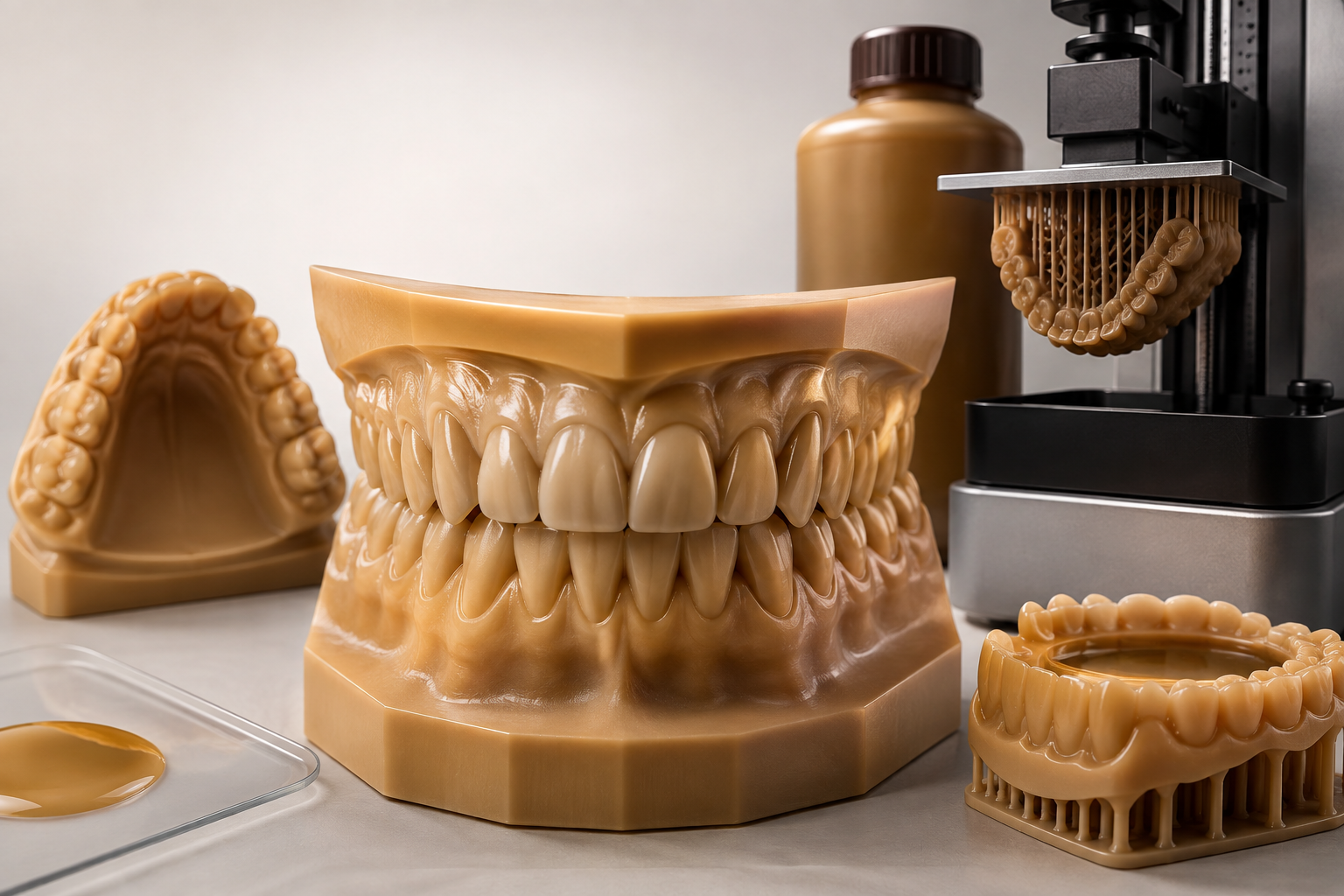
Full-arch dental models must accurately reproduce the patient's anatomy with clear visibility of tooth contours, margins, contact points, gingiva, and occlusal surfaces after printing. The choice of model resin affects how easily labs can inspect and work with the model.
A suitable resin should provide consistent detail, stability, a good surface finish, and easy handling. Color matters too, as strong contrast helps identify margins and features during inspection.
Zirconia Guys offers dental lab materials designed to support different stages of digital dental production. Its range includes Whip Mix VeriMODEL Golden Brown, a model resin intended for dental model applications where accuracy, detail, and visual definition are important.
What Should a Dental Model Resin Deliver in Full-Arch Cases?
A full-arch model should accurately depict the entire arch, not just individual teeth. Loss of detail or inconsistency hampers inspection and lab work.
When evaluating a dental model resin, laboratories should consider several practical factors:
- Dimensional accuracy: The printed model should closely reproduce digital design.
- Fine detail: Margins, contacts, anatomy, and preparation of surfaces should remain clearly defined.
- Surface quality: A clean surface makes inspection easier and can reduce unnecessary finishing.
- Consistency: The material should produce predictable results across repeated cases.
- Handling: Full-arch models need enough toughness for routine laboratory use.
- Printer compatibility: The resin should match the laboratory's printer and validated processing workflow.
These traits are important when choosing dental lab materials for models across multiple production stages.
A model isn't just a visual copy of a scan; it acts as a reference for design verification, restoration, occlusal evaluation, and communication. Its quality affects how confidently technicians interpret its information.
How Does VeriMODEL Golden Brown Support Full-Arch Model Accuracy?
The VeriMODEL All-Purpose range provides high-quality surface finish and precision for dental models, ideal for accurate working and presentation in crown, bridge, prosthetics, and orthodontics.
For full-arch applications, this precision is crucial because the model has multiple areas aligning with the digital design.
A useful dental model resin should help reproduce:
- Preparation finish lines
- Tooth morphology
- Gingival contours
- Occlusal anatomy
- Interproximal areas
- Arch form
- Contact relationships
For a technician, accurate reproduction provides reliable references. Poorly defined margins or distorted areas may need extra interpretation before production.
This is why high-contrast dental model resin should not be evaluated solely on color. The resin must first provide the underlying dimensional and surface accuracy required for the model's intended use.
Why Does Model Color Matter for Dental Model Inspection?
Color is often overlooked when labs compare model materials, but it affects how easily surface features are read.
The Golden-Brown variant has a darker, warm color that creates visual contrast against restorative materials. Whip Mix describes it as providing bold contrast that aids detailed viewing of margins and anatomy.
This makes high-contrast dental model resin useful for technicians inspecting small or closely spaced features.
The contrast can help make areas such as:
- Preparation margins
- Gingival anatomy
- Occlusal surfaces
- Contact areas
- Tooth contours
Easier to distinguish.
The benefit is especially relevant to full-arch models as multiple teeth and structures are viewed together. Clear separation between the model and other materials simplifies inspection.
VeriMODEL Golden Brown vs VeriMODEL Grey: Which Model Resin Fits Your Workflow?
The VeriMODEL range includes Golden Brown, Grey, and Ivory variants. The manufacturer lists the same 385/405nm DLP and LCD compatibility for the All-Purpose range.
The primary difference between Whip Mix VeriMODEL Golden Brown and Whip Mix VeriMODEL Grey is the visual presentation of the finished model.
| Consideration | VeriMODEL Golden Brown | VeriMODEL Grey |
|---|---|---|
| Color | Golden brown | Grey |
| Visual character | Warm, darker appearance | Neutral appearance |
| Contrast | Strong contrast with lighter restorative materials | Neutral contrast |
| Margin inspection | Well suited to contrast-focused inspection | Suitable for general model inspection |
| Main consideration | Visibility of margins and anatomy | Preference for a neutral model appearance |
Choosing between Whip Mix VeriMODEL Golden Brown and Grey depends on the lab's inspection environment and model type.
How Should Technicians Handle and Post-Process Full-Arch Models?
Even high-quality resin needs proper printing and post-processing. Full-arch models are large, so support for placement, orientation, cleaning, and curing are important.
A practical workflow includes:
- Confirm printer compatibility: Verify that the printer and resin are compatible with the required wavelength.
- Prepare the digital file: Check the arch, margins, bases, and other model features before slicing.
- Choose the printing orientation: Position the model to support the required detail while managing supports appropriately.
- Print using validated parameters: Follow the resin and printer manufacturer's recommended settings.
- Wash the model correctly: Remove uncured resin according to the established laboratory procedure.
- Post-cure as specified: Follow the recommended curing process to achieve the intended material properties.
- Inspect the finished model: Check margins, anatomy, surface quality, and any areas affected by support.
Handling after post-processing is important. Full-arch models can be transferred or reused, so avoid unnecessary force.
Good processing practices are as vital as choosing the right dental lab materials. A good resin can't be made up for incorrect exposure, washing, curing, or support of placement.
How Does Model Resin Differ from Other Dental Printing Resins?
Different dental printing materials are developed for different applications. A model resin should not be selected simply because another resin works successfully on the same printer.
For example, Whip Mix VeriSplint Clear is intended for rigid dental splints and protective appliances rather than model production. The product information specifically distinguishes VeriSPLINT from dedicated model resins. For a full comparison of VeriSPLINT Clear against other rigid splint resins, see VeriSPLINT Clear vs KeySplint Hard Clear: What Is the Difference?
This distinction is important when evaluating a dental splint printing resin. Splint materials need properties appropriate for their intended appliance application, while model materials need to reproduce anatomy and dimensions accurately.
Similarly, clear night guard resin is selected to produce night guards and should be assessed according to its specific intended application. It should not automatically be substituted for a model resin.
Where Does Model Resin Fit in a Digital Dental Laboratory Workflow?
A printed model is one part of a wider digital production process. A laboratory may move from scanning and CAD design to model printing, restoration design, milling, finishing, and quality control. This means dental lab materials need to be selected according to the role they perform at each stage.
For example, resin supports physical model production, while zirconia blocks are used for milling restorations. Zirconia blocks dental must meet specific strength, translucency, shade, and milling needs.
A zirconia blank is therefore evaluated differently from a printed model material. The same applies to zirconia dental blanks, which are intended for restorative manufacturing rather than model fabrication.
Dental zirconia discs are another part of the CAD/CAM restorative workflow. They may be used to mill crowns, bridges, or other restorations, while model resin supports physical model production, zirconia blocks dental laboratories use are generally part of the restorative milling stage.
Separating these material categories helps labs select suitable dental materials for each stage and reduces the risk of using products outside their intended application.
How Should Laboratories Choose a Resin for Full-Arch Models?
Laboratories comparing Whip Mix Verimodel Grey with other model resins should also consider color preference alongside accuracy, detail, and printer compatibility.
Before selecting a material, technicians can review:
- Printer compatibility: Confirm the required DLP or LCD system and wavelength.
- Accuracy: Check whether the material is designed for precise model production.
- Detail: Look for clear reproduction of margins and anatomy.
- Surface finish: Consider how easily the finished model can be inspected.
- Colour: Determine whether greater contrast would benefit the workflow.
- Handling: Consider how the model will be used and moved after printing.
- Post-processing: Review the washing and curing requirements.
- Application: Make sure the resin is intended for the type of model being produced.
For full-arch work, a high-contrast dental model resin can be particularly useful when visual inspection of margins and anatomy is an important part of the workflow.
Making Full-Arch Model Production More Predictable
Full-arch models need to provide a reliable physical representation of the digital case. Accuracy, surface detail, visual contrast, and appropriate handling all contribute to the usefulness of the finished model.
Whip Mix VeriMODEL Golden Brown is designed specifically for dental model production, with the manufacturer highlighting precision, detailed surfaces, sharp margins, and strong visual contrast with restorative materials. It is compatible with DLP and LCD printers using 385/405nm wavelengths.
For laboratories, the choice of dental lab materials should always follow the intended application. Model resins, splint materials, night guard materials, and restorative products such as dental zirconia each serve different purposes.
Zirconia Guys supplies dental lab materials for digital dental workflows, including VeriMODEL Golden Brown and other CAD/CAM materials. Its range includes model resins, zirconia blocks, zirconia dental blanks, and dental zirconia discs, giving laboratories access to materials used at different stages of production.


