

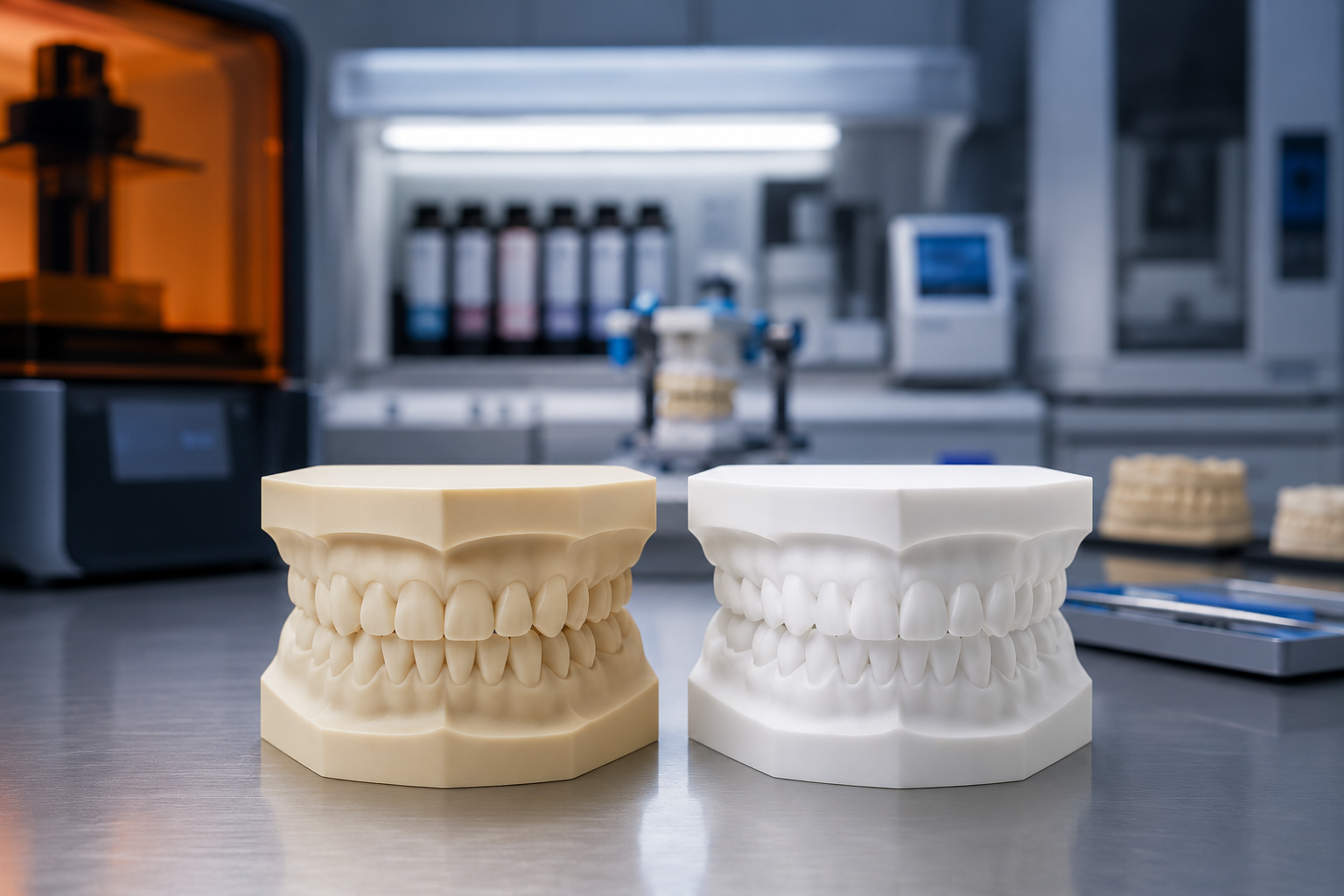
Orthodontic model resin is one of the most technically demanding categories in dental 3D printing not because the applications are clinically complex, but because the tolerance for dimensional error is extremely low. A model used for clear aligner thermoforming must reproduce tooth anatomy accurately enough that the aligner seats without distortion. A model used for indirect bonding tray fabrication must maintain bracket positioning to within fractions of a millimeter. A model used for patient records must be detailed enough to read margin lines and contact points clearly under magnification. The resin that produces all of these results reliably, batch after batch, is not simply any photopolymer that cures white.
Two products that labs consistently compare for orthodontic model production are Key Ortho Model resin from Keystone Industries and VeriModel Ortho White from Whip Mix. Both are formulated specifically for dental orthodontic applications. Both are available from US inventory. And both serve the orthodontic model category but with different formulation priorities, different handling characteristics, and different ideal use cases. This guide gives labs a clear framework for deciding which one belongs in their workflow.
What Orthodontic Model Resin Actually Needs to Deliver?
Before comparing the two products, it is worth being precise about what performance requirements a dental ortho model 3d resin must satisfy because not all labs use ortho models for the same applications, and the application determines which properties matter most.
Dimensional accuracy
The model must reproduce the digital scan geometry faithfully. Any dimensional deviation warping, shrinkage, or inconsistent layer adhesion translates directly into aligner misfit or IBT bracket position error. This is the most critical property for any orthodontic model resin and the first criterion to evaluate.
Surface detail resolution
Brackets bond to tooth surfaces. Aligners form against tooth contours. Both require a resin that prints fine anatomical detail interproximal contacts, marginal ridges, gingival contours without artifacts or surface roughness that obscure the anatomy the lab is working from.
Surface hardness
Ortho models are handled repeatedly during aligner thermoforming, IBT fabrication, bracket placement, and patient record review. A resin that is too soft scratches easily and loses surface quality over repeated handling. The model needs to remain dimensionally stable and surface-intact through its functional lifespan.
Color and contrast
White or off-white models provide the contrast needed to read margin lines, check contact points, and photograph cases for records. A model that is too translucent, too yellow, or inconsistently pigmented makes clinical evaluation and photography difficult.
Post-cure stability
Models that warp or dimensionally shift after post-cure or that continue to change over the following 24–48 hours cannot be trusted for aligner thermoforming or IBT fabrication. Dimensional stability through and after the full post-cure cycle is essential.
Key Ortho Model Resin: What It Is and Where It Performs
Key Ortho Model is Keystone's dedicated formulation for orthodontic model printing. It is engineered for open-system compatibility across MSLA and DLP platforms operating at 385 nm or 405 nm, and it is specifically designed for the dimensional accuracy requirements of aligner and IBT workflows.
The formulation prioritizes a tight dimensional tolerance the printed model reproduces scan geometry with minimal shrinkage and consistent layer adhesion from the base of the model to the incisal tips of the anterior teeth. For labs running high-volume clear aligner workflows where every model feeds directly into thermoforming, this consistency is the property that determines production reliability.
The key ortho model resin for braces is widely used in orthodontic labs specifically because the bracket positioning accuracy in IBT applications is well-documented and consistent with the tolerance requirements of indirect bonding protocols. Labs that have validated the product for IBT report that bracket transfer accuracy meets clinical requirements without requiring supplementary position verification steps.
Key Ortho Model prints in a white formulation that provides clear contrast for margin reading and clinical photography. Surface hardness after full post-cure is sufficient for repeated handling across a standard aligner series typically 20–40 thermoforming cycles for a full aligner case.
Key Ortho Model performance summary:
- Dimensional accuracy: High validated for aligner thermoforming and IBT
- Surface detail: High fine interproximal anatomy reproduced cleanly
- Surface hardness: Good handles repeated thermoforming without surface degradation
- Color: Bright white high contrast for photography and margin reading
- Post-cure stability: Stable minimal post-cure dimensional shift
- System compatibility: Open system, 385/405 nm
VeriModel Ortho White: What It Is and Where It Performs?
VeriModel Ortho White is Whip Mix's orthodontic model resin, part of their VeriModel range of dental diagnostic model photopolymers. Like Key Ortho Model, it is formulated for orthodontic applications on open-system printers at 385/405 nm wavelengths.
Where VeriModel Ortho White differentiates itself is in its surface texture and finish characteristics. The formulation produces a smooth, matte-white surface that reads anatomical detail with exceptional clarity particularly useful for labs where patient record photography is a significant output requirement, and for orthodontists who review models under magnification for treatment planning. The matte surface reduces light glare during photography and under examination lighting, making surface anatomy easier to evaluate than the slightly reflective surface of some competitive resins.
The orthodontic model resin from Whip Mix also benefits from the established clinical validation that Whip Mix has conducted across its VeriModel product range. Labs working in practices that specify Whip Mix materials system-wide will find VeriModel Ortho White integrates naturally into their existing resin protocols.
VeriModel Ortho White performance summary:
- Dimensional accuracy: High consistent with aligner and IBT requirements
- Surface detail: Very high matte finish enhances anatomical readability
- Surface hardness: Good handles standard orthodontic lab workflows
- Color: Matte white reduced glare, excellent for photography
- Post-cure stability: Stable
- System compatibility: Open system, 385/405 nm
Side-by-Side Comparison
| Property | Key Ortho Model | VeriModel Ortho White |
|---|---|---|
| Manufacturer | Keystone Industries | Whip Mix |
| Primary application | Aligner thermoforming, IBT | Aligner thermoforming, records, photography |
| Dimensional accuracy | High IBT validated | High aligner validated |
| Surface finish | Bright white, slight sheen | Matte white, reduced glare |
| Surface detail | High | Very high |
| Photography quality | Good | Excellent preferred for records |
| Hardness | Good | Good |
| Post-cure stability | Stable | Stable |
| Wavelength | 385/405 nm | 385/405 nm |
| Open system | Yes | Yes |
| US inventory | Yes ZirconiaGuys | Yes ZirconiaGuys |
The direct comparison reveals that these are two products with similar technical specifications but different formulation strengths. Key Ortho Model has the edge in IBT bracket positioning documentation and high-volume production consistency. VeriModel Ortho White has the edge in surface finish quality for photography and anatomical readability under examination.
For a deeper understanding of how ortho model resin fits within the full dental 3D printing resin ecosystem alongside surgical guide resins, splint resins, and temporary crown resins the guide to Resin for Dental 3D Printing: Uses, Types, and Tips covers material selection across all application categories in detail.
Which One Should Your Lab Choose?
The selection framework depends on what your lab primarily uses orthodontic models for. There is no universally superior product there is the product that best fits your specific production workflow.
Choose Key Ortho Model if:
Your primary ortho model application is indirect bonding tray fabrication. IBT accuracy depends on bracket positioning relative to the printed tooth geometry Key Ortho Model's dimensional tolerance and surface hardness are specifically validated for this workflow. If your lab produces IBTs at volume and remake rates from bracket position error are a concern, Key Ortho Model is the more defensible choice.
Your workflow involves high-volume aligner series production where model-to-model consistency across a full case (24 or 48 aligner steps) matters more than individual model surface finish quality. Production consistency across large print runs is where Key Ortho Model's formulation stability is most valuable.
As a key ortho model resin supplier, ZirconiaGuys stocks Key Ortho Model from US inventory with full batch documentation available on request relevant for labs maintaining material traceability records for their orthodontic workflows.
Choose VeriModel Ortho White if:
Your primary ortho model application is patient record photography and treatment planning review. The matte white surface of VeriModel Ortho White is meaningfully better for photography reduced glare, higher surface detail readability, and a more clinically professional appearance in case documentation. For orthodontic practices that use printed model photography as a standard of care documentation tool, this matters.
Your lab works with orthodontists who review models directly under examination lighting. The matte finish reads anatomical detail more clearly under overhead lighting than a reflective surface contact points, marginal ridges, and axial contours are more easily assessed without the light scattering that a bright, slightly reflective white surface produces.
Choose both if:
Your lab serves both orthodontists who prioritize IBT accuracy and practices that emphasize photographic documentation. Stocking both products and using each in its optimal application is a legitimate production decision the per-disc cost difference does not justify using a record photography model for an IBT case, or vice versa.
Workflow Tips That Apply to Both Products
Regardless of which ortho model resin you select, the following workflow principles apply across both products and determine whether your printed models meet the dimensional and surface quality standards ortho workflows require.
Validate your exposure settings per batch.
Photopolymer batch variation affects cure kinetics. When a new batch arrives, print a validation model and verify dimension against your CAD reference before committing it to patient production. A 0.1 mm dimensional deviation per tooth is clinically significant in an aligner workflow.
Orient models at 15–25 degrees to the build platform.
Flat base printing maximizes the peel force on model bases, which causes warping in large flat sections. A slight angle reduces peel stress and produces more consistently flat model bases that articulate correctly.
Post-cure to full specification.
Under-cured ortho models have lower surface hardness and are more susceptible to distortion under thermoforming pressure. Run the full post-cure cycle specified by the manufacturer for both Key Ortho Model and VeriModel Ortho White, this is the step most commonly shortened with the most direct impact on model dimensional stability.
Store resins at 22–26°C and away from UV.
Cold resin produces higher viscosity, which affects layer uniformity and surface quality. Resin stored in a temperature-controlled environment away from ambient UV light maintains consistent performance across its shelf life.
Sourcing Ortho Model Resin in the US
For US dental labs, domestic inventory availability eliminates the lead time and batch variability associated with international sourcing. The dental ortho model 3d resin range from Keystone and the VeriModel range from Whip Mix are both stocked at ZirconiaGuys from US inventory — same-day shipping on in-stock items, full batch documentation on request, and consistent supply for labs running ortho model production at any volume.
Labs that also run zirconia restoration workflows alongside their orthodontic resin production can consolidate supply through ZirconiaGuys stocking dental zirconia discs, zirconia blocks dental, zirconia blank formats, and zirconia dental blanks from Upcera and Aidite alongside the full Keystone and Whip Mix resin ranges. Consolidating zirconia blocks and resin supply through a single US distributor reduces ordering overhead and simplifies the documentation management that quality-managed dental labs maintain across their full material inventory.
The choice between Key Ortho Model and VeriModel Ortho White is not a decision about which product is technically superior both are well-formulated, clinically validated ortho model resins that perform well in their intended applications. It is a decision about which product best matches what your lab actually uses ortho models for: IBT and high-volume aligner production favor Key Ortho Model's consistency and bracket accuracy documentation; record photography and treatment planning review favor VeriModel Ortho White's matte surface and anatomical readability.
Run your own validation before committing either product to full clinical production. Print a test model, check dimensions against your CAD reference, evaluate surface finish under your lab's examination conditions, and photograph the result. The product that produces the result you need in your specific workflow is the correct choice regardless of what any comparison guide recommends.


