

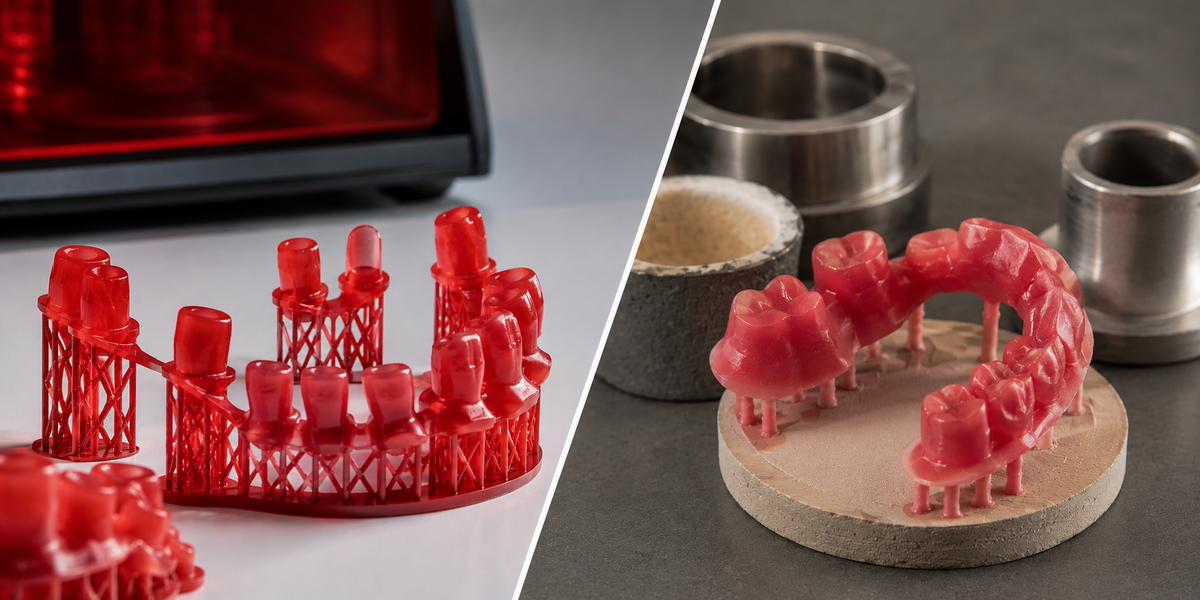
The lost-wax casting process has been the backbone of metal dental restorations for over a century. Its logic is elegant: carve or press a pattern in wax, invest it in refractory material, burn out the wax to leave a precise void, and cast molten metal into that void. The accuracy of the final casting depends entirely on how faithfully the burnout void reproduces the original pattern geometry which means the accuracy of the casting is only as good as the accuracy of the pattern.
Traditional wax patterns have served this process reliably, but they carry limitations that every experienced dental casting technician knows: dimensional distortion from handling and temperature, wax-to-wax attachment inconsistencies in complex frameworks, variable burnout residue if firing profiles are not precise, and the fundamental limitation that wax patterns are fabricated by hand making their accuracy dependent on technician skill and the quality of the dies they are carved on. The question facing dental labs evaluating digital workflows is whether 3D printed castable resin can improve on these limitations and specifically, whether VeriCAST Red from Whip Mix delivers the casting accuracy that clinical restorations demand.
What VeriCAST Red Is and How It Works?
VeriCAST Red is a photopolymer resin formulated by Whip Mix specifically for the lost-wax casting workflow in dental laboratories. It is designed to be printed on MSLA or DLP 3D printers at 385 nm or 405 nm wavelength, then invested and burned out using the same phosphate-bonded investments and furnace cycles used for conventional wax patterns with modifications to the burnout profile to accommodate the different thermal decomposition characteristics of photopolymer resin versus carving wax.
The resin is colored red specifically to distinguish it visually from other dental resins in the lab a practical design decision that prevents confusion between castable resin and model, splint, or guide resins that are not suitable for investing and casting. The red coloration also makes the sprued pattern easy to inspect against the white investment surface during the investing step.
The vericast red resin is available from ZirconiaGuys from US inventory same-day shipping on in-stock items, with no international lead times for US dental labs.
Dimensional Accuracy: Printed Resin vs Hand-Carved Wax
This is the central comparison for any lab evaluating the switch from wax to printed castable resin. Dimensional accuracy in the final casting depends on three sequential variables: pattern accuracy, investment expansion, and casting shrinkage. VeriCAST Red affects the first variable pattern accuracy and is neutral on the second and third, which are determined by investment selection and alloy characteristics.
Pattern accuracy from wax: A hand-carved wax pattern on a die reproduces the preparation geometry through the skill of the technician. An experienced waxer working on a well-articulated model produces patterns with excellent marginal adaptation. The limitation is consistency wax patterns vary between technicians, between sessions, and in response to handling temperature. Wax softens at room temperature when handled for extended periods. Reattachment of wax sprues creates joints that are mechanically weaker than the pattern itself. In complex multi-unit frameworks, the dimensional accumulation of small wax-handling distortions across a long-span bridge can produce measurable discrepancy at the terminal abutment.
Pattern accuracy from VeriCAST Red: A digitally designed and printed pattern derives its geometry from the CAD file which is dimensionally fixed regardless of who prints it, when it is printed, or how it is handled after printing. The CAD design applies consistent offsets for casting shrinkage, investment expansion, and marginal gap specification across every unit in the case. The printed pattern does not soften at room temperature. Sprue attachment is designed in CAD and printed as an integral part of the pattern rather than attached manually. In multi-unit frameworks, the terminal abutment pattern has the same geometric accuracy as the first abutment pattern there is no accumulation of handling distortion.
The marginal accuracy of printed castable resin patterns, when the printer is properly calibrated and the resin is printed at validated parameters, consistently matches or exceeds hand-carved wax for marginal gap at the critical casting margin the area where fit accuracy most directly affects clinical outcome.
Burnout Behavior: The Critical Difference
Wax and photopolymer resin do not behave identically during the investment burnout cycle, and this difference is where most casting failures occur when labs transition from wax to printed resin without adjusting their burnout protocol.
Traditional carving wax begins flowing and evaporating at 60–70°C and is completely eliminated from the investment by 400–450°C in a conventional burnout. The residue from wax burnout is minimal primarily carbon that oxidizes cleanly in a well-vented furnace.
Photopolymer resin has a different thermal decomposition profile. It does not flow like wax it pyrolyzes, decomposing into volatile organic compounds that must evacuate through the investment. If the burnout cycle ramps too quickly through the pyrolysis temperature range, the resin decomposes faster than the gases can escape, creating internal pressure that fractures the investment or leaves residue in the mold that contaminates the casting.
The validated burnout protocol for burnout resin whip mix vericast requires a slow ramp through the pyrolysis zone typically holding at an intermediate temperature of 250–350°C before continuing to peak burnout temperature. The specific protocol is published by Whip Mix and should be followed exactly. Labs that attempt to run VeriCAST Red on a standard wax burnout cycle without the intermediate hold produce consistently inferior castings porosity, incomplete burnout residue, or investment fracture. Labs that follow the validated protocol produce clean investment molds that cast as reliably as wax.
Investment Compatibility
VeriCAST Red is compatible with standard phosphate-bonded investment systems used for metal dental casting the same investments used for conventional wax pattern casting. This is a significant practical advantage: labs do not need to purchase new investment materials or recalibrate their expansion compensation systems when transitioning from wax to printed resin.
The investment expansion required to compensate for casting shrinkage is the same whether the pattern is wax or resin it is determined by the alloy, not the pattern material. Labs calibrated for a specific alloy-investment combination can continue using the same liquid-to-powder ratio and mixing technique with VeriCAST Red patterns.
For more context on how printed resins fit into the broader dental lab material workflow including biocompatibility, application categories, and production tips the guide to Resin for Dental 3D Printing: Uses, Types, and Tips covers the full photopolymer selection framework across dental lab applications.
Workflow Efficiency: Where Printed Resin Gains the Most
The accuracy comparison is close both methods, done correctly, produce castings with clinically acceptable fit. The efficiency comparison is where printed castable resin creates the clearest workflow advantage for most dental labs.
Design time vs carving time: Wax carving requires direct manual labor on every pattern. A full-arch framework waxed by hand requires a skilled technician's time at the bench for the full duration of the waxup. A CAD-designed framework is designed once on-screen and reproduced exactly across any number of cases. For multi-unit cases, digital design is consistently faster than wax carving once the lab's digital workflow is established.
Consistency across cases: Every printed pattern is geometrically identical to the CAD design. There is no session-to-session variation in how a technician's hands felt that day, how the wax temperature varied, or how long the pattern sat before investing. This consistency translates directly into more predictable fit and reduced try-in adjustment time at delivery.
Complex geometry: Printed resin excels in geometrically complex restorations full-arch frameworks, precision attachment housings, complex substructures where hand carving is time-intensive and error-prone. The printer does not get tired and does not make mistakes from manual fatigue.
Remake risk: Wax pattern distortion during handling the most common source of remakes in traditional casting workflows is eliminated with printed patterns. A dropped wax pattern is potentially deformed. A dropped printed resin pattern is structurally unchanged.
For dental resin 3d printing workflows, the efficiency gains from printed castable resin compound significantly across a month's production particularly for labs producing multi-unit cases where wax carving time is the primary labor cost in the casting workflow. Labs running Keystone splint resins, model resins, and VeriCAST Red from a single supplier simplify procurement without splitting their resin inventory across multiple vendor relationships.
Where Traditional Wax Retains Advantages?
A complete comparison requires honesty about where wax still has a legitimate edge.
Rapid chairside modification.
If a framework is returned from casting and requires minor adjustment before soldering or finishing, a wax addition is faster than reprinting a revised pattern. For labs where iterative clinical feedback during framework try-in drives modifications before final casting, wax remains more flexible for rapid design changes.
Low investment in equipment.
A wax carving workflow requires no printer, no post-cure unit, and no digital design software. For small labs producing low volumes of cast restorations, the capital investment in a digital casting workflow may not be justified by the volume of cases produced.
Established technician skill.
Labs with highly experienced waxers who produce consistent, accurate patterns do not have an obvious quality problem that digital printing solves. The efficiency gains are real, but they are gained incrementally rather than dramatically in a lab already running a smooth wax carving operation.
For labs already familiar with whip mix dental products across their casting and investment workflows, the transition to VeriCAST Red printed patterns is a natural extension of an existing supplier relationship rather than an entirely new procurement decision. The investment system compatibility means no new materials need to be qualified before the first printed casting case.
Practical Transition Guidance for Labs Moving from Wax to VeriCAST Red
If your lab is evaluating the transition from traditional wax patterns to printed castable resin, the following sequence produces the most reliable validation results.
Start with single-unit cases before transitioning multi-unit frameworks. Single crowns are the lowest-complexity validation print, invest, cast, evaluate fit on the model and at try-in. Validate the burnout protocol using the Whip Mix published cycle before your first case.
Run the first five printed cases alongside your standard wax workflow cast both for the same case type and compare fit outcomes. This parallel validation gives you direct comparison data from your specific lab setup rather than relying on published specifications alone.
Document the printer parameters, post-cure protocol, and burnout cycle that produced acceptable results, and lock those parameters as your validated protocol before scaling to full production volume. Parameter drift changing exposure time, post-cure duration, or burnout hold temperatures without formal revalidation is the most common cause of inconsistent results after an initially successful validation.
VeriCAST Red does not replace traditional wax pattern casting as a clinical outcome the final casting accuracy, when both methods are executed correctly, is comparable. What it replaces is the variability, labor intensity, and geometric limitation of hand carving. For dental labs producing complex restorations at production volume, the consistency and efficiency gains of printed castable resin patterns represent a meaningful operational improvement over traditional wax workflows.
The transition requires investment in equipment, protocol validation, and technician training but it is a one-time investment that pays across every casting case the lab produces thereafter. Sourcing vericast red resin, dental zirconia discs, zirconia dental blanks, and zirconia blocks from a single US distributor means consistent batch documentation and no supply chain uncertainty across your full production material range. Zirconia blocks dental and zirconia blank stock alongside castable resin from the same supplier eliminates the multi-vendor ordering complexity that most full-service labs deal with when running both digital casting and CAD/CAM milled restoration workflows.


