

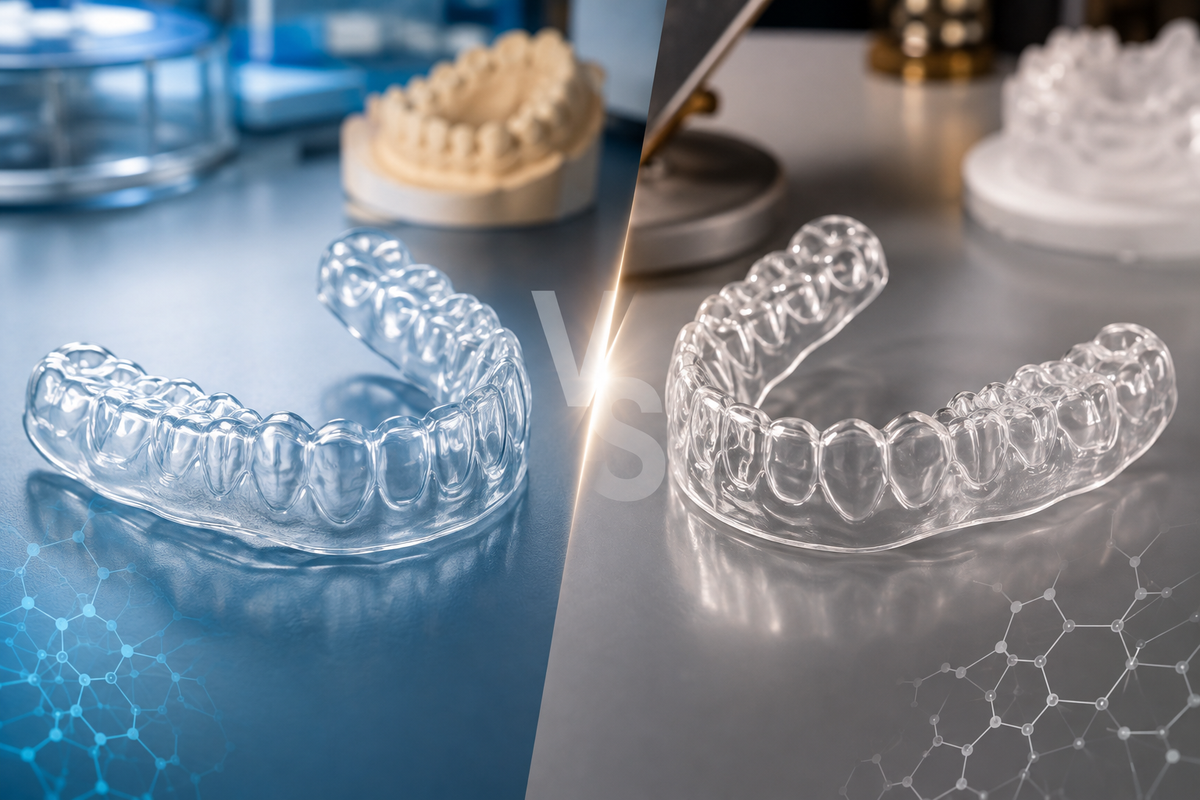
Choosing a clear night guard resin is crucial for dental labs shifting to digital workflows. The resin needs to balance rigidity, durability, clarity, biocompatibility, print compatibility, and post-processing efficiency. Since formulations and printer systems vary, it's better to compare materials based on their intended use than a single specification.
KeySplint Hard Clear and VeriSPLINT Clear are both for rigid dental splints and night guards, but they differ in printer compatibility and workflow. Knowing these helps labs choose the right material for their equipment, case volume, and needs.
Zirconia Guys supplies dental lab materials for dental professionals and laboratories in the U.S., including digital materials for modern CAD/CAM workflows. Its selection provides laboratories with access to products such as KeySplint Hard Clear for their appliance production requirements.
KeySplint Hard Clear vs. VeriSPLINT Clear at a Glance
Both materials are intended for rigid intraoral appliances, but their specifications and validated workflows should be reviewed before stocking either resin.
KeySplint Hard Clear is a biocompatible photopolymer for rigid dental splints and night guards, suitable for bite planes, mouthguards, night guards, splints, repositions, and retainers, designed for DLP printing at 385-405 nm.
VeriSPLINT Clear is also designed specifically for bite guards, dental splints, and occlusal night guards. Whip Mix states that it is FDA 510(k)- cleared, fully transparent, polishable, and compatible with DLP printers at 385 nm.
| Feature | KeySplint Hard Clear | VeriSPLINT Clear |
|---|---|---|
| Primary use | Rigid splints and night guards | Bite guards, splints and occlusal night guards |
| Material type | Biocompatible photopolymer resin | Biocompatible 3D-printing resin |
| Appearance | Clear | Clear |
| Printer compatibility | Selected 385/405 nm systems | DLP printers featuring 385 nm |
| Post-processing | Requires validated washing and post-curing | Requires validated post-processing |
| Main workflow consideration | Broad printer validation | Splint-focused workflow |
What Makes KeySplint Hard Clear Suitable for Night Guards?
KeySplint Hard Clear is designed for rigid dental devices such as splints and night guards, emphasizing strength, durability, and shape stability. It is biocompatible, abrasion-resistant, and easy to polish.
For a laboratory evaluating a clear night guard resin , important considerations include:
- Rigidity for occlusal applications
- Resistance to wear
- Clear appearance
- Ability to polish the finished appliance
- Validated printer compatibility
- Required post-curing workflow
- Biocompatibility documentation
The material is available in a clear 1 kg bottle, with the manufacturer identifying product code 4220011 for the 1 kg clear formulation.
Its printer validation is broad. Manufacturer resources list KeySplint Hard Clear for systems from Asiga, SprintRay, Nexa, Phrozen, Anycubic, and others, though validated settings vary by model.
What Makes VeriSPLINT Clear Different?
Whip Mix designs VeriSPLINT Clear for digital production of bite guards, dental splints, and occlusal night guards, emphasizing rigidity, durability, transparency, polish ability, and biocompatibility.
For labs with compatible equipment, the material enables efficient splint production. Whip Mix says its full-build platform can produce up to four splints in under an hour.
When evaluating Whip Mix Verisplint Clear , labs should therefore consider:
- Existing printer wavelength
- Validated printer settings
- Expected number of splints per build
- Post-processing requirements
- Appliance design and indication
- Material availability
- Cost per finished appliance
This makes Whip Mix Verisplint clear particularly relevant for laboratories that already use compatible Whip Mix workflows or want a resin specifically positioned around efficient splint production.
How Do Their Printer Workflows Compare?
Check printer compatibility before stocking clear night guard resin. Even if the resin suits the application, it may be unsuitable for a specific printer if the wavelength, settings, build platform, or curing system aren't validated.
KeySplint Hard Clear is compatible with several 385 nm and 405 nm systems, such as Asiga MAX at 385 nm and SprintRay Pro at 405 nm, with specific settings on printer pages.
VeriSPLINT Clear is listed by Whip Mix for DLP printers featuring 385 nm technology. Before purchasing either material, laboratories should confirm:
- Printer model
- Wavelength
- Layer height
- Validated exposure settings
- Wash system
- Post-cure equipment
- Manufacturer-approved workflow
This step is more important than simply choosing a clear night guard resin based on price or appearance.
Which Resin Fits a High-Volume Dental Lab?
For high-volume labs, material choice involves more than resin prices. Factors such as throughput, compatibility, post-processing, consistency, and remakes affect actual costs.
VeriSPLINT Clear enables rapid production, with Whip Mix reporting up to four splints in under an hour.
KeySplint Hard Clear appeals to labs with multiple validated printers, offering flexibility across digital equipment. Its manufacturer provides validation info for various systems.
A laboratory should compare:
- Cost per printed appliance
- Build capacity
- Print time
- Post-processing time
- Printer availability
- Resin shelf life
- Remake frequency
The best clear night guard resin supports the entire production process, not just the lowest material cost.
Does Clear Appearance Matter Patient-Facing Appliances?
Yes. Transparency can influence how patients perceive a night guard, especially when they want an appliance that is less noticeable during wear.
Both materials are designed as clear formulations. KeySplint Hard Clear is the clear version of the KeySplint Hard family, while VeriSPLINT is marketed as fully transparent.
Final appearance depends on more than the liquid resin; printing parameters, orientation, washing, curing, surface finishing, and polishing also affect the finished appliance.
A properly processed clear night guard resin can therefore provide a more consistent appearance than a poorly processed resin, regardless of the formulation selected.
How Should Labs Compare Material Costs?
Stocking decisions should be based on total workflow cost rather than the purchase price of a resin alone.
The same principle applies when laboratories compare other dental lab materials. A lower upfront cost may not translate to lower production costs if the material requires more bench time, results in more failures, or has limited printer compatibility.
Labs should evaluate:
- Resin cost per gram
- Resin used per appliance
- Printer throughput
- Labor required for finishing
- Post-cure requirements
- Material waste
- Remake rate
- Storage and shelf-life considerations
This approach is crucial for labs buying zirconia material, blanks, or CAD/CAM consumables. Although zirconia block prices aid budgeting, purchase cost alone doesn't reflect the true restoration production cost.
When reviewing zirconium dental products, laboratories should consider the intended indication, processing requirements, and overall workflow rather than comparing purchase prices alone.
Should Night Guard Resin Be Compared with Zirconia Materials?
Zirconia dental material is used for indirect restorations, while splint resin is designed for digitally fabricated intraoral appliances. A zirconium block or zirconia blanks should not be treated as an alternative to a dedicated splint resin.
The same distinction applies to zirconia multilayer materials. A multilayer zirconia disc is designed to provide different optical and strength characteristics across a restoration, not to replace a flexible or rigid printed appliance material. For a closer look at how labs evaluate multilayer zirconia by strength, translucency, and shade, see How Does TT One Multilayer Compare to Explore Esthetic for Esthetic Zone Cases?
Labs may stock both categories because their workflows serve different clinical needs. A laboratory could use a clear night guard resin for digitally printed occlusal appliances while maintaining zirconia blocks for crown-and-bridge production.
What Should Your Lab Stock?
The choice between KeySplint Hard Clear Resin and VeriSPLINT Clear depends on the laboratory's current equipment and production needs.
Consider KeySplint Hard Clear Resin when:
- The laboratory uses compatible 385- or 405-nm printers.
- Multiple printer platforms are part of the workflow.
- Rigid splints and night guards are regular indications.
- Clear, polishable appliances are required.
- The laboratory values broad printer validation.
Consider VeriSPLINT Clear when:
- The laboratory uses a compatible 385 nm DLP printer.
- Fast splint production is a major priority.
- The lab regularly produces bite guards and occlusal splints.
- Transparent, polishable material is preferred.
- The existing workflow aligns with Whip Mix specifications.
Neither choice should be based on the product name alone. Always verify the latest manufacturer-approved printer, wash, cure, and processing requirements before production.
A Practical Stocking Strategy for Dental Labs
For laboratories deciding which dental lab materials to keep in inventory, application-specific stocking can prevent unnecessary material overlap.
A practical approach is to review:
- Current printer fleet
- Primary appliance types
- Monthly splint volume
- Validated resin options
- Production time per appliance
- Post-processing capacity
- Material cost per finished case
- Supplier availability
The same inventory principle applies to other CAD/CAM materials. For laboratories that also handle zirconium dental restorations, keeping restorative materials separate from appliance resins can make inventory planning and case allocation more straightforward.
Laboratories may track zirconia block prices, zirconia blanks, zirconium block inventory, and zirconia multilayer options separately because each serves a different production purpose.
A dental lab material supplier with a broad digital portfolio can also simplify inventory planning by enabling laboratories to source different categories of consumables from a single supplier.
Choosing the Right Clear Night Guard Resin
KeySplint Hard Clear and VeriSPLINT Clear are both purpose-designed options for digitally fabricated rigid splints and night guards. The better choice depends on printer compatibility, production volume, post-processing requirements, material availability, and the laboratory's preferred workflow.
For laboratories comparing Whip Mix VeriSplint Clear with KeySplint Hard Clear, the most useful question is not which resin is universally better. It is which resin fits the laboratory's validated equipment and production goals.
Zirconia Guys supplies dental lab materials, including KeySplint Hard Clear for digital splints. It supports labs with CAD/CAM materials and zirconia products, enabling diverse digital workflows.


