

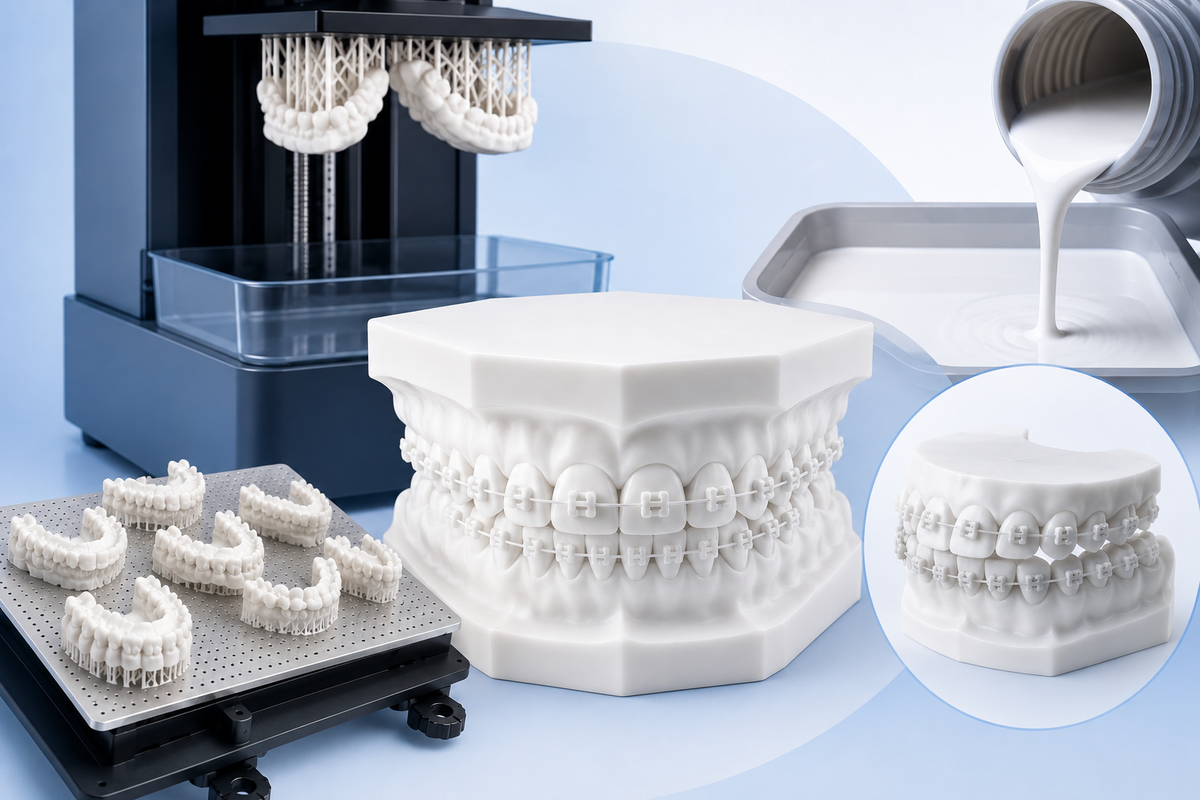
Material cost per case is one of the most undertracked numbers in dental lab production and in orthodontic model printing specifically, it is the number that determines whether your 3D printing workflow is genuinely more cost-efficient than plaster or stone models, or whether resin consumption is eroding the margin you assumed digital production would deliver. VeriMODEL Ortho White from Whip Mix is one of the most widely adopted orthodontic model resins in US dental labs. But when labs are asked exactly how much resin a single model uses, the answer is almost always a guess.
This guide gives you a real answer. It covers the variables that determine resin consumption per model, how to calculate your actual per-model volume, what a single bottle of VeriMODEL Ortho White typically yields in practice, and how to use that data to manage your resin inventory and case economics accurately.
Why Resin Volume Per Model Is Not a Simple Number?
Before getting to the calculation, it is worth explaining why resin consumption per orthodontic model is variable rather than fixed because understanding the variables is what allows labs to control them.
Model geometry.
A full-arch orthodontic model with standard base height and complete arch coverage uses significantly more resin than a partial-arch model or a trimmed diagnostic model. The volume of material in the final part is the primary driver of resin consumption, and that volume is determined by how the model is designed in the digital workflow.
Hollow vs solid printing.
Most orthodontic model printing software gives labs the option to print models hollow with a defined wall thickness, rather than printing them as solid blocks. A solid full-arch model uses roughly 3–4x more resin than a hollowed model with a 2–3 mm wall and drain holes. Hollow printing is standard practice for production efficiency but the wall thickness setting is directly adjustable and has a proportional effect on both print time and resin consumption.
Support material.
Supports consume resin in addition to the model itself. The support volume depends on model orientation, the density of the support structure, and whether the slicer is set to minimize supports for resin efficiency or maximize supports for print reliability. Labs optimizing for resin cost should use the lightest support structure that their printer can reliably print without failure.
Resin remaining in the vat.
Every print cycle leaves a layer of resin coating the FEP film and vat surfaces that does not transfer into the model. This loss is small per print but accumulates over time particularly when a vat is emptied and residual resin is filtered out rather than returned to the bottle. Labs that track this loss accurately include it in their per-model cost calculations.
Waste from failed prints.
Failed prints consume resin without producing a usable model. A 3% print failure rate means every 33rd model's worth of resin is lost. This is relevant to per-model cost but is separate from the consumption calculation for a successful print.
VeriMODEL Ortho White: What the Resin Is Designed For
Before calculating consumption, it helps to understand what VeriMODEL Ortho White is optimized for because that optimization affects how the resin behaves during printing and why it is specified for orthodontic model applications rather than general model or splint production.
VeriMODEL Ortho White is a photopolymer resin formulated specifically for orthodontic study and working models. Its key properties are dimensional accuracy for tight-tolerance aligner and bracket workflows, a bright white color that reads clearly under clinical and scanning lighting, surface hardness sufficient for thermoforming appliance production directly on the printed model, and biocompatibility appropriate for the incidental contact that occurs during clinical use of orthodontic appliances fabricated on the model.
The white ortho resin whip mix formulation is calibrated for 385 nm and 405 nm light sources, making it compatible with the majority of dental 3D printing systems used in US labs. Batch-to-batch color consistency a practical requirement for labs that match models to cases by visual reference is one of the product's consistently cited advantages among labs that have standardized on it for orthodontic production.
The Volume Calculation: Step by Step
To calculate actual resin consumption per model, you need three pieces of data from your slicer software: the model volume, the support volume, and the layer count. Most dental slicers exocad, 3Shape, Asiga Composer, Chitubox, and others display the estimated resin volume for each print job before you commit to printing. Use that number as your baseline.
Step 1: Get the estimated volume from your slicer.
Before printing, note the resin volume displayed in the slicer. This figure represents the combined volume of the model and its supports in milliliters.
Step 2: Add a vat waste factor.
Add approximately 3–5% to the slicer estimate to account for resin that remains coating the vat and FEP film after the print. For labs running high print volumes daily, this figure can be measured directly by weighing the resin bottle before and after a series of prints and comparing the difference to the cumulative slicer estimates.
Step 3: Calculate your adjusted per-model volume.
Add the vat waste factor to the slicer estimate. This is your adjusted per-model resin consumption.
Typical volume ranges for VeriMODEL Ortho White by model type:
| Model Type | Wall Setting | Estimated Volume |
|---|---|---|
| Full-arch solid model | N/A (solid) | 35–50 ml |
| Full-arch hollow, 3 mm wall | 3 mm | 12–18 ml |
| Full-arch hollow, 2 mm wall | 2 mm | 9–13 ml |
| Partial arch / quadrant model | 2–3 mm wall | 5–9 ml |
| Trimmed diagnostic model | 2 mm wall | 8–12 ml |
These are representative estimates based on standard full-arch arch form geometry. Your actual volumes will vary based on arch width, base height, and whether you include anatomical bases or flat bases in your design standard. Run your own measurement series on your first 10 prints and use that data not generic estimates as your production baseline.
For labs that have not yet built a complete orthodontic model resin workflow and want to compare options, our guide to Resin for Dental 3D Printing: Uses, Types, and Tips covers the full category of dental photopolymer resins and their clinical applications in detail.
Bottle Yield: How Many Models Per Bottle?
VeriMODEL Ortho White is available in standard bottle sizes. Using the volume estimates above and a standard hollow full-arch model at a 2.5 mm average wall thickness consuming approximately 14 ml per model including vat waste factor:
500 ml bottle: Approximately 35 full-arch hollow models per bottle.
1000 ml bottle: Approximately 70 full-arch hollow models per bottle.
These figures assume single-arch models. Dual-arch cases (upper and lower printed in the same batch) effectively double the resin consumption per patient case so a dual-arch case at 14 ml per arch uses approximately 28 ml total, yielding roughly 35 patient cases per 1000 ml bottle.
For labs running mixed print beds printing multiple model types in a single session the yield calculation should be done at the print session level rather than per individual model. Sum the slicer-estimated volumes for all models in a session, add the vat waste factor once per session (not per model), and use that as your session consumption figure.
Cost Per Model: Running the Numbers
For labs that need a comparison point against an alternative orthodontic model resin option particularly for labs considering whether to standardize on one resin system for both orthodontic models and general diagnostic models the orthodontic model printing resin from Keystone offers a comparable workflow at a different price point, with its own batch documentation and ISO compliance profile for labs that require multi-supplier qualification.
The important principle in any cost-per-model analysis is to include all resin costs the model volume, the support volume, and the vat waste factor not just the slicer's model volume estimate. Labs that calculate cost only on the model volume understate true resin cost by 15–25% depending on support density and vat management practices.
Optimizing Resin Consumption in Your Orthodontic Model Workflow
Once you have an accurate per-model consumption baseline, the following workflow adjustments have the most direct impact on resin cost per case.
Hollow printing as the default.
If your lab is still printing solid orthodontic models, switching to hollow printing with drain holes is the single highest-impact change available. The reduction in resin per model is 60–75% compared to solid, with no clinical impact on model function for aligner or bracket workflows.
Wall thickness optimization.
A 2 mm wall is structurally adequate for most orthodontic model applications thermoforming pressure, clinical handling, and bracket placement. A 3 mm wall uses approximately 30% more resin than a 2 mm wall for no additional clinical benefit on most cases. Set 2 mm as your lab standard and test for structural adequacy before moving to thinner walls.
Print bed utilization.
Resin efficiency improves with fuller print beds the vat waste factor is fixed per session regardless of how many models are in the batch. A session printing 4 models uses the same vat waste as a session printing 8 models. Batch your orthodontic model prints to maximize bed utilization before starting a print run.
Vat management.
Filter resin back into its bottle after every session using a mesh filter. Resin left in the vat between sessions is exposed to ambient light and oxidation, reducing its usable shelf life. Proper vat management extends the effective shelf life of your open resin and reduces disposal waste.
Support optimization.
Review your support settings specifically for orthodontic models. Standard dental model geometry a relatively flat tissue surface and a blocky base requires fewer supports than complex anatomical or prosthetic parts. Reducing support density from a default setting to an optimized orthodontic model setting can reduce support volume by 20–40% per model.
For labs building out their full range of dental key model 3d printing resin options alongside VeriMODEL Ortho White particularly labs that produce both orthodontic models and diagnostic study models stocking both a white orthodontic formulation and a stone-colored general model resin gives you material-appropriate options for each case type without using premium ortho resin for non-orthodontic applications where a lower-cost diagnostic model resin is sufficient.
Inventory Management: How Much Resin to Keep in Stock
For a lab producing 20 orthodontic cases per week (40 full-arch models), the monthly resin consumption is approximately:
40 models/week × 4.3 weeks × 14 ml/model = 2,408 ml per month
At 1000 ml per bottle, this equates to approximately 2.4 bottles per month. A practical stock level for this volume is 4–6 bottles on hand two to three months of production providing a buffer against supplier lead time variability while avoiding excessive shelf stock that ties up capital and risks resin expiry.
For dental resin 3d printing products including VeriMODEL Ortho White and the full Keystone and Whip Mix resin ranges, ZirconiaGuys stocks from US inventory with same-day shipping on in-stock items enabling labs to run leaner inventory levels than international sourcing allows, since lead time uncertainty is eliminated.
The answer to how much VeriMODEL Ortho White resin one orthodontic model uses is: approximately 9–18 ml for a standard hollow full-arch model, depending on wall thickness, arch geometry, and support volume plus a 3–5% vat waste factor on top. Knowing that number accurately, rather than estimating it, is what allows labs to price orthodontic model production correctly, manage resin inventory efficiently, and evaluate material cost as a real line item in their CAD/CAM production economics.
The same calculation discipline that applies to white ortho resin whip mix consumption applies across every material your lab uses zirconia blocks dental inventory, dental zirconia discs stock levels, zirconia blank and zirconia dental blanks procurement quantities the labs that track material consumption per case across their full workflow are the ones that identify where margins are being lost before the losses compound.


