

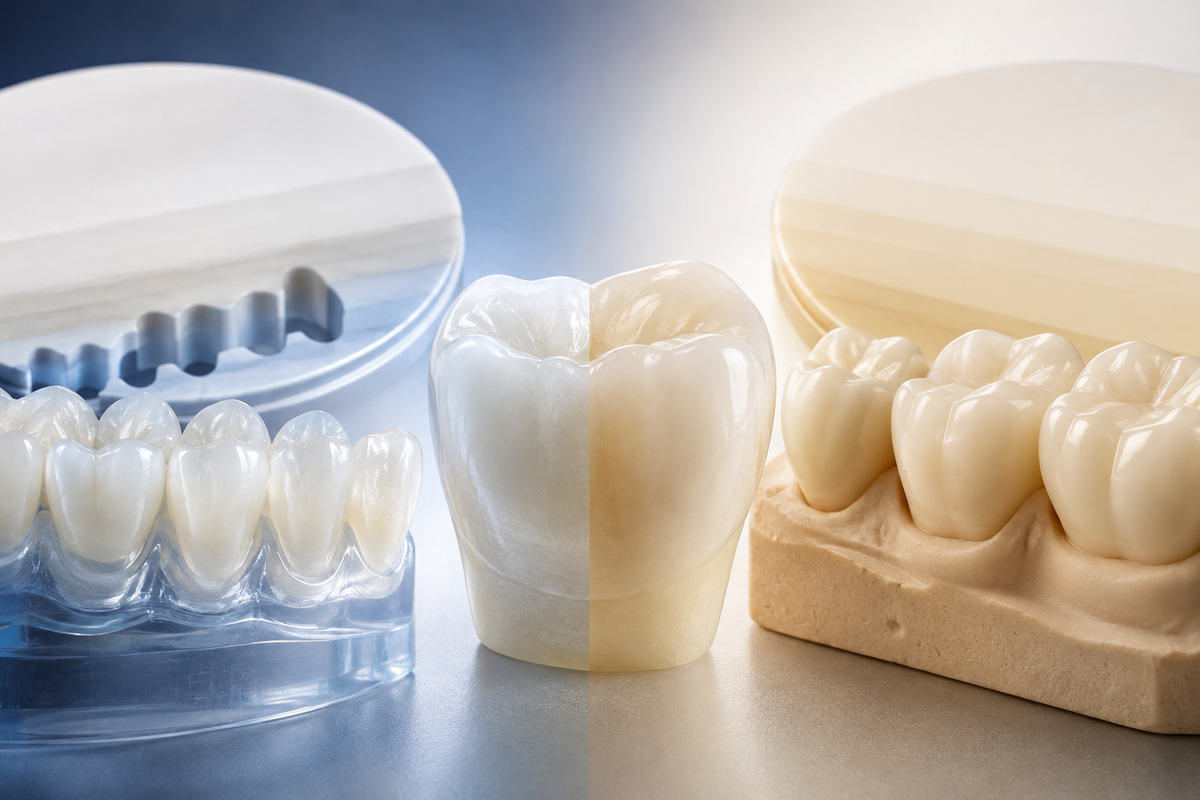
The most consequential decision in zirconia crown production is not which mill to use, which sintering furnace to run, or which stain brand to apply. It is the disc selection decision made before any of those steps begin. And the single property that most determines whether that decision is correct for the case is translucency specifically, where the restoration being produced sits on the translucency-to-opacity spectrum, and whether the disc selected can deliver that optical behavior from the mill.
Dental labs that treat zirconia as a single material category choosing discs based on price, availability, or habit rather than optical specification consistently produce restorations that either look flat and artificial in the anterior zone or waste expensive high-translucency material on posterior cases that don't require it. Understanding exactly how translucency and opacity behave in multilayer zirconia, what drives those properties at the material level, and how Aidite's product range maps to specific clinical requirements is the foundation of consistent zirconia crown quality across every case type.
What Translucency and Opacity Actually Mean in Zirconia?
In everyday language, translucent means "lets light through" and opaque means "blocks light." In the context of dental zirconia, both of these descriptions are correct but insufficient because the clinical question is not simply whether light passes through the material, but how it interacts with the material on its way through, and what that interaction looks like to the human eye under varying lighting conditions.
Natural tooth structure is not uniformly translucent or uniformly opaque. It is a complex optical structure with distinct zones: the dentin core is relatively opaque and highly chromatic, scattering light in a warm, yellow-orange wavelength range. The enamel layer over that dentin is semi-translucent, transmitting some light while also scattering it in cooler, bluish wavelength ranges a property called opalescence. The incisal edge in anterior teeth, where enamel is at its thickest and no dentin is present, is the most translucent zone, often appearing blue-grey in young patients with high natural translucency.
A zirconia crown that looks natural replicates this optical architecture as closely as possible. A crown that looks artificial does not and the most common reason a zirconia crown looks artificial is not shade error. It is optical mismatch: a material that is too opaque to transmit the light that adjacent natural teeth transmit, producing a restoration that appears flat, bright, and dead under clinical and social lighting conditions.
The yttria content of zirconia controls translucency through its effect on crystal phase composition. Higher yttria content increases the cubic crystal phase fraction, which reduces light scattering and increases light transmission. Lower yttria content maintains predominantly tetragonal phase, which scatters light more and produces a more opaque, stronger material. This is the fundamental tradeoff that governs every zirconia disc selection decision and the one covered in depth in the guide to Guide to Materials & Strengths of Zirconia Dental Restorations, which details how 3Y, 4Y, and 5Y grades map to strength and optical performance across all clinical indications.
Why Multilayer Architecture Changes the Decision Framework?
Single-composition zirconia discs place the lab in a forced tradeoff: choose a higher-translucency grade and accept reduced strength, or choose a higher-strength grade and accept reduced translucency. For single-unit anterior crowns, this tradeoff is managed by specifying 5Y or 4Y high-translucency material. For posterior bridges, it is managed by specifying 3Y-TZP for structural priority. But many clinical cases do not sit neatly at either end of this spectrum.
Multilayer zirconia discs resolve this tradeoff by building gradient optical properties into the disc architecture itself. Rather than a single composition throughout the disc, multilayer discs are manufactured with a progressive change in yttria content from the cervical end to the incisal end. The cervical zone designed to correspond to the root-third of the crown contains a composition closer to 3Y-TZP: more opaque, higher chroma, warmer undertone. The incisal zone designed to correspond to the enamel-third of the crown contains a composition closer to 4Y or 5Y: more translucent, lower chroma, cooler optical character.
When the CAD/CAM toolpath correctly aligns the restoration with these zones, the milled crown already contains the optical gradient of a natural tooth without staining. The technician mills, sinters, and delivers. The shade gradient is in the material.
The clinical significance of this architecture is not just esthetic efficiency. It is accuracy. A stain applied to the surface of a white zirconia blank can approximate a shade gradient, but it sits on top of the material rather than within it. Surface stain can fire unevenly, vary between technicians, and fade at micro-crack sites over time. A gradient built into the multilayer architecture is chemically stable, batch-consistent, and technician-independent in a way that surface staining can never be.
The translucent multilayer zirconia aidite 3D Pro Zir disc format from Aidite is specifically engineered around this multilayer gradient principle delivering a cervical-to-incisal optical transition within a single disc that matches the optical zonation of natural dentition in the standard VITA shade range. For labs producing high-volume anterior cases where shade accuracy and workflow efficiency must both be maintained, this disc architecture reduces the staining step on the majority of standard A-shade cases to a glaze-only workflow.
The Clinical Spectrum: Matching Optical Requirements to Crown Location
Every crown location in the mouth has a different optical requirement. The anterior zone demands maximum natural appearance. The posterior zone demands structural reliability. The premolar zone sits between both demands. Understanding where each Aidite multilayer product sits in this spectrum is what enables correct disc selection for every case type.
Maxillary central and lateral incisors are the most demanding esthetic cases in the mouth. Adjacent natural teeth particularly in young patients have high incisal translucency and distinct dentin-to-enamel gradient. A crown in this zone that is too opaque stands out immediately under natural light. Maximum-translucency multilayer material with strong incisal zone optical character is the correct specification.
Canines bear lateral guidance forces that make them moderately load-sensitive. They also have significant esthetic visibility. A high-translucency 4Y multilayer disc that balances esthetic performance with adequate flexural strength is the typical correct choice maximum 5Y translucency is reserved for centrals and laterals where the esthetic demand is highest.
Premolars receive partial esthetic scrutiny and partial occlusal load. A 4Y multilayer pre-shaded disc covers most premolar single-crown cases. Where the premolar is adjacent to highly translucent anterior teeth in a case involving multiple units, matching the translucency level across the full span takes priority.
Posterior molars are the least esthetically demanding and most structurally demanding position. A white 3Y-TZP disc, either monolithic or with basic multilayer architecture, is structurally appropriate. High-translucency multilayer material is neither required nor recommended here the strength tradeoff in 5Y esthetic grades is not clinically justified in a zone where esthetic visibility is minimal and occlusal load is maximum.
Posterior bridges of 3 or more units require 3Y-TZP grade regardless of esthetic zone position. Connector strength is the governing criterion, and no multilayer esthetic disc in the 4Y or 5Y range should be specified for a posterior 3-unit bridge without verifying the connector cross-section against the manufacturer's minimum strength data.
Aidite's Multilayer Zirconia Range: Product-Level Selection Guide
Aidite produces multiple multilayer zirconia disc formats, each positioned at a different point on the translucency-opacity spectrum and calibrated for different clinical applications. Understanding each product's optical specification prevents the most common selection error: treating the entire Aidite multilayer range as interchangeable.
HonorZir SHT Pre-Shaded:
The HonorZir SHT format is Aidite's pre-shaded multilayer disc for standard anterior and premolar cases. The SHT designation indicates super-high translucency the disc is calibrated for cases where significant incisal translucency is clinically required but the case does not represent an extreme esthetic challenge. Pre-shaded format means the VITA-compatible shade gradient is already embedded in the material no liquid shade immersion is required for standard A-shade cases.
The aidite multilayer shaded zirconia disc in this format is the correct default for daily anterior and premolar production at most dental labs. The pre-shaded gradient covers the A1–D4 shade range reliably, reducing finishing time significantly on standard cases without sacrificing the esthetic quality that anterior zone restorations require.
Superfect Zir SHT White:
The Superfect Zir SHT White format sits at the maximum-translucency end of the Aidite multilayer range. The white (unshaded) format gives labs complete shade control through liquid immersion or brush-on staining essential for complex cases, unusual shade requests, or cases requiring characterization effects that a pre-shaded disc cannot deliver. The SHT optical specification delivers high incisal translucency that approaches the optical character of natural enamel in the incisal zone.
The aidite superfect zir sht white disc is the correct specification for labs handling demanding anterior esthetic cases, cosmetic dentistry workflows where adjacent restorations are being matched to existing e.max veneers, or any case where the pre-shaded gradient format is insufficient for the specific shade requirement. The added staining labor is justified by the esthetic control this format provides.
3D Pro Zir Multilayer:
The 3D Pro Zir is Aidite's premium multilayer disc with the most refined internal gradient architecture. Designed for cases where the clinical expectation is the highest optical quality cases adjacent to highly translucent natural dentition, full-arch anterior restorations, or cases where esthetic outcome is the primary clinical success criterion the 3D Pro Zir delivers the most natural optical gradient in the Aidite range.
White vs. Pre-Shaded: How Format Affects the Translucency Decision
The translucency specification and the disc format white or pre-shaded are two separate decisions that interact with each other in production.
A pre-shaded multilayer disc has its optical gradient embedded in the material. For standard cases, this eliminates staining labor entirely. The limitation is that the pre-shaded gradient is fixed it cannot be adjusted for unusual shade values, strong B or C chroma cases, or cases requiring surface characterization beyond what a glaze application provides.
A white multilayer disc has the same internal gradient architecture as its pre-shaded counterpart, but without pigmentation. The technician controls the final shade entirely through liquid immersion or surface staining. This format is the correct choice for complex cases, but adds staining labor and inter-technician variability to every standard case it is used for.
The practical stocking rule: Pre-shaded multilayer as the default for 70–80% of standard A-shade anterior production. White multilayer as the secondary stock for complex cases requiring custom shade control. Labs that run all cases through white discs are creating unnecessary staining labor on cases that a pre-shaded disc handles correctly and labs that run all cases through pre-shaded discs are forcing compensation on complex cases where shade flexibility is genuinely required.
For the full range of aidite zirconia discs for dental labs including white, pre-shaded, multilayer, and monolithic formats across the complete strength range ZirconiaGuys stocks the Aidite lineup from US inventory with same-day shipping on in-stock items.
Sintering and Its Effect on Translucency
One of the most underappreciated sources of translucency variation in zirconia crown production is not the disc it is the sintering protocol. The final translucency of a sintered zirconia crown is a product of both the disc's inherent optical specification and the sintering conditions that develop it.
High-translucency multilayer discs require controlled sintering to achieve their specified optical properties. The key variables are ramp rate and peak hold temperature. Most Aidite multilayer products specify a ramp rate of ≤5°C per minute and a peak hold between 1480–1550°C for the specified dwell time. Accelerated sintering running a fast-fire profile to save furnace time disrupts grain growth and produces a cloudier, less translucent result than the disc specification. A 5Y disc sintered on an aggressive profile will look more like a 4Y or even 3Y disc in its final translucency.
The sintering protocol must be treated as a material specification, not a furnace convenience setting. Validate the profile once against the manufacturer's data, document the validated settings, and apply them consistently across every case. Translucency variation that appears to be a disc quality problem frequently traces to sintering protocol inconsistency.
Practical Selection Summary
| Crown Location | Optical Priority | Recommended Aidite Format |
|---|---|---|
| Maxillary central/lateral incisors | Maximum translucency | 3D Pro Zir Multilayer or Superfect Zir SHT White |
| Canines | High translucency + adequate strength | HonorZir SHT Pre-Shaded or Superfect SHT White |
| Premolars | Balanced esthetics/strength | HonorZir SHT Pre-Shaded |
| Posterior single crowns | Strength priority, basic esthetics | 3Y monolithic or HonorZir white |
| Posterior 3+ unit bridges | Structural — connector strength governs | 3Y-TZP monolithic |
| Complex/unusual shade cases | Full shade control | White format (Superfect or HonorZir white) |
| Standard A-shade anterior volume | Workflow efficiency | Pre-shaded format (HonorZir SHT Pre-Shaded) |
Translucency vs. opacity in multilayer zirconia crown selection is not a binary choice between two options it is a continuous spectrum that must be matched to the specific optical requirements of every case location. Aidite's multilayer range provides distinct products at different points on that spectrum, and the clinical value of those products is only realized when they are selected correctly for the indication.
The zirconia blank selection decision for anterior crowns, the dental zirconia discs format decision between white and pre-shaded, the sintering protocol that develops the disc's optical specification all of these decisions compound. A correct disc on the wrong sintering profile produces the wrong result. A correct sintering profile on the wrong disc produces the wrong result. Zirconia dental blanks in multilayer format only deliver their designed optical performance when every elment of the workflow is aligned with the material specification.
For zirconia blocks dental procurement across the full Aidite multilayer range 3D Pro Zir, HonorZir SHT, Superfect Zir, and the complete white and pre-shaded lineup ZirconiaGuys stocks the full Aidite zirconia blocks range from US inventory with batch documentation, technical support on sintering profiles, and same-day shipping on in-stock items.


