

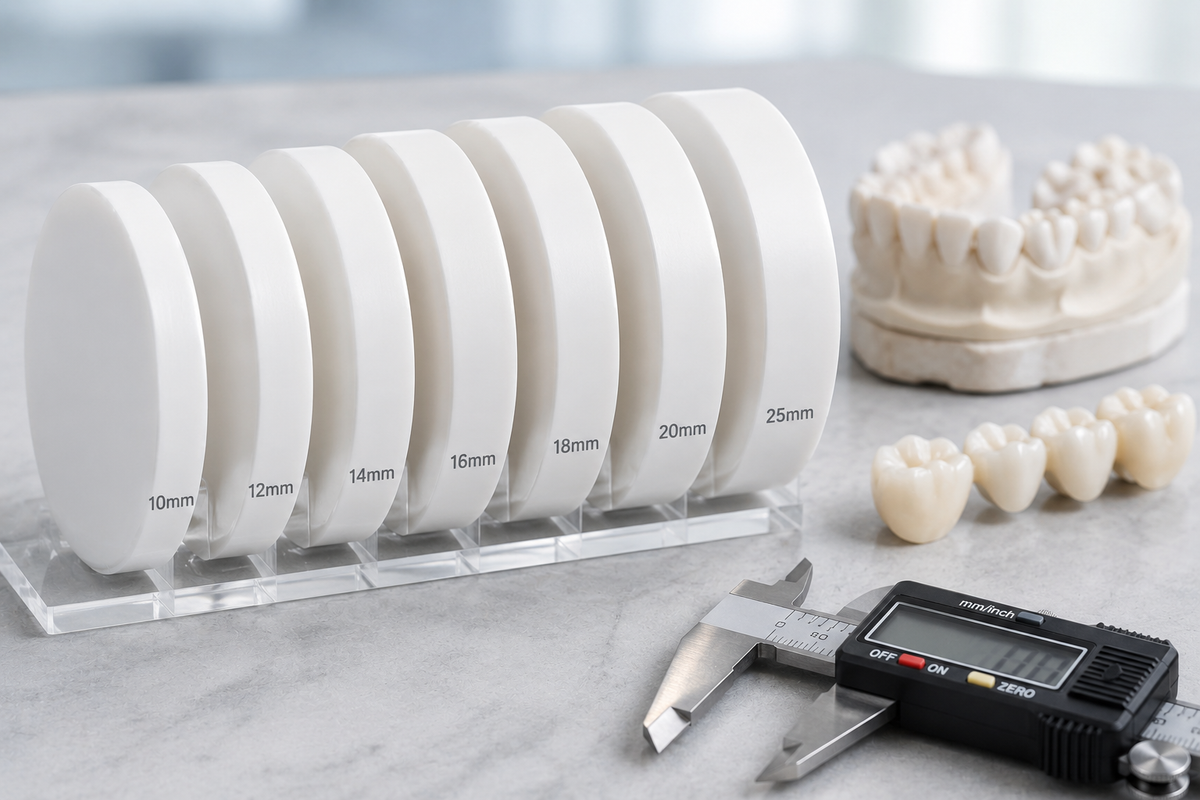
Disc thickness is one of the most consequential material decisions in a zirconia milling workflow and one of the least systematically documented in most dental labs. The grade gets the attention. The shade gets the conversation. Thickness gets selected by habit, by what happens to be in stock, or by a vague sense that thicker is safer. None of those are sound production strategies, and the consequences show up in two ways: over-milled restorations that lack the structural reserve the case requires, or unnecessarily thick restorations that compromise occlusal space, require excessive reduction adjustments, and waste disc material on every case.
Aidite's zirconia disc range spans multiple thickness options across their product lines 10 mm, 12 mm, 14 mm, and 16 mm and each thickness is not just a measurement but a clinical specification. Matching the correct thickness to the case type is what allows the restoration to exit the sintering furnace with appropriate occlusal anatomy, adequate structural cross-section, and the fit accuracy that the patient model demands. This guide provides the complete reference framework for making that selection correctly across the full range of Aidite zirconia indications.
Why Disc Thickness Matters More Than Most Labs Realize?
The relationship between disc thickness and clinical outcome is not linear, and it operates differently than most technicians initially expect. The intuitive assumption is that thicker always means more material and therefore stronger. In practice, the correct thickness is the one that allows the CAD/CAM design to be milled with adequate occlusal wall thickness and connector cross-section and those values are determined by the restoration design, not by the disc.
What disc thickness actually controls is the milling envelope the maximum anatomical height of the restoration that can be milled from a given blank. A 10 mm disc limits the maximum restoration height to approximately 7–8 mm post-sintering (accounting for 20–25% sintering shrinkage). A 14 mm disc expands that envelope to approximately 10–11 mm. For most anterior crowns, 10–12 mm is sufficient. For posterior crowns with significant occlusal height, or for cases requiring large-format bridge pontics, inadequate disc thickness means the design cannot be accurately milled without compromisingocclusal anatomy.
The secondary consideration is toolpath efficiency. Milling a thin restoration from a thick disc wastes material and increases milling time. A well-matched disc thickness reduces material waste per case and optimizes production economics across the disc's usable area.
The Aidite Disc Range: Products, Grades, and Available Thicknesses
Aidite produces one of the most comprehensive zirconia disc ranges available to US dental labs, covering high-strength, esthetic, multilayer, pre-shaded, and white formats across multiple thicknesses. Understanding the product line structure is the foundation of correct thickness selection because each product within the Aidite range has distinct thickness availability that reflects its clinical design intent.
The full range of aidite zirconia discs for dental labs at ZirconiaGuys covers the complete Aidite lineup from US inventory including Aizir, HonorZir SHT, Superfect Zir SHT, and 3D Pro multilayer formats across all available thicknesses.
Aizir — Aidite's high-translucency single-layer disc, available in 12 mm and 14 mm. Formulated for maximum translucency in the esthetic zone. The 12 mm format is the daily anterior production standard; the 14 mm covers cases with larger occlusal height requirements or posterior esthetic single crowns where additional milling clearance is needed.
HonorZir SHT — Super high-translucency pre-shaded multilayer disc, available in 10 mm and 14 mm. The 10 mm format targets standard anterior crown height cases where pre-shaded shade accuracy is the production priority. The 14 mm format extends coverage to larger anterior cases and selected premolar indications.
Superfect Zir SHT — Super high-translucency white and pre-shaded discs, available in 12 mm. The single thickness offering reflects a targeted design for standard esthetic cases where custom shade control (white format) or pre-shaded efficiency is the primary requirement.
3D Pro Zir — Aidite's multilayer gradient disc for advanced esthetic applications, available in 12 mm. Designed for anterior cases requiring the most natural gradient architecture, the 12 mm format covers the range of standard anterior crown heights.
Aidite High-Strength (standard 3Y-TZP) — Available in 14 mm and 16 mm for posterior bridge and high-load single crown applications where structural reserve is the primary requirement and esthetic grading is secondary.
This product-to-thickness mapping is the first filter in disc selection: identify which Aidite product line is appropriate for the case indication, then select within the available thickness options for that product.
The Clinical Framework: Matching Thickness to Case Type
Thickness selection follows from three clinical variables: the anatomical height of the restoration, the structural demands of the indication, and the specific Aidite product line required for the grade and shade specification. Understanding how to choose correctly for your case requires understanding your guide to the Guide to Materials & Strengths of Zirconia Dental Restorations because thickness selection and grade selection are interdependent decisions for bridge and high-load cases.
Anterior single crowns (central and lateral incisors, canines):
The standard anatomical crown height for anterior teeth falls between 8–11 mm clinical crown length. After accounting for sintering shrinkage of approximately 20–25%, the pre-sintered blank must be at minimum 10–14 mm in height. For most standard anterior cases, a 12 mm disc provides adequate milling envelope with a small safety margin. For cases with longer clinical crowns longer upper centrals, or cases where the preparation leaves more supragingival height than average a 14 mm disc prevents design compromise at the incisal edge.
The 10 mm format is appropriate for anterior crowns only when the clinical crown height is confirmed to be on the shorter end of the range (below 8 mm post-sintering) and the case design has been verified in the CAM software before committing the disc to production.
Premolar single crowns:
Premolar crowns have standard clinical heights that fall within the same 8–11 mm range as anterior teeth but carry higher occlusal loads particularly first premolars in lateral guidance function. The 12 mm disc covers standard premolar crown cases comfortably. For cases requiring additional occlusal thickness to meet a minimum recommended wall thickness of 1.5 mm after milling, a 14 mm disc provides the reserve.
Posterior single crowns (first and second molars):
Molar crowns represent the most demanding thickness selection scenario in the Aidite range. Clinical crown heights in the molar region vary significantly based on patient anatomy and preparation design, but standard molar crown heights frequently approach or exceed 10 mm post-sintering requiring a pre-sintered blank of 12.5–13.5 mm. This places standard molar cases at the upper limit of a 12 mm disc and comfortably within a 14 mm disc.
For posterior single crowns where adequate occlusal wall thickness (minimum 1.5 mm at the thinnest point) is a confirmed design requirement, the 14 mm disc is the correct default. Using a 12 mm disc for molar cases risks insufficient occlusal material at the cusp tips when the crown height approaches the milling envelope limit.
Posterior bridges (3-unit and extended span):
Posterior bridges require the 14 mm or 16 mm thickness format without exception. The pontic body of a 3-unit posterior bridge frequently exceeds the milling envelope of a 12 mm disc, and more importantly, the connector cross-section must meet minimum dimensional requirements for the span length and occlusal load typically 9 mm² minimum cross-sectional area for a standard 3-unit posterior bridge. Insufficient disc thickness limits the connector height available in the design, forcing the lab to choose between inadequate connector dimensions and compromised occlusal anatomy. The 16 mm disc eliminates this constraint entirely for extended span posterior bridges.
Anterior bridges (3-unit):
Anterior bridge pontics, particularly in the upper anterior region, can have significant ridge lap depth that adds to the overall milling height. While a 12 mm disc covers many anterior bridge cases, labs should verify pontic depth in the CAM design before committing. Where the pontic plus the connector depth approaches the milling envelope, a 14 mm disc prevents design compromise.
Product-Specific Thickness Guidance: Aidite Aizir
The Aidite Aizir line Aidite's flagship high-translucency single-layer disc is available in both 12 mm and 14 mm. The 12 mm format covers standard anterior single crowns and premolar cases without issue. The 14 mm format is the correct specification for:
- Anterior crowns with confirmed clinical height above 9 mm post-sintering
- Premolar single crowns in high-load lateral guidance function
- Posterior single crowns in the esthetic zone where the Aizir's translucency properties are clinically preferred over a higher-strength 3Y-TZP grade
The aizir zirconia 12 mm disc is the most widely stocked format and appropriate for the majority of cases in the Aizir range. The 14 mm format should be stocked as a secondary option for the case scenarios above rather than as a default replacement for the 12 mm.
Product-Specific Thickness Guidance: Aidite HonorZir SHT Pre-Shaded
HonorZir SHT is Aidite's pre-shaded super high-translucency multilayer disc — designed for labs that want pre-built VITA-compatible shade gradients with maximum translucency for anterior esthetic production without staining labor.
The 10 mm format of the aidite honorzir sht pre-shaded disc is appropriate for:
- Short to medium anterior crown cases where clinical crown height is below 8 mm post-sintering
- Cases where the referring dentist has specified a pre-shaded shade value that falls within the HonorZir color range
- High-volume anterior production where the smaller disc format allows more efficient disc utilization per case
The 14 mm format extends coverage to anterior cases with longer clinical crowns and adds premolar single crown capacity to the HonorZir line. Labs running significant anterior bridge volumes should confirm that their design's pontic height falls within the 14 mm milling envelope before committing HonorZir SHT to a bridge case HonorZir's primary indication is single unit anterior work.
Product-Specific Thickness Guidance: Superfect Zir SHT White
The Superfect Zir SHT white disc format is Aidite's choice for anterior cases requiring full manual shade control from a high-translucency white starting point. The superfect zir sht white is available in 12 mm making it the straightforward choice for standard anterior single crown and short premolar cases where custom staining is part of the lab workflow.
The single thickness offering in the Superfect Zir SHT white format reflects its targeted indication. For cases requiring more milling envelope than 12 mm provides, the Aizir 14 mm in white format is the appropriate alternative.
Practical Thickness Selection Decision Guide
Use this framework for every Aidite zirconia case at disc selection:
Step 1 — Identify the indication: Single unit anterior, single unit posterior, or bridge? This determines which Aidite product line is appropriate and immediately constrains the available thickness options.
Step 2 — Measure the crown height in the CAD design: Before pulling a disc from stock, open the CAD file and confirm the maximum restoration height (pontic or crown body, whichever is greater). Multiply by 1.25 to account for sintering shrinkage this is the minimum disc thickness required.
Step 3 — Add milling clearance: Add 1–2 mm to the calculated minimum for toolpath clearance and design margin. This is your target disc thickness.
Step 4 — Match to available Aidite format: Select the closest Aidite product thickness equal to or greater than your target. Never use a disc thinner than the calculated minimum.
Step 5 — Document the selection: Record the disc product, thickness, and batch number in the work order. This traceability data supports remake analysis when needed and is part of a compliant production record.
Connector Dimensions and Thickness: The Bridge Calculation
For bridge cases, thickness selection has a direct structural implication beyond the milling envelope. Connector cross-section area the minimum connector dimension that ensures structural integrity across the span is constrained by disc thickness when the connector height is limited by the available blank.
For a standard 3-unit posterior bridge, most manufacturer recommendations specify a minimum connector cross-section of 9 mm² (typically 3 mm × 3 mm). If the disc is 12 mm and the bridge design requires a pontic that uses 10 mm of the disc height, the remaining material for the connector is insufficient to meet the 9 mm² minimum without design compromise. The 14 mm disc or 16 mm for extended spans provides the height reserve to meet connector minimums without sacrificing pontic anatomy.
This calculation should be performed in the CAM software before milling begins on every bridge case. Most CAM systems include connector cross-section measurement tools use them. The structural integrity of the bridge depends on it.
Stocking Strategy for US Dental Labs
For US dental labs building or rationalizing their Aidite disc inventory, the following stocking framework covers the majority of clinical production without excessive inventory complexity:
Primary stock — 12 mm discs across the Aidite product lines covering your most common anterior and premolar indications. For most labs, this means Aizir 12 mm, HonorZir SHT pre-shaded (in both 10 mm and 12 mm where available), and Superfect Zir SHT white 12 mm as the daily anterior production standard.
Secondary stock — 14 mm discs in the Aizir format for posterior single crowns and larger anterior cases, plus Aidite high-strength 3Y-TZP in 14 mm for posterior bridge production.
Extended capability — 16 mm discs in the Aidite high-strength format for labs running extended-span posterior bridges or implant-supported bridge frameworks where maximum structural reserve is required.
All Aidite disc formats listed above are available from ZirconiaGuys from US inventory covering aidite zirconia discs, dental zirconia discs, and the complete zirconia blocks dental range for labs that also run block-format milling for chairside or compact mill applications. Zirconia dental blanks in both disc and block format, including zirconia blank options across standard and high-impact grades, ship same day or next day from domestic stock with no international lead times.
Disc thickness selection is not a default decision it is a clinical specification that directly affects restoration anatomy, structural integrity, and production efficiency on every zirconia case your lab mills. The Aidite product range provides the thickness options to cover every standard clinical indication from thin anterior veneers to extended-span posterior bridges, and the selection framework is straightforward once the relationship between disc thickness, milling envelope, sintering shrinkage, and connector geometry is clearly understood.
Build the thickness calculation step into your lab's pre-milling checklist for every case. Verify crown height in the CAD file. Confirm connector cross-section on every bridge. Document the disc product, thickness, and batch for every work order. These three habits implemented consistently eliminate the avoidable thickness-related production errors that most labs attribute to other causes. The material is rarely the problem. The thickness selection decision that precedes the mill run usually is.


