

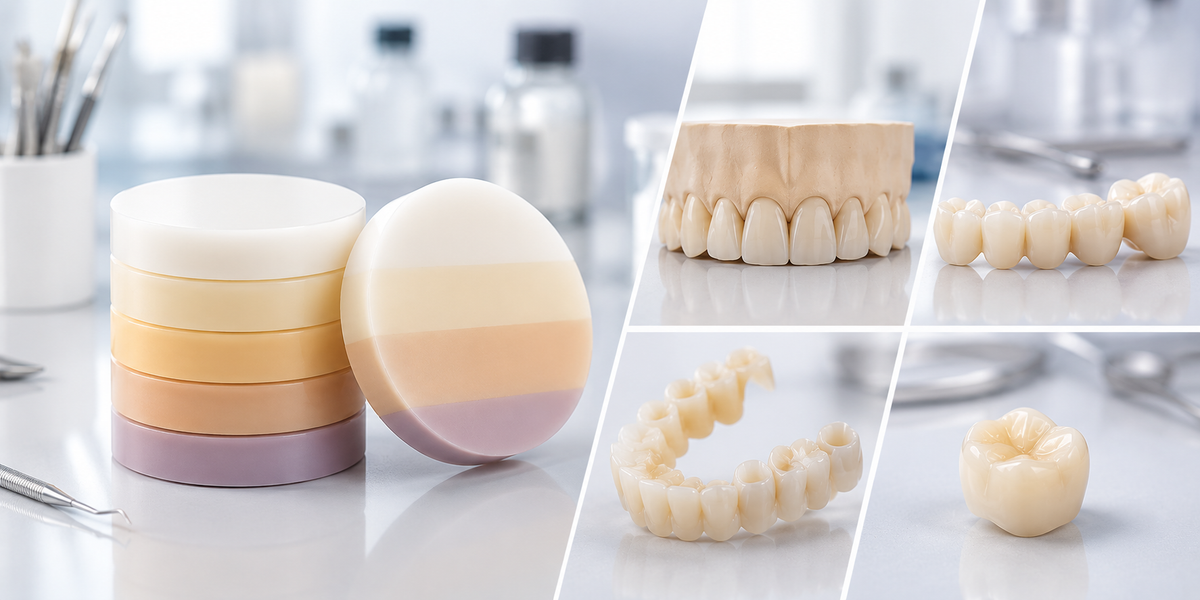
Provisional restorations are not a commodity step in the dental workflow they are a clinical tool that protects the preparation, previews the final esthetic outcome, maintains occlusal relationships during treatment, and gives the patient and clinician time to evaluate shade and form before permanent materials are committed. The quality of the provisional directly influences the quality of the final restoration. A provisional that does not accurately represent the target shade, fails to maintain marginal seal, or fractures under occlusal load creates downstream problems that even the most carefully milled zirconia cannot fully correct.
The material that drives provisional quality in a CAD/CAM dental lab is the PMMA disc and not all PMMA discs are equivalent. Aidite multilayer PMMA discs have become a widely specified choice in US dental labs for provisional production, but "multilayer PMMA" is not a single product. It is a format category covering multiple formulations, shade systems, and thickness ranges each suited to different provisional applications. Selecting the wrong format for the case type wastes the material's capabilities and forces compensation through extra finishing steps. Selecting correctly makes provisionals faster, more accurate, and more clinically useful.
This guide gives labs a clear, case-by-case framework for choosing the right multilayer pmma blocks aidite format for every provisional indication they encounter in daily production.
What Multilayer PMMA Actually Means and Why It Matters for Provisionals?
A multilayer PMMA disc is manufactured with a gradient of shade and translucency built into the disc itself transitioning from a warmer, more saturated, more opaque zone at the cervical end to a cooler, more translucent zone at the incisal end. This gradient architecture replicates the natural optical zonation of human dentition: the dentin-dominated, higher-chroma cervical third transitioning through the body to the enamel-dominated, translucent incisal third.
For provisional restorations, this gradient matters clinically because a provisional is the esthetic preview the patient and clinician evaluate before the permanent restoration is finalized. A provisional produced from a single-shade, flat PMMA disc even a correctly matched shade looks flat and monochromatic under natural lighting. It lacks the internal light play that makes natural teeth look alive. A well-designed multilayer provisional, by contrast, transmits and reflects light in a way that approximates natural dentition convincingly enough for patients to assess the esthetic outcome with confidence.
The aidite pmma multilayer disc is manufactured with Aidite's gradient pigmentation system across multiple internal layers each zone calibrated to VITA Classic shade standards, enabling the milled provisional to exit the mill with the full cervical-to-incisal gradient already present in the material. For standard A-shade cases, this eliminates the staining step entirely. For complex cases, it provides a gradient baseline that significantly reduces the characterization required to achieve a natural result.
Case Type 1: Single-Unit Anterior Provisional Crowns
Single anterior crown provisionals are where multilayer PMMA delivers its most visible advantage and where material selection matters most. The anterior zone is where shade mismatch, translucency gaps, and flat optical character are immediately apparent to patients and clinicians under mixed lighting conditions.
Key selection criteria for single anterior provisionals:
The disc shade should correspond to the target VITA shade within one A-D step. Multilayer PMMA provides a gradient, not a precise point match so a disc specified at A2 will produce a provisional that reads naturally as A2 in the body zone with appropriate translucency toward the incisal. If the target shade is an unusual strong chroma (B4, C3, D4), a pre-shaded multilayer disc will require supplementary staining to reach the target, but still provides a better starting point than a white PMMA blank.
Disc thickness: For full-coverage single unit anterior crowns, 12 mm disc thickness provides adequate material depth for correct gradient zone capture. The design software's blank orientation tool should position the incisal edge of the crown in the incisal zone of the disc and the preparation margin in the body-to-cervical transition zone.
Wear period consideration: For provisionals worn 2–6 weeks while the final restoration is being fabricated, standard multilayer PMMA formulation is appropriate. For cases requiring extended provisional wear of 3–6 months orthodontic alignment cases, implant osseointegration phases, or complex occlusal rehabilitation cases specify a higher-quality pre-polymerized disc with documented low porosity. Porosity determines how quickly the provisional surface absorbs staining agents and degrades in surface quality over extended wear.
For a full breakdown of where provisional PMMA fits within the broader CAD/CAM material ecosystem and when to transition from provisional to definitive materials the guide to Role of Dental PMMA in Temporary and Long-Term Restorations covers the complete clinical decision framework.
Case Type 2: Multi-Unit Anterior Bridge Provisionals
Three-unit and four-unit anterior bridge provisionals introduce two additional selection considerations that single-unit cases do not: inter-unit shade consistency and connector strength.
Inter-unit shade consistency is where multilayer PMMA has a significant workflow advantage over stained single-shade discs. In a three-unit anterior bridge provisional, all three units must shade-match each other and approximate the adjacent natural teeth. When provisionals are produced from a single-shade disc with external staining, the consistency of the result across three units depends entirely on how uniformly the stain is applied and fired a technician-dependent variable that creates unit-to-unit variation in multi-unit cases.
When the same three units are milled from a multilayer pre-shaded disc, the gradient is consistent across all three units because it is in the material, not in the application. Unit-to-unit consistency is built into the disc rather than dependent on staining technique.
Connector strength in PMMA bridge provisionals is a structural consideration that disc selection cannot fully address it must be addressed in the design. PMMA at 80–120 MPa flexural strength is adequate for single units and short-span provisionals, but minimum connector cross-section dimensions must be respected in the CAD design regardless of disc quality. A minimum 9 mm² connector cross-section for a 3-unit anterior bridge is the general guidance confirm with the specific disc manufacturer's published data.
Disc selection for anterior bridge provisionals: Same multilayer pre-shaded format as single anterior crowns, but prioritize batch consistency all units in the bridge must be milled from the same disc batch to guarantee shade matching across the span.
Case Type 3: Posterior Single Crown and Short-Span Bridge Provisionals
Posterior provisional cases have different priorities than anterior cases. Shade accuracy is secondary to occlusal accuracy, marginal seal, and structural integrity under posterior occlusal forces. A posterior provisional that looks natural but fractures at the connector or loses marginal seal over a 6-week provisional period is a clinical problem regardless of its esthetic quality.
For posterior provisionals, the multilayer gradient architecture is still useful it reduces post-milling work and produces a more natural-looking restoration than single-shade opaque PMMA but the primary selection criteria shift toward mechanical properties and machinability.
Disc thickness for posterior provisionals: 14 mm discs provide the additional material depth needed for full-contour posterior crowns with adequate occlusal thickness. Posterior cusps in full-contour design require sufficient material in the occlusal zone under-thickness provisionals fracture at the cusp tips under first occlusal contact.
Posterior bridge provisionals (3–4 unit): For posterior bridge provisionals in high-load cases molar-region spans or cases with known bruxism the structural demands may exceed what standard multilayer PMMA reliably delivers over a 4–8 week provisional period. In these cases, consider a higher-strength PMMA formulation or reinforce the provisional with a fiber framework if the case permits.
Case Type 4: Clear and Transparent Provisional Applications
Not all provisional cases require tooth-shade PMMA. Clear provisional applications occlusal splints, clear retainers, diagnostic overlays, and some orthodontic transitional appliances require a transparent or near-transparent PMMA formulation, not a tooth-shade gradient.
Using multilayer tooth-shade PMMA for clear provisional applications produces an opaque, tooth-colored result where transparency is the clinical requirement. This is a material selection error that requires remaking the case from the correct formulation.
The aidite clear pmma disc is formulated for these transparent provisional applications optically clear, with the same pre-polymerized machinability and biocompatibility as the tooth-shade multilayer range but without pigmentation. Labs running both tooth-shade and transparent provisional workflows should stock both formats and build internal protocols that specify which goes to which case type.
Case Type 5: Full-Arch and Implant-Supported Provisional Restorations
Full-arch provisional restorations immediate loading implant-supported fixed prostheses, full-arch rehabilitation provisionals, and PMMA hybrid frameworks represent the most demanding provisional application in terms of material volume, structural requirements, and esthetic expectation.
For full-arch provisionals, the disc selection must account for the full-arch span length that will be milled from a single disc. Standard 98 mm diameter discs accommodate most quadrant-based cases, but full-arch hybrid provisionals may require larger format discs or a segmented production approach where the arch is fabricated in sections.
Implant-supported provisionals during the osseointegration phase require particular attention to residual monomer content. A PMMA provisional in extended contact with peri-implant tissue for 3–6 months must meet biocompatibility standards for long-term mucosal contact, not just short-term provisional contact. The pre-polymerized Aidite formulation meets this standard conventional bench-mixed acrylic with higher residual monomer does not reliably meet the same threshold for extended implant-site contact.
For labs that also produce removable denture bases alongside fixed provisionals, the aidite denture base pmma is the correct disc format for the tissue-contact denture base application not the tooth-shade multilayer disc, which is formulated for crown and bridge optical properties rather than gingival shade accuracy and tissue-contact biocompatibility.
Practical Disc Selection Framework
| Case Type | Recommended Format | Thickness | Primary Selection Criteria |
|---|---|---|---|
| Single anterior crown | Multilayer pre-shaded | 12 mm | Shade gradient accuracy, translucency |
| Multi-unit anterior bridge | Multilayer pre-shaded, same batch | 12 mm | Inter-unit consistency, batch match |
| Posterior single crown | Multilayer pre-shaded or single-shade | 14 mm | Occlusal thickness, machinability |
| Posterior bridge (3–4 unit) | Higher-strength multilayer | 14 mm | Connector strength, wear resistance |
| Long-term provisional (3–12 months) | Pre-polymerized, low porosity | 12–14 mm | Surface durability, stain resistance |
| Clear/transparent application | Clear PMMA (no pigment) | 10–12 mm | Optical clarity |
| Full-arch implant provisional | Pre-polymerized, biocompatibility documented | 14–20 mm | Residual monomer, long-term contact |
Milling and Workflow Parameters for Aidite Multilayer PMMA
Getting the material selection right is half the workflow. The other half is correct milling and finishing parameters that preserve the gradient architecture the disc was manufactured to deliver.
Blank orientation is critical.
The multilayer gradient is directional the cervical zone and the incisal zone are specific ends of the disc. Mounting the disc in the wrong orientation reverses the gradient, producing a provisional with incisal-grade translucency at the cervical margin and opaque dentin character at the incisal edge. Always verify the disc's directional marking before milling.
CAD zone mapping.
In your design software (exocad, 3Shape, or equivalent), use the blank orientation/layer mapping tool to align the preparation margin with the body-to-cervical zone of the disc and the incisal edge or cusp tips with the incisal zone. Most software systems handle this automatically when the disc parameters are loaded correctly but verify the layer assignment visually in the software before committing the toolpath.
Milling speed.
PMMA machines at significantly higher speeds than pre-sintered zirconia. Standard PMMA milling parameters produce clean, low-roughness surfaces on Aidite multilayer PMMA without special tool path modifications. If your milling system produces rough, fibrous surfaces on PMMA, verify bur condition worn PMMA burs produce surface quality degradation that requires excessive polishing to correct.
Polishing.
Aidite multilayer PMMA polishes to a high gloss in a standard pumice-then-compound sequence. The pre-polymerized matrix produces a smooth milled surface that reaches clinical-grade polish quickly. Labs reporting excessive polishing time on PMMA provisionals are typically compensating for worn burs or incorrect milling speed rather than a material limitation.
Stocking Strategy for Labs Running Multiple Provisional Types
Most full-service dental labs produce more than one provisional type anterior crowns, posterior bridges, long-term implant provisionals, and occasional clear appliances. Building a stocking strategy that covers all indications without overcomplicating inventory is a practical management decision.
The multilayer pmma disc range from Aidite available at ZirconiaGuys covers all shade ranges, multiple thicknesses, and both tooth-shade and clear formulations from US inventory enabling labs to standardize on a single supplier for their entire provisional PMMA requirement alongside their zirconia blocks and milling material inventory.
Recommended minimum Aidite multilayer PMMA inventory for a full-service dental lab:
- A2 multilayer pre-shaded in 12 mm — the highest-volume anterior provisional shade for most US demographics
- A3 multilayer pre-shaded in 12 mm — second highest volume anterior and posterior provisional shade
- 14 mm multilayer in A2 or A3 — for posterior full-contour and bridge provisionals
- Clear PMMA in 10 mm or 12 mm — for occlusal splints and transparent appliance cases
This four-SKU minimum covers the significant majority of provisional cases in most general dental lab workflows. Dental zirconia discs, zirconia dental blanks, and zirconia blocks dental stock can be ordered from the same supplier consolidating delivery, documentation, and technical support for the full milling material inventory through a single US-based relationship.
Choosing the right Aidite multilayer PMMA for each provisional case type is not a complicated decision once the selection criteria are clear shade gradient for anterior esthetics, structural performance for posterior high-load cases, transparent formulation for clear appliances, and biocompatibility-documented pre-polymerized discs for long-term implant contact. What makes the decision complex is attempting to use one disc format for all cases or defaulting to material selection by habit rather than by indication.
The aidite pmma multilayer range exists precisely because different provisional applications have genuinely different material requirements. The pmma dental material selection decision made at the disc procurement stage matching formulation to indication is what determines whether provisionals are a production strength or a source of rework in your lab's daily workflow. A zirconia blank of the right grade for the right case, alongside the right PMMA disc for the right provisional, sourced consistently from a reliable US supplier, is the foundation of a dental lab workflow that produces correct outcomes the first time.


