

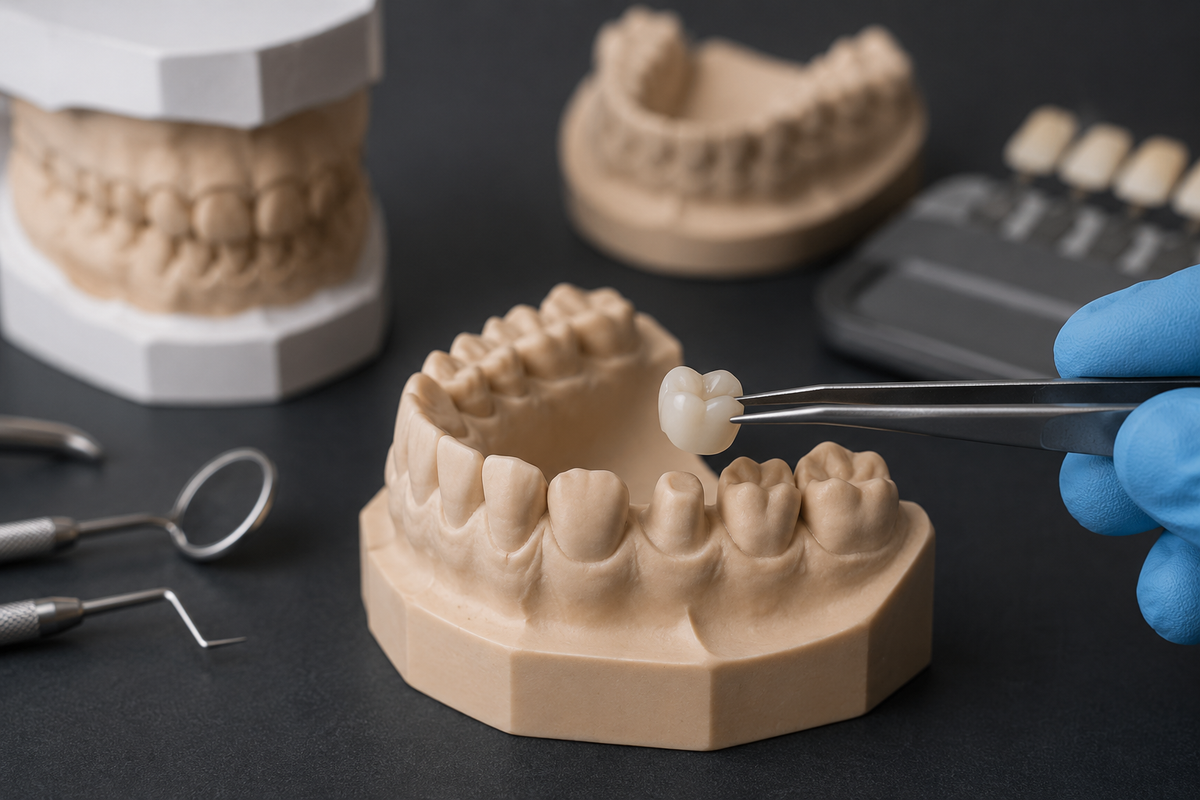
Crown and bridge planning depends on a clear, reliable representation of the patient's teeth. Diagnostic models help dental professionals and technicians examine tooth anatomy, preparation areas, occlusion, and available restorative space before fabrication begins. If a model contains distortion or loses important details, it may affect how the case is evaluated.
The right dental diagnostic model resin should clearly reproduce dental anatomy while maintaining dimensional stability during printing and post-processing. A suitable study model dental resin can also make physical models easier to inspect, handle, and use during laboratory communication.
Zirconia Guys provides dental lab materials for dental professionals and laboratories working with digital dental workflows. Its range includes materials such as VeriModel Ivory for model-printing applications, giving laboratories another option when selecting a suitable dental lab material supplier.
Why Model Accuracy Matters in Crown and Bridge Work
A diagnostic model is not simply a physical copy of a digital scan. It provides a reference that can help the dental team understand the case before restorative fabrication.
For crown and bridge work, a model should reproduce:
- Tooth anatomy and contours
- Preparation areas
- Occlusal surfaces
- Interproximal relationships
- Gingival contours
- Arch relationships
- Available restorative space
A distorted model can make these features harder to assess. Even when a model is used only for diagnosis, unclear margins or altered tooth positions can reduce its usefulness.
This is why a dental diagnostic model resin should be evaluated for its intended application. A study model dental resin should provide the level of detail and stability needed for the laboratory's specific workflow.
What Makes a Dental Diagnostic Model Resin Accurate?
Model accuracy depends on both the resin and the complete printing process. Important characteristics include:
Dimensional Stability
The printed model should maintain its intended shape and dimensions after printing, washing, and curing. Excessive dimensional changes can reduce its value for diagnostic assessment.
A stable study model dental resin can support more consistent results across repeated model production.
Detail Reproduction
Fine dental anatomy should remain clearly visible after printing. Defined tooth surfaces and contours make models easier to examine.
A good dental diagnostic model resin should therefore provide suitable detail reproduction for the intended diagnostic application.
Surface Quality
A clean surface helps technicians and clinicians inspect tooth anatomy. Excessive roughness, support marks, or printing defects can make certain areas harder to evaluate.
Post-Curing Stability
Post-curing is part of the normal workflow for many printed resins. The material should remain sufficiently stable when processed according to the manufacturer's instructions.
How Accurate Should a Model Be for Crown and Bridge Planning?
There is no single accuracy level that applies to every dental model. The required level depends on what the model is being used for.
A diagnostic model is generally intended for evaluation, planning, communication, or study rather than direct fabrication of the final restoration. For crown and bridge cases, it should provide a dependable representation of:
- Tooth positions
- Occlusal relationships
- Preparation geometry
- Interproximal spaces
- Gingival contours
- Restorative clearance
The greater the planning detail required, the more important model accuracy becomes. Choosing an appropriate dental diagnostic model resin is therefore part of maintaining a reliable digital-to-physical workflow.
A study model dental resin should be selected based on its intended use rather than simply its appearance or printing speed.
What Can Affect Printed Model Accuracy?
Even a suitable dental diagnostic model resin can produce inconsistent results if the printing process is not controlled. Several factors can affect the final model.
- Printer calibration: Incorrect calibration can introduce dimensional errors.
- Layer thickness: Settings can influence fine-detail reproduction and surface quality.
- Model orientation: Orientation affects support, surfaces, and detail of reproduction.
- Support placement: Poorly positioned supports can leave marks on important areas.
- Washing: Incorrect washing can affect the model's final characteristics.
- Curing: The recommended curing process should be followed carefully.
- Storage: Excessive heat or unsuitable conditions may affect some printed models.
These factors should be considered alongside the properties of the study model dental resin, especially when the laboratory also works with zirconium dental materials in its broader digital workflow.
Diagnostic Model Resin vs Restorative Zirconia
Diagnostic model resin and restorative materials serve different purposes. A dental diagnostic model resin is used to create a physical representation of the patient's dentition for evaluation and planning.
In contrast, zirconia dental material is used for specific restorative applications, while zirconium dental materials are selected based on their intended restorative use and processing requirements. A zirconium block is processed through a CAD/CAM workflow to produce a dental restoration, while zirconia blanks are manufactured for restorative milling.
Similarly, zirconia multilayer materials contain variations across the blank that can support specific shade and translucency requirements. These properties are important when selecting restorative materials but are not the primary criteria for choosing a model resin.
Therefore, a zirconium block should not be compared directly with a dental diagnostic model resin simply because both may be used in a digital dental laboratory.
How Does Model Resin Differ from Restorative Zirconia?
Laboratories researching restorative materials may also compare zirconia blocks price when planning their material purchases. However, the price of zirconia blanks should not be used to evaluate the value of a model resin.
A zirconium block is selected according to factors such as strength, shade, translucency, indications, and processing requirements. A dental diagnostic model resin is evaluated according to print accuracy, detail, stability, workflow compatibility, and intended application.
When comparing dental lab materials, laboratories should therefore consider what role each material plays. This is particularly important when a laboratory uses both model resins and zirconia dental material as part of its digital workflow.
What Should Labs Check Before Choosing a Model Resin?
Before selecting a study model dental resin, laboratories should review the complete workflow.
Key factors include:
- Application: Confirm that the resin is intended for diagnostic or study models.
- Dimensional stability: Review the manufacturer's technical information.
- Detail reproduction: Check how clearly dental anatomy can be reproduced.
- Printer compatibility: Confirm compatibility with the laboratory's equipment.
- Post-processing: Review washing and curing requirements.
- Surface quality: Consider how easily the finished model can be examined.
- Color: A suitable color can improve visibility of anatomical details.
- Consistency: Look for predictable results across repeated prints.
A suitable dental diagnostic model resin can support a more consistent workflow and reduce avoidable reprints or finishing adjustments. Choosing a model resin also involves looking at printer compatibility, dimensional accuracy, surface finish, and the specific requirements of the intended application.
For laboratories purchasing multiple dental lab materials, compatibility with existing equipment and processes should also be considered.
How Does Whip Mix VeriModel Ivory Fit Model Workflows?
Whip Mix VeriModel Ivory is designed for digital dental model applications. Its ivory appearance can make dental anatomy and surface details easier to distinguish during model evaluation.
When considering whip mix verimodel ivory, laboratories should review printer compatibility, recommended processing settings, and the intended application. Resin performance depends on the complete printing and post-processing workflow.
For laboratories producing physical diagnostic models from digital impressions, whip mix verimodel ivory can be considered as part of a model-printing workflow. The suitability of whip mix verimodel ivory should always be assessed against the laboratory's equipment and the manufacturer's processing recommendations.
A Practical Accuracy Checklist for Crown and Bridge Models
| Factor | What to Check | Why It Matters |
|---|---|---|
| Dimensional stability | Consistent model dimensions | Supports reliable evaluation |
| Detail reproduction | Clear anatomy and contours | Improves visual assessment |
| Surface quality | Defined, clean surfaces | Makes features easier to inspect |
| Printer compatibility | Suitable equipment and settings | Supports consistent production |
| Post-processing | Controlled washing and curing | Helps preserve model properties |
This checklist can help laboratories compare dental diagnostic model resin options based on practical requirements rather than a single specification.
A study model dental resin should ultimately fit the laboratory's printer, workflow, intended application, and quality expectations.
Choosing a Reliable Resin for Diagnostic Models
Accuracy matters because crown-and-bridge diagnostic models need to represent the patient's dentition clearly and consistently. A suitable dental diagnostic model resin should provide appropriate dimensional stability, detail reproduction, surface quality, and post-processing performance.
Restorative materials such as zirconia dental material, zirconium block, zirconia blanks, and zirconia multilayer serve different purposes and should be evaluated according to their specific applications. Similarly, zirconia blocks price is a separate purchasing consideration when laboratories select restorative materials.
Zirconia Guys supplies dental lab materials, including digital workflow options. They help labs explore options such as VeriModel Ivory for model printing.
Explore the VeriModel Ivory product and review its specifications to determine whether it fits your laboratory's workflow.


