

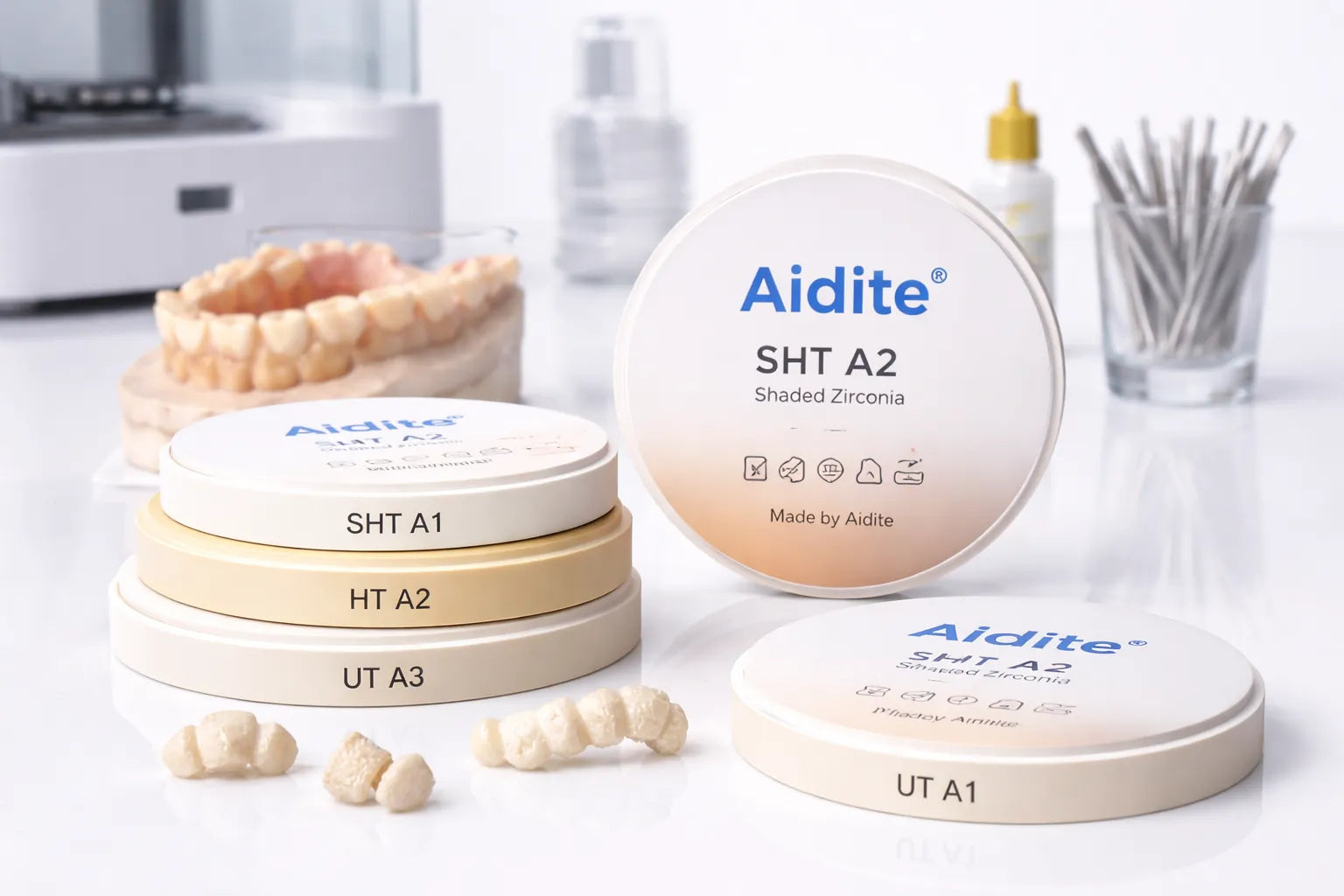
This blog highlights simple and practical tips for improving results when using shaded zirconia discs in dental restorations.
Zirconia restorations are changing the face of dentistry today. Their strength, stability, and natural beauty enable dental labs to deliver predictable results that meet patients' aesthetic needs across the United States. Shaded zirconia discs help achieve these objectives with stable colour transitions and reduced finishing requirements.
Dental labs strive to produce restorations that appear lifelike and fit perfectly. Shaded zirconia discs help meet these requirements with smoother workflows and stable results. It is their versatility that makes them an important material for crowns, bridges, veneers, and multi-unit cases. The following tips help dental labs achieve better results and more consistent shade accuracy.
Select the Right Disc for Each Case
Choosing the right disc affects the quality of each restoration. Labs should consider their translucency, strength and shade gradient. Matching these features to case requirements improves aesthetic accuracy. Supporting materials, such as Key Denture Base Resin for Dental Labs, can provide stability for removable or hybrid cases, enabling predictable results.
Plan the Restoration With Proper Design Techniques
A good design will provide the foundation for a positive zirconia restoration. Laboratories should be able to assure proper thickness and anatomical balance. A well-designed component eliminates weak spots and enables smooth sintering, which is necessary for long-term durability. The use of a key denture base resin for try-ins or as structural support may improve accuracy.
Some practical considerations are:
- Making sure that the thickness is uniform throughout the restoration.
- Retaining anatomical contours for correct occlusion.
- Using supportive resin for trial frameworks if the need arises.
Following these steps minimizes remakes and ensures the restorations are a perfect fit.
Use Accurate Nesting for Better Shade Results
Nesting is crucial so that each unit matches its intended shade gradient. Technicians need to place anterior restorations anteriorly, and posterior units belong to the deeper layers of the disc. This method reduces shading mismatches and helps achieve natural aesthetics.
Benefits of accurate nesting are:
- Anterior units should be placed in the incisal zone to preserve the translucency.
- Arranging posterior units in deeper layers to maintain a uniform shade depth.
- Similar shades should be placed near each other to reduce color variation across multiple units.
Accurate nesting is significant for multi-unit cases where shade consistency is important.
Apply Milling Strategies That Support Disc Quality
Reliable milling helps to enhance smoothness and minimize chipping of the surface. Selecting the proper tools and exerting steady, controlled pressure conserves the disc's internal structure. For labs that also need temporary supports, many buy key denture base resin online to make trial frameworks or transitional models. This integration ensures a smoother workflow and fewer adjustments.
Maintain Disc Integrity During Handling
Shaded zirconia discs are best when handled carefully. Before milling discs, labs should not drop them or scratch them. Contamination is avoided by proper storage in a clean, dry environment, which helps achieve optimum sintering.
Basic handling measures are:
- Archiving discs in marked containers so that they can be easily recognized.
- Reducing unwarranted disc contact.
- Storing discs in a dust-free and moisture-free space.
These practices ensure the accuracy of shade and mechanical performance.
Follow Correct Sintering Procedures
Sintering affects strength and final shade. Technicians must use recommended heating and cooling cycles to prevent internal stress and cracking. Proper sintering parameters are used to achieve strong, durable restorations. Stable sintering also helps retain the anticipated translucency and surface finish of the disc.
Use Polishing Techniques That Enhance Translucency
Polishing improves the esthetics and the reflective properties of light, making restorations appear more natural. Labs need to apply soft, gentle pressure rather than harsh methods, which can affect shade or surface finish. Effective polishing is one method for enhancing patient satisfaction by creating realistic restorations that blend with adjacent teeth.
Evaluate Fit and Finish Before Delivery
Quality control can ensure that restorations meet professional standards. Margins, contacts, and occlusal contacts must be thoroughly checked before sending restorations to clinicians. Careful evaluation minimizes chairside adjustments and enhances teamwork with dental practitioners.
Support Workflow Efficiency With Organized Materials
Organized workflows enhance productivity and case management daily. Labs benefit from disc storage by shade, translucency and size for quick access. Additionally, collaborating with a reliable dental denture base resin supplier is important to ensure that supportive materials are always available. This combination enables greater efficiency and the meeting of tight deadlines without compromising quality.
Consider Additive Options for Hybrid Cases
Hybrid treatments will sometimes require supportive materials that complement zirconia. Using denture base 3D printing resin for try-ins, prototypes, or transitional components helps improve flexibility. This way, the adjustments are easier and offer better structural support during complex workflows.
Strengthen Communication With Clinicians
Clear communication ensures that shade, translucency, and design expectations are aligned. The lab should share digital scans and reference photos before milling. Discussing expected finishing requirements also minimizes adjustments and lets one have more predictable results.
Improve Shade Verification With Digital Tools
Digital shade verification helps reduce subjectivity and increase accuracy. Combined with proper nesting, it enables technicians to create restorations that blend naturally. Using digital tools to compare multiple units helps ensure consistent aesthetic outcomes in complex cases.
Enhance Long-term Performance With Proper Finishing
Finishing adds strength to the surface, longevity and patient comfort. Labs should be careful in adjusting contacts and should avoid excessive thin margins. Proper finishing also retains surface gloss and minimizes the risk of fractures, which contribute to patient satisfaction.
Support Predictable Outcomes With Consistent Protocols
Documenting every step, from disc selection to final polishing, is key to reproducibility. Consistency minimises errors, improves efficiency, and ensures professional-quality results even during high-volume production cycles.
Final Observations
Natural, lasting restorations can be attained through reliable materials, disciplined workflows and considerate techniques. These objectives are facilitated by shaded zirconia discs, which enhance shade accuracy and provide reliable performance. At Zirconia Guys, we aim to provide materials and knowledge that help dental laboratories improve the outcomes for restorations and simplify daily workflow.


