

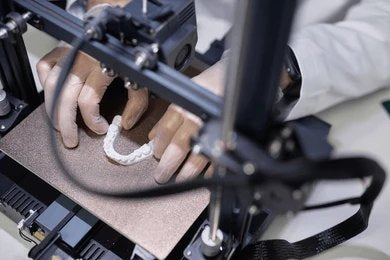
This blog breaks down the critical safety and performance differences between specialised surgical guide resins and standard 3D printing materials used in dental implantology.
The adoption of 3D printing in dentistry has progressed beyond the "early adopter" phase and is now a standard of care, especially in implant surgery. The fact that one can print a surgical guide in-house or order one from a lab has democratised guided surgery, so it's no longer reserved for complex full-arch reconstructions but can be used for more routine cases. However, with the advent of 3D printers in dental offices and labs, a dangerous misconception has arisen: "resin is resin." It is tempting to see the price disparity between a specialized dental resin and a standard hobbyist resin and wonder whether the extra price is really worth it.
This is not just a question of print quality; it is a question of patient safety and surgical precision. While a typical grey resin may appear to be just the right material for a Yoda figurine or a prototype bracket, if that same substance were placed in a patient's mouth during an operation, it could be highly hazardous. Understanding the basic distinctions between key guide resin and standard 3D Printing resins is imperative for any clinician or technician concerned with clinical outcomes and regulatory compliance. The difference is found in the invisible chemistry - biocompatibility, sterilization stability, dimensional accuracy under stress.
The Critical Factor: Biocompatibility
The most glaring difference between a dedicated key guide 3d printing resin and the standard modelling resin is biocompatibility. Standard resins are designed for industrial or hobbyist applications where visual detail is the focus. These materials are often found to contain cytotoxic photo-initiators and monomers. If placed in the mouth, they can leach chemicals that can irritate the tissue, trigger allergic reactions, or even cause chemical burns on the gingiva.
In contrast, KeyPrint KeyGuide resin is strictly tested to comply with medical device standards. It is FDA 510(k) cleared, CE marked, and a Class I medical device. This means it has been extensively biologically tested (ISO 10993) to ensure it is non-cytotoxic, non-irritating, and safe for intra-oral contact (during surgery). When you buy key guide dental resin online, you're paying for the assurance that the material will not harm the patient, which no standard "tough" or "model" resin can provide.
Sterilization: Surviving the Autoclave
Surgical guides have to be sterile before they reach the surgical area. This poses a huge engineering challenge to resin manufacturers. Most thermoplastics and resins have relatively low heat deflection temperatures. If you were to put a guide printed from standard model resin into a steam autoclave at 121 °C or 134 °C, it would warp, melt, or become brittle. A warped guide is either useless or dangerous, as it would misposition the drill.
Key guide resin for implant surgery is specially designed to withstand the harsh environment of a steam autoclave without losing its dimensional integrity. It is stable and accurate even after sterilization so that the guide fits the patient as well as it did the model. This thermal stability enables a sterile workflow that simply cannot be done with standard resins.
Optical Clarity for Surgical Visibility
Visibility is the key factor during implant placement. The surgeon needs to observe soft-tissue blanching to ensure the guide is fully seated. They also have to visualize the drilling site to provide irrigation and cooling. Standard resins often have an opaque grey, white or black colouring to conceal layer lines and reveal surface details. While aesthetically suitable for models, opacity is an enemy in surgery.
KeyGuide resin is designed to be transparent. When polished, it has outstanding optical clarity, enabling the surgeon to check the seating of the guide relative to the teeth or tissue. This transparency is not merely an aesthetic consideration; it is required to be functional to avoid placement errors when a guide is not fully seated.
Mechanical Properties: Rigidity vs. Brittleness
A surgical guide has to be rigid enough to withstand the lateral forces of a drilling handpiece. If the resin is too flexible (like some standard "tough" resins), the metal sleeve could go off during drilling, causing angulation errors. On the other hand, if the resin is too brittle (such as standard "clear" resins), it may shatter if dropped or crack due to drill vibration.
Key guide 3d printing resin has a particular balance:
High Flexural Modulus: It is stiff enough to keep the metal drill sleeve firmly in place and ensure the drill goes precisely where it is supposed to.
Tensile Strength: It has sufficient tensile strength to snap over the teeth and retain without breaking.
Impact Resistance: Unlike generic clear resins, which are often glass-like and fragile, KeyGuide is durable enough to take normal handling in a busy surgical environment.
The Cost of Compliance vs. The Cost of Failure
Specialised dental resins are indeed more expensive than standard resins. However, this cost has to be balanced against the liability and clinical risk. It is illegal to use a non-compliant resin to make a surgical guide in most jurisdictions. If an implant fails or a patient has a reaction, the use of non-validated materials leaves the clinician legally defenceless.
Furthermore, the price of the resin per guide is a small fraction of the total cost of the surgery. Saving a couple of bucks on resin is nothing compared to your failed implant or warped guide from the autoclave. Finding a good dental key guide resin supplier allows you to achieve consistent batch printing every time, reducing the hidden costs of failed prints and printer troubleshooting.
Validated Workflows for Precision
Standard resins are often "experimental", requiring the user to dial in their own exposure settings. While this is fine for hobbyists, dental labs require dependability. KeyGuide has tested workflows on leading dental printers, including Asiga, SprintRay, and Carbon.
Pre-set Parameters: The exposure times, lift speeds and light intensities are pre-calibrated by the manufacturer to ensure the guide is printed with an accuracy of a micrometre.
Dimensional Accuracy: Great care is taken to ensure that these validated settings prevent the guide from shrinking or expanding in unpredictable ways during the guiding phase of the print, providing a passive fit.
Post-Processing Protocols: There are clear instructions for washing and curing to ensure the material reaches its full potential in terms of biocompatibility and mechanical properties.
Why "Good Enough" Isn't Good Enough
In the field of implant dentistry, precision is measured in fractions of millimetres. A deviation of only a few degrees at the entry point may cause a significant error at the apex of the implant, which could damage the mandibular nerve or sinus. Standard resins introduce variables - of shrinkage, warping, and flexibility - that are unacceptable in this high-stakes environment.
Using a dedicated material such as KeyGuide eliminates these variables. You make sure that the digital plan developed in the software is faithfully translated into the real-life surgery.
Commitment to Quality
The material of choice reflects a lab's commitment to quality. While it might be possible to print a guide shape from anything, printing a functional, safe, and accurate medical device requires the right chemistry. At Zirconia Guys, we believe that using certified, purpose-built materials such as KeyGuide is the only way to deliver the safety and precision your patients and surgical partners deserve.


