

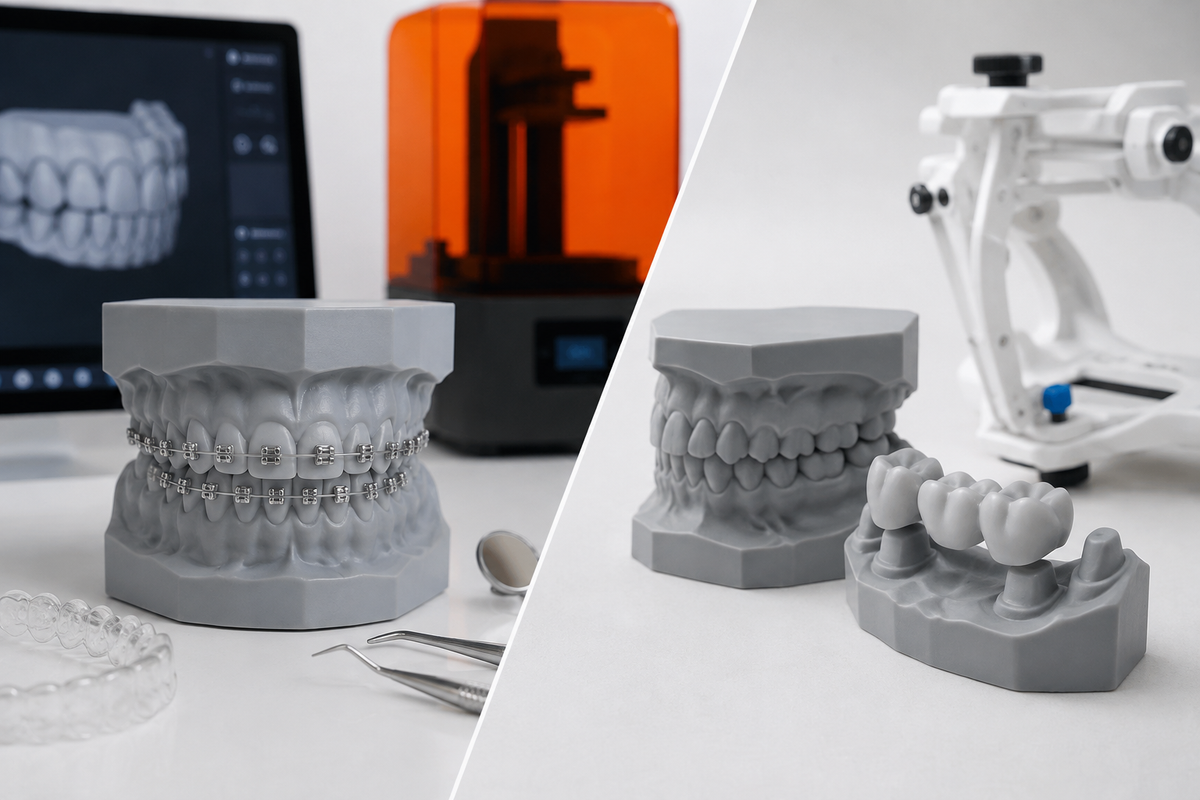
Digital dentistry has made 3D-printed models an important part of modern dental laboratory workflows. These models can support diagnosis, treatment planning, restoration design, and laboratory procedures. The resin selected for model production should therefore provide the detail and accuracy required for its intended application.
A common question is whether one model resin can be used for both diagnostic and working models. Whip Mix VeriMODEL Grey is designed for dental model production and is intended for working and presentation models. Its suitability for a specific case still depends on printer compatibility, validated settings, post-processing, and the purpose of the model.
Zirconia Guys supplies Whip Mix VeriMODEL Grey for dental laboratories and professionals looking for suitable materials for digital model production. Understanding its intended applications can help laboratories make more informed material decisions.
What Is Whip Mix VeriMODEL Grey Designed For?
Whip Mix VeriMODEL Grey is an all-purpose 3D-print resin designed for producing dental models. It is intended for working and presentation models used in crown and bridge, prosthetic, and orthodontic workflows.
The material is compatible with DLP and LCD printers using 385 nm and 405 nm light sources. This makes printer compatibility an important consideration before adding it to a laboratory workflow.
Key points include:
- Designed for dental model production
- Suitable for working and presentation models
- Compatible with appropriate DLP and LCD printing systems
- Designed to reproduce detailed model surfaces
- Available in different colours within the VeriMODEL range
These characteristics make Whip Mix VeriMODEL Grey relevant to laboratories that need a model resin for more than simple presentation purposes.
Can Whip Mix VeriMODEL Grey Be Used for Diagnostic Dental Models?
Yes. Whip Mix VeriMODEL Grey can be considered for diagnostic models when it is printed and processed according to the manufacturer's requirements.
A dental diagnostic model resin should reproduce relevant anatomy clearly enough for examination and treatment planning. Depending on the case, this can include tooth contours, occlusal surfaces, gingival anatomy, and the relationship between opposing arches.
For diagnostic applications, laboratories should pay attention to:
- Dimensional accuracy
- Surface detail
- Anatomical reproduction
- Model orientation
- Printing accuracy
- Proper post-processing
A suitable dental diagnostic model resin can convert a digital scan into a physical model that clinicians and technicians can examine directly.
However, a printed model should be used according to its intended purpose. The clinician remains responsible for determining whether the available diagnostic records are sufficient for a particular case.
Is Whip Mix VeriMODEL Grey Suitable for Working Models?
Yes. Working models are another intended application for Whip Mix VeriMODEL Grey.
A working model needs to reproduce important areas accurately enough for laboratory procedures. Depending on the case, technicians may use it to inspect preparations, margins, contacts, occlusion, or restoration of positioning.
The material can be considered for workflows involving:
- Crown and bridge procedures
- Prosthetic work
- Orthodontic models
- Restoration verification
- Laboratory design and fabrication
A dental diagnostic model resin and a working model resin do not necessarily have to be different materials. When a resin is intended for both applications and the laboratory's validated workflow provides the required accuracy, the same material can support both purposes.
The key consideration is the quality and accuracy required for the specific working procedure.
What Is the Difference Between Diagnostic and Working Dental Models?
Diagnostic and working models can look similar, but they serve different purposes. Understanding this distinction helps laboratories determine what level of detail and accuracy is required.
| Model Type | Primary Purpose | Important Requirements |
|---|---|---|
| Diagnostic model | Examination and treatment planning | Clear anatomy and dimensional consistency |
| Working model | Laboratory procedures | Accurate margins, contacts, occlusion, and surface detail |
| Presentation model | Communication and visual reference | Clean appearance and visible anatomy |
A dental diagnostic model resin should reproduce the anatomy needed for examination. A working model may require greater attention to specific areas, such as preparation of margins and interproximal contacts.
Therefore, the same resin may be suitable for both applications, but the laboratory should still assess the accuracy and quality of each printed model before using.
What Should Laboratories Check Before Printing a Dental Model?
Choosing a suitable resin is only one part of producing an accurate model. Printer settings, model design, orientation, and post-processing can all influence the result.
Before using Whip Mix VeriMODEL Grey, laboratories should check:
- Printer compatibility: Confirm that the printer is compatible with the resin and required wavelength.
- Material profile: Use the appropriate validated printer settings.
- Model orientation: Position the model to support accurate printing and reduce potential distortion.
- Support placement: Avoid placing supports where they may affect important anatomical or working surfaces.
- Washing: Follow the recommended cleaning procedure after printing.
- Post-curing: Use the appropriate curing process for the material and printer workflow.
- Final inspection: Check for incomplete areas, distortion, surface defects, or other printing issues.
These factors are particularly important when a dental diagnostic model resin is being used for detailed models. A material can have suitable properties, but incorrect printing or post-processing can still affect the finished model.
How Does Whip Mix VeriMODEL Grey Compare with Golden Brown?
Whip Mix VeriMODEL Golden Brown is another color option in the VeriMODEL range. Like the grey version, it is intended for working and presentation models.
The main difference is visual appearance. Golden Brown provides a warmer shade that may offer useful contrast when examining restorative materials and model details.
A laboratory may consider Whip Mix VeriMODEL Golden Brown when:
- A warmer model color is preferred
- Additional visual contrast is useful
- Models are used for presentation
- The laboratory already has a workflow built around the Golden-Brown shade
Whip Mix VeriMODEL Golden Brown is not necessarily better than Grey. The choice should depend on the laboratory's visual preferences and the intended model application.
For routine diagnostic and working models, the most important factors remain in dimensional accuracy, surface detail, printer compatibility, and proper processing rather than color alone.
How Is Dental Model Resin Different from Zirconia?
Dental model resin and zirconia serve different purposes within a digital dental workflow. Model resin is used to create physical representations of dental anatomy, while zirconia is used to manufacture dental restorations.
For example, zirconia blocks dental laboratories use are intended for milling restorations rather than producing diagnostic models. A zirconia blank is also selected according to the requirements of the restoration being fabricated.
The same distinction applies to zirconia dental blanks and dental zirconia discs. These materials belong to the restorative side of CAD/CAM production, while model resin belongs to the model-production stage.
Understanding this difference helps laboratories select materials according to their intended application:
- Dental diagnostic model resin: Used for producing physical dental models
- Zirconia blank: Used as a starting material for milling restorations
- Zirconia dental blanks: Used for CAD/CAM restorative fabrication
- Dental zirconia discs: Used for milling dental restorations
- Zirconia blocks dental: Selected according to restorative requirements
This means dental zirconia should not be treated as an alternative to model resin, even though both materials can be part of the same digital workflow.
Choosing the Right Material for Each Digital Workflow
Whip Mix VeriMODEL Grey can be suitable for both diagnostic and working models when it is used within its intended applications and processed according to the appropriate printing workflow. Its ability to support different model applications can make it a practical option for laboratories looking for consistency across routine digital workflows.
The final model quality still depends on more than the resin itself. Printer compatibility, validated settings, model design, orientation, washing, curing, and quality inspection all play a role in producing accurate and usable models. Choosing the right dental diagnostic model resin should therefore be based on the requirements of the specific application.
Zirconia Guys supplies Whip Mix VeriMODEL Grey along with other dental laboratory materials for dental professionals and laboratories. Its range can help laboratories explore suitable materials for digital model production and other CAD/CAM workflows based on their specific production requirements.


