

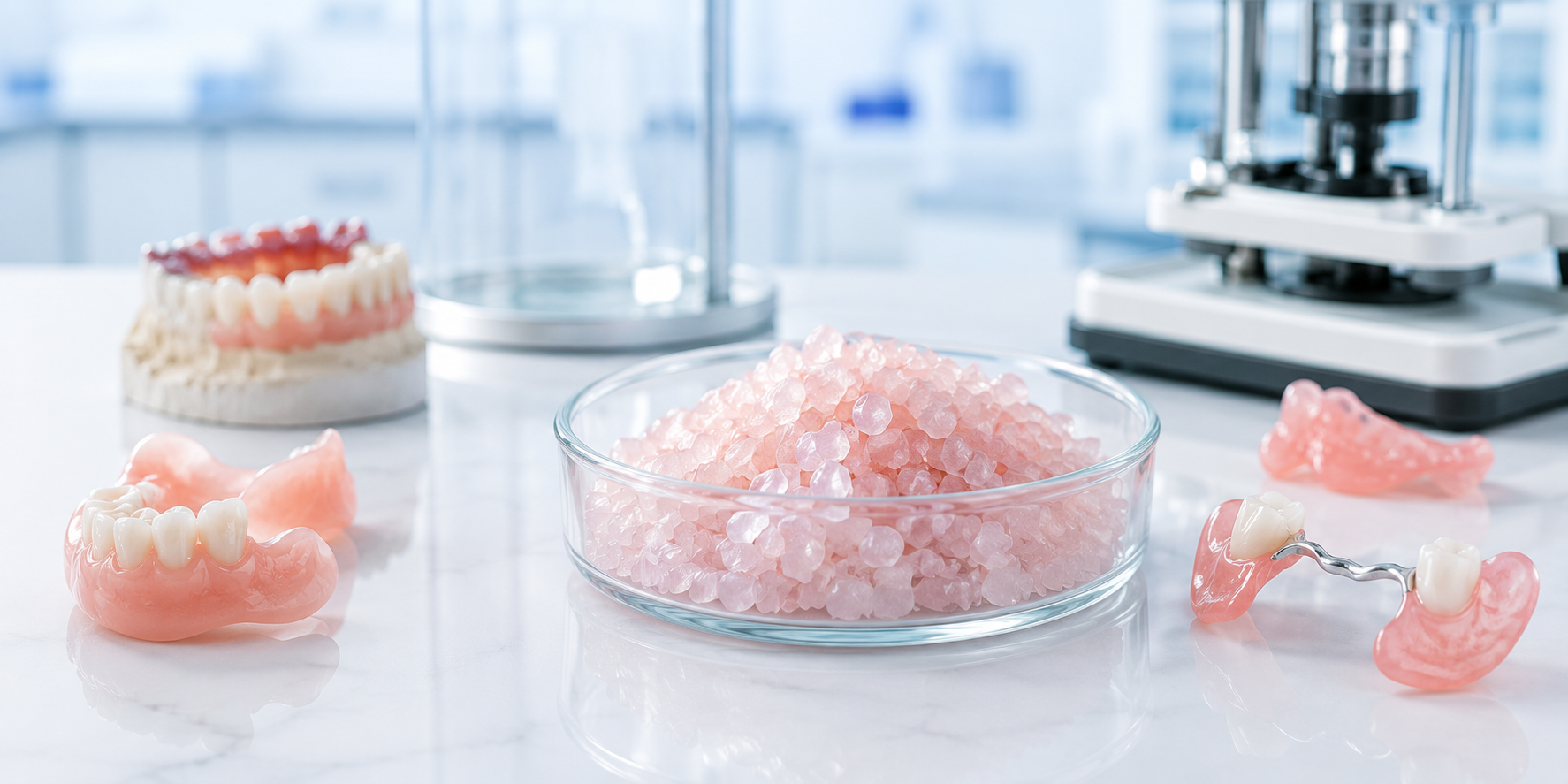
Acrylic resin is one of the most widely used materials in dentistry yet most discussions about it either stay surface-level or focus on industrial applications that have little relevance to dental lab workflows. For dental professionals and lab technicians, acrylic resin is not an abstract chemistry concept. It is the material inside every denture base, every temporary crown, every occlusal splint, and every 3D-printed dental appliance in daily production. Understanding what it is, why it performs the way it does, and how to select the right formulation for each application directly affects the clinical quality and efficiency of everything a dental lab produces.
This guide covers acrylic resin specifically through the lens of dental laboratory use what differentiates CAD/CAM-grade PMMA from bench-mixed acrylic, where each formulation fits in the clinical workflow, how acrylic resin compares to dental zirconia discs and ceramic alternatives, and how to build a rational acrylic resin inventory for a full-service dental lab.
What Is Acrylic Resin? The Chemistry Behind the Material
Acrylic resin is the collective name for a family of polymers derived from acrylic acid, methacrylic acid, or their derivatives. In dentistry, the most clinically relevant member of this family is polymethyl methacrylate PMMA formed by polymerizing methyl methacrylate (MMA) monomer into long polymer chains. The properties of the final material depend primarily on how that polymerization is carried out: the temperature, pressure, initiator system, and degree of conversion all affect the mechanical and biological characteristics of the finished product.
The distinction that matters most in a dental lab context is the difference between bench-polymerized acrylic and industrially pre-polymerized acrylic. Conventional acryclic resin denta applications bench-mixed denture acrylic, cold-cure temporary material, chairside repair resin are polymerized at atmospheric pressure with chemical or heat initiation. Industrial pre-polymerized PMMA, used in CAD/CAM disc form, is polymerized under 50–200 bar of pressure at elevated temperature. That pressure difference is what fundamentally separates the two material classes in terms of residual monomer content, porosity, mechanical consistency, and clinical performance.
Bench-polymerized acrylic typically retains 3–5% residual monomer unreacted MMA that can leach into oral tissue, causing sensitivity responses in susceptible patients. Industrial pre-polymerized PMMA achieves residual monomer below 0.5%, well within ISO 20795-1 biocompatibility thresholds. The higher-pressure polymerization also eliminates most porosity, producing a denser, more homogeneous polymer matrix that mills more cleanly, polishes more easily, and maintains its surface quality longer under intraoral conditions.
Types of Acrylic Resin Used in Dental Labs
Acrylic resin in dentistry is not a single product it is a material class with distinct formulations for distinct clinical applications. Using the wrong formulation for an application is one of the most avoidable sources of suboptimal clinical outcomes in dental laboratory production.
PMMA denture base resin is formulated with gingival-tone pigmentation and optimized for tissue contact. Its primary requirements are biocompatibility (low residual monomer), dimensional stability after milling and polishing, and shade accuracy that matches natural gingival tissue across patient demographics. The key denture base resin is the standard for digital denture workflows pre-polymerized to industrial standards, compatible with all major open-system mills, and documented to meet ISO 20795-1 denture base polymer requirements.
Multilayer PMMA for crown and bridge provisionals is formulated with a dentine-to-incisal shade gradient. This gradient architecture replicates the optical zonation of natural tooth anatomy warmer, more saturated chroma at the cervical transitioning to cooler, more translucent appearance at the incisal edge within a single pre-shaded disc. Labs using multilayer PMMA for anterior temporaries eliminate the external staining step on standard A-D shade cases, reducing finishing time significantly per unit.
Hard splint acrylic is a high-hardness PMMA formulation used for occlusal splints, night guards, and bruxism appliances. This formulation prioritizes surface hardness and dimensional accuracy over translucency or shade matching. Milled hard splint acrylic delivers superior occlusal accuracy compared to pressure-formed thermoplastics because the restoration is designed from a digital model and milled to a precise occlusal scheme rather than vacuum-formed over an analog cast.
Cold-cure and auto-polymerizing acrylic remains in use for chairside repairs, denture relines, and custom impression trays. This bench-mixed format is not a CAD/CAM material it is a manual chairside material that serves repair and adjustment functions that pre-polymerized discs cannot address. Understanding where cold-cure acrylic fits relative to milled PMMA prevents labs from inappropriately substituting one for the other.
Dental Resin 3D Printing: Where Acrylic Chemistry Meets Digital Production
The fastest-growing segment of acrylic resin use in dental labs is photopolymer resin for 3D printing a category that has expanded dramatically alongside the adoption of desktop and professional dental 3D printers. Dental resin 3d printing products are formulations of acrylic-based monomers and oligomers that cure rapidly under ultraviolet or visible light, layer by layer, to produce dental appliances, models, surgical guides, and provisional restorations.
While the chemistry shares the same acrylic monomer foundation as PMMA, 3D printing resins are distinct products with distinct formulation requirements. Photopolymer resins must cure at specific wavelengths (typically 385 nm or 405 nm) within defined layer thickness parameters for the printer's build platform. They must also meet biocompatibility requirements appropriate to their specific application a model resin used only for diagnostic casts has different requirements than a splint resin or a try-in restoration that contacts oral tissue.
The key clinical categories of dental 3D printing resin in current lab use include model resins for study casts and implant planning models, surgical guide resins for implant placement guides, splint and night guard resins, try-in restorations for checking shade and fit before final fabrication, orthodontic model resins, and temporary crown and bridge resins for direct printing of provisionals. Each category requires a specifically formulated resin cross-category substitution produces unreliable results and potential biocompatibility issues.
The zirconia blocks dental workflow and the 3D printing resin workflow are increasingly complementary rather than competing. Labs run milled zirconia for permanent fixed restorations and 3D-printed resin for the surrounding workflow infrastructure diagnostic models, surgical guides, provisional restorations, and custom trays creating a fully digital production pipeline where both material categories contribute at their respective strength points.
Key Benefits of Acrylic Resin in Dental Applications
Understanding why acryclic resin dental formulations remain the standard for specific applications despite the expansion of dental zirconia discs, ceramic, and composite alternatives comes down to a set of clinically relevant properties that no other material class combines at acrylic's cost and accessibility.
Repairability
Acrylic resin is the only dental restoration material that can be chairside-repaired using the same material class as the original restoration. A fractured denture base, a broken provisional crown, a cracked splint all can be repaired with cold-cure acrylic at the chairside without fabricating a new restoration. Zirconia blank and ceramic restorations, by contrast, cannot be repaired when fractured they must be remade. This repairability is clinically significant in removable prosthetics, long-term provisionals, and any application where chairside modification is expected.
Adjustability
Acrylic resin can be ground, added to, and polished at the chairside with conventional laboratory burs and acrylic instruments. Occlusal adjustments, margin refinements, contact point modifications all are straightforward with acrylic in ways that ceramic and zirconia dental blanks are not. For provisional restorations that serve as the clinical template for the final restoration design, this adjustability is a core functional requirement.
Biocompatibility in Tissue-Contact Applications
Pre-polymerized, industrial-grade PMMA with residual monomer below ISO 20795-1 thresholds is biocompatible for long-term tissue contact the standard for denture bases that sit against oral mucosa all day. This biocompatibility profile, combined with the material's light weight and tissue-like esthetic character, makes PMMA the correct material for removable prosthetics regardless of the increasing strength of ceramic alternatives.
Cost Efficiency
Acrylic resin discs and 3D printing resins are significantly lower in per-unit material cost than ceramic or dental zirconia discs. For temporary restorations with defined functional lifespans typically 2–12 weeks for provisionals, 3–12 months for long-term temporaries material cost per unit is a legitimate procurement factor. The lower material cost of acrylic supports competitive pricing on provisional workflows without sacrificing material quality when the correct formulation is sourced from a reliable supplier.
CAD/CAM Machinability
PMMA is one of the most machinable materials in the CAD/CAM portfolio. Its pre-sintered softness relative to zirconia produces clean chip formation, minimal tool wear, fast milling cycles, and smooth surfaces that require minimal post-processing. A milled PMMA provisional crown takes a fraction of the milling time required for a zirconia blank of equivalent size a workflow efficiency that matters significantly in high-volume lab production.
Acrylic Resin vs. Zirconia: A Clear Division of Indications
The most important framework for dental labs working with both materials is understanding that acrylic resin and dental zirconia are not competing materials they are complementary materials with clearly separated primary indications.
Dental bonding resin and other acrylic-based materials cover the temporary and removable spectrum: provisionals, denture bases, splints, orthodontic appliances, surgical guides, and diagnostic models. Zirconia blocks whether zirconia blank format for chairside mills or disc format for lab mills cover the permanent fixed restoration spectrum: crowns, bridges, implant-supported frameworks, and full-arch reconstructions. The two material categories serve different points in the same treatment workflow, and labs that stock and use both correctly are more efficient and produce better outcomes than labs that attempt to use one material class across all applications.
As a zirconia materials distributor usa, ZirconiaGuys stocks the full range of both material categories acrylic resin formulations including Keystone's dental resin range and the complete Upcera and Aidite zirconia dental blanks and disc lineup from US inventory. Labs sourcing both CAD/CAM material categories from a single US supplier reduce ordering overhead, maintain consistent batch documentation, and access technical support across the full workflow from provisional to permanent.
How to Select the Right Acrylic Resin Formulation?
The most common acrylic resin selection error in dental labs is treating it as a single product category. The following framework maps clinical applications to the correct formulation:
- For full and partial denture bases — use industrial pre-polymerized PMMA denture base discs in gingival shades. Confirm ISO 20795-1 compliance and documented residual monomer levels below 0.5%.
- For anterior temporary crowns — use multilayer pre-shaded PMMA discs that match your shade system. Pre-shaded multilayer eliminates staining on standard A-D shade cases and is the most time-efficient format for high-volume anterior provisional production.
- For posterior temporary crowns — use single-shade PMMA in the appropriate tooth shade. Multilayer gradient adds cost without esthetic benefit in posterior cases where shade precision is secondary to fit and occlusal accuracy.
- For occlusal splints and night guards — use hard splint PMMA specifically formulated for this application. Standard crown-and-bridge PMMA is not hard enough for long-term splint applications under bruxism loading.
- For surgical guides — use biocompatible surgical guide resin formulated for the appropriate printer wavelength. Guide resin must meet biocompatibility requirements for tissue contact during surgical procedures.
- For orthodontic models — use dimensional-accuracy model resin. Model resins are not biocompatible for intraoral use and should not be substituted for splint or provisional resins.
Acrylic resin remains one of the most clinically indispensable material categories in dental laboratory production not because it is the strongest or most durable material available, but because it is the right material for a specific and large set of clinical applications where repairability, adjustability, biocompatibility, and cost efficiency are the determining requirements. Understanding the distinction between formulations, matching each to its correct indication, and sourcing from suppliers who document batch quality and meet ISO standards is what separates labs that use acrylic resin effectively from those that compensate for material selection errors through extra labor and remakes.


