

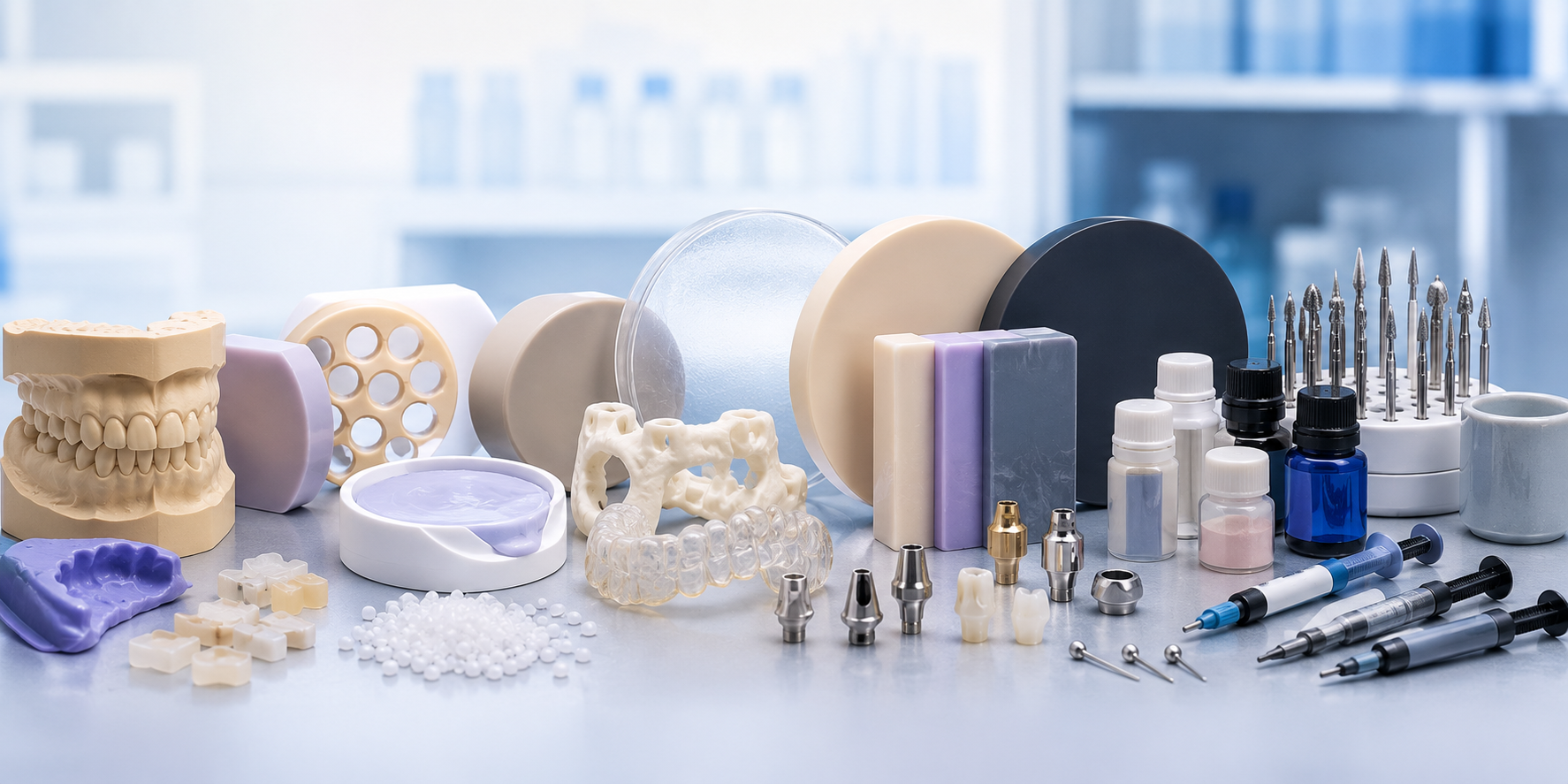
The materials a dental lab stocks define what it can produce, how fast it can produce it, and how consistently it can deliver clinical-quality outcomes. Material selection is not a procurement decision that happens once it is an ongoing operational choice that directly determines case quality, remake rates, bench time per unit, and ultimately, the lab's competitive position in an increasingly demanding market.
Modern dental laboratories run on a core set of materials that have been refined over decades of clinical use and CAD/CAM development. Some are ceramic. Some are polymer. Some are metal. Each has a clearly defined role, a specific set of clinical indications, and performance characteristics that make it the right choice for some cases and the wrong choice for others. Understanding all eight gives any dental professional lab technician, prosthodontist, or practice owner a complete picture of what the modern dental lab production floor actually runs on.
1. Zirconia — The Dominant CAD/CAM Ceramic
Zirconia is the highest-volume CAD/CAM milling material in the modern dental lab and has been since it displaced PFM as the standard for fixed restorations in the 2010s. No other material combines the flexural strength range (500–1200+ MPa depending on grade), biocompatibility, chemical stability, and esthetic versatility of the current zirconia family. It covers every fixed restoration indication from high-load posterior bridges to translucent anterior veneers with distinct grades engineered for each point on that spectrum.
The material is available as dental lab materials in three primary grade classifications. 3Y-TZP (three mole percent yttria) delivers 900–1200+ MPa flexural strength for posterior bridge and high-load applications. 4Y zirconia provides 600–800 MPa with significantly higher translucency the daily production standard for anterior and premolar cases. 5Y zirconia pushes translucency to its maximum at 500–650 MPa reserved for anterior esthetic cases where shade matching to highly translucent natural dentition is the overriding clinical priority.
Disc formats: Zirconia blocks dental labs rely on come in two primary formats: flat single-composition (white unshaded or pre-shaded) and multilayer gradient. Flat white zirconia blank discs give full manual shade control through external staining. Pre-shaded multilayer discs embed the VITA-compatible shade gradient internally, eliminating the staining step for standard A–D shade cases and reducing bench time significantly at volume. For labs running the full range of anterior and posterior cases, stocking both formats is the correct strategy.
Disc formats and sourcing: The standard diameter for dental lab milling is 98mm, compatible with all major open-system mills. As a trusted zirconia materials distributor usa, ZirconiaGuys stocks aidite zirconia discs for dental labs including the full Aidite multilayer and pre-shaded range, as well as upcera dental zirconia across 3Y, 4Y, and 5Y grades — all from US inventory with no international lead times.
Clinical indications: Posterior bridges (3Y), anterior crowns (4Y/5Y multilayer), premolar crowns (4Y), implant-supported restorations (grade by zone), full-mouth rehabilitation frameworks.
2. PMMA — The Provisional and Removable Standard
PMMA (polymethyl methacrylate) is the second-highest-volume CAD/CAM milling material in most dental labs and the exclusive material class for temporary restorations, denture bases, and occlusal appliances in digital workflows. It is not a competitor to dental zirconia discs it is the provisional phase that precedes the final zirconia restoration in every full treatment workflow.
Pre-polymerized CAD/CAM PMMA discs are manufactured under industrial pressure and temperature conditions that produce a denser, more homogeneous polymer matrix than anything bench-mixed acrylic can deliver. Residual monomer content drops below 0.5% — well within ISO 20795-1 biocompatibility thresholds and dimensional stability improves significantly over conventional flask-and-pack processing.
Formulation types: Denture base PMMA carries gingival tissue pigmentation for full and partial denture bases. Multilayer PMMA incorporates a dentine-to-incisal shade gradient for temporary crown and bridge provisionals. Clear PMMA formulations serve occlusal splints, night guards, and clear appliances. Each formulation is optimized for its specific application using denture base PMMA for crown provisionals or clear PMMA for denture bases are both material selection errors that produce poor clinical results.
Clinical indications: Temporary crowns and bridges (2–8 weeks), long-term provisionals (3–12 months), CAD/CAM full and partial denture bases, implant-supported temporaries during osseointegration, occlusal splints and night guards.
3. Lithium Disilicate — Precision Esthetics for Single Units
Lithium disilicate (most commonly encountered as IPS e.max) occupies a specific, well-defined position in the dental lab materials ecosystem: maximum esthetic integration for single-unit anterior restorations where the clinical priority is optical matching to highly translucent natural dentition. Its flexural strength of approximately 400 MPa is lower than all zirconia grades but higher than feldspathic porcelain, making it appropriate for single-unit crowns and veneers under moderate occlusal load.
The material's optical properties are its defining clinical advantage. Lithium disilicate transmits and scatters light in a way that produces exceptional depth of color and natural-looking translucency the standard against which esthetic zirconia grades are benchmarked. For anterior single crowns adjacent to natural teeth with high translucency, lithium disilicate and 5Y zirconia are the two materials worth evaluating, with the final choice depending on preparation design and bonding requirements.
Clinical indications: Anterior single crowns, veneers, inlays, onlays. Not appropriate for posterior bridges of 3+ units or high-load posterior single crowns where 3Y or 4Y zirconia is the structurally safer choice.
4. PEEK — High-Performance Polymer for Framework Applications
PEEK (polyether ether ketone) has entered dental lab production as a metal-free alternative for removable partial denture frameworks, implant-supported bars, and orthodontic appliances. Its flexural strength of 80–170 MPa, combined with its tooth-like elastic modulus and excellent biocompatibility, makes it uniquely suited for applications where metal frameworks have traditionally been used but metal-free solutions are clinically preferred.
PEEK does not corrode, does not generate allergic responses in metal-sensitive patients, and can be milled from pre-fabricated discs in standard CAD/CAM equipment. The material's tooth-like color also eliminates the greyish translucency problem associated with metal frameworks under thin tissue or mucosa. Labs that handle patients with documented metal allergies or who specify metal-free full workflows should stock PEEK alongside their standard dental zirconia and PMMA inventory.
Clinical indications: Removable partial denture frameworks, implant-supported bars and telescopic crowns, long-term provisional frameworks, orthodontic retention appliances.
5. Cobalt-Chrome (Co-Cr) Alloy — The Metal Framework Standard
Despite the growth of PEEK and milled titanium, cobalt-chrome alloy remains the dominant material for cast and sintered removable partial denture frameworks in labs that handle high volume removable prosthetics. Its mechanical properties flexural strength of 600–900 MPa, high hardness, and excellent fatigue resistance make it the benchmark for metal frameworks that must remain dimensionally stable under repeated loading across years of clinical service.
In modern labs, Co-Cr frameworks are produced by one of three methods conventional lost-wax casting, selective laser sintering (SLS) from Co-Cr powder, or milling from pre-fabricated Co-Cr blanks. The SLS and milling routes integrate directly into digital lab workflows, eliminating the manual casting steps that introduce the most variability in conventional framework production. Zirconia dental blanks and Co-Cr discs can both be processed in the same digital design workflow the material and fabrication route diverge only at the manufacturing stage.
Clinical indications: Removable partial denture frameworks, metal-ceramic crown and bridge substructures, implant bars and custom abutments requiring high fatigue resistance.
6. Composite Resin Chairside and CAD/CAM Versatility
Composite resin serves dual roles in modern dental production: as a chairside direct restorative material placed by the clinician, and as a pre-fabricated CAD/CAM block for indirect lab-milled restorations. The CAD/CAM composite category represented by products like Vita Enamic (polymer-infiltrated ceramic network) and resin nano-ceramic blocks occupies the gap between pure PMMA provisionals and full ceramic crowns.
CAD/CAM composite blocks deliver flexural strength in the 150–200 MPa range with an elastic modulus closer to natural dentin than either zirconia or lithium disilicate. This elastic compliance is clinically advantageous in cases where stress absorption at the restoration-tooth interface is a design priority full-coverage crowns on structurally compromised teeth, for example, where the flex of the restoration reduces fracture risk at the margin.
Clinical indications: Single-unit crowns and onlays in moderate-load cases, inlays, veneers, implant crowns where elastic modulus matching to surrounding bone and tissue is clinically preferred.
7. 3D Printing Resins — The Fastest-Growing Material Category
3D printing resins have become a significant share of modern dental lab materials inventories in labs that have adopted digital light processing (DLP) or stereolithography (SLA) printing workflows. The category covers a wide range of formulations: model resins for diagnostic casts, surgical guide resins for implant placement guides, splint resins for hard and soft night guards, tray resins for custom impression trays, and most recently permanent crown resins with mechanical properties approaching composite blocks.
Keystone dental products represent one of the most complete 3D printing resin ranges available to US labs, covering model, splint, tray, ortho, guide, and denture base applications within a single brand ecosystem. Labs running DLP or SLA printing workflows benefit from consistent brand compatibility matching resin formulations to print profiles validated for the same manufacturer reduces the calibration and troubleshooting overhead that comes with mixing resin brands across applications.
The material's throughput advantage over milling is most significant for high-volume model and guide production a DLP printer can produce multiple models simultaneously overnight, with no operator intervention, at a per-unit material cost below any comparable milled alternative.
Clinical indications: Diagnostic models, surgical guides, custom impression trays, orthodontic models, hard and soft splints, provisional crowns (permanent resin grades), denture bases (printable PMMA grades).
8. Titanium The Implant and Framework Metal
Titanium — primarily Grade 4 commercially pure and Grade 5 (Ti-6Al-4V alloy) — is the implant material and the metal substructure choice for implant-supported restorations where maximum biocompatibility is the clinical requirement. Its combination of low density, high strength-to-weight ratio, corrosion resistance in oral fluids, and exceptional osseointegration performance makes it the universal standard for implant fixtures and a preferred material for implant bars and custom abutments.
In dental lab production, titanium is processed as pre-milled blanks for custom abutments and implant bars, or as a received component (the implant fixture itself) onto which lab-fabricated crowns and superstructures are mounted. Milled titanium abutments from pre-fabricated blanks are standard in labs handling implant-level work the precision of CAD/CAM milling produces abutment margins and platform geometries that casting cannot consistently replicate.
Clinical indications: Implant fixtures (placed surgically), custom abutments, implant bars for full-arch restorations, metal-ceramic substructures requiring maximum biocompatibility.
How to Build a Complete Material Inventory for Your Dental Lab?
A well-stocked modern dental lab doesn't require every material on this list it requires the right materials for its case mix. The following framework guides inventory decisions based on production focus:
- Full-service lab (fixed + removable + implant): 3Y and 4Y/5Y zirconia in flat and multilayer formats, PMMA in denture base and multilayer crown formulations, lithium disilicate for anterior esthetic cases, Co-Cr for removable frameworks, titanium components for implant work, and 3D printing resins for models and guides.
- Fixed-only CAD/CAM lab: Zirconia as the primary milling material across 3Y, 4Y, and 5Y grades. PMMA multilayer for temporaries. Composite or lithium disilicate for select anterior cases. 3D resin for models and surgical guides.
- Removable-focused lab: PMMA denture base as the primary material. Co-Cr or PEEK for partial denture frameworks. 3D model resin for diagnostic casts and articulation.
Sourcing all zirconia dental blanks, PMMA, and 3D resins from a US-based zirconia materials distributor usa eliminates international lead time uncertainty and ensures consistent batch documentation the foundation of reproducible quality across production runs.
The eight materials covered in this guide represent the complete production palette of a modern dental laboratory. Zirconia anchors the fixed restoration workflow. PMMA handles provisionals and removables. Lithium disilicate serves the esthetic anterior niche. PEEK and Co-Cr cover metal-free and traditional framework applications. Composite resin bridges the gap between temporaries and ceramics. 3D printing resins are transforming model, guide, and appliance production. Titanium is the implant and custom abutment standard.
Understanding each material at the level of its mechanical properties, clinical indications, and production workflow requirements is what separates labs that consistently hit quality targets from labs that compensate for material selection errors through extra labor and remakes. The right material in the right application is the foundation of every efficient, consistent dental lab.


