

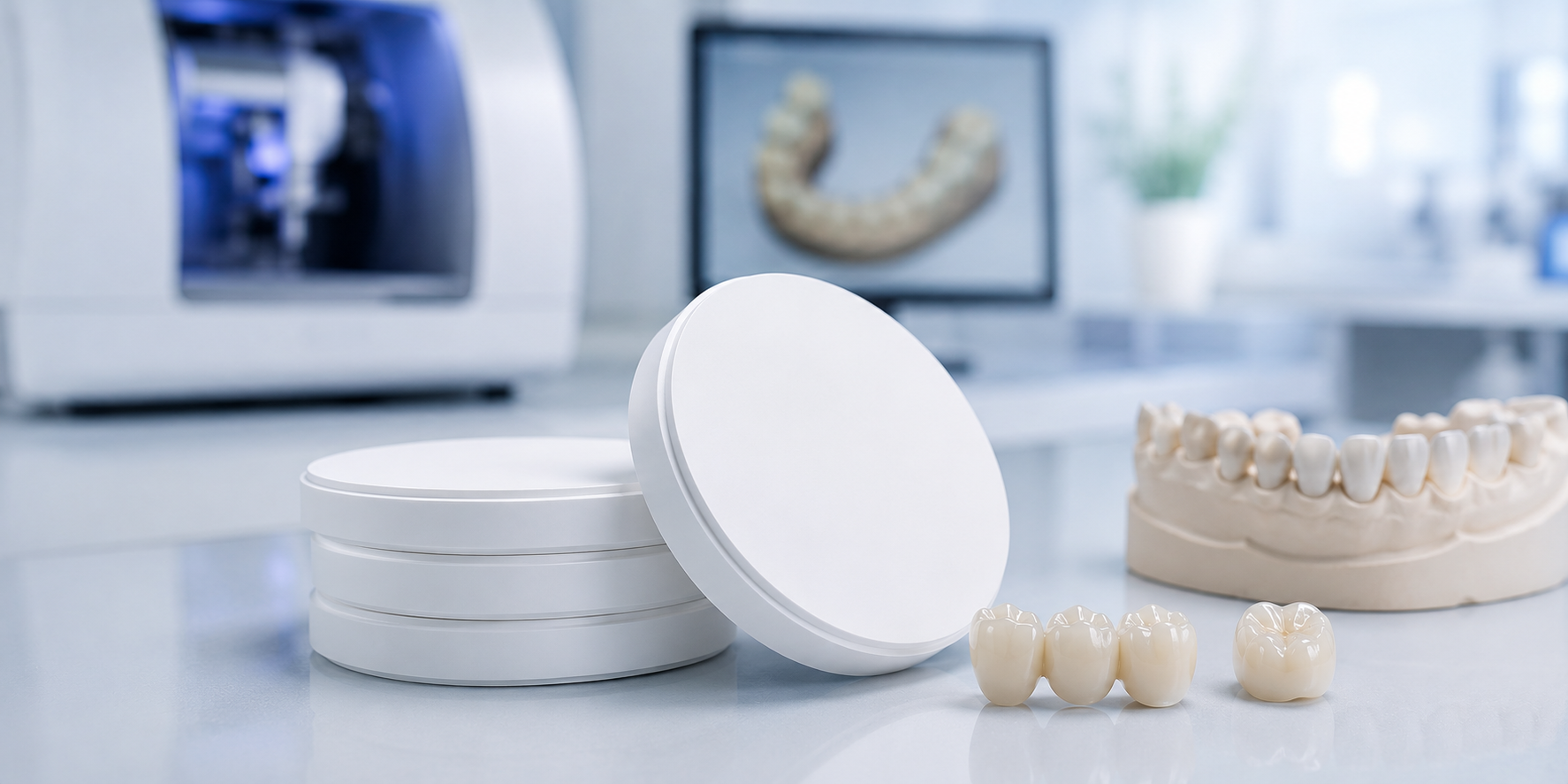
The shift toward zirconia in dental restorations is not a trend driven by marketing it is a materials science outcome. When dental labs and clinicians compare restoration options on the criteria that actually determine clinical success strength, longevity, biocompatibility, esthetic quality, and workflow efficiency zirconia consistently outperforms the alternatives across the widest range of indications. No other single material class covers posterior structural demand and anterior esthetic requirements with the same reliability.
Understanding why dental zirconia has become the dominant restoration material requires looking at both what the material delivers clinically and how the disc format integrates into modern CAD/CAM production workflows. This guide covers both the material advantages that make zirconia the right choice, and the practical disc selection decisions that determine how well those advantages translate into production outcomes.
What Zirconia Discs Are and How They Work in CAD/CAM?
Zirconia in its natural state is zirconium dioxide a white crystalline ceramic oxide. For dental use, it is stabilized with yttrium oxide (yttria) to prevent destructive phase transformation at room temperature, then processed into pre-sintered disc blanks for CAD/CAM milling. The disc is milled in its chalk-like pre-sintered state, approximately 20–25% oversized to compensate for the shrinkage that occurs during the sintering step. After milling, the restoration is sintered in a furnace to its final dimensions and full mechanical strength.
This production sequence is what makes zirconia discs the backbone of modern dental lab operations. The pre-sintered state is soft enough to mill with precision at high speed, while the sintered final product delivers mechanical properties that no other milled dental ceramic can match. The disc format enables digital design, digital milling, and sintering to be performed sequentially producing accurate, consistent, reproducible restorations at a production pace that hand-fabrication workflows cannot approach.
Every dental zirconia discs order from a reliable zirconia materials distributor USA should include the full technical specification for the disc yttria content, flexural strength after sintering, sintering profile requirements, and open-system compatibility confirmation. These specifications directly determine clinical suitability and are not interchangeable between products even when they share the same grade designation.
The Core Material Advantages That Make Zirconia the Standard
Flexural strength that covers every clinical indication.
Zirconia's flexural strength range 500 to 1200+ MPa depending on grade is without equal in restorative dentistry. Lithium disilicate (e.max) delivers approximately 400 MPa. PFM ceramic layers deliver 200–400 MPa on a metal substructure. Standard dental porcelain without a substructure delivers 80–120 MPa. Zirconia at its lowest-strength esthetic grade (5Y, ~500–650 MPa) still exceeds every competing ceramic for single-unit applications. At its highest-strength grade (3Y, 900–1200+ MPa), it is the only ceramic material that reliably meets the connector cross-section requirements for multi-unit posterior bridges under full occlusal load.
Biocompatibility for long-term tissue contact.
Dental zirconia is chemically inert in oral environments. It does not corrode, does not leach metal ions into oral tissue, and does not generate galvanic currents at margins the way metal-containing restorations can. It meets ISO 6872 biocompatibility requirements for dental ceramic and is the standard material for implant-supported restorations where tissue contact is permanent and continuous.
Esthetic versatility across the grade range.
The early knock on zirconia that it was too opaque for anterior esthetic cases no longer applies to modern formulations. The development of 4Y and 5Y yttria grades, combined with multilayer gradient disc manufacturing, has produced zirconia dental blanks that transmit light in a way that closely approximates natural enamel. Pre-shaded multilayer discs eliminate the external staining step for standard A-D shade cases, and the optical gradient from cervical to incisal produces natural-looking shade transitions directly from the mill.
Wear characteristics that protect opposing dentition.
One of the less-discussed advantages of modern zirconia formulations is their wear behavior. Early high-strength 3Y zirconia was criticized for excessive wear on opposing natural enamel due to surface roughness after polishing. Modern 4Y and 5Y esthetic grades, polished to a smooth glaze finish, exhibit wear rates that are clinically compatible with natural dentition producing minimal wear on opposing teeth under normal occlusal conditions.
Open-system CAD/CAM compatibility.
Standard zirconia blocks dental labs use are produced in 98 mm disc diameter the universal open-system format compatible with all major dental milling machines including Roland, Amann Girrbach, Zirkonzahn, VHF, Sirona, and Datron. This compatibility means labs can evaluate and switch products without equipment investment, keeping procurement competitive and workflow flexible.
For a detailed breakdown of how zirconia grades compare on strength, translucency, and clinical indication including the 3Y, 4Y, and 5Y classification system explained in ful the Guide to Materials & Strengths of Zirconia Dental Restorations on ZirconiaGuys covers every variable that determines correct material selection.
Zirconia Discs vs. Competing Restoration Materials
The case for zirconia is strongest when viewed comparatively. Here is how dental zirconia discs stack up against the other materials labs and clinicians regularly evaluate.
Zirconia vs. PFM (porcelain-fused-to-metal).
PFM restorations dominated for decades before zirconia displaced them as the production standard. PFM delivers acceptable strength through its metal substructure and acceptable esthetics through the porcelain veneer but the combination produces a dark metal margin at the gumline, requires opaque masking layers that reduce translucency, carries corrosion risk from the metal alloy, and is significantly more labor-intensive to prouce than a milled zirconia crown. Modern zirconia blank formats deliver better esthetics, comparable or superior strength, no metal margin, and faster production. PFM has no advantage over zirconia for the majority of crown and bridge cases.
Zirconia vs. lithium disilicate.
Lithium disilicate (e.max) offers excellent translucency and strong bonding characteristics that make it the preferred choice for thin veneers and minimally prepared anterior crowns where adhesive bonding is the retention mechanism. For occlusal crowns under full occlusal load, zirconia's higher flexural strength is the decisive advantage. For posterior bridges, there is no contest zirconia is the only appropriate ceramic choice. The zirconia blocks dental format handles every indication lithium disilicate covers, plus the posterior structural cases where lithium disilicate is contraindicated.
Zirconia vs. PMMA.
PMMA (polymethyl methacrylate) is the temporary restoration material correct for provisionals, denture bases, and splints. It is not a competitor to zirconia for permanent restorations. PMMA at 80–120 MPa flexural strength will not survive the years of occlusal loading that a zirconia restoration handles without degradation. The two materials are complementary workflow components: PMMA handles the temporary phase, zirconia delivers the permanent restoration.
| Material | Flexural Strength | Posterior Bridge | Anterior Esthetics | Long-Term Stability |
|---|---|---|---|---|
| 3Y Zirconia | 900–1200+ MPa | Best choice | Requires staining | Excellent |
| 4Y/5Y Zirconia | 500–800 MPa | Short spans only | Excellent | Excellent |
| Lithium disilicate | ~400 MPa | Not recommended | Very good | Good |
| PFM | 200–400 MPa ceramic | Acceptable | Metal margin issue | Moderate |
| PMMA | 80–120 MPa | Temporary only | Temporary only | Limited |
White vs. Pre-Shaded Zirconia Blanks: Choosing the Right Format
The grade decision (3Y/4Y/5Y) determines structural and optical performance. The format decision white unshaded vs. pre-shaded determines how the disc integrates into the lab's production workflow and how much finishing labor each case requires.
White zirconia dental blanks
They give the technician complete manual control over shade. The uncolored starting point enables custom staining across any shade range — standard VITA, unusual chromas, or complex characterization effects. White blanks are the right choice for complex cases, unusual shades, or when the technician needs to build precise effects (craze lines, fluorosis, hypocalcification simulation) that pre-shaded discs cannot accommodate without additional surface work.
Pre-shaded zirconia dental blanks
They are pigmented at the manufacturing stage to match VITA Classic or 3D-Master shade values. For the majority of daily lab production standard A1 through D4 cases pre-shaded discs eliminate the external staining step entirely and deliver consistent results regardless of which technician handles the case. The shade gradient is in the material, not dependent on operator technique.
The practical stocking strategy for most labs: white blanks as a secondary stock for complex and custom cases, pre-shaded as the production default for standard shade volume. Labs that standardize on pre-shaded multilayer discs for anterior cases consistently report significant reductions in post-sintering finishing time.
Which Zirconia Discs to Stock: Product Selection for US Dental Labs?
For US dental labs sourcing from a reliable zirconia materials distributor USA, the product selection decision comes down to matching disc specifications to the production mix of the specific lab.
For labs with high posterior bridge volume, explore functional zirconia by Upcera is a proven choice engineered for the strength requirements of multi-unit posterior cases, with consistent pre-sintered density that supports reliable milling performance across long production runs. The functional grade delivers the flexural strength posterior bridges require without the compromises of esthetic-grade formulations that are not designed for structural applications.
For labs with high anterior esthetic volume, explore esthetics zirconia discs by Upcera provide the multilayer gradient architecture and VITA-calibrated shade consistency that high-throughput anterior production demands. The four-layer TT-GT gradient eliminates routine staining on standard A-shade anterior cases delivering natural-looking results from the sintering furnace without additional bench work for the majority of daily cases.
ZirconiaGuys stocks both product lines from US inventory no international lead times, no import uncertainty. All products ship with full batch documentation including flexural strength data, shade specification certificates, and sintering profile guidelines.
What to Verify Before Ordering Zirconia Discs?
Sourcing from any zirconia materials distributor USA whether for the first time or switching from an existing supplier the following specifications should be confirmed before committing to production volume:
Yttria content and grade designation.
Confirm whether the product is 3Y, 4Y, 5Y, or a mixed gradient. The grade determines the strength and translucency properties that make the disc suitable or unsuitable for your specific indications.
Published flexural strength.
Ask for the manufacturer's technical datasheet showing flexural strength values achieved under ISO 6872 test conditions. Marketing strength claims without ISO test methodology are not reliable for clinical specification decisions.
Sintering profile compatibility.
Confirm that the disc's required sintering ramp rate and peak temperature are within your furnace's capabilities. Esthetic-grade discs with multilayer gradients are particularly sensitive to sintering schedule deviations.
Batch certificate availability.
A reliable supplier provides batch-level documentation for every order shade specification, mechanical properties, and biocompatibility compliance per batch. This is the foundation of quality control in any high-volume production environment.
Open-system disc diameter.
Confirm 98 mm standard format. Non-standard disc dimensions or proprietary adapter requirements limit your milling system flexibility and increase procurement dependency on a single vendor.
Zirconia discs have earned their position as the default material for dental restorations through consistent clinical performance across two decades of real-world use. The material delivers where it counts strength that covers every structural indication, optical quality that handles every esthetic requirement, and a CAD/CAM workflow integration that makes production-scale fabrication accurate and efficient.
Selecting the right zirconia dental blanks for your lab's specific production mix matched by grade, format, and architecture to the actual cases you run is the decision that converts those material advantages into clinical outcomes and lab efficiency. Source from a reliable US distributor, verify specifications against your indications, and stock both functional and esthetic grades to cover your full production range without material compromise.


