

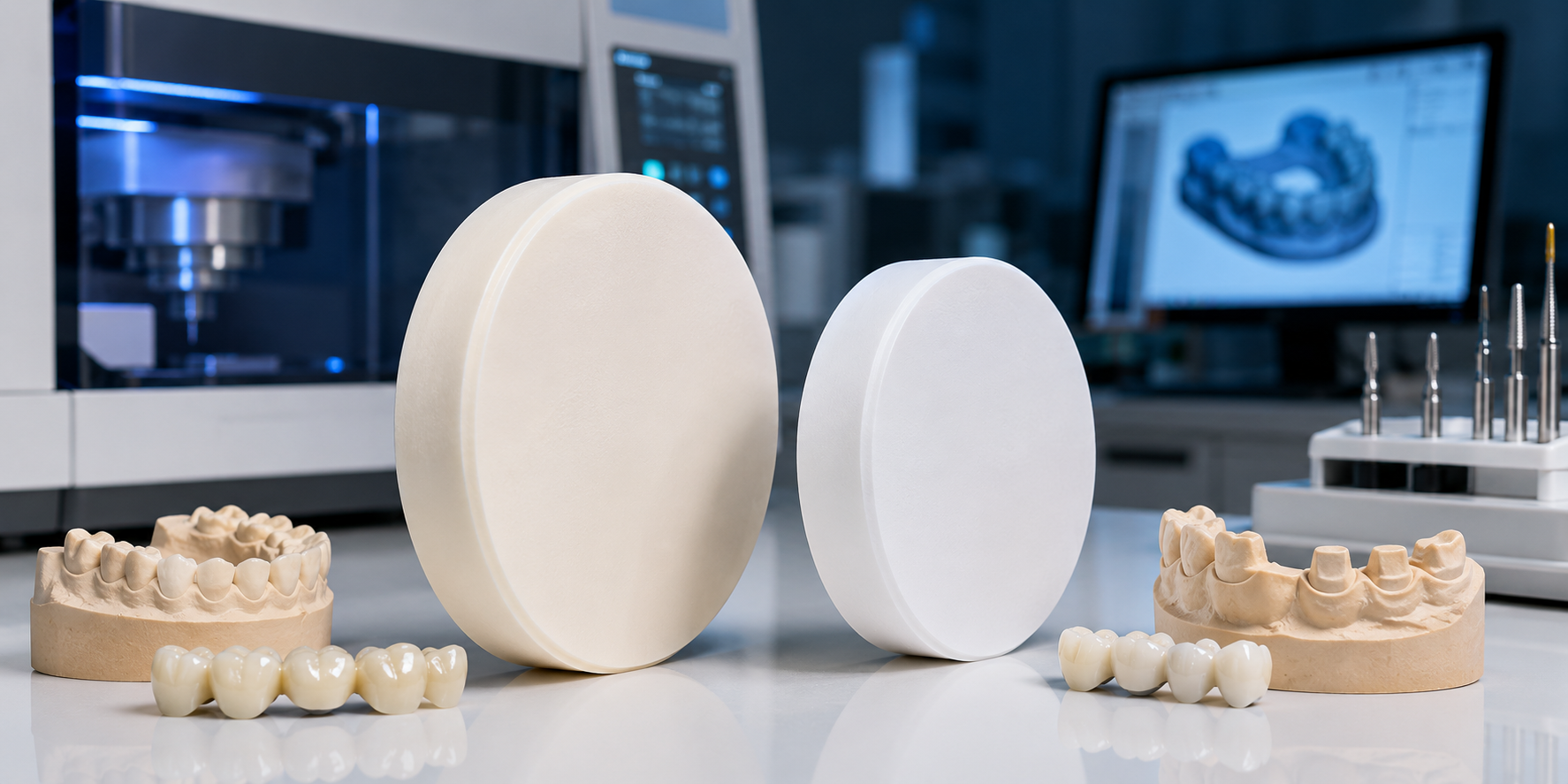
Disc thickness is one of the most consistently underspecified variables in dental lab zirconia procurement. Most labs order the thickness they started with and never revisit it until a case arrives that the standard disc cannot safely handle, or until wasted material from over-thick discs starts showing up in the cost-per-case calculation. The Aidite 3D Pro Zir line is available in both 12mm and 16mm formats, and the difference between them is not arbitrary. It maps directly to specific clinical indications, restoration geometries, and occlusal load scenarios that determine whether a disc has the structural reserve a case actually requires.
This guide answers the thickness question clearly what determines whether a case needs 16mm, where 12mm is the correct and more economical choice, and how to build a stocking decision into your lab workflow that eliminates the guesswork on every incoming case.
What the 3D Pro Zir Line Is Built For?
The Aidite 3D Pro Zir is a multilayer zirconia disc engineered for cases where high translucency and structural performance are both required not traded off against each other. It uses Aidite's proprietary 3D gradient architecture, which distributes yttria content across multiple distinct zones within the disc, producing a dentin-to-incisal optical gradient while maintaining the mechanical properties required for both anterior esthetic work and demanding posterior cases.
This is the distinction that makes the 3D Pro Zir relevant across a wider indication range than a standard high-translucency 5Y disc. Standard 5Y discs optimize for maximum translucency at the cost of reduced strength appropriate for single-unit anterior crowns, but limiting for multi-unit cases or posterior work where the connector cross-section needs structural reserve behind it. The 3D Pro Zir's multilayer architecture gives labs a disc that performs in both zones without requiring two separate product lines for anterior and posterior.
The thickness question 12mm or 16mm is therefore not a question about which disc is better. It is a question about which thickness gives a specific case the material volume it needs to be designed correctly.
Understanding What Disc Thickness Actually Controls
Before comparing the two formats, it is important to be precise about what disc thickness controls in a milling workflow because it is often misunderstood as purely a strength variable when it is more accurately a geometry variable with downstream strength implications.
Disc thickness determines the maximum occlusal-cervical height that can be milled from a single blank without the restoration breaching the disc boundary. For single crowns with standard preparation heights, 12mm provides sufficient material volume in the vast majority of cases. The thickness constraint becomes relevant in three specific scenarios: restorations with tall clinical crowns, cases where the CAD design requires a specific vertical dimension that 12mm cannot accommodate without compromising wall thickness, and bridge pontic designs where the vertical bulk of the pontic body requires additional material depth to achieve correct emergence profile and tissue clearance.
The aidite 3d pro zir 12mm disc handles the full range of standard single-unit crowns and bridges where clinical crown height is within normal parameters. For most anterior and premolar single crowns, 12mm is not just adequate it is the correct format, because the multilayer gradient is distributed across the full 12mm depth, and using a thicker disc than the case requires wastes material without adding clinical value.
When 12mm Is the Right Choice?
The 12mm format covers the significant majority of daily dental lab production. Understanding where it is definitively appropriate rather than treating 16mm as the default "safe" choice reduces material cost per case and ensures the gradient architecture of the disc is being used efficiently.
aidite 3d zirconia discs in 12mm are the correct specification for these case types:
-
Standard anterior single crowns.
Upper and lower incisors, canines, and premolars with standard preparation heights typically 4–7mm of clinical crown height are well within the 12mm thickness range. The gradient architecture of the 3D Pro Zir delivers its optimal esthetic outcome in this format, with the incisal zone aligned correctly to the top of the disc and the cervical zone at the base. -
Anterior 3-unit bridges.
Standard 3-unit anterior bridges with normal pontic dimensions and preparation heights are producible from 12mm stock. The critical variable is connector cross-section, not disc thickness verify connector dimensions against Aidite's published minimum connector area data for the 3D Pro Zir before finalizing the design, regardless of which thickness you are using. -
Premolar single crowns and short-span premolar bridges.
Premolar clinical crown heights are typically shorter than anterior teeth, making 12mm more than sufficient for the restoration geometry. The posterior location also means the esthetic gradient is less critical the dentin-body zone of the disc is doing more work than the incisal zone but the multilayer architecture still delivers improved esthetic integration versus a flat single-grade disc. -
High-volume anterior production.
For labs running anterior crown production at scale, 12mm is the economical standard. More blanks per disc, faster milling on thinner stock, and no excess material waste. When the case mix is predominantly standard anterior work, 12mm is the correct procurement default.
Understanding the difference between 3Y, 4Y, and 5Y zirconia matters here too the 3D Pro Zir's multilayer architecture incorporates gradient yttria content, meaning the strength and translucency properties vary across the disc depth regardless of whether you are using 12mm or 16mm stock. Thickness adds material volume; it does not change the gradient architecture that determines esthetic performance.
When 16mm Is the Required Choice?
The 16mm format exists because specific case types genuinely cannot be correctly produced from 12mm stock and attempting to do so results in either technically compromised restorations or design workarounds that affect clinical quality.
aidite 3d pro multilayer zirconia blocks usa labs stock in 16mm are specified for these indications:
-
Posterior full-contour crowns with high clinical crown height.
Patients with long posterior clinical crowns particularly mandibular molars where the crown preparation has significant vertical height, or cases where supraeruption has produced an extended clinical crown require additional material volume to mill the full contour without breaching the disc boundary. A 12mm disc in these cases forces the lab to compromise on occlusal thickness, wall thickness, or cervical anatomy. 16mm eliminates that constraint. -
Full-arch and quadrant zirconia cases.
Full-arch zirconia frameworks and multi-unit quadrant bridges often require pontic bodies and connector dimensions that exceed what 12mm stock can accommodate without geometric compromises. The additional 4mm of material volume in 16mm stock provides the design freedom these complex cases require. -
Implant-supported posterior restorations with custom emergence profiles.
Implant crown designs frequently incorporate emergence profiles that add vertical dimension below the restoration body. This subgingival emergence geometry is invisible in the mouth but requires material volume in the disc during milling. On implant cases with significant platform depth below the tissue, 16mm provides the necessary material reserve that 12mm does not. -
Cases with deep subgingival margin preparations.
Preparations that extend significantly below the tissue line require additional cervical material volume in the milled blank. If the margin-to-cusp-tip dimension exceeds what 12mm can accommodate while maintaining minimum wall thickness throughout the restoration, 16mm is the correct specification. -
Posterior bridges with large pontic spans.
Pontic bodies for posterior bridges in the molar region require both vertical bulk and adequate emergence form. In cases where the vertical dimension of the pontic body from the tissue contact point to the occlusal surface exceeds the safe milling envelope of 12mm stock, 16mm is required to produce the correct pontic anatomy.
The Practical Decision Framework
The thickness decision is made at the design stage, not the procurement stage. The correct workflow is:
- First, examine the prescription and model to determine clinical crown height for each unit in the case. If any unit exceeds 10–11mm from preparation margin to planned occlusal surface, 16mm stock is required. If all units are within standard parameters, 12mm is the correct choice.
- Second, check pontic dimensions on bridge cases. If the vertical dimension of any pontic body from tissue contact to occlusal surface approaches or exceeds 10mm, 16mm stock provides the safe design margin.
- Third, verify connector cross-sections against Aidite's published data regardless of thickness. Disc thickness does not compensate for undersized connectors the minimum connector area requirement is a material strength specification that applies to both 12mm and 16mm formats.
| Case Type | Correct Thickness | Key Variable |
|---|---|---|
| Standard anterior single crown | 12mm | Crown height within normal range |
| Standard premolar crown | 12mm | Shorter clinical crown height |
| Anterior 3-unit bridge | 12mm | Verify connector dimensions |
| Posterior single crown, normal height | 12mm | Standard preparation |
| Posterior crown, tall clinical crown | 16mm | Crown height exceeds 10–11mm |
| Posterior bridge, large pontic | 16mm | Pontic vertical dimension |
| Full-arch zirconia framework | 16mm | Framework geometry complexity |
| Implant crown, deep emergence | 16mm | Subgingival emergence profile depth |
| Full-mouth rehabilitation | 16mm (posterior) | Complex geometry, safe margin |
Stocking Both Thicknesses Correctly
For most full-service dental labs, the correct stocking decision is to carry both formats with 12mm as the production default and 16mm as the case-specific specification for the indications above.
The high translucency multilayer zirconia aidite supplier at ZirconiaGuys stocks the 3D Pro Zir in both 12mm and 16mm from US inventory, with same-day shipping on in-stock items. For labs that receive a mix of standard and complex posterior cases, having both thicknesses available eliminates the production delays that come from ordering a non-standard thickness mid-case.
Procurement tip: Track which case types in your production mix consistently require 16mm. Most labs find that 16mm cases represent 15–25% of their total zirconia production volume — enough to warrant keeping a standing inventory of both thicknesses, but not enough to make 16mm the default procurement format. Ordering 16mm as a default for all cases adds material cost to the 75–85% of cases where 12mm was the technically correct choice.
Two GSC queries dental labs are already searching aidite 3d pro multilayer and 3d pro multilayer confirm that this product line is actively being researched by lab buyers. Labs evaluating the 3D Pro Zir for the first time should start with 12mm for the majority of their standard case mix and add 16mm inventory as their case volume and prescription analysis identifies the specific indications where the extra thickness is clinically required.
On zirconia blocks price: The 16mm format carries a higher per-disc cost than 12mm, reflecting the additional material volume. This cost premium is only justified when the case genuinely requires it. Using 16mm as a universal default adds unnecessary material cost on every standard case a cumulative overhead that compounds across monthly production volume. Match the thickness to the case, not to a conservative procurement habit.
The 12mm vs 16mm decision for dental zirconia discs is not a safety margin question it is a case geometry question. Zirconia dental blanks in 16mm exist for cases where the clinical dimensions genuinely require the additional material volume. Zirconia blocks dental labs stock in 12mm cover the full standard production range efficiently and economically. Building a clear protocol for when to specify each thickness based on clinical crown height, pontic dimensions, and case complexity is one of the simplest workflow improvements a lab can implement to reduce material waste and eliminate design compromises on cases that actually need the extra depth.
For labs sourcing zirconia blocks and zirconia blank stock from a domestic US supplier, ZirconiaGuys carries the full Aidite 3D Pro Zir range in both thicknesses from US inventory no international lead times, consistent batch quality, and full technical documentation available on request.


