

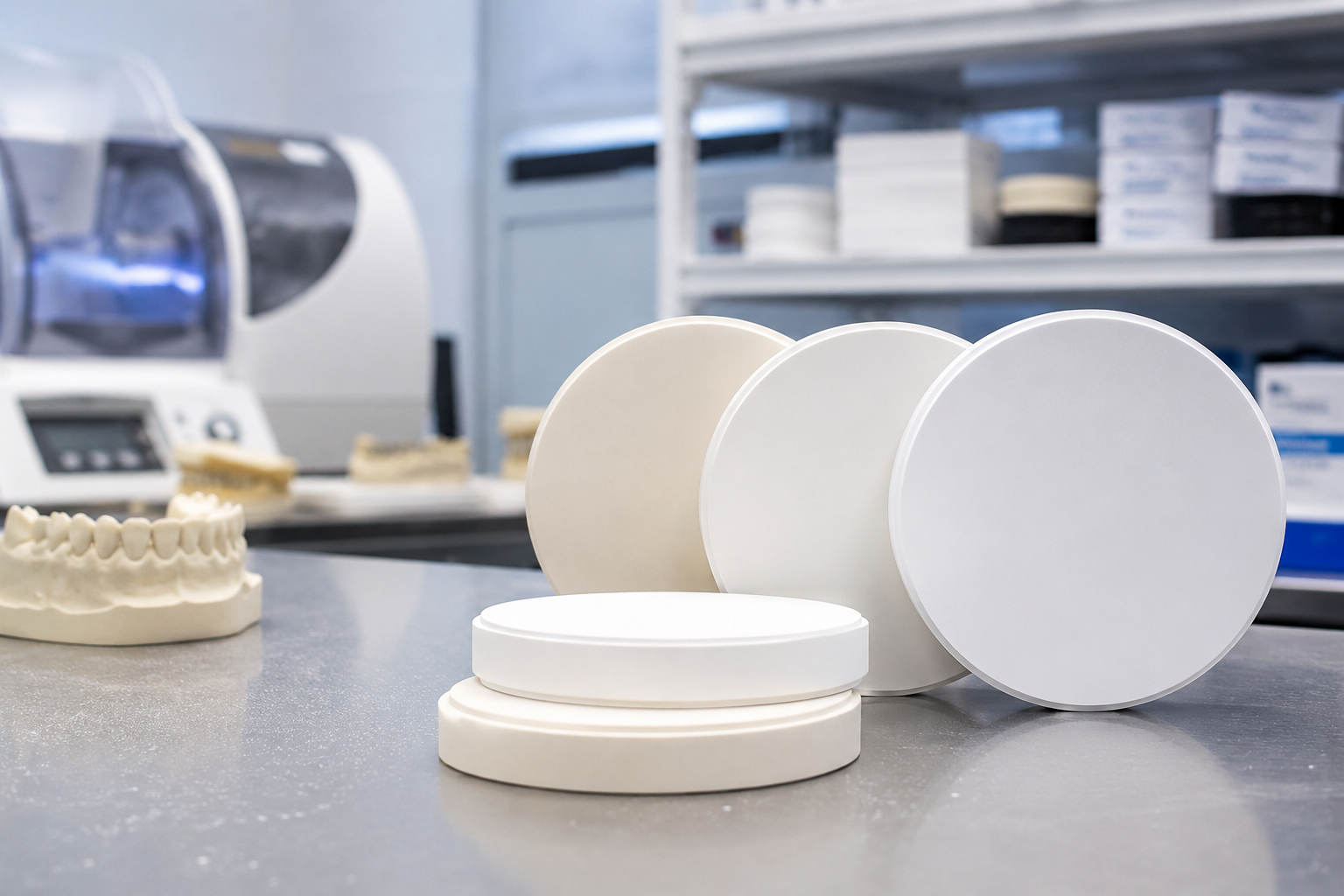
When a dental lab invests in a stock of zirconia blocks, the assumption is that the material sitting in storage is ready to perform exactly as specified when it reaches the mill. That assumption is correct but only if the blocks have been stored correctly and used within a timeframe that keeps their material properties intact. Zirconia is a ceramic material with defined storage requirements, and ignoring those requirements creates production problems that are difficult to trace back to their source.
This guide covers what shelf life actually means for dental zirconia discs and blocks, what degrades zirconia in storage, how to identify blocks that have been compromised, and the correct storage conditions that protect your material investment across every batch.
Does Zirconia Actually Expire?
The straightforward answer is: zirconia does not have an expiration date in the way a pharmaceutical product does, but it does have a manufacturer-recommended use-by period typically two years from the manufacturing date for most commercial zirconia blocks dental products and real degradation mechanisms that make that recommendation clinically meaningful rather than arbitrary.
The degradation is not visible on the surface of the disc. A zirconia blank that has been stored incorrectly for three years looks identical to a fresh one. The changes happen at the microstructural level moisture absorption, surface hydrothermal degradation, and humidity-driven phase transformation that reduce the material's performance in ways that only become apparent during or after sintering.
Understanding what degrades zirconia in storage and why the manufacturer's recommended storage period exists is the foundation of a reliable material management protocol in any dental lab. It is also directly relevant to the question labs most frequently ask: can we use a block that has been sitting in storage for longer than the recommended period?
For a broader understanding of how zirconia material properties affect clinical performance, the Guide to Materials & Strengths of Zirconia Dental Restorations covers the full grade and strength framework useful context for evaluating whether a stored block meets the requirements of the specific case you are planning.
The Three Degradation Mechanisms That Affect Stored Zirconia
1. Low-temperature degradation (LTD) — hydrothermal aging
Low-temperature degradation is the most clinically significant degradation mechanism in dental zirconia and the primary reason storage conditions matter. LTD occurs when zirconia in its pre-sintered or sintered state is exposed to moisture at temperatures between 25°C and 300°C over extended periods.
The mechanism: water molecules interact with the zirconia crystal lattice at the surface, catalyzing a gradual transformation of tetragonal phase crystals to monoclinic phase. Since the transformation toughening mechanism that gives 3Y zirconia its exceptional strength depends on the tetragonal phase being present and available to transform under stress, progressive monoclinic conversion in storage reduces the effective toughening capacity of the material before it ever reaches the mill.
In pre-sintered zirconia blocks, the porous green body is more vulnerable to moisture penetration than sintered ceramic the open porosity of the pre-sintered disc allows moisture to reach deeper into the material than it can penetrate in a dense sintered form. This means that storage moisture exposure in pre-sintered discs is more damaging than equivalent exposure to sintered ceramic.
2. Humidity-driven binder degradation
Pre-sintered zirconia blocks contain organic binders that hold the powder compact together before sintering. These binders are hygroscopic they absorb moisture from the surrounding environment. Excessive moisture absorption softens the binder system, which affects milling behavior: the disc becomes softer and more prone to chipping during milling, produces rougher milled surfaces, and may exhibit dimensional inconsistency as the binder-modified green body machines differently in different moisture zones within the disc.
Labs that have noticed unexpected surface roughness or chipping on older stock without changing milling parameters are often experiencing binder degradation a storage problem presenting as a milling problem.
3. Contamination from ambient exposure
Open or damaged packaging exposes zirconia dental blanks to particulate contamination airborne materials, dust, dental lab particulates from adjacent milling operations, and chemical vapors from adhesives, cleaning agents, or other lab materials. Zirconia's porous pre-sintered surface absorbs contaminants readily, and many of these contaminants do not volatilize during sintering at the rates that leave the material clean. The result is sintered discolorations, unexpected shade shifts, or surface inclusions in the final restoration.
What the Manufacturer's Recommended Storage Period Means in Practice
Most commercial zirconia blocks dental products carry a manufacturer recommendation of 24 months from the manufacturing date, stored in original sealed packaging under specified conditions. This is not a regulatory requirement in most markets it is a material performance guarantee. The manufacturer is stating that the product will meet its published mechanical and optical specifications when used within this period under correct conditions.
Beyond the recommended period, the manufacturer does not guarantee that the material meets its published specifications. This does not mean every block beyond 24 months is defective it means the lab assumes responsibility for performance verification if it uses out-of-date stock. For clinical production, this distinction matters: a remake caused by out-of-date material is a lab-absorbed cost that the manufacturer will not cover.
The 24-month standard covers aidite zirconia blocks, which carry full batch documentation including manufacturing date and recommended use period with every product shipped through ZirconiaGuys from US inventory allowing labs to track stock age accurately without relying on memory or informal records.
Correct Storage Conditions for Zirconia Blocks
The storage conditions that protect zirconia dental blanks from all three degradation mechanisms are straightforward and inexpensive to maintain. The challenge is not the cost of correct storage it is the discipline of maintaining it consistently across a busy production environment.
Temperature
Store at room temperature, 15–25°C. Avoid storage near sintering furnaces, window-facing surfaces with direct sun exposure, or areas adjacent to heated equipment. Thermal cycling repeated temperature fluctuations across wide ranges accelerates moisture ingress through condensation during cooling phases.
Humidity
Maintain relative humidity below 50%. Humid storage environments are the primary cause of binder degradation and the most common avoidable storage problem in dental labs. If your lab operates in a high-humidity climate or during summer months, consider humidity-controlled storage cabinets for zirconia inventory. Silica gel desiccant packets in storage containers are an effective low-cost solution for controlling micro-environment humidity around stored blocks.
Packaging Integrity
Keep blocks in their original sealed manufacturer packaging until use. The original packaging is designed to maintain the correct humidity micro-environment and protect the disc from physical damage and contamination. Do not transfer discs to secondary containers, plastic bags, or uncovered shelving before use. Once a disc is removed from original packaging and partially used, reseal it in an airtight container with desiccant for subsequent storage.
Separation from Contamination Sources
Store zirconia away from areas where PMMA milling, acrylic work, or stain and glaze applications are performed. Airborne acrylic particles and chemical vapors from staining materials are absorbed by exposed pre-sintered zirconia surfaces.
Physical Orientation
Store discs horizontally or in a purpose-made vertical rack that fully supports the disc without point-loading at the edge. Zirconia in its pre-sintered state has sufficient rigidity to resist breakage under its own weight, but unsupported discs stored leaning at angles can develop stress fractures at the edge particularly in larger diameter 98 mm discs.
The upcera zirconia block range at ZirconiaGuys includes storage guidance documentation with each product, and US-stocked inventory means labs receive blocks with maximum remaining shelf life no time lost to international shipping.
How to Identify a Degraded Zirconia Block Before It Reaches the Mill
Since degraded zirconia looks identical to fresh material, visual inspection alone is insufficient for storage quality assessment. The following indicators are more reliable:
Check the Manufacturing Date
Every commercial zirconia blank carries a manufacturing date on the packaging. If the date is beyond the recommended use period and storage conditions cannot be verified, treat the block as a risk item not necessarily defective, but requiring performance verification before committing it to clinical production.
Mill a Test Piece
Before running a full case on a block of uncertain storage history, mill a test crown form and evaluate milling behavior, surface finish, and post-sintering translucency and shade against a known good reference. Degraded blocks often show subtle milling behavior differences more dust, slightly rougher surface, minor chipping at fine margins that a test piece will reveal before a clinical restoration is affected.
Evaluate Post-Sintering Optical Properties
LTD-affected zirconia typically shows reduced translucency after sintering and a slightly warmer, more opaque appearance than the product specification predicts. If a sintered test piece looks noticeably different from your established standard for the same product, storage-related degradation is a likely contributor.
Check for Discoloration on the Disc Surface
Yellow, brown, or grey patches on the surface of a zirconia blank that were not present when the disc was opened indicate either contamination from ambient exposure or binder degradation. These patches will cause localized shade anomalies in the sintered restoration.
For labs looking to maintain consistent quality across their dental zirconia discs inventory, buy ht white zirconia online from ZirconiaGuys in quantities that align with your realistic 60–90 day consumption reducing the period any single disc sits in storage and eliminating the risk of working from aging stock.
Stock Management: Buying Right to Avoid Shelf Life Problems
The most reliable protection against shelf life issues is buying in quantities matched to production volume. Labs that overbuy during promotions or to hit free-shipping thresholds accumulate stock that ages in storage creating the exact problem that correct storage protocols are designed to prevent.
A practical approach: calculate your average monthly consumption for each disc SKU across a rolling 90-day period. Maintain a maximum of 90 days of stock on hand for each product. Reorder when stock reaches a 30-day supply level. This rotation system ensures that no disc sits in storage for more than three months a small fraction of the 24-month recommended use period that eliminates shelf life as a production variable entirely.
For labs standardizing their multilayer anterior disc stock, buy st multilayer zirconia online from ZirconiaGuys with same-day US shipping means you can maintain a lean 30-day stock level and reorder with confidence no need to carry excess inventory as a buffer against long lead times.
Labs sourcing zirconia blocks and zirconia dental blanks from a domestic US inventory supplier benefit from this lean stocking strategy most directly: short lead times make just-in-time ordering practical in a way that overseas sourcing cannot support.
Zirconia blocks dental labs rely on daily are precision materials with real storage requirements. The 24-month manufacturer recommendation is not a bureaucratic formality it reflects the hydrothermal degradation and binder sensitivity that make correct storage a clinical quality issue, not just an inventory management one. Labs that track manufacturing dates, maintain correct humidity and temperature conditions, rotate stock on a first-in-first-out basis, and buy in quantities matched to consumption will never encounter the production problems that come from degraded zirconia material.
The investment in correct storage practice is minimal. The cost of a remake caused by undetected material degradation in time, materials, and customer confidence is not.


