

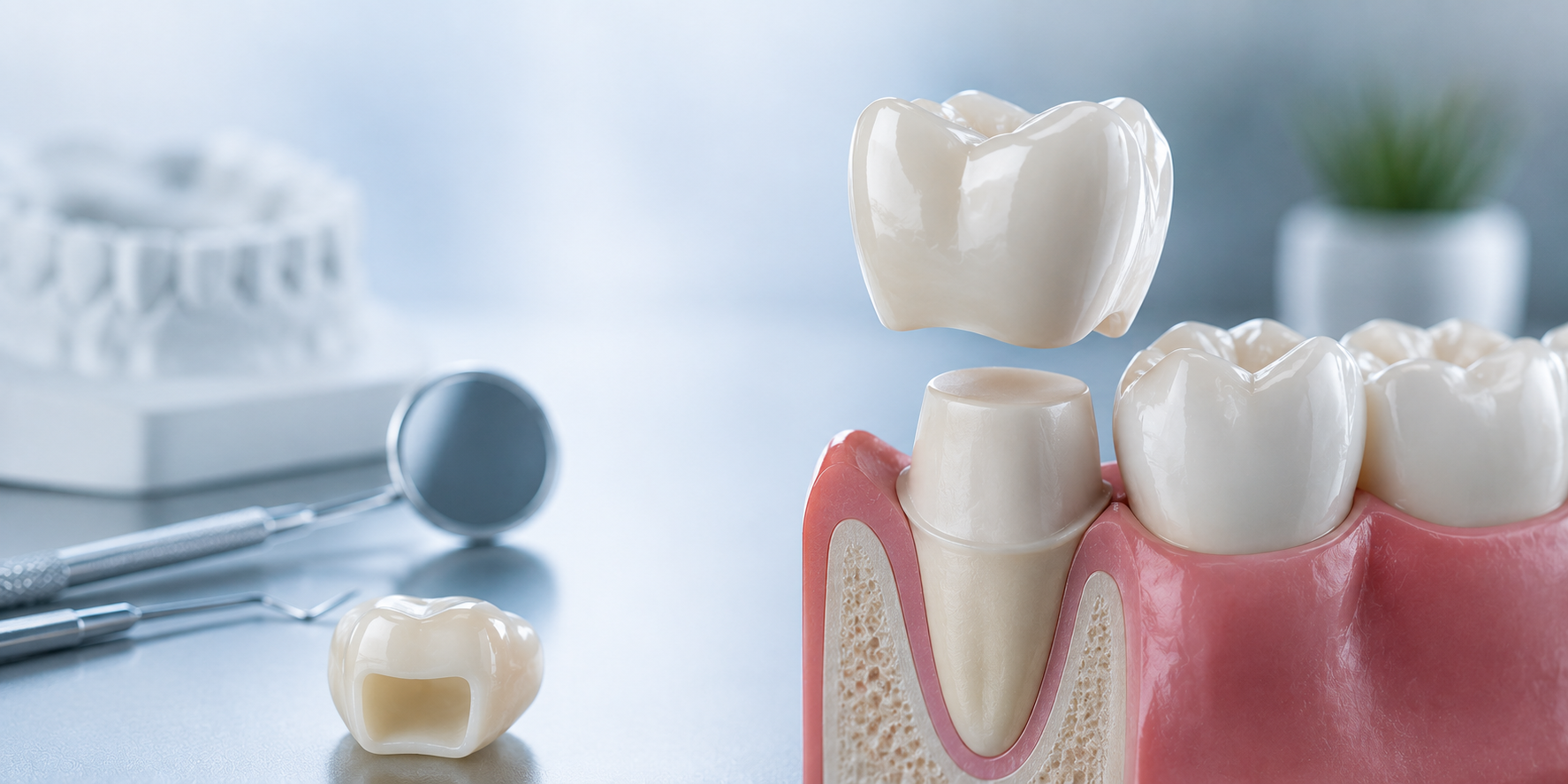
Zirconia crowns have fundamentally changed what is achievable in restorative dentistry. Before zirconia, dental labs and clinicians faced a persistent compromise: strong materials were ugly and biologically problematic, while esthetic materials were structurally fragile. Metal-ceramic crowns with their dark margins, porcelain-fused-to-metal restorations prone to chipping, and all-ceramic options with limited strength all forced clinicians to trade off appearance against function depending on where the restoration sat in the mouth.
Zirconia ended that compromise. Today it is the dominant crown material across virtually every clinical indication anterior esthetic cases, posterior high-load bridges, implant-supported frameworks, and full-arch rehabilitations. Understanding why zirconia crowns have had this impact, and how the material is correctly selected and sourced by dental labs, is the subject of this guide.
What Makes Zirconia Crowns Clinically Significant?
Zirconia is a crystalline oxide ceramic zirconium dioxide (ZrO₂) stabilized with yttrium oxide that was adopted in dentistry because it solved problems no previous material class could solve simultaneously. Its combination of structural strength, biological safety, chemical stability, and esthetic adaptability is what elevated it from a niche posterior material to the universal standard for permanent crown and bridge restorations.
Strength that covers every clinical zone.
The flexural strength of zirconia blocks dental grade 3Y-TZP material exceeds 900 MPa roughly double the strength of lithium disilicate and multiple times the strength of feldspathic porcelain. This means zirconia can cover posterior molars under heavy occlusal load, multi-unit posterior bridges with demanding connector cross-sections, and implant-supported frameworks applications that glass-ceramic materials cannot reliably handle. Labs sourcing aidite zirconia discs for high-volume production benefit from a material that performs across this full indication range without requiring different base materials for different case types.
Biocompatibility for long-term tissue contact.
Zirconia is chemically inert in oral environments. It does not corrode, does not leach metal ions into surrounding tissue, and does not produce the gingival discoloration associated with metal substructures in PFM restorations. For patients with metal sensitivities, zirconia is frequently the only viable permanent crown material. Long-term clinical studies consistently show healthy periodontal tissue response around zirconia margins compared to both metal-ceramic and all-metal alternatives.
Optical versatility across the esthetic spectrum.
Early zirconia grades were opaque strong but clinically limited to posterior applications where appearance was secondary. The development of high-translucency 4Y and 5Y zirconia grades changed this entirely. Modern esthetic-grade zirconia transmits light in a way that approximates natural enamel, enabling anterior restorations that blend with natural dentition under all lighting conditions. A single material class now serves both the esthetic demands of anterior cases and the structural demands of posterior cases only the grade selection changes.
CAD/CAM production efficiency.
Zirconia is milled in its pre-sintered state chalk-like and soft from dental zirconia discs in standard 98 mm diameter format. This enables precise digital milling with fast toolpaths, followed by sintering that densifies and strengthens the restoration to its final dimensions. The CAD/CAM workflow eliminates the hand-building variability of feldspathic layering and the multi-step laboratory complexity of PFM fabrication. One material, one milling step, one sintering step consistent, reproducible results at production speed.
Zirconia Blanks and Discs: The Foundation of Crown Production
Every zirconia crown starts as a zirconia blank a pre-sintered disc of zirconia material from which the restoration is milled. The quality of the blank determines the quality of the crown. Strength properties, shade consistency, translucency behavior, sintering shrinkage accuracy, and surface finish after milling are all determined at the manufacturing stage of the disc, before the lab ever loads a case into the mill.
Zirconia dental blanks come in several formats that define the production workflow. White (unshaded) blanks give the lab full manual control over shade through external staining. Pre-shaded blanks are pigmented during manufacturing to match VITA shade values, eliminating or minimizing post-sintering staining on standard A–D shade cases. Multilayer blanks incorporate a cervical-to-incisal gradient of shade and translucency, replicating the optical zonation of natural tooth anatomy within a single disc.
For US dental labs evaluating the full range of disc formats and grade options, the upcera dental zirconia blank lineup covers 3Y, 4Y, and 5Y grades in white, pre-shaded, and multilayer formats stocked domestically for fast delivery without international lead times. Reliable domestic sourcing from a trusted zirconia materials distributor USA eliminates the batch variability and extended delivery times that come with direct overseas procurement.
The zirconia blocks used for chairside mills rectangular blanks for systems like CEREC share the same material chemistry as disc-format blanks but differ in form factor and compatible equipment. For full-service dental labs running disc-based milling systems, the 98 mm disc format provides the largest usable milling area per blank and the broadest compatibility with open-system mills.
The Clinical Impact of Zirconia on Patient Outcomes
The adoption of zirconia crowns has produced measurable improvements in patient outcomes across the clinical metrics that matter most to both practitioners and patients.
Longevity and survival rates.
Clinical studies consistently report 10-year survival rates above 95% for zirconia single crowns and above 90% for 3-unit zirconia bridges. These rates are comparable to or better than PFM restorations, without the chipping risk that plagues the porcelain veneer layer in PFM. Patients receiving zirconia crowns today can expect the restoration to function for their lifetime under normal clinical conditions — a claim that cannot be made for any temporary or provisional material.
Patient comfort and acceptance.
Zirconia's low thermal conductivity reduces the post-placement sensitivity that patients experience with metal crowns. Its smooth, polished surface does not abrade opposing dentition at the same rate as rough ceramic surfaces. Patients report high acceptance of zirconia restorations both esthetically, because properly shade-matched zirconia is indistinguishable from natural dentition to the untrained eye, and functionally, because correctly fitting zirconia crowns feel natural under occlusal load.
Elimination of metal-related complications.
The absence of metal substructure eliminates the dark gingival margin shadow common in PFM crowns, eliminates metallic taste complaints, and removes the risk of metal ion hypersensitivity reactions. For patients who have experienced tissue reactions to metal alloys in previous restorations, zirconia is clinically transformative.
Implant compatibility.
Zirconia has become the dominant material for implant-supported single crowns and short-span bridges. Its biological neutrality makes it the ideal material for restorations in direct proximity to implant components and peri-implant tissue, where metal ion leaching and corrosion are active concerns with metal-containing alternatives.
How Zirconia Grade Selection Determines Crown Performance?
Not all dental zirconia discs perform identically and within a given product format, the grade selection (3Y, 4Y, or 5Y) determines which clinical performance profile the crown delivers. Matching grade to indication is the most consequential material decision in zirconia crown production.
The tt multilayer zirconia format delivers maximum translucency in a gradient disc architecture the correct choice for anterior single crowns where matching highly translucent natural dentition is the clinical priority. The TT formulation pushes the cubic phase fraction toward its maximum, producing incisal opalescence that approximates natural enamel behavior under varied lighting conditions. Labs producing anterior cases where the patient has naturally translucent teeth common in younger patients and in cases adjacent to ceramic veneers need this grade level to avoid restorations that appear flat and artificial.
The st multilayer zirconia format offers a super-translucency gradient architecture calibrated for the broader range of everyday anterior and premolar cases where high translucency is important but the extreme incisal opalescence of TT-grade material is not the primary requirement. For labs running high-volume anterior crown production, the ST multilayer format delivers consistent gradient esthetics across standard A–D shades with minimal post-sintering staining, making it the most efficient daily production standard for esthetic cases.
For posterior crowns and bridges where structural performance is the primary requirement, monolithic 3Y-TZP in white or pre-shaded format is the correct material. The 900–1200+ MPa flexural strength of 3Y provides the connector cross-section reliability that multi-unit posterior bridges under full occlusal load demand. High-translucency 5Y grades are not appropriate for this indication regardless of esthetic appeal the strength tradeoff in 5Y is real and clinically consequential in posterior bridge applications.
Zirconia multilayer discs whether TT, ST, or other gradient formulations consistently outperform flat single-grade discs of the same base composition for anterior esthetic cases. The gradient architecture replicates natural tooth optical zonation in a way that no amount of external staining on a flat monolithic disc can fully replicate.
Sourcing Zirconia: What Dental Labs Should Demand from Their Supplier
The material quality of a zirconia blank is determined entirely at the manufacturing stage — by the purity of the zirconia powder, the precision of the yttria distribution, the pressing parameters, and the quality control applied to every production batch. Once a disc is manufactured, no amount of careful milling or precise sintering can compensate for poor raw material quality or inconsistent pre-sintering.
This is why supplier selection is as important as product selection for zirconia blocks dental procurement. The criteria that separate a reliable zirconia materials distributor USA from a generic import supplier are:
- Batch documentation — shade specification certificates, mechanical property data, and biocompatibility compliance certificates for every batch, not just on request. This documentation enables labs to track performance across orders and identify drift before it affects clinical production.
- Domestic inventory — US-stocked products eliminate the 4–8 week lead times and import unpredictability of direct overseas procurement. For labs managing just-in-time inventory, domestic stock availability is a production reliability requirement.
- Technical support — milling parameters, sintering profiles, and material-specific guidance. Different zirconia formulations require different sintering ramp rates and peak hold temperatures. A supplier that provides accurate, product-specific technical documentation prevents the sintering errors that produce cloudy, undertranslucent restorations from otherwise good disc stock.
- Consistent grade range — labs running both anterior esthetic and posterior structural production need access to the full grade spectrum from high-translucency 5Y to structural 3Y-TZP, in both white and pre-shaded formats. A supplier that stocks only part of the range forces split procurement that increases ordering complexity and reduces batch consistency across the material inventory.
Zirconia crowns matter in modern dentistry because they solved a problem that every previous restoration material only partially addressed. The combination of structural strength, biological safety, esthetic versatility, and CAD/CAM production efficiency in a single material class is what has made dental zirconia discs the default raw material for permanent restorations in modern dental labs worldwide. Selecting the right grade, the right format, and the right supplier are the three decisions that determine whether a lab captures all of that material's clinical potential or compensates for avoidable material selection errors on every case it produces.


