

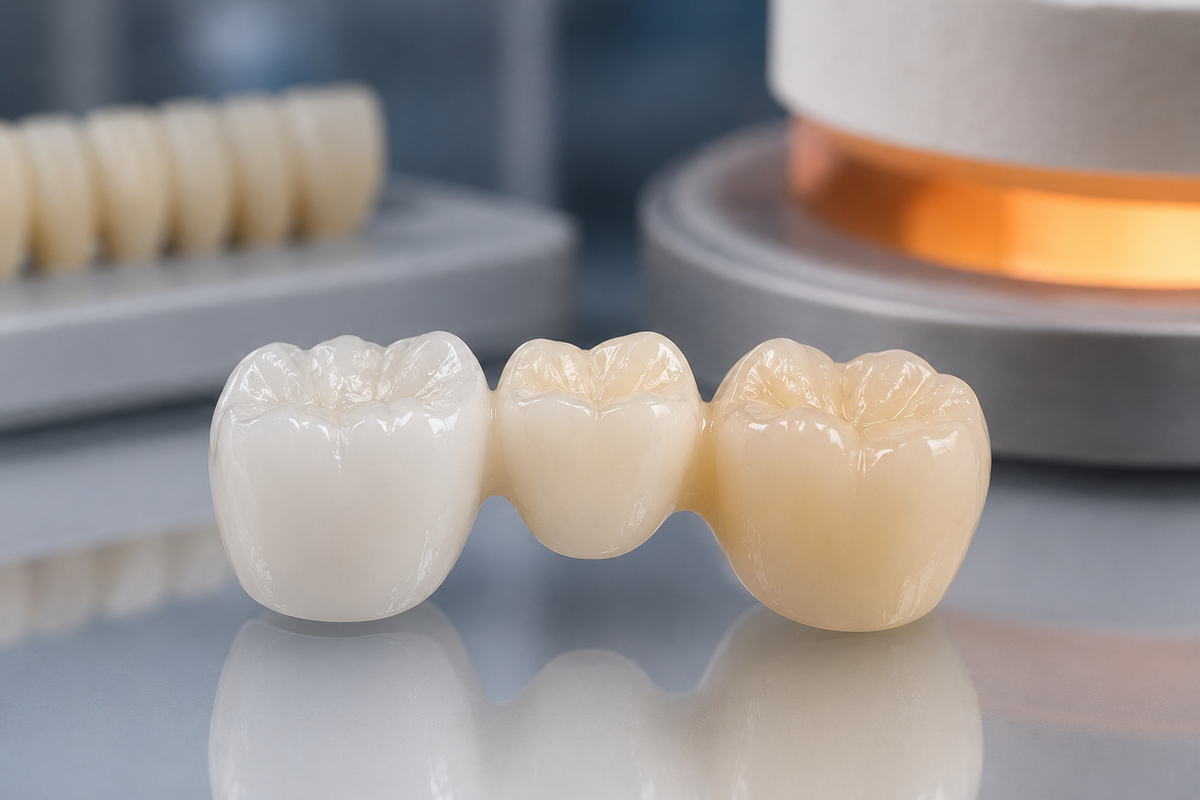
You mill a three-unit bridge from a single Aidite zirconia disc. Every unit comes from the same blank, sintered in the same furnace cycle, on the same tray, in the same batch. The pontic exits sintering at A2. The abutment crowns exit at something closer to A3.5. Nothing in the workflow changed between units the disc, the furnace, the cycle, the staining protocol were identical across all three. Yet the result is three units that cannot be delivered together without a remake.
This is one of the most frustrating and poorly understood failure modes in zirconia bridge production. It is also one of the most preventable once you understand the actual causes, which are almost never the ones labs initially suspect. This guide explains the five root causes of intra-bridge shade variation in Aidite zirconia, how to diagnose which one is driving your specific problem, and what to change in your workflow to eliminate it before the next bridge goes into the furnace.
Why This Problem Is More Common in Bridges Than Single Units?
Shade variation between units in a single bridge is more visible and more clinically damaging than the same degree of variation across separate single-unit cases. When a single crown comes out slightly darker than expected, the lab adjusts the staining protocol and remakes it. When units within a three-unit bridge come out at different shades, you cannot adjust one without affecting the others the entire bridge is a remake regardless of how good any individual unit looks.
The reason bridges amplify this problem is geometry. A bridge is a single milled piece, but the connector regions, the pontic, and the abutment crowns all have different thicknesses, different surface-area-to-volume ratios, and different positions within the sintering furnace. All three of these physical differences create different sintering conditions for each unit within the same bridge and different sintering conditions produce different shade outcomes even from chemically identical starting material.
Understanding this geometry-driven variability is the starting point for solving the problem. It shifts the diagnosis away from the disc which is usually not the issue and toward the sintering conditions, the milling orientation, and the staining protocol design.
Cause 1: Positional Variation Within the Disc
Multilayer and pre-shaded zirconia discs from Aidite are manufactured with intentional shade gradients warm and more opaque at the cervical end of the disc, progressively more translucent toward the incisal end. This gradient is the feature that makes pre-shaded discs clinically efficient. It is also the feature that causes shade variation when a bridge is milled from a single blank without correctly aligning the gradient to the restoration design.
In a standard three-unit bridge, the pontic and abutment crowns need to be positioned at the same gradient depth within the disc to receive equivalent shade values. If the bridge design places one abutment crown at the mid-body zone of the disc and the other at the incisal zonebecause the connectors or the span geometry forces an angled positioning the two crowns are milled from materially different shade zones within the same blank.
This is the most common cause of intra-bridge shade variation in pre-shaded Aidite zirconia, and it is entirely a milling orientation issue. The fix is in the CAM software, not the sintering furnace.
Diagnosis: If the shade difference between units follows the gradient direction of the disc one unit lighter, one unit darker, in a pattern that corresponds to incisal vs cervical positioning positional disc variation is the cause.
Fix: In your CAM software, review the bridge orientation within the disc. Ensure all three units are positioned at equivalent gradient depth all sitting in the body zone of the disc, with incisal edges of all units facing the same direction relative to the disc's gradient axis. For long-span bridges where this alignment is geometrically difficult, consider using a white disc with manual staining rather than relying on the pre-shaded gradient to carry the shade.
For labs evaluating aidite zirconia bridges across the full Aidite range from standard pre-shaded formats to white blanks for custom cases the full Aidite lineup is available at ZirconiaGuys from US inventory, including multiple disc grades and thicknesses suited to different bridge span requirements.
Cause 2: Differential Sintering Temperature Across the Bridge
Dental sintering furnaces do not deliver perfectly uniform temperature at every point in the firing chamber. There is always a temperature gradient typically 5–20°C between the hottest zone (usually center, upper portion of the chamber) and the cooler zones near the walls, floor, and door. For single-unit crowns on a full tray, this gradient averages out across the batch. For a bridge where three connected units span different positions in the chamber, each unit experiences a slightly different peak temperature.
Temperature affects zirconia shade through two mechanisms. First, it controls the degree of grain growth during sintering faster grain growth at higher temperatures produces a slightly more translucent, lighter-appearing material. Second, it affects how pigments in pre-shaded discs develop during the sintering hold most colorant systems in zirconia are temperature-sensitive, and a 10°C difference in peak temperature can shift the final shade by a measurable amount.
This is why the same bridge design, milled from the same disc, can produce consistent results in one furnace position and inconsistent results in another. The bridge is large enough that it spans a meaningful temperature gradient within the chamber.
Diagnosis: If the shade difference between units is consistent across multiple bridge cases but changes when you move the bridge to a different tray position in the furnace, temperature variation is the cause.
Fix: Map your furnace's temperature uniformity by sintering calibration beads or shade reference pieces at multiple positions in the chamber. Identify the most uniform zone — typically center chamber, positioned so the entire bridge fits within the same thermal zone. For bridges longer than 40 mm, evaluate whether your furnace's chamber uniformity is adequate for bridge production or whether a furnace upgrade or calibration service is needed.
Also verify that your sintering program matches Aidite's published parameters for the specific disc product. The difference between 3Y, 4Y, and 5Y zirconia grades includes different sintering temperature requirements using a 3Y sintering profile on a 4Y disc, or running an esthetic-grade disc on an accelerated cycle, produces shade outcomes that deviate from the manufacturer's specification and vary unpredictably between units.
Cause 3: Differential Stain Penetration by Unit Thickness
When labs apply liquid shade stain to a milled bridge before sintering, the stain penetrates into the surface of the pre-sintered zirconia by capillary action. The depth and concentration of stain uptake depends on the porosity of the pre-sintered surface and the dwell time of the stain but also critically on the surface-area-to-volume ratio of each unit.
In a three-unit bridge, the pontic typically has a larger external surface area relative to its volume than the abutment crowns. This means that when the same volume of stain is applied uniformly across the bridge, the pontic absorbs a higher relative concentration of colorant per unit volume than the thicker abutment crowns. After sintering, the pontic exits darker than the abutments not because of material variation or furnace variation, but because of differential stain absorption driven by geometry.
This cause is particularly common in bridges with a full-contour pontic design, where the pontic body is substantially thinner than the abutment crowns, and in cases where the staining protocol calls for immersion rather than brush application.
Diagnosis: If the pontic is consistently darker than the abutment crowns across multiple cases, and the shade difference is proportional to the thickness difference between units, differential stain absorption is the cause.
Fix: Apply stain by brush rather than immersion, and calibrate the amount applied per unit to its surface area and thickness rather than applying uniformly across the bridge. For the pontic, use a lighter hand or a more dilute stain concentration. For the abutment crowns, apply slightly more stain to compensate for their greater volume. This requires a short calibration run on a test bridge before applying the adjusted protocol to patient cases.
For cases where the shade complexity is beyond what stain calibration can reliably control, the aidite superfect zir pre-shaded disc format minimizes the staining requirement by carrying the shade gradient in the material itself reducing the lab's dependence on stain application accuracy for shade outcomes in standard A-shade bridge cases.
Cause 4: Tray Loading and Support Contact
How the bridge sits on the sintering tray affects airflow around each unit and the conduction of heat through the tray surface into the bridge. Units that rest directly on the tray surface or on aluminum oxide sintering beads experience conductive heat transfer from below in addition to the convective heat from the furnace atmosphere. Units that are elevated or bridging across the support bed receive heat primarily through convection.
In a long-span bridge where the two abutment crowns rest on the tray surface and the pontic arches between them, the thermal history of the pontic — which is elevated — differs from that of the supported abutment crowns. This difference is small, but in shade-critical anterior bridge cases it can be enough to produce a visible discrepancy.
Diagnosis: Check whether the shade difference pattern corresponds to which units are in contact with the tray. If the supported units are consistently different from the suspended pontic, tray contact is contributing.
Fix: Adjust the bridge orientation on the tray so all units are at equivalent elevation. Use sufficient sintering bead support to stabilize the bridge without creating uneven contact — ideally supporting the bridge at the connector regions so the pontic and abutment crowns are all elevated equally above the tray surface.
Cause 5: Batch Variation Amplified by Bridge Geometry
This cause is less common but worth understanding. Zirconia disc production involves pressing and sintering powder, and while manufacturers including Aidite control batch consistency tightly, there is always a small degree of variation in colorant distribution across the surface of any disc particularly toward the edges, where pressing pressure is slightly lower and colorant distribution can be marginally less uniform.
A single-unit crown milled from one zone of the disc is affected by the local colorant concentration in that zone only. A bridge milled across a wider area of the disc spans more of the disc's colorant distribution, and any local variation in that distribution creates unit-to-unit shade differences that would not appear in single-unit cases from the same disc.
Diagnosis: If you are seeing shade variation in bridges but not in single-unit cases from the same disc batch, and the variation pattern does not correspond to gradient direction, temperature, or staining batch distribution variation may be contributing.
Fix: For anterior bridges where shade precision is critical, mill from the center of the disc rather than the edges. Edges tend to show more batch variation across all zirconia disc manufacturers. If the problem persists across multiple batches, switch to a white zirconia blank format for that case type and carry the shade through manual staining, which gives you full control over the shade regardless of disc batch variation.
The aidite honorzir sht pre-shaded disc format is Aidite's pre-shaded offering with a natural-gradient multilayer construction a strong option for anterior bridge cases where the built-in gradient reduces the staining requirement and the multilayer architecture distributes shade more evenly across the disc than single-shade pre-shaded formats.
Building a Prevention Protocol for Bridge Shade Consistency
The five causes above rarely operate in isolation. Most bridge shade variation cases involve two or three contributing factors a slightly suboptimal disc orientation combined with a staining protocol that was calibrated for single units, running in a furnace zone that is 8°C cooler than the center. Each factor individually might not produce a visible problem. Together, they push the outcome past the threshold of acceptability.
A prevention protocol addresses all five simultaneously:
Before milling: Confirm disc orientation in the CAM software. Verify all units are positioned at equivalent gradient depth. Mill from the center third of the disc for shade-critical cases.
Before staining: Review the bridge geometry. Identify which units are thinner (typically the pontic) and calibrate stain application accordingly. Use brush application for shade-critical cases.
Before loading the furnace: Check the tray setup. Confirm all units are at equivalent elevation. Position the bridge in the verified uniform zone of the furnace chamber.
After sintering: Evaluate shade under three light sources before any glazing office fluorescent, natural daylight, and incandescent. Shade differences that are invisible under one light source often become apparent under another. Identify discrepancies before glazing, when correction is still possible.
After glazing: Document the outcome and correlate it with the disc position, stain protocol, and furnace position used. Over time, this documentation produces a calibrated workflow that eliminates the guesswork from bridge shade management.
For labs producing both anterior and posterior aidite zirconia bridges, the choice of disc format dental zirconia discs in pre-shaded multilayer for anterior esthetic bridges versus white zirconia blocks dental for posterior structural bridges is as important as the sintering protocol in determining shade consistency. The high translucency aizir zirconia disc, for instance, is a high-translucency format suited to anterior single units and short-span esthetic bridges where maximum incisal translucency is the priority a different specification than a posterior structural bridge where shade precision matters less than connector strength.
Intra-bridge shade variation in aidite zirconia bridges is almost always a workflow problem, not a material problem. The disc, the sintering furnace, the staining protocol, and the tray loading interact to produce the final shade outcome and any one of them can introduce enough variation to push individual units apart. The labs that solve this problem consistently are not the ones with the best materials. They are the ones with the most systematically documented and calibrated workflows.
Zirconia dental blanks and zirconia blocks from a consistent US supplier with full batch documentation give you the material stability to isolate workflow variables. From there, the five-cause framework in this guide gives you the diagnostic structure to identify and fix exactly which part of your bridge production workflow is introducing shade variation and eliminate it before the next case goes into the furnace.


