

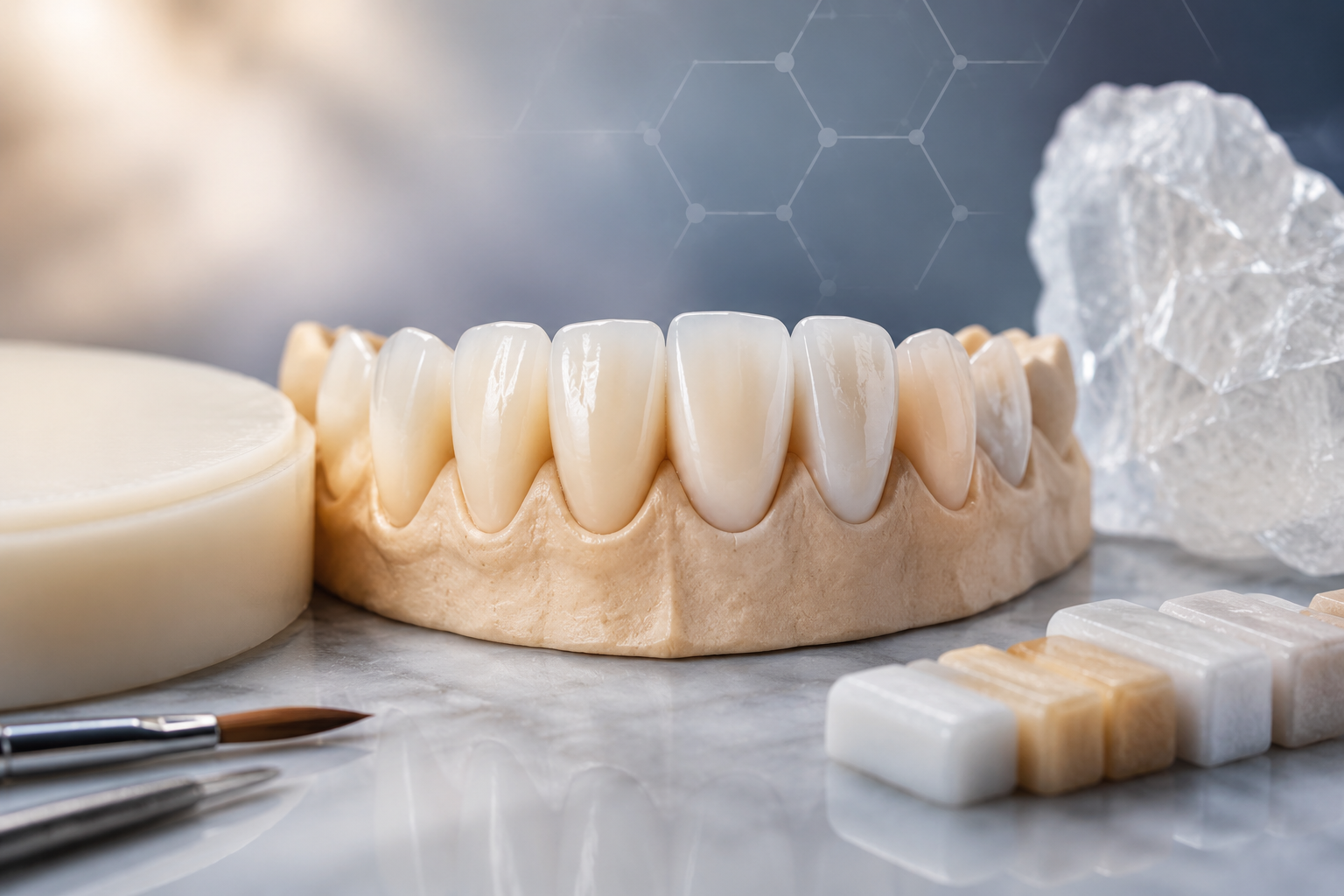
Anterior restorations are where dental labs face their most demanding material selection decisions. The anterior zone is the most visible area of the mouth every shade mismatch, translucency gap, or surface texture inconsistency is immediately apparent under clinical and social lighting conditions. At the same time, anterior teeth are not load-free. Canines bear significant lateral guidance forces. Upper centrals in edge-to-edge function take direct occlusal load. The material that looks perfect but fractures in six months is no more acceptable than the material that survives indefinitely but looks artificial next to natural dentition.
The question labs need to answer for every anterior case is not simply "which material looks best?" it is which material delivers the right combination of optical properties, mechanical performance, and clinical longevity for this specific patient, this specific shade requirement, and this specific occlusal scenario. This guide provides a clear, practical framework for making that decision across the three main material categories used in anterior restoration production today.
The Two Demands Every Anterior Material Must Meet
Before comparing materials, it is worth being precise about what "esthetics" and "durability" actually mean in the anterior context because both terms cover multiple distinct properties that materials address differently.
Esthetics in anterior restorations requires:
- Translucency that approximates natural enamel particularly in the incisal third, where light transmission determines whether a restoration looks alive or flat.
- Shade accuracy that matches adjacent natural teeth under multiple light sources, not just the dental operatory light.
- Surface texture that reflects light in the same way as natural enamel not mirror-smooth like over-glazed ceramic, and not rough like under-polished acrylic.
- Long-term color stability the material must not stain, yellow, or grey over the years of clinical service.
Durability in anterior restorations requires:
- Flexural strength sufficient to survive the specific occlusal loads of the anterior region typically 400–900 MPa depending on the case.
- Fracture toughness resistance to crack propagation under repeated functional stress.
- Wear resistance that protects both the restoration and opposing dentition over time.
- Chemical stability in oral fluids resistance to degradation, dissolution, or surface breakdown.
No single material is perfect on all of these dimensions simultaneously. The correct material for each anterior case is the one that best satisfies the specific combination of esthetic and mechanical requirements that case presents.
Material Option 1: High-Translucency Zirconia (4Y and 5Y Grades)
High-translucency zirconia has become the default anterior restoration material in modern dental labs for a straightforward reason: it delivers the best combination of esthetic performance and mechanical reliability of any single material currently available for anterior fixed restorations.
The key to understanding why lies in the yttria content classification system the difference between 3Y, 4Y, and 5Y zirconia is the most important material science concept in anterior case planning. 4Y and 5Y grades shift the crystal microstructure toward a higher cubic phase fraction, which increases light transmission dramatically compared to standard 3Y-TZP. The result is a material that transmits light in a way that closely approximates natural enamel particularly in multilayer disc formats where the gradient architecture builds the dentin-to-incisal optical transition into the material itself.
For anterior single crowns in the esthetic zone, explore esthetics zirconia by Upcera delivers four distinct chromatic layers calibrated to VITA Classic and 3D-Master shade guides — the cervical zone warm and saturated, the incisal zone translucent and opalescent. Labs producing standard A-shade anterior cases on this material report minimal staining requirements and consistently natural-looking results that pass shade matching under mixed lighting. The pre-shaded multilayer format eliminates the staining step on the majority of standard cases, reducing bench time without sacrificing esthetic quality.
For cases requiring maximum incisal translucency younger patients with highly translucent natural dentition, cases adjacent to e.max veneers, or lateral incisors where optical delicacy is most visible the tt one multilayer zirconia disc format pushes the incisal zone to total-translucency formulation, delivering the opalescent quality of natural enamel that standard 4Y discs cannot always replicate in direct comparison under natural light.
Mechanical performance of 4Y/5Y zirconia for anterior cases:
| Grade | Flexural Strength | Best Anterior Indication |
|---|---|---|
| 4Y multilayer | 600–800 MPa | Anterior single crowns, short-span bridges, premolars |
| 5Y high-translucency | 500–650 MPa | Anterior single crowns, maximum esthetic priority |
| 3Y-TZP | 900–1200 MPa | Not recommended for anterior esthetics too opaque |
The mechanical performance of 4Y and 5Y zirconia is more than adequate for anterior single crowns under normal occlusal conditions. The strength range of 500–800 MPa significantly exceeds the functional load requirements of most anterior cases. Where caution is needed is in anterior bridges particularly 3-unit spans where connector cross-section dimensions must be verified against the specific disc's published flexural strength data before committing the design.
Material Option 2: Lithium Disilicate
Lithium disilicate remains a clinically relevant option for anterior single crowns and veneers, and understanding where it genuinely outperforms zirconia and where it doesn't is important for labs advising clinicians on material selection.
Where lithium disilicate has an advantage:
Lithium disilicate at approximately 400 MPa flexural strength is weaker than any zirconia grade, but it offers bonding characteristics that zirconia does not. In minimally prepared anterior cases thin veneers, conservative overlays, or preparations where retention form is limited lithium disilicate's ability to bond reliably to tooth structure through adhesive cementation can be clinically superior to a zirconia crown that relies on conventional cementation on a short or tapered preparation.
The optical character of pressed or CAD/CAM-milled lithium disilicate is also excellent highly translucent, with a natural crystalline appearance that some clinicians consider the closest approximation to natural enamel currently available in a restorative material.
Where zirconia outperforms lithium disilicate:
For anterior 3-unit bridges, lithium disilicate is not appropriate connector strength is insufficient for bridge span loads. multilayered zirconia handles this indication correctly, delivering the esthetic gradient of a multilayer disc with the structural reserve that anterior bridge connectors require.
The practical selection rule: specify lithium disilicate for minimally prepared veneers and conservative overlays where adhesive bonding is the primary retention mechanism. Specify high-translucency zirconia for full-coverage crowns where preparation retention is standard and mechanical performance requirements exceed what lithium disilicate safely delivers.
Material Option 3: PMMA for Anterior Provisionals
PMMA does not compete with zirconia or lithium disilicate for permanent anterior restorations it is the provisional phase material that precedes them. But its role in the anterior esthetic workflow is more clinically significant than its temporary status suggests.
A well-fabricated PMMA anterior provisional does three things that directly affect the quality of the final restoration: it protects the prepared tooth during the treatment period, it establishes the occlusal scheme and vertical dimension that the permanent restoration will inherit, and it gives the patient and clinician an opportunity to evaluate shade, shape, and function before the permanent material is committed.
For aidite zirconia bridges and other multi-unit anterior fixed cases, the quality of the PMMA provisional phase is not a minor consideration it is the esthetic and functional template from which the final restoration is designed and approved. Labs that produce provisional phases carelessly on anterior bridge cases create downstream problems that the best zirconia disc cannot fully correct.
Key PMMA requirements for anterior provisionals:
- Multilayer format for accurate shade preview the provisional's gradient should approximate the intended final restoration shade.
- Low residual monomer for biocompatibility during extended wear periods.
- Surface hardness sufficient to resist staining over the provisional period.
- Dimensional accuracy that allows the clinician to evaluate emergence profile and contact relationships accurately.
Making the Selection Decision: A Practical Framework
The correct material for any anterior case follows from three clinical questions:
1. What is the preparation type?
- Full coverage crown → high-translucency zirconia (4Y or 5Y multilayer).
- Minimal preparation veneer or overlay → lithium disilicate with adhesive cementation.
- Temporary → PMMA multilayer.
2. What is the esthetic priority level?
- Standard A-shade case, moderately translucent adjacent teeth → 4Y multilayer pre-shaded disc.
- High-translucency adjacent dentition, young patient, adjacent to e.max veneers → 5Y total-translucency multilayer disc.
- Complex characterization, unusual shade, hypocalcification → white zirconia blank with manual staining protocol.
3. What is the span length?
- Single unit → 4Y or 5Y zirconia, lithium disilicate both acceptable.
- 3-unit anterior bridge → 4Y multilayer zirconia only — verify connector dimensions.
- 4+ unit span → consult manufacturer strength data; 4Y may require connector reinforcement.
Sourcing Anterior Zirconia Materials in the US
For US dental labs building anterior material inventory, dental zirconia discs in both 4Y multilayer and 5Y high-translucency formats are the core stock. Zirconia blocks dental labs also use for single-unit anterior work offer the same material in smaller quantities for low-volume or trial evaluation before committing to full disc stock.
As a zirconia materials distributor usa with US inventory, ZirconiaGuys stocks the full Upcera and Aidite anterior zirconia range zirconia dental blanks in white and pre-shaded multilayer formats, multiple thicknesses, open-system compatible with same-day shipping on in-stock items. Zirconia blocks in individual unit quantities are also available for labs evaluating new products before moving to disc-format volume purchasing.
The anterior zone does not reward compromise. Selecting a material that performs adequately on esthetics but falls short on durability or vice versa produces outcomes that reflect poorly on the lab regardless of the technician's skill. The material selection framework is straightforward: high-translucency multilayer zirconia for the majority of full-coverage anterior cases, lithium disilicate for minimal preparation adhesive cases, and high-quality PMMA multilayer for the provisional phase that sets up the final result.
The difference between a natural-looking anterior restoration and a remake often traces back to the material selection decision made before the case entered the mill not to what happened after.


