

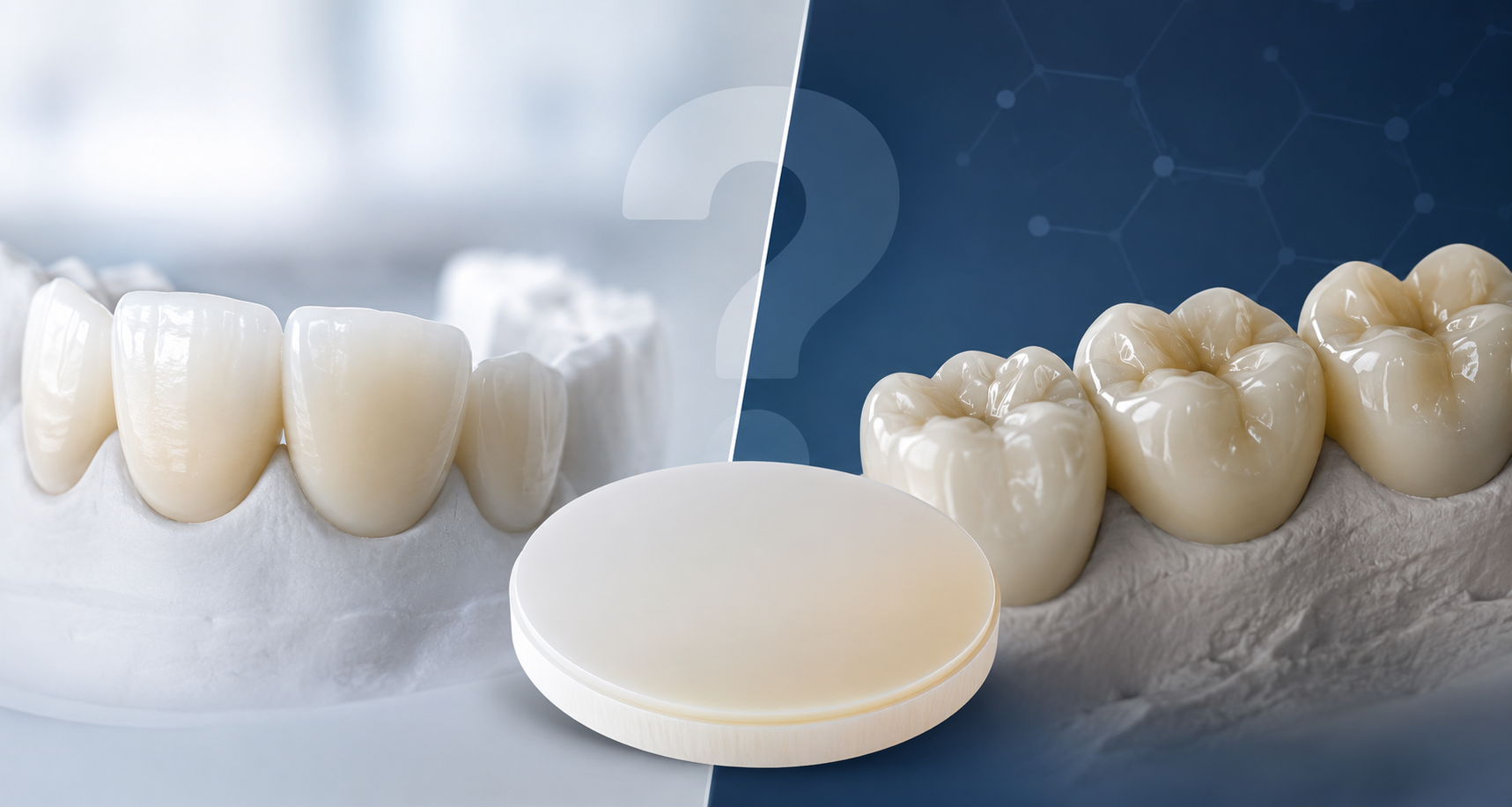
Upcera's Explore Esthetics disc is one of the most specified multilayer zirconia products in US dental labs particularly for anterior esthetic production. But a question comes up regularly in lab workflows: can it handle posterior crowns, or is it strictly an anterior material? It is a fair question, and the answer requires more than a yes or no. It requires understanding what the disc was designed to do, where its material properties sit relative to posterior demands, and where the clinical risk line falls.
This guide gives dental labs a clear, evidence-based answer covering the flexural strength of Explore Esthetics, the specific posterior scenarios where it performs acceptably, the scenarios where it does not, and how to make the right material selection decision without guesswork on every case.
What Explore Esthetics Is Designed to Do?
Before addressing the posterior question, it helps to be precise about what Explore Esthetics is engineered for. It is a multilayer high-translucency zirconia disc built on a 4Y–5Y gradient formulation. Upcera's TT-GT (Transparency Gradient Technology) produces four distinct chromatic zones across the disc from a warmer, more opaque dentin zone at the cervical end to a cooler, highly translucent incisal zone. The disc is calibrated to VITA Classic and 3D-Master shade guides and is available in standard 98 mm diameter in multiple thicknesses.
The design priority of the disc is optical performance in the anterior zone. The gradient architecture, the 4Y–5Y yttria formulation, and the VITA shade calibration are all optimized for anterior single crowns and short-span anterior bridges where natural translucency and shade accuracy are the overriding clinical requirements. The explore esthetics zirconia discs are among the most widely used anterior esthetic formats in US lab production precisely because they deliver consistent, predictable anterior results with minimal finishing labor.
The Strength Question: What the Numbers Actually Say
The reason the posterior suitability question matters is strength. Explore Esthetics is a high-translucency multilayer formulation, which means its yttria content is elevated relative to standard 3Y-TZP. That elevation in yttria content increases the cubic phase fraction delivering better translucency while reducing the tetragonal phase fraction responsible for transformation toughening and peak flexural strength.
Explore Esthetics delivers flexural strength in the 600–750 MPa range depending on sintering conditions and measurement protocol. This is meaningfully lower than 3Y-TZP at 900–1200 MPa, but it is not a weak material by any clinical standard. The question is whether 600–750 MPa is adequate for the specific mechanical demands of the posterior case being considered.
For context on where this sits in the broader zirconia landscape, the guide to the difference between 3Y, 4Y, and 5Y zirconia covers the full grade classification system, strength ranges, and clinical indication mapping in detail useful background for any lab making systematic grade selection decisions.
The short version: 600–750 MPa is above the clinical failure threshold for posterior single crowns in most occlusal scenarios. It is not adequate for posterior bridges of 3 or more units where connector cross-section requirements demand 700–900+ MPa to prevent connector fracture under functional load.
Where Explore Esthetics Works for Posterior Cases?
Based on the strength data and the disc's material architecture, there are specific posterior scenarios where Explore Esthetics is clinically appropriate:
-
Posterior single crowns in standard occlusal load cases.
For first and second premolar single crowns, and for first molar single crowns in patients with normal occlusal function, 600–750 MPa is within clinical safety margins. The disc's 14 mm thickness option provides adequate material volume for full-contour posterior single crown milling without thinning the occlusal surface below safe dimensions. Labs producing posterior single premolar crowns on Explore Esthetics and sintering correctly consistently report acceptable clinical outcomes. -
Second premolar single crowns.
Second premolars sit in the transitional zone between anterior esthetic priority and posterior structural priority. For these cases, the esthetic benefit of the Explore Esthetics gradient particularly on patients with a high smile line where premolars are visible may justify the slightly reduced strength reserve compared to a 3Y disc, provided the occlusal load is normal. -
Posterior single crowns with documented low occlusal load.
For patients with reduced dentition, geriatric patients with reduced bite force, or cases where the opposing arch is fully removable, the occlusal demand on a posterior single crown is significantly lower than in a full-arch natural dentition scenario. In these cases, the strength reserve in Explore Esthetics is more than adequate.
Where the disc performs poorly for posterior work:
-
Posterior bridges of any span.
This is the clearest clinical boundary. The flexural strength of Explore Esthetics is insufficient for posterior bridge connectors under functional occlusal load. A 3-unit posterior bridge connector requires a minimum cross-section of approximately 9 mm² at a flexural strength of 700+ MPa to survive long-term function. Explore Esthetics at 600–750 MPa does not safely meet this requirement. Labs that attempt to use Explore Esthetics for posterior bridge spans either because of esthetic requests from the prescribing dentist or material availability issues are creating fracture risk at the connector. -
Patients with documented bruxism.
In bruxing patients, occlusal forces on posterior crowns can exceed normal functional loads by a factor of 2–4. A material with 600–750 MPa flexural strength that is adequate under normal function becomes marginal under parafunctional force. For bruxing patients, specify a 3Y-TZP disc for any posterior restoration regardless of esthetic preference. -
Full-arch posterior rehabilitation cases.
When all posterior units in a quadrant are being restored simultaneously, the total occlusal load is redistributed across the restored arch. For these cases, the structural reserve of 3Y-TZP is the safer choice across all posterior units.
The Bridge Indication Boundary
One of the most common misapplication scenarios for Explore Esthetics involves anterior-to-posterior bridge cases where the prescribing dentist wants maximum translucency across a 3-unit bridge that spans from a premolar to a first molar. The esthetic motivation is understandable, but the structural risk is real.
For any bridge that includes a posterior connector regardless of whether the anterior unit is being matched to natural anterior dentition the connector cross-section is at risk under Explore Esthetics' flexural strength range. Labs in this situation have two options: use a stronger 4Y grade that balances esthetic performance with adequate connector strength, or use Explore Esthetics for the anterior units and a different disc for the posterior pontic and retainer with a split-design approach in cases where the workflow allows it.
The explore esthetics zirconia for bridges product specification page at ZirconiaGuys includes the manufacturer's published connector dimension minimums always verify these against your specific case design before committing to the disc for any bridge indication.
When to Switch to Explore Functional?
When a posterior case exceeds what Explore Esthetics safely covers posterior bridges, bruxing patients, high-load molar single crowns — the correct material switch within the Upcera range is to Explore Functional. The explore functional zirconia for crowns disc is engineered as Upcera's strength-priority multilayer format, delivering 700–900 MPa flexural strength with a multilayer architecture that still produces better esthetic results than flat monolithic 3Y-TZP.
Explore Functional covers the posterior bridge indication that Explore Esthetics does not. For 3-unit posterior bridges, 4-unit cases, full-arch posterior rehabilitation, and bruxing patients, Explore Functional delivers the structural reserve required while maintaining the gradient architecture that makes multilayer discs superior to flat white discs for any case with esthetic requirements.
The practical stocking strategy for labs running both esthetic and functional cases: stock Explore Esthetics as the default for anterior single crowns and anterior short-span bridges, and stock Explore Functional as the default for posterior bridges, high-load posterior cases, and any mixed anterior-posterior case where a connector falls in the posterior zone.
Using GSC Data to Understand What Labs Are Actually Searching
Two search queries that appear consistently in dental lab GSC data are directly relevant to this topic. Labs searching for types of zirconia in dentistry are looking for exactly this kind of indication guidance which grade for which case, what the differences mean clinically, and how to apply that to daily production decisions. Labs searching explore esthetics zirconia for bridges are already in the specific decision moment this blog addresses they are holding a disc and asking whether it is safe for the bridge case on their bench.
Both of these searches signal the same underlying need: labs want clear, product-specific clinical guidance that goes beyond generic material descriptions. The answer to "can I use Explore Esthetics for this posterior case?" should not require a phone call to a sales rep it should be answerable from reliable, authoritative content.
Practical Decision Framework for Every Case
Apply this framework before selecting Explore Esthetics for any posterior case:
Step 1 — Is it a single unit or a bridge?
- Single unit → proceed to Step 2.
- Bridge with any posterior connector → switch to Explore Functional or 3Y-TZP.
Step 2 — What is the occlusal load status?
- Normal function → Explore Esthetics is clinically appropriate for premolar and first molar single crowns.
- Documented bruxism or parafunctional loading → switch to 3Y-TZP.
Step 3 — Is esthetics the overriding clinical priority for this posterior unit?
- High smile line, visible posterior zone, esthetic-priority case → Explore Esthetics appropriate for single units in normal function.
- Standard posterior case where esthetics is secondary to structural performance → Explore Functional or 3Y-TZP.
Sourcing Both Formats for Your Lab
For US dental labs stocking the Upcera range, upcera zirconia at ZirconiaGuys covers both Explore Esthetics and Explore Functional in multiple thicknesses from US inventory enabling labs to stock the correct disc for each indication without multi-vendor ordering. Both formats are open-system compatible and ship from domestic stock with standard lead times.
dental zirconia discs selection at the product level not just at the brand level is what determines whether your lab consistently produces safe, accurate posterior restorations alongside high-quality anterior esthetic work. Explore Esthetics is an excellent disc in its correct indication. The posterior single crown is within its range. The posterior bridge is not.
Explore Esthetics zirconia is not limited to anterior cases but it is not unlimited for posterior ones either. Posterior single crowns in normal occlusal function fall within its clinical performance envelope. Posterior bridges, bruxing patients, and high-load molar cases fall outside it. Understanding that boundary is what allows labs to use dental zirconia discs like Explore Esthetics confidently where they perform correctly and to reach for the right zirconia blank or zirconia blocks dental format when the case demands more structural reserve than the esthetic grade can safely deliver.
The material selection decision is not about which disc looks best in a brochure. It is about which zirconia dental blanks and zirconia blocks format correctly matches the mechanical and esthetic requirements of the specific case every time.


