

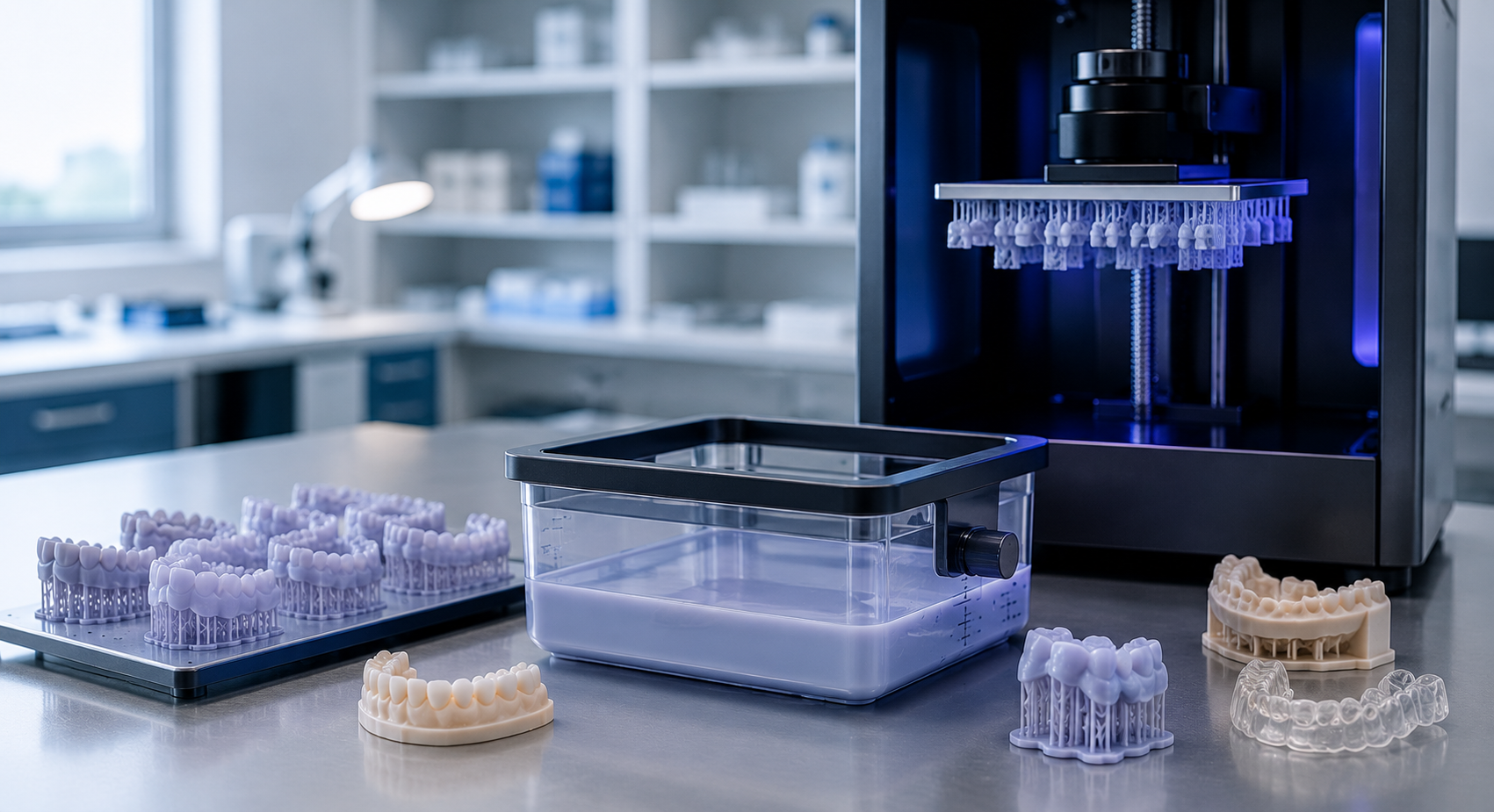
Every dental lab that runs a 3D printer has encountered the same frustrating scenario: a print that worked perfectly last month suddenly produces warped bases, delaminated layers, or surfaces that won't post-cure correctly and nothing in the printer settings changed. The resin is the same product, from the same supplier, run on the same machine with the same parameters. The variable that changed is time.
Resin shelf life is one of the least-discussed sources of print failure in dental 3D printing workflows, and one of the most impactful. Unlike dental zirconia discs or milled PMMA where a disc either mills correctly or it doesn't resin degradation is gradual and difficult to detect visually until it is already producing clinical failures. Understanding how dental resins age, what storage conditions accelerate degradation, how to test resin before committing it to a clinical production run, and what the shelf life parameters of specific products mean in practice is foundational knowledge for any lab running a resin-based printing workflow.
What Is Dental Resin Shelf Life and Why Does It Matter?
Dental 3D printing resins are photopolymer formulations liquid monomers and oligomers combined with photoinitiators, pigments, and stabilizers that polymerize when exposed to the specific wavelength of UV or visible light emitted by the printer's light source. The shelf life of a dental resin is the manufacturer's specification for the period during which the resin will perform within its validated parameters when stored correctly.
Shelf life matters because every component of the resin formulation has a finite stability window. Photoinitiators the compounds that absorb light and trigger polymerization — degrade over time, particularly when exposed to ambient light, heat, or oxygen. As photoinitiator concentration drops, the resin requires longer exposure times to achieve the same degree of cure, and the cure depth profile shifts in ways that can cause interlayer bonding failures, dimensional distortion, and surface quality degradation.
Stabilizers added during manufacturing slow this degradation, but they do not stop it. Even in sealed, correctly stored resin, the formulation changes over time. The manufacturer's shelf life specification is the period within which that change remains within the validated tolerance for clinical performance. After that point, the resin may still print — but it may not print to the dimensional and mechanical specifications that clinical applications require.
This matters more for dental applications than for general 3D printing because dental restorations and appliances have defined clinical requirements. A model printed from degraded resin may still look acceptable but be dimensionally inaccurate at the level that affects crown fit, splint occlusion, or surgical guide positioning. The failure is not always visible — it shows up clinically, after delivery.
How Resin Degrades: The Chemistry of Shelf Life?
Understanding how resin degrades makes it possible to prevent and detect degradation before it affects production. There are four primary degradation mechanisms in dental photopolymer resins.
Photoinitiator depletion.
Photoinitiators are consumed during curing — but they also undergo slow decomposition reactions in the presence of ambient light, even at low intensity. This is why resins must be stored in opaque containers away from light sources. A bottle left on a bench under fluorescent lighting for several weeks can lose meaningful photoinitiator activity even without being opened. Once photoinitiator concentration drops below the formulation threshold, cure depth decreases, interlayer bonding weakens, and dimensional accuracy deteriorates.
Monomer pre-polymerization.
Dental resins contain reactive monomers that can begin slow polymerization reactions without light exposure triggered by heat, mechanical shaking, or trace amounts of radical contamination. Pre-polymerization raises the viscosity of the resin gradually. As viscosity increases beyond the formulation's validated range, the resin spreads less uniformly across the build platform, layer thickness becomes inconsistent, and the print's dimensional accuracy degrades. Heavily pre-polymerized resin develops visible cloudiness or particulate matter but this is a late-stage sign. Early-stage viscosity increase is not visually detectable without measurement.
Additive separation and settling.
Pigments, fillers, and other additives in dental resins are suspended in the liquid monomer matrix. Over time particularly if the resin is stored undisturbed for extended periods these additives settle toward the bottom of the container. Inadequate mixing before use means the resin drawn from the top of the container has different pigment and filler concentration than the resin at the bottom, producing shade and opacity inconsistency across a production run.
Hydrolytic degradation.
Dental resins absorb moisture from the atmosphere over time, particularly in humid storage environments. Water molecules disrupt the monomer-oligomer interaction, alter the resin's photochemical response, and reduce the mechanical properties of the cured material. Resins stored in opened containers in humid environments degrade significantly faster than sealed resins in controlled storage conditions.
Shelf Life by Resin Type: What the Numbers Mean in Practice
Different dental resin formulations have different shelf lives depending on their chemistry, photoinitiator system, and stabilizer package. Most dental-grade resins specify shelf life between 12 and 24 months from the manufacturing date when stored under manufacturer-specified conditions typically sealed, away from light, between 15°C and 25°C.
For diagnostic model resins, the shelf life impact is primarily dimensional degraded model resin produces inaccurate reproductions that affect crown fit evaluation, orthodontic model accuracy, and surgical guide placement. For the dental 3d printing key mask resin used in opaque model masking applications where precise surface reproduction is required photoinitiator depletion directly affects the sharpness of surface detail reproduction. The masking function of this resin depends on complete, uniform surface cure, which degrades progressively as the photoinitiator concentration drops below the formulation threshold.
Splint and night guard resins are particularly sensitive to shelf life issues because their mechanical properties hardness, flexural strength, and resistance to deformation under occlusal load are tightly specified for clinical function. A splint printed from resin with degraded photoinitiator may appear correctly cured at the surface but have subsurface layers with incomplete crosslinking, producing a restoration that fractures or deforms earlier than its clinical specification allows. This failure mode is dangerous precisely because it is not detectable at delivery it presents clinically after weeks or months of patient use.
Surgical guide resins carry the highest clinical risk from shelf life failure because dimensional accuracy is directly linked to implant placement safety. A surgical guide printed from degraded resin that is off-specification by even 0.2–0.3 mm at the sleeve position can translate to a clinically significant implant angulation error.
The Key Model Resin Standard: Why Consistency Begins at the Bottle
For dental labs evaluating their model printing workflow, the key model resin product line from Keystone Industries sets the standard for what documented shelf life management looks like in practice. Each batch carries a manufacturing date and expiry date, with validated storage conditions specified on the label. This documentation enables labs to implement first-in-first-out inventory rotation the single most effective workflow practice for eliminating shelf life-related print failures.
First-in-first-out (FIFO) inventory rotation means the oldest stock is always used before newer stock. In practice, this requires labeling each resin bottle with its receipt date when it arrives, storing newer bottles behind older ones on the shelf, and checking manufacturing and expiry dates at each new order. Labs that skip this step frequently discover after a run of unexplained print failures — that they have been drawing from a bottle received 18 months ago while newer stock sat behind it.
Batch documentation also enables traceability. When a print failure occurs, batch documentation allows the lab to determine whether the resin was within shelf life, whether storage conditions were met, and whether the specific batch had any quality variation noted by the manufacturer. Without this documentation, troubleshooting print failures is guesswork.
For labs that stock multiple resin types model, splint, surgical guide, denture base the documentation discipline established for one product should apply uniformly across the full resin inventory. Inconsistent documentation practices are the root cause of most shelf life-related production failures.
Storage Protocols That Extend Resin Performance
Correct storage is what makes the manufacturer's shelf life specification achievable. Most dental resin failures attributed to "bad batches" are actually storage failures — product that was within specification at delivery but was degraded by incorrect handling before use.
Temperature control is the most critical storage variable. Dental resins should be stored between 15°C and 25°C. Heat accelerates all four degradation mechanisms simultaneously photoinitiator decomposition, pre-polymerization, additive settling, and hydrolytic degradation. Labs that store resin in rooms that reach 30°C+ during summer months are routinely consuming two to three months of effective shelf life per summer. Dedicated climate-controlled storage for resins even just a temperature-stable cabinet away from direct heat sources significantly extends practical shelf life.
Light exclusion is equally critical. Resins must be stored in their original opaque containers, away from UV light sources, fluorescent tubes, and windows. Photoinitiator activation begins at light intensities far below those that produce visible curing ambient lab lighting is sufficient to trigger slow photoinitiator depletion in exposed resin. Never transfer resin to clear containers for storage, even temporarily.
Sealed storage after opening is essential for preventing moisture ingress and oxidative degradation. After each use, resins should be sealed tightly and stored upright. Resin remaining in the printer's vat after a print run should be filtered back into the original container through a resin filter to remove any partially cured particles, then resealed and stored correctly.
For labs managing a full range of dental resin 3d printing products from model resins through splint, surgical guide, and denture base formulations a dedicated resin storage area with temperature monitoring and light exclusion is not an optional upgrade. It is a clinical quality control measure.
Testing Resin Before Clinical Production: A Practical Protocol
When resin age or storage history is uncertain for example, when stock was received without clear documentation, stored in suboptimal conditions, or carried over from a previous production period testing before clinical use is essential.
The test print protocol for resin shelf life evaluation involves printing a standardized test geometry from the suspect resin using the validated parameters for that resin. The test print should include:
- A thin-walled section (0.5–1.0 mm) to evaluate interlayer bonding and surface cure completeness. Delamination, surface tackiness, or visible layer lines in areas that should be smooth indicate photoinitiator depletion.
- A calibrated dimensional reference feature a circle or square of known dimension to evaluate whether the resin is printing within dimensional tolerance. Swelling, shrinkage, or distortion beyond the validated tolerance indicates monomer pre-polymerization or altered cure kinetics.
- A surface detail section reproducing a fine texture to evaluate whether the resin is achieving the surface resolution specified for its clinical application. Loss of detail sharpness indicates viscosity increase or photoinitiator degradation.
For key splint soft resin and other mechanically critical resins, the test protocol should include a post-cure hardness check using a Shore durometer or equivalent. Hardness below specification indicates incomplete crosslinking from photoinitiator depletion a clinical failure mode that the print's visual appearance will not reveal.
If the test print fails any of these criteria, the resin should be removed from clinical production regardless of its stated expiry date. A resin that was stored incorrectly may fail within its nominal shelf life. The test protocol is the definitive quality gate, not the expiry date alone.
How Resin Shelf Life Connects to Your Full Material Workflow?
Dental labs that run both 3D printing and milling workflows manage two fundamentally different material stability profiles. Zirconia blocks and milled PMMA discs the solid-state materials that form the backbone of most lab production do not degrade meaningfully over time in normal storage conditions. A zirconia blank stored correctly for two years performs identically to one used the week it was delivered. Zirconia dental blanks and zirconia blocks dental discs have effectively indefinite shelf lives under normal lab storage no photoinitiator degradation, no viscosity change, no light sensitivity.
This stability difference has a practical implication for inventory management: the discipline required for resin inventory is significantly greater than for solid-state milling materials. Labs expanding from pure milling workflows into 3D printing need to implement dedicated resin inventory protocols FIFO rotation, temperature monitoring, batch documentation, and periodic test printing that simply do not apply to their dental zirconia discs and PMMA disc inventory.
As a zirconia materials distributor USA supplying both milling materials and dental 3D printing resins, ZirconiaGuys stocks Keystone resin products from US inventory with full batch documentation. Understanding the shelf life and storage requirements of each product is part of the supplier relationship labs that have questions about specific product storage requirements or batch dates can request documentation directly.
For a broader look at how impression tray resins and other dental 3D printing materials fit into the full CAD/CAM workflow, the ZirconiaGuys guide to dental impression trays covers the material selection and workflow considerations for tray-based digital impression workflows in detail.
Resin shelf life is a workflow variable that rewards discipline and punishes neglect. The labs that eliminate resin-related print failures are not the ones using the most expensive resins they are the ones that implement FIFO inventory rotation consistently, store resins correctly, test before clinical production when any doubt exists, and treat resin management as a clinical quality control function rather than a supply room afterthought. The investment is minimal. The payoff in eliminated remakes, consistent print quality.


