

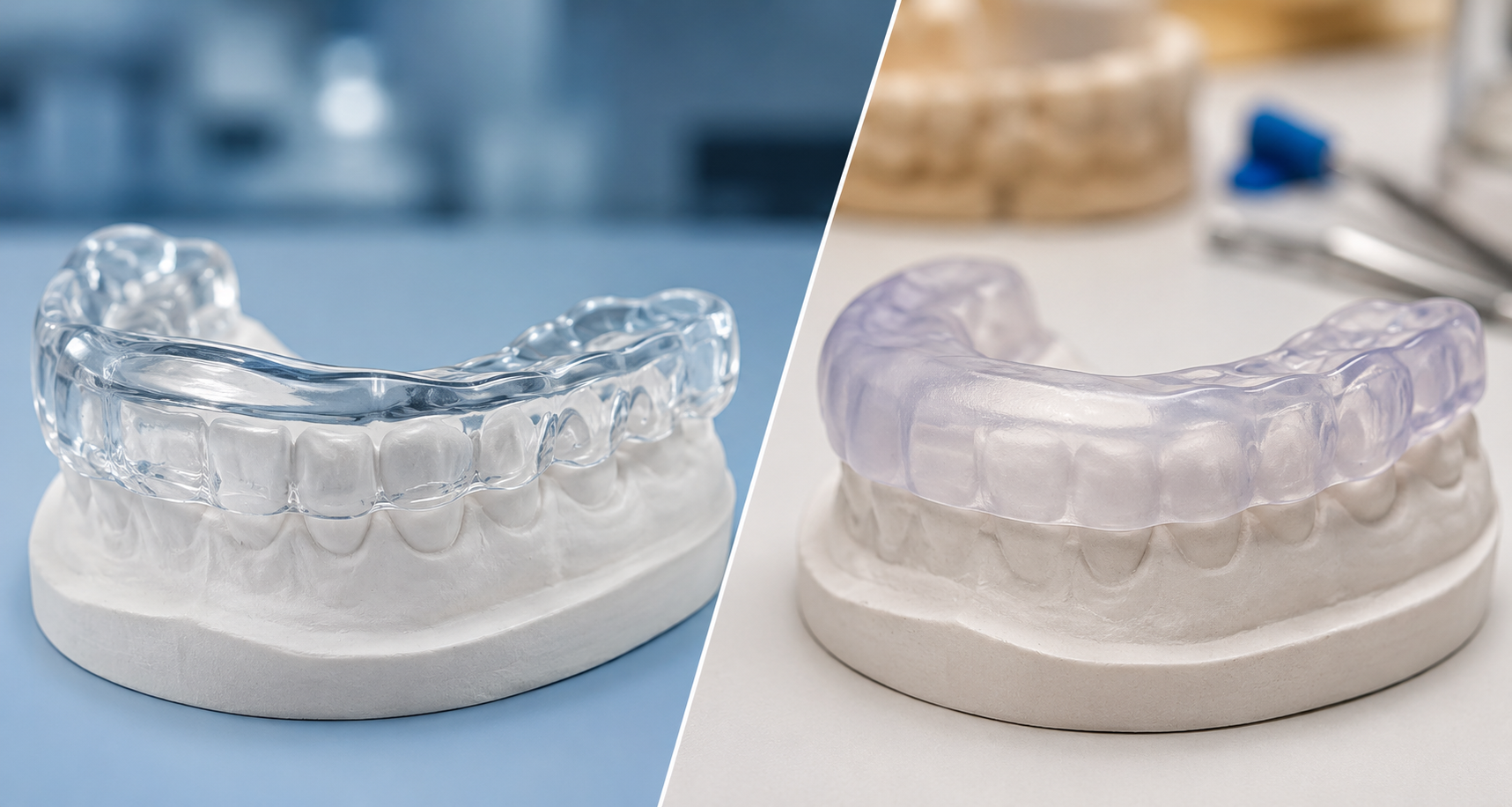
Occlusal splints are one of the highest-volume appliance categories in most full-service dental labs, and yet the hard-versus-soft material decision is made by habit more often than by clinical reasoning. A lab stocks one resin, uses it for every case, and adjusts the prescription to fit the material rather than the other way around. The result is a predictable pattern of problems: hard splints returned by sensitive patients who won't wear them, soft splints ground through within months by heavy bruxers, and remake conversations that could have been avoided at the material selection stage.
What follows is a practical framework for making the hard-versus-soft decision based on the clinical factors that actually predict which material will perform for a given patient not based on what happens to be loaded in the printer.
The Mechanical Difference That Drives Everything Else
Hard and soft splint resins are not versions of the same material at different thicknesses. They are mechanically different materials designed for different loading conditions, and the distinction matters in ways that go beyond patient comfort.
Hard splint resin is a rigid, high-modulus polymer. Under occlusal load, it does not deform. This means force is distributed broadly across the appliance surface rather than concentrating at individual contact points the same physics that makes a rigid floor more durable under point loads than a foam mat. That even force distribution is also what makes hard resin adjustable: because the material doesn't compress, a technician can create a balanced occlusal scheme by grinding to contact, and that scheme stays geometrically stable in the patient's mouth.
Soft splint resin is a lower-modulus, flexible polymer. It absorbs and cushions impact, which patients experience as more comfortable, particularly at first wear. The tradeoff is that flexible materials concentrate wear at high-contact points the same spots where bruxism force is greatest and the contact scheme is harder to verify and maintain because the material's flex changes how contacts feel both at chairside adjustment and during function.
Neither is the wrong choice categorically. The question is which loading condition the patient presents with.
When Hard Resin Is the Correct Specification?
Severe bruxism with documented tooth wear or appliance history.
When a patient presents with faceting, enamel loss, or a history of grinding through previous soft appliances within months, if the lab is specifying hard resin for dental splints it will last significantly longer under that force pattern than any soft alternative the material's rigidity means wear distributes rather than concentrates, and heavy bruxers don't perforate it at canine contacts the way they do soft resin.
Long-term nightly wear cases.
Duration of use is one of the strongest predictors of which material performs better. Over a 12–36 month wear period:
- Dimensional stability under repeated loading favors rigid material
- Occlusal scheme maintenance the contact pattern set at delivery holds in hard resin; soft resin contact patterns drift
- Key splint hard resin meets the flexural strength threshold needed for extended nightly use without requiring interim remakes on moderate-to-heavy bruxers
- Polishability after adjustment remains consistent throughout the appliance's lifespan with hard resin; soft resin surfaces micro-roughen faster at adjustment points
TMJ stabilization protocols.
Stabilization splints managing temporomandibular dysfunction require a full-coverage rigid surface where even, simultaneous posterior contact can be verified and maintained over a treatment course measured in months. Soft resin's compressibility makes it impossible to verify true simultaneous contact clinically the material gives slightly under the pressure of the articulating paper tap, masking actual contact distribution. Hard resin does not.
Any case where the prescribing dentist will be adjusting occlusion at delivery.
If the dentist is going to grind the appliance to establish contacts, hard resin holds the adjusted surface. Soft resin recovers slightly after grinding, and the adjusted contacts can shift enough to undermine the adjustment within the first few nights of wear.
Why Soft Resin Has a Legitimate Clinical Role?
The durability case for hard resin in heavy-bruxism cases is strong, but it is not universal. Soft resin is the correct specification in clinical scenarios where the appliance's primary job is compliance, not durability.
First-time appliance wearers.
tients who have never worn an occlusal splint particularly those with gag sensitivity, tight arches, or general intolerance to oral hardware adapt to soft resin at significantly higher rates than hard resin in the first two to four weeks. A patient who doesn't wear the appliance because it's uncomfortable delivers zero clinical benefit regardless of how durable the material is.
Mild bruxism and clenching-dominant patterns.
Patients whose parafunctional activity is primarily vertical clenching rather than lateral grinding generate concentrated vertical force rather than the shear forces that destroy soft resin at contact points. For these patients, a soft appliance may comfortably outlast the typical treatment review period without showing significant wear and the comfort advantage supports consistent nightly use.
Short-term diagnostic use.
When the splint is being prescribed to test whether occlusal appliance therapy changes a patient's symptom pattern before committing to a long-term protocol, the lower cost and faster patient acceptance of soft resin make it the more pragmatic choice for a 6–8 week evaluation period.
Where hard resin cannot deliver acceptable comfort for a new or sensitive patient, key splint soft resin for night guards provides a structured alternative not as a permanent solution for heavy bruxers, but as the right material for the cases above where compliance risk outweighs durability risk.
A Decision Table for Daily Lab Workflow
| Clinical Factor | Hard Resin | Soft Resin |
|---|---|---|
| Bruxism severity | Moderate–severe | Mild, clenching-dominant |
| Appliance history | Previous soft splints worn through | First-time wearer |
| Treatment duration | Long-term (12+ months) | Short-term or diagnostic |
| TMJ stabilization | Yes | No |
| Occlusal adjustment at delivery | Required | Minimal |
| Patient comfort tolerance | Established | Low or unknown |
| Pediatric / mixed dentition | No | Yes |
The dual-protocol approach soft resin for the first 4–6 weeks of a new patient's treatment, transitioning to hard resin once they are adapted and tolerant is worth standardizing for moderate-bruxism new patients. It addresses the compliance risk without conceding on long-term durability.
Material Consistency Matters as Much as the Hard/Soft Decision
The clinical decision framework above assumes the resin you are printing with actually performs to its labeled specification. This is less guaranteed than it sounds. Shore D values vary between manufacturers even at the same nominal hardness rating, and post-cure behavior how much the material continues to harden after initial cure and how it responds to chairside adjustment varies enough between products that a lab's adjustment protocol calibrated to one resin will not transfer cleanly to a different brand labeled with the same hardness category.
Dental splint printing resin whether hard or soft should be sourced from a supplier that provides consistent batch documentation, because the adjustment and finishing protocols your technicians build around a specific material depend on that material behaving predictably across every order. ZirconiaGuys carries both Keystone hard and soft splint resin formulations with full product documentation.
This material-consistency logic applies equally across other resin categories in the lab. The same principle of matching material rigidity to application duration and loading conditions and verifying that the specific product meets the mechanical threshold the application requires runs through how labs should think about PMMA provisional materials (see our piece on how material rigidity maps to clinical durability in PMMA provisionals, where the tradeoff between flexibility and durability appears in a different clinical context).
Hard resin handles high force, long duration, and precision occlusal control. Soft resin handles comfort, compliance, and low-to-moderate force over shorter treatment periods. Neither is a universal default. The labs that produce the fewest splint remakes are the ones that have both materials in inventory, a clear protocol for which cases go to which resin, and a reliable source for consistent batch quality because even the correct material decision fails if the resin isn't performing to specification when it comes off the printer.


