

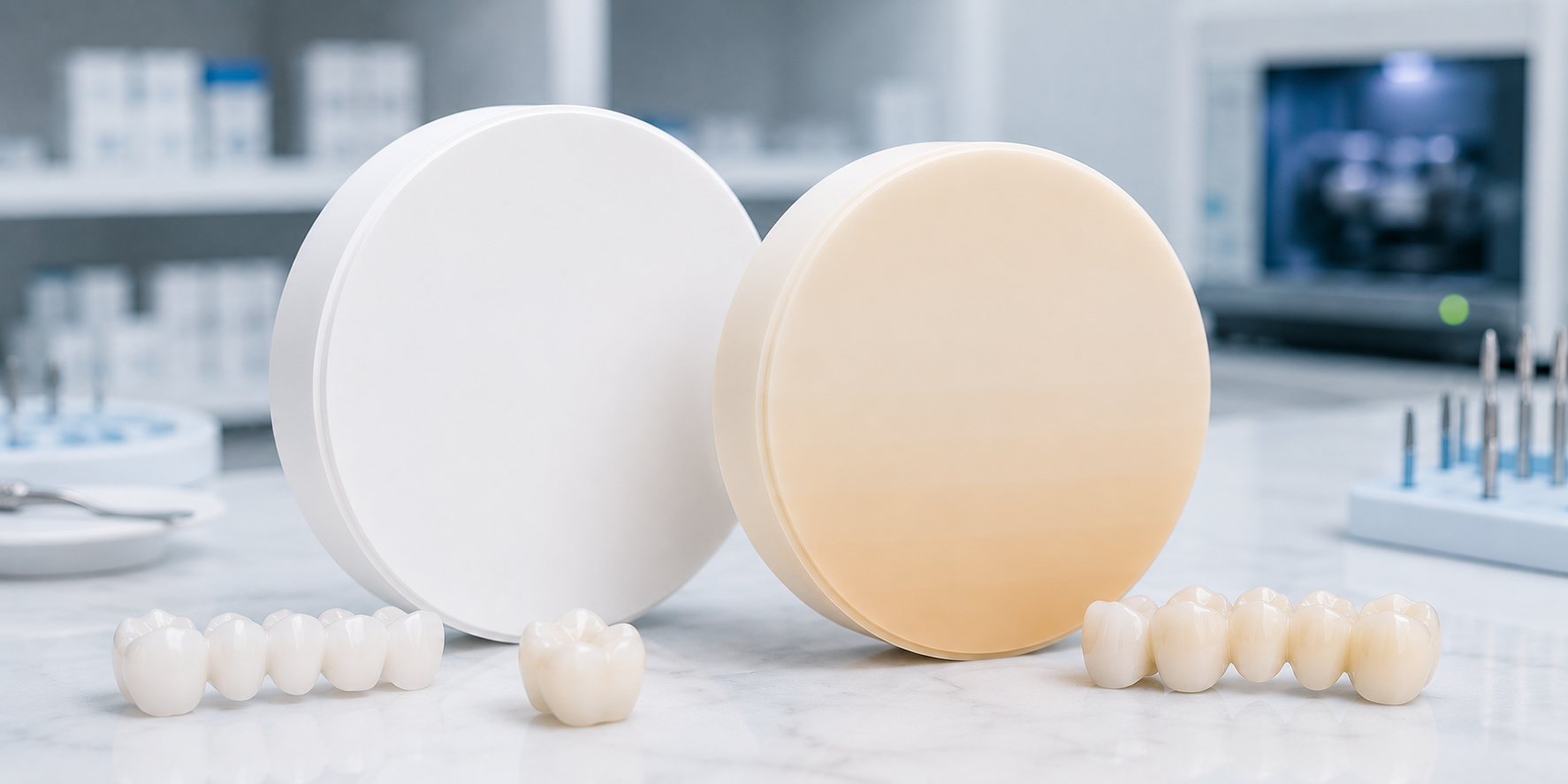
Every dental lab running a CAD/CAM workflow eventually arrives at the same fork in the material decision tree: white disc or pre-shaded disc? On the surface, this looks like a simple procurement choice. In practice, it is a workflow architecture decision that affects bench time, remake rates, shade consistency, and production economics on every zirconia case your lab runs. Getting it right means understanding what each format actually delivers and where each one is the wrong tool for the case.
This guide gives you a clear, practical framework for choosing between HT white and pre-shaded dental zirconia discs based on case type, lab volume, and the specific demands of your clinical production workflow.
What the Format Decision Actually Controls?
Before comparing the two formats, it is worth being precise about what the white vs. pre-shaded distinction means at the material level because it is often described in vague terms that do not help labs make informed decisions.
A zirconia blank in white (unshaded) format leaves the manufacturing process without pigmentation. The disc is a uniform, bright white throughout. Every shade value applied to the final restoration comes from the lab through liquid shade immersion, brush-on staining, or both after the restoration has been milled and before final sintering. White discs give the technician complete control over the shade outcome, but that control comes with a corresponding labor requirement on every unit.
A pre-shaded zirconia blank is pigmented during manufacturing to match specific VITA Classic or 3D-Master shade values. The shade gradient is built into the material itself from a warmer, more saturated cervical zone to a more translucent incisal zone before the disc reaches your mill. The lab mills the restoration, sinters it, and the shade is already there. For standard cases, the finishing step reduces to a glaze application rather than a staining protocol.
The format decision is therefore a decision about where shade control lives: in the material (pre-shaded) or in the technician's hands (white). Neither answer is universally correct. The correct answer depends on the case.
When HT White Is the Right Choice?
High-translucency white zirconia is the correct format when shade control requirements exceed what a fixed pre-shaded gradient can deliver. This includes four specific clinical scenarios.
Complex or unusual shade requests.
Cases involving strong B or C chroma values, shade requests outside the standard VITA A–D range, or cases requiring close matching to teeth with unusual coloring staining from tetracycline, fluorosis, heavy characterization, or significant hypocalcification cannot be reliably addressed with a pre-shaded disc. The pre-shaded format is calibrated to cover the standard range. Complex cases need the full flexibility of a white starting point.
Multi-unit cases requiring precise shade matching across units.
When a multi-unit case requires shade matching that must be verified and adjusted unit by unit particularly in cases adjacent to natural teeth with unusual optical character white discs allow the technician to calibrate each unit individually rather than relying on a fixed factory gradient.
Cases requiring surface characterization effects.
Craze lines, incisal halo effects, hypocalcification spots, and custom translucency mapping are all achievable with white discs and targeted stain application. Pre-shaded discs make these effects more difficult to control, since the existing gradient influences how surface stains appear after firing.
Labs prioritizing maximum shade flexibility over workflow speed.
High-end cosmetic dental labs where every case is treated as a custom esthetic challenge and where technician time is the expected investment will typically run white discs as their primary stock, accepting the staining labor in exchange for unlimited shade flexibility.
The ht white zirconia disc from Upcera is specifically formulated for this use case. Its high-translucency composition gives technicians a predictable optical baseline to stain from the material transmits light consistently enough that shade layering produces reliable, repeatable results rather than the unpredictable outcomes that lower-translucency white discs can produce when stain penetrates unevenly.
When HT White Creates Unnecessary Work?
The honest counterpoint to white disc flexibility is that the vast majority of dental lab cases do not need it. Most labs find that 70–80% of their anterior cases fall within the standard VITA A1–D4 shade range, where a pre-shaded disc delivers a clinical result indistinguishable from a carefully stained white disc in significantly less bench time.
For those standard cases, the ht white dental zirconia blocks format means: mill the restoration, apply shade liquid, fire a staining cycle, evaluate, potentially re-fire, then glaze. A pre-shaded disc compresses that to: mill, evaluate shade, glaze. The difference is meaningful at volume. At 20 anterior cases per week, the staining labor saved by pre-shaded discs on standard cases represents hours of recoverable technician time.
This is also where understanding the relationship between disc format and zirconia grade matters. White discs are available across all grade ranges 3Y, 4Y, and 5Y and the grade determines translucency and strength independently of whether the disc is white or pre-shaded. If your lab is unclear on the 3Y, 4Y, and 5Y distinction, our guide to the difference between 3Y, 4Y, and 5Y zirconia covers the material science and clinical selection criteria in full detail.
When Pre-Shaded Is the Right Choice?
Pre-shaded zirconia dental blanks are the correct default format for the majority of dental labs running standard anterior production workflows. The clinical case for them is straightforward: when the shade outcome is predictable and the case falls within the standard range, why add a staining step that the material can eliminate?
The st pre shaded zirconia disc format is the most widely stocked pre-shaded format for this reason. The pre-shaded gradient is calibrated to VITA shade standards and sintered into the disc during manufacturing the shade is chemically stable and cannot chip, flake, or fade the way external surface stain can over time. This material-level stability is one of the most underappreciated advantages of pre-shaded discs: the shade is not a surface treatment, it is the material.
Standard anterior crowns in A–D shade range.
Single-unit anterior crowns in A1, A2, A3, B2, or any other standard VITA value are where pre-shaded discs deliver their clearest workflow advantage. The result from the sintering furnace requires at most a minor characterization touch before glazing. Most cases go straight to glaze.
High-volume production labs.
Labs producing 15 or more zirconia anterior cases per week benefit significantly from pre-shaded formats. The cumulative reduction in staining labor across a month's production represents a material labor efficiency gain one of the few material decisions with a directly calculable return on investment.
Multi-technician environments.
In labs where multiple technicians handle anterior cases, pre-shaded discs reduce technician-to-technician shade variation. The shade outcome depends on the material, not on how each technician applies and fires stain. Consistency across the production floor improves without requiring standardized staining protocols to be enforced across staff.
Cases where the referring dentist specifies a standard VITA shade.
When the prescription reads A2 and the patient's adjacent teeth are standard A2, there is no clinical justification for the additional staining labor that a white disc requires. The pre-shaded disc is the correct tool.
Comparing the Two Formats Side by Side
| Factor | HT White Zirconia | Pre-Shaded Zirconia |
|---|---|---|
| Shade flexibility | Unlimited full manual control | Fixed to VITA standard shades |
| Post-mill staining | Required for every unit | Not required for standard cases |
| Best for | Complex, custom, high-chroma cases | Standard A–D shade production |
| Bench time per unit | Higher | Significantly lower |
| Multi-unit consistency | Technician-dependent | Material-controlled |
| Shade stability | Surface stain can vary | Gradient is stable and permanent |
| Remake risk | Moderate | Low |
| Cost per disc | Typically lower | Slightly higher |
| Real cost per case | Higher (staining labor included) | Lower at production volume |
How to Stock Both Formats Correctly
The correct answer for most full-service dental labs is not one format or the other — it is both, with clear protocols for which cases go to which disc.
Default stock: Pre-shaded dental zirconia discs in your most-used shade groupings. For most labs, this means stocking A-shade range pre-shaded discs as the primary anterior production material. These cover the majority of daily cases without staining labor.
Secondary stock: HT white zirconia blocks dental in your preferred grade for complex and custom cases. These handle the cases where shade flexibility is genuinely required unusual shades, strong characterization requirements, or cases where the pre-shaded gradient cannot deliver the specific optical result needed.
Avoid: Using white discs as the default simply because they cost less per disc. The lower disc price is consumed by staining labor on every standard case. Pre-shaded discs at slightly higher acquisition cost deliver lower real cost per case at any meaningful production volume.
As a zirconia materials distributor USA labs rely on for consistent US-stocked inventory, ZirconiaGuys carries both formats across Upcera and Aidite product lines white and pre-shaded zirconia blocks, multiple thicknesses, open-system compatible with same-day shipping on in-stock items.
The choice between HT white and pre-shaded zirconia dental blanks is not a question of which format is better it is a question of which format is correct for each case type and production volume. White discs deliver flexibility. Pre-shaded discs deliver efficiency. The labs producing the best work at the lowest real cost per case are the ones who have both formats in inventory, use each in its correct application, and source them from a dental lab material supplier with consistent batch quality and US-based stock.
If your current workflow runs every anterior case through a full staining protocol regardless of shade complexity, switching standard A–D shade cases to pre-shaded discs is one of the highest-return material decisions available to you measurable in recovered technician hours from the first week of implementation.


