

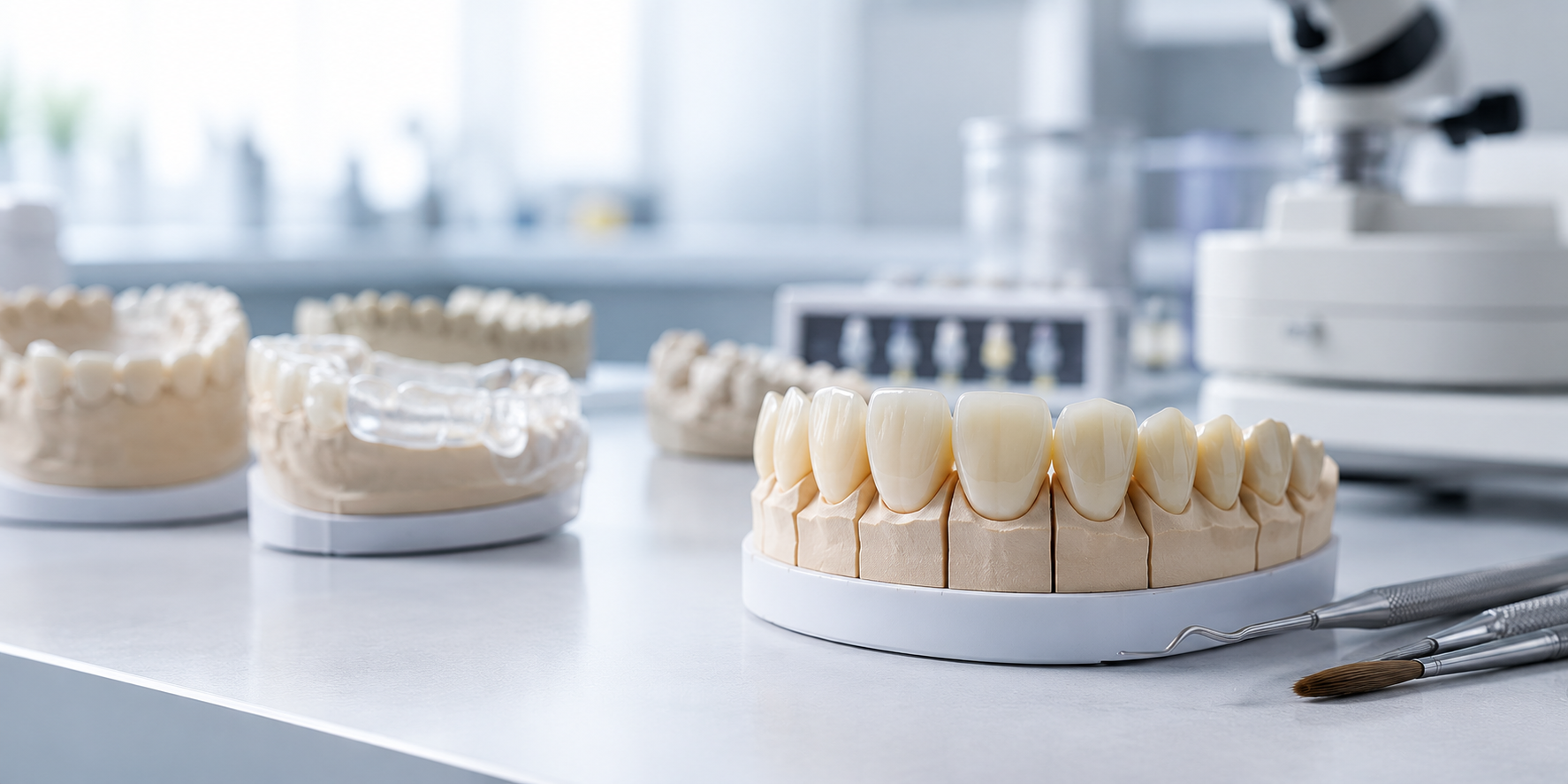
Temporary restorations do more clinical work than most labs give them credit for. Beyond protecting the prepared tooth during treatment, a well-made provisional sets patient expectations for the final restoration shape, shade, translucency, and surface texture are all evaluated during the temporary phase. When the provisional looks flat, too opaque, or poorly shade-matched, patients arrive at the delivery appointment already skeptical. When it looks natural, delivery becomes significantly easier.
The esthetic quality of temporary restorations is not determined primarily by the finishing technician's skill it is determined upstream, by the material selected and the workflow used to produce it. Most esthetic problems with temporaries can be traced to one of three causes: wrong PMMA formulation for the application, toolpath alignment errors that waste the disc's gradient architecture, or surface finishing shortcuts that leave the restoration looking processed rather than natural. Each of these is a fixable workflow problem, not a talent problem. This guide covers how to fix them.
Why Material Selection Is the Largest Esthetic Variable in Temporary Production?
The single most impactful decision in temporary restoration esthetics is made before the case reaches the milling machine: the PMMA disc format. Labs that use single-shade opaque PMMA for anterior provisional cases are working against the material from the start — no amount of staining, polishing, or glazing fully compensates for a disc that was never designed to produce natural-looking tooth anatomy.
As we covered in our guide to the role of dental PMMA in temporary and long-term restorations, PMMA is a material class with distinct formulations for distinct applications. The formulation decision determines the optical ceiling of the finished restoration. Single-shade discs have a flat optical ceiling every unit looks the same regardless of how well it is milled and finished. Multilayer gradient discs have a much higher optical ceiling — the material itself contributes translucency, shade depth, and incisal character that single-shade formats cannot replicate regardless of post-processing effort.
What multilayer PMMA actually does differently: A multilayer disc is manufactured with gradient yttria-analog pigmentation — transitioning from a higher-chroma, more opaque zone at the cervical end to a more translucent, cooler zone at the incisal end. When the CAD/CAM toolpath is correctly aligned with this internal gradient, the milled restoration already contains the optical character of natural tooth anatomy before any surface work is applied. The dentin zone of the crown exits sintering looking warm and saturated. The incisal zone exits looking translucent and cool. The technician's job is refinement, not compensation.
For aidite pmma multilayer discs specifically, this gradient architecture is calibrated to VITA shade references meaning the internal gradient matches the chroma and value relationships of standard A-D shades across the full disc. Labs that have standardized on this product for anterior temporary production consistently report faster case turnaround and fewer shade-correction remakes compared to their previous single-shade workflow.
Getting the Toolpath Right: The Step Most Labs Skip
Selecting a multilayer PMMA disc and then milling it without aligning the toolpath to its internal gradient is the most common technical error in temporary production. The result is a restoration with the gradient running in the wrong direction incisal-grade translucent material at the cervical, dentin-grade opaque material at the incisal edge. The crown exits the mill looking bright white at the margin and flat at the tip. The gradient is working exactly as designed, just backwards.
Every multilayer PMMA disc is directionally marked an engraved arrow or notation on the disc surface indicates the gingival-to-incisal axis. This marking must be verified against the mill's chuck orientation before every case from a new batch. For temporary crowns aidite pmma, the correct orientation places the disc's dentin-dominant zone at the base of the crown preparation margin and the translucent zone toward the incisal edge of the crown design.
Beyond orientation, the CAD design itself must be positioned to capture the gradient correctly. In exocad and 3Shape, the blank orientation module allows the technician to visualize where the crown design sits within the disc's gradient layers before committing the toolpath. Use it. A crown designed with the preparation margin sitting in the incisal zone of the disc will look wrong regardless of material quality, orientation, or finishing technique. The five minutes spent verifying gradient placement before milling eliminates the most common reason temporary restorations require shade correction.
Checklist before milling any anterior multilayer PMMA case:
- Disc directional marking verified against mill chuck orientation
- Crown preparation margin positioned in the body/dentin zone of the disc
- Incisal one-third of crown design falling within the enamel/translucent zone
- CAD software blank orientation preview reviewed and confirmed
- Feed rate appropriate for PMMA at the layer transition zones (reduce by 10–15%)
Shade Selection for PMMA Temporaries: Matching the Final Restoration Intent
The shade workflow for PMMA temporaries is different from zirconia and treating them the same is one of the most consistent sources of shade mismatch at delivery. Dental zirconia discs for permanent restorations are shaded to a final sintered result. PMMA provisionals are shaded in a pre-cured state that shifts slightly in value and chroma after milling and polishing. Labs that shade-match PMMA wet (immediately after milling, before polishing) consistently overshoot — the final polished and dried restoration is lighter and lower-chroma than the wet shade assessment suggested.
The correct shade assessment sequence for PMMA temporaries:
- First, select the disc shade that corresponds to the final restoration target shade from the prescribing dentist's shade records. Pre-shaded multilayer PMMA in standard A-D formats covers the significant majority of everyday cases use the pre-shaded disc as the baseline and plan for minimal supplementary staining.
- Second, after milling and before any polishing, evaluate the dry milled surface under dental operatory-equivalent lighting. This is the closest approximation of the final polished result. Wet assessment distorts apparent value.
- Third, compare the dry milled surface to the shade tab under three light sources fluorescent, daylight, and incandescent. Shade tabs look different under each. If the shade matches under fluorescent only, it will fail in the patient's natural environment. Multilayer PMMA discs with correctly formulated internal gradients perform consistently across light sources a flat single-shade disc often metamers badly under incandescent or natural light even when it looks correct under fluorescent.
- Fourth, if supplementary staining is needed typically only for cases outside the standard A-D range or when the prescribing dentist requires a very specific characterization — apply at 30–50% of your normal stain concentration. Pre-shaded multilayer PMMA already carries internal chroma; full stain concentration oversaturates the cervical zone and produces a result that looks hand-painted rather than natural.
Surface Finishing: Where Esthetics Are Won or Lost
Material selection and toolpath alignment set the optical potential of the temporary restoration. Surface finishing determines how much of that potential is actually realized. A correctly milled multilayer PMMA provisional with poor surface finishing looks worse than a single-shade disc that has been properly finished the gradient character in the material is invisible under a hazy, scratched surface.
For aidite denture base pmma and crown-and-bridge PMMA provisionals alike, the finishing sequence follows the same principle: work from coarse to fine until the surface is optically smooth, then polish to high gloss without adding heat.
Four-stage finishing sequence for PMMA temporaries:
- Stage 1 — Gross reduction: Tungsten carbide bur or acrylic trimming bur at low speed for sprue removal and gross morphology refinement. Keep speed low PMMA heats quickly and heat generates surface smearing that makes subsequent polishing harder.
- Stage 2 — Surface refinement: Silicone polishing points in medium and fine grits, working all surfaces systematically. The goal at this stage is to eliminate all milling tool marks and produce a uniformly matte surface with consistent scratch depth. Any deep tooling marks left at this stage will show through the final gloss polish.
- Stage 3 — Pre-polish: Pumice slurry with a rag wheel or felt point at low RPM. Apply consistently across all surfaces. The pumice slurry removes fine scratches from Stage 2 and prepares the surface for high-gloss polishing. Do not rush this step pumice stage quality directly determines final gloss quality.
- Stage 4 — High-gloss polish: Acrylic polishing compound (tin oxide or aluminum oxide-based, not abrasive paste) with a clean dry felt wheel or muslin wheel at low RPM. Apply light, even pressure. The goal is a mirror-like surface you should be able to see reflection in the completed restoration surface before delivery.
Critical error to avoid: Polishing wheels that have been used for one stage should not be reused for a finer stage without cleaning. Contaminating a fine polishing wheel with pumice residue introduces scratches that defeat the purpose of the finer step. Dedicate separate wheels to each stage.
When to Use Staining on PMMA Temporaries and When Not To?
Staining is where many labs add unnecessary time to temporary production. The appropriate question before reaching for the stain kit is not "how should I stain this?" it is "does this actually need staining?" For pre-shaded multilayer pmma disc formats, the answer in standard A-D shade cases is usually no.
The cases where staining genuinely adds value on PMMA temporaries are narrow and specific:
- Custom characterization cases — when the prescribing dentist has requested replication of specific natural tooth features (craze lines, hypocalcification spots, incisal halo, fluorosis). These effects cannot be achieved through disc selection alone and require surface staining.
- Strong B or C shade cases — outside the standard A-shade range, where pre-shaded discs in those shades are not stocked or where the shade is unusually high-chroma.
- Cases adjacent to distinctive existing dentition — when the patient's natural teeth have visible and unusual optical characteristics (strong internal blue tones, deep amber cervical saturation) that standard disc shades do not match.
- Extended temporary cases — where the provisional will be worn for 3+ months and the prescribing dentist wants a more refined esthetic result that guides the final restoration design. In these cases, careful characterization of the temporary can provide diagnostic value for the final lab prescription.
In all other cases which is the majority of daily production — the pre-shaded gradient disc correctly milled and properly finished produces a result that does not need staining. Adding stain to a correctly executed multilayer temporary case introduces variables (stain concentration, firing consistency, color shift on firing) that are more likely to degrade the result than improve it.
How Temporary Esthetics Connect to Final Zirconia Outcomes?
The esthetic quality of a temporary restoration directly affects the prescription accuracy for the final restoration. A correctly shaded, correctly shaped PMMA temporary gives the prescribing dentist a patient-tested prototype for the permanent case. Shape modifications, length adjustments, and shade refinements can be incorporated into the final dental zirconia discs prescription based on patient feedback during the temporary phase before the permanent restoration is milled.
Labs that produce high-quality temporaries receive better-specified final prescriptions. The dentist has already resolved shape and shade at the temporary stage, which means the final lab prescription is more precise and the delivered restoration requires fewer adjustments. The downstream efficiency gain from better temporaries is not just patient satisfaction it reduces re-do requests, reduces delivery chair time, and reduces the likelihood of a remake on the permanent restoration.
This connection between temporary and permanent quality is why the material investment in high-quality multilayer PMMA pays off beyond the temporary case itself. As a dedicated zirconia materials distributor USA, ZirconiaGuys supplies both the PMMA range for provisionals and the full dental zirconia discs range for permanent restorations meaning labs can align the temporary and permanent workflows around the same shade references, the same supplier documentation, and the same technical support.
Improving the esthetics of temporary restorations is a systems problem, not a skills problem. The material needs to be right multilayer pre-shaded PMMA for anterior provisional cases, single-shade for posterior where esthetics are less critical. The toolpath needs to capture the gradient correctly. The finishing sequence needs to be executed completely, without skipping stages. And the staining decision needs to be disciplined reserved for cases that genuinely need it, not applied reflexively to every unit.
Labs that fix the material and workflow first consistently achieve better results than labs that compensate for wrong materials through extra finishing effort. The quality is in the upstream decisions. Zirconia dental blanks and PMMA provisionals both perform at their best when the lab uses each in its correct application, in the correct format, with the workflow adapted to the specific material's requirements.


