

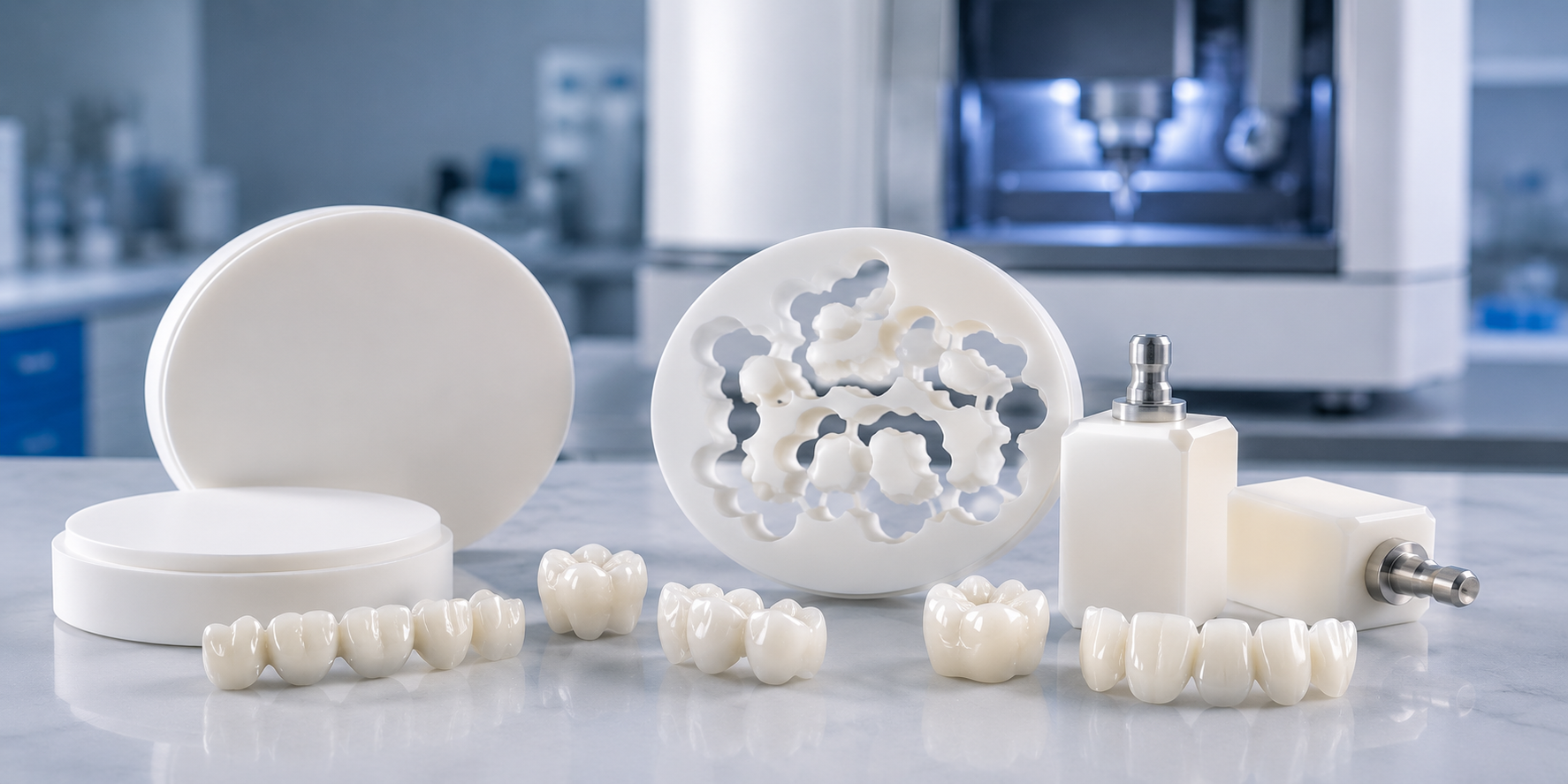
The zirconia block you select at the start of a case determines the clinical outcome at the end. Strength grade, disc format, pre-shaded or white, monolithic or multilayer each decision compounds into the final restoration's esthetic quality, structural reliability, and the amount of bench time required to get it there. Labs that get this selection right consistently produce better restorations with fewer remakes. Labs that treat it as a commodity decision pay for it in rework.
This guide cuts through the complexity and gives dental labs a clear, practical framework for matching zirconia blocks to clinical indications from simple single-unit posterior crowns to full-arch implant-supported prostheses. Whether you are building out a new CAD/CAM workflow or rationalizing an existing material inventory, this is the selection reference you need.
Why Zirconia Block Selection Is More Complex Than It Looks?
The term zirconia blocks dental labs work with covers a wide range of products that share a material class but differ substantially in performance. A 3Y-TZP monolithic disc used for a posterior bridge and a 5Y multilayer pre-shaded disc used for an anterior esthetic crown are both "zirconia blocks" but their flexural strength, translucency, sintering requirements, and ideal clinical applications have almost nothing in common.
The key variables that define any zirconia block are: yttria content (which controls the strength-to-translucency tradeoff), disc format (white or pre-shaded), and disc architecture (monolithic flat or multilayer gradient). Understanding each variable is what enables correct selection — and getting just one variable wrong produces a restoration that requires significantly more post-sintering correction than a correctly specified block would have needed.
For a detailed breakdown of how yttria content drives the performance differences between 3Y, 4Y, and 5Y grades, refer to our blog on the difference between 3Y, 4Y, and 5Y zirconia, which covers the crystal phase science, clinical strength data, and indication framework in full.
Step 1 — Match the Strength Grade to the Structural Demand
The first selection decision is always strength grade. Before considering esthetics, format, or price, identify the peak structural demand of the restoration. This single question determines the minimum yttria grade that is clinically safe.
Posterior bridges of 3 or more units — 3Y-TZP is the only clinically appropriate grade. Flexural strength of 900–1200+ MPa is required to safely meet the connector cross-section minimums under posterior occlusal load. Any material below 700–800 MPa creates meaningful fracture risk at the connector — a risk that no esthetic benefit justifies.
Posterior single crowns — 3Y or 4Y is appropriate depending on the patient's occlusal load. For bruxers or patients with documented heavy occlusion, 3Y provides the safety margin. For standard loading, 4Y delivers better esthetic integration without structural compromise.
Anterior single crowns and short-span anterior bridges — 4Y or 5Y is appropriate. The occlusal demand in the anterior zone is lower than posterior, and the esthetic demand is higher. This is where the strength-translucency tradeoff works in the lab's favor — you can afford to trade some strength for significantly better optical performance.
Anterior veneers — 5Y is the correct grade. The material volume in a veneer is too thin for posterior load demands to be relevant. Maximum translucency is the overriding clinical priority.
Implant-supported crowns — Grade selection follows zone. Anterior implant crowns: 5Y or 4Y multilayer. Posterior implant single crowns: 4Y or 3Y. Posterior implant bridges: 3Y only.
The aidite zirconia blocks range covers 3Y through 5Y across multiple disc formats including Aidite's high-strength grades for posterior structural cases and high-translucency multilayer grades for anterior esthetic work all available from US inventory at ZirconiaGuys.
| Restoration Type | Minimum Grade | Preferred Format |
|---|---|---|
| Posterior bridge (3+ unit) | 3Y-TZP | Monolithic white or pre-shaded |
| Posterior single crown | 3Y or 4Y | Pre-shaded or white |
| Anterior bridge (3-unit) | 4Y | Multilayer pre-shaded |
| Anterior single crown | 4Y or 5Y | Multilayer pre-shaded |
| Anterior veneer | 5Y | Pre-shaded |
| Implant posterior bridge | 3Y | Monolithic |
| Implant anterior crown | 5Y or 4Y | Multilayer pre-shaded |
Step 2 — Choose the Right Disc Format: White vs. Pre-Shaded
Once the grade is determined, the format decision follows. This is where labs often lose time and create unnecessary rework by defaulting to one format for all cases.
A zirconia blank in white format gives the technician full manual control over shade. The lab applies external liquid shade after milling, building the color precisely to match any shade request including unusual chromas, complex characterization, and cases outside the standard VITA A-D range. White blanks are the right choice for custom and complex cases but they require staining labor on every unit.
A pre-shaded blank has the shade built into the material during manufacturing. For standard A1 through D4 cases the significant majority of daily lab production pre-shaded discs eliminate the external staining step entirely. The shade is in the material, consistently reproducible batch to batch, without the operator variability that manual staining introduces.
The upcera dental zirconia blank range covers both formats across 3Y, 4Y, and 5Y grades. Upcera's pre-shaded formulations are calibrated to both VITA Classic and 3D-Master shade guides — making them compatible with either shade-matching system your referring dentists use. For labs evaluating the full Upcera format range, ZirconiaGuys stocks the complete lineup from US inventory with no international lead times.
Practical stocking guidance: Use white zirconia dental blanks as your secondary inventory for custom cases. Use pre-shaded multilayer as your primary production stock. Most labs find that 70–80% of their cases fall within standard A-D shades where pre-shaded discs deliver better consistency with less labor than white blanks and manual staining.
Step 3 — Monolithic or Multilayer? The Architecture Decision
The third decision is disc architecture. This choice determines how the optical properties of the finished restoration are structured and it has significant implications for both esthetic outcome and finishing workflow.
Monolithic zirconia is manufactured from a single, homogeneous composition. Every point in the disc has identical strength, shade, and translucency. Monolithic discs are the correct format for high-strength posterior bridge applications where structural uniformity at the connector is critical. They are also the correct format for cases using white discs where full stain control is needed the uniform starting point enables clean, consistent shade layering.
Multilayer zirconia incorporates a gradient of yttria content from the cervical end to the incisal end of the disc. This gradient produces a corresponding gradient of translucency and shade character stronger and more opaque at the cervical, more translucent at the incisal that replicates the natural optical zonation of a real tooth. When the CAD/CAM toolpath is correctly oriented to this internal gradient, the milled crown already contains the natural shade transition before any stain is applied.
For labs producing high-volume anterior esthetic work, zirconia blocks with natural gradient architecture such as the Aidite Superfect ZIR SHT pre-shaded multilayer disc represent the highest-efficiency format for standard anterior cases. The internal gradient eliminates staining on the majority of A-D shade cases, reduces finishing time per unit significantly, and delivers consistent shade transitions across multi-unit cases that manual staining cannot replicate with the same reliability. For a deeper look at how multilayer esthetic disc technology works in anterior case workflows, our blog on esthetic zirconia discs covers the material science and milling workflow in detail.
Step 4 — Thickness, Diameter, and Equipment Compatibility
Grade, format, and architecture settled the final selection variables are physical dimensions and equipment compatibility.
Disc thickness must match the restoration's minimum material requirements:
- 10 mm — Anterior single crowns, thin veneers
- 12 mm — Standard anterior and premolar crowns, anterior bridges
- 14 mm — Posterior single crowns, short-span posterior bridges
- 16–20 mm — Full-arch and long-span bridge cases
Always verify the manufacturer's published minimum wall thickness and connector cross-section requirements for the specific disc. Esthetic-grade 5Y discs may require slightly more material volume than 3Y discs of the same restoration type to compensate for the lower flexural strength.
Disc diameter is standardized at 98 mm for virtually all open-system dental milling machines — Roland, Amann Girrbach, Zirkonzahn, VHF, and Sirona included. Confirm open-system compatibility before committing to any new product, particularly if switching from a manufacturer whose format has historically been proprietary.
The dental zirconia discs available at ZirconiaGuys are all 98 mm diameter in standard open-system format compatible with every major milling system used in US dental labs. As a zirconia materials distributor USA labs rely on for consistent domestic inventory, ZirconiaGuys ships same day or next day on in-stock items, eliminating the international lead time uncertainty that affects direct overseas sourcing.
Choosing the right zirconia block for each dental restoration is a structured decision not a preference. Strength grade first, format second, architecture third, dimensions and compatibility fourth. Every variable in that sequence has a correct answer for any given clinical indication, and selecting correctly at each step produces restorations that require less post-sintering intervention, fewer remakes, and more consistent clinical outcomes.
For US dental labs, sourcing zirconia blocks from a domestic zirconia materials distributor USA means consistent stock, same-day shipping, and full technical documentation without the lead time uncertainty of international supply chains. ZirconiaGuys stocks Aidite, Upcera, and other leading brands across all grades and formats from US inventory, with technical support available for sintering profiles and milling parameters on every product we carry.


