

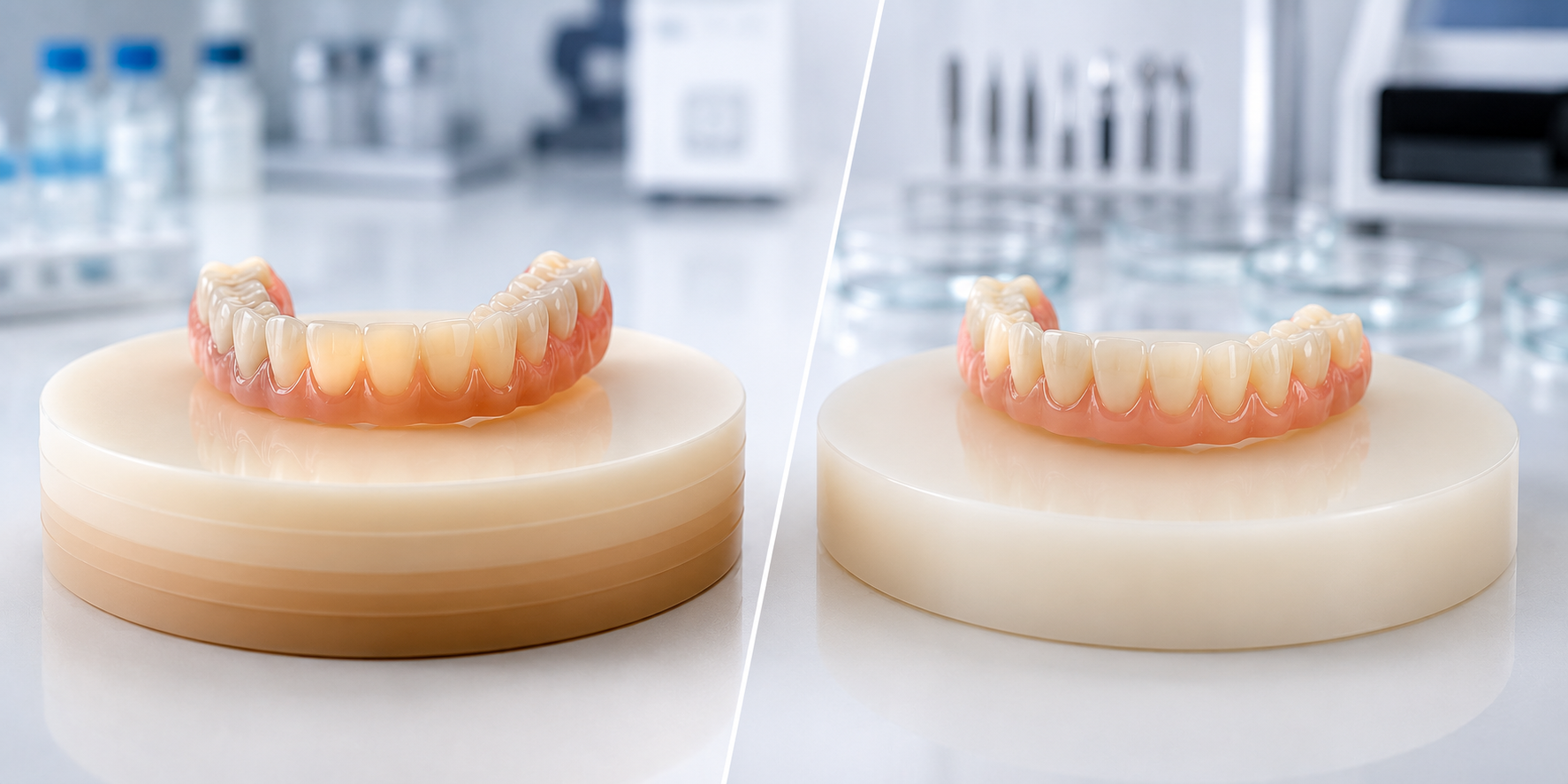
The question of whether to stock multilayer or monolayer PMMA comes up in every dental lab at some point usually after a technician spends 25 minutes staining a temporary crown that should have taken 8, or after a patient rejects a provisional because it looks flat compared to the adjacent natural teeth. Both scenarios have the same root cause: using a monolayer disc for a case that needed a multilayer.
PMMA is a material category, not a single product. The format decision multilayer gradient versus single-shade monolayer determines esthetic outcome ceiling as much as the grade of material itself. This guide explains the difference between the two formats, where each belongs in a dental lab workflow, and how to make the correct choice for every case type without overthinking it.
What Is the Actual Difference Between Multilayer and Monolayer PMMA?
The difference is architectural, not chemical. Both multilayer and monolayer PMMA discs are manufactured from the same base polymer pre-polymerized polymethyl methacrylate. The chemistry, biocompatibility, and machinability are essentially equivalent. What differs is how the shade and translucency are distributed through the disc.
Monolayer PMMA is a single-composition disc. Every point through the disc thickness has the same shade value, the same opacity, and the same translucency. If you mill a crown from a monolayer A2 disc, every section of that crown cervical, body, incisal is the same A2 value. There is no internal gradient. The optical character of the restoration is uniform throughout.
Multilayer PMMA is manufactured with a deliberate gradient built into the disc during production. The cervical end of the disc contains a higher-chroma, more saturated, more opaque formulation that mimics natural dentin. As you move toward the incisal end of the disc, the composition transitions to a less saturated, more translucent formulation that replicates the optical behavior of natural enamel. A correctly oriented and toolpath-mapped multilayer disc produces a crown with a built-in shade gradient warmer and more opaque at the gingival margin, cooler and more translucent at the incisal edge without any external staining.
That internal gradient is the entire esthetic argument for multilayer PMMA. Natural teeth are not a single uniform shade. They are optically complex structures with distinct dentin and enamel zones that transmit, scatter, and absorb light differently. A monolayer disc cannot replicate this complexity without external staining. A well-designed multilayer disc approximates it from the mill.
Why Multilayer Matters for Temporary Restorations?
For labs producing temporary crowns and bridges, the aidite pmma multilayer disc format addresses the single most common complaint about PMMA provisionals: they look artificial. Not because PMMA is an inferior material, but because a flat, single-shade monolayer disc produces a flat, single-shade result and natural teeth simply do not look like that.
This matters clinically beyond pure esthetics. Temporary restorations in anterior cases serve as shade and shape previews for the final restoration. If the provisional looks wrong too opaque, too uniform, lacking the natural variation that adjacent teeth show the patient may reject it, require modification, or lose confidence in the treatment plan before the permanent restoration is placed. A multilayer provisional that enters the mouth looking natural buys time, builds confidence, and gives the clinician and patient a realistic preview of the final outcome.
The workflow benefit is equally significant. A multilayer disc eliminates or minimizes the staining step for standard A-shade cases. Labs that track time per unit consistently report that anterior temporary crowns produced from multilayer pre-shaded discs take 15–20 fewer minutes per unit than equivalent restorations produced from white monolayer discs requiring full external staining. At production volume, that time saving compounds quickly.
The Case for Monolayer PMMA: Where It Still Belongs
Monolayer PMMA is not obsolete it is misapplied when used for anterior esthetic cases, but correctly applied for a significant range of other applications where its simplicity and cost efficiency are genuine advantages.
Evaluating the full multilayer pmma disc range versus monolayer options makes most sense when a lab handles multiple workflows simultaneously. For posterior single-unit temporaries where occlusal accuracy and fit matter far more than incisal translucency a monolayer disc in a standard posterior shade delivers a perfectly acceptable result at lower material cost per unit than a multilayer disc. The gradient architecture of a multilayer disc is partly wasted on a second molar where no one is evaluating the incisal esthetic zone.
For hard acrylic occlusal splints and night guards, monolayer clear PMMA is the correct format optical clarity matters and no shade gradient is required. For diagnostic study models and some full-arch removable frameworks, single-shade formats are appropriate. The key distinction is whether the restoration will be evaluated esthetically at the incisal edge by the patient. If not, a monolayer disc does the job correctly and more cost-efficiently.
| Application | Recommended Format | Reason |
|---|---|---|
| Anterior temporary crowns | Multilayer pre-shaded | Shade gradient essential, staining minimized |
| Anterior long-term provisionals | Multilayer pre-shaded | Extended wear optical quality matters throughout |
| Posterior single unit temporaries | Monolayer single-shade | Esthetics secondary to fit and occlusal accuracy |
| Full-arch anterior bridge provisionals | Multilayer pre-shaded | Consistent gradient across multiple units |
| Occlusal splints / night guards | Monolayer clear | Clarity required, no shade gradient needed |
| Implant temporaries (anterior) | Multilayer pre-shaded | Shade matching to adjacent natural teeth critical |
| Implant temporaries (posterior) | Monolayer single-shade | Strength and fit priority |
Shade Matching: Where Multilayer PMMA Outperforms
The esthetic performance gap between multilayer and monolayer PMMA is most visible in three specific clinical scenarios.
Adjacent to natural teeth in the anterior zone.
Natural anterior teeth have a distinct incisal halo a zone of high translucency at the incisal edge that creates a characteristic blue-grey appearance under lateral lighting. Monolayer PMMA at any shade value cannot replicate this effect because the material is uniform in opacity throughout. A multilayer disc with a properly translucent incisal zone approximates this halo without any external characterization. For patients with high natural translucency common in younger patients and in lateral incisors this difference is visible and clinically significant.
Multi-unit anterior cases.
When multiple adjacent anterior crowns must match each other and blend with remaining natural teeth, shade consistency across units is critical. Multilayer discs provide this consistency by building the gradient into the material every crown milled from the same disc position has the same internal gradient. Monolayer discs in multi-unit cases require the technician to apply the same stain gradient to every unit individually, introducing operator-dependent variability across the case.
Long-term provisionals.
External stain on monolayer PMMA is a surface application. Over weeks and months of wear, external stain can absorb, discolor, or wear unevenly particularly in the incisal zone where occlusal contact occurs. Multilayer PMMA's internal gradient is part of the material itself and does not wear separately from the restoration. For provisionals worn for three months or longer, the stability of an internal gradient versus an applied surface stain is a meaningful clinical difference.
PMMA and Zirconia: The Right Material Pairing for Complete Workflows
Understanding the multilayer vs monolayer PMMA decision also requires understanding where PMMA sits relative to zirconia in the full restorative workflow. As a zirconia materials distributor usa, ZirconiaGuys works with labs that run both PMMA and zirconia workflows simultaneously and the most efficient labs use each material in its defined role.
PMMA handles the provisional phase. Dental zirconia discs handle the permanent phase. The esthetic preview that a well-chosen multilayer PMMA provisional provides directly informs the shade and shape specification for the final zirconia restoration. A multilayer PMMA temporary that the patient approves gives the clinician confirmed shade data to specify the permanent dental zirconia restoration with confidence reducing remake risk on the final case.
For labs that also produce zirconia blocks dental restorations alongside PMMA provisionals, this parallel workflow is the production standard. The temporary in multilayer PMMA, the permanent in multilayer zirconia using the same shade gradient architecture in both materials for a consistent clinical result through the full treatment cycle.
Workflow Integration: Getting the Most From Multilayer PMMA Discs
Multilayer PMMA discs deliver their esthetic advantage only when the milling workflow respects their gradient architecture. The most common source of disappointing results from multilayer discs is not the material it is incorrect disc orientation or toolpath mapping that places the wrong zone of the disc in the wrong anatomical location of the restoration.
Disc orientation is non-negotiable.
Every multilayer PMMA disc is directionally marked — an arrow or engraved indicator shows the gingival-to-incisal axis of the gradient. Mounting the disc backwards places the high-translucency incisal material at the cervical margin and the opaque dentin material at the incisal edge. The result looks exactly wrong — bright and flat at the gumline, dark at the tip. Always verify orientation before milling the first unit from any new batch.
CAM toolpath mapping.
In exocad, 3Shape, or your CAM software, use the blank orientation tool to align the crown design with the disc's internal gradient. The preparation margin should sit in the body-to-cervical zone of the disc. The cusp tips and incisal edge should sit in the enamel-to-incisal zone. Misalignment of even 5–8 mm along the gradient axis produces a visible shade shift in the milled restoration.
Staining protocol adjustment.
Pre-shaded multilayer discs already carry chroma. Applying the same stain intensity used on white monolayer blanks will over-saturate the cervical zone and produce artificial-looking results. For any characterization work on multilayer provisionals, start at 30–40% of your standard stain concentration and build up after a test application. Most standard A-shade cases from quality multilayer discs require no staining at all.
For temporary crowns aidite pmma, Aidite publishes specific milling parameters for their multilayer disc range — including recommended spindle speed, feed rate, and step depth for optimal surface finish on the tissue-facing and occlusal surfaces. Following these parameters produces a milled surface that requires minimal polishing, reducing finishing time per unit further.
A Note on PMMA Within the Broader CAD/CAM Material Decision
Labs evaluating their full material inventory PMMA multilayer, monolayer, zirconia blank formats, dental zirconia discs, and supporting materials benefit from understanding the full role of PMMA as covered in our detailed guide to the Role of Dental PMMA in Temporary and Long-Term Restorations. The multilayer vs monolayer decision is one layer of the PMMA selection framework. The broader context of PMMA versus zirconia, and PMMA application types from provisionals to denture bases to splints, informs which disc formats your lab actually needs to stock.
For labs sourcing both PMMA and zirconia dental blanks from a single US supplier, ZirconiaGuys stocks Aidite's full PMMA range multilayer, denture base, and clear formulations alongside Aidite and Upcera zirconia lines from US inventory. Consolidating supply reduces ordering overhead, ensures consistent batch documentation, and gives labs a single point of contact for technical support across both material categories.
The multilayer versus monolayer decision is straightforward once the clinical logic is clear. Anterior esthetic cases temporary crowns, anterior bridge provisionals, long-term provisionals, implant temporaries in the esthetic zone belong on multilayer pre-shaded discs. Posterior single units, splints, models, and applications where incisal translucency is not a clinical requirement belong on monolayer formats. Running anterior cases on monolayer discs and compensating through staining is the most common avoidable inefficiency in PMMA production workflows one that multilayer discs eliminate entirely for the significant majority of standard cases.


