

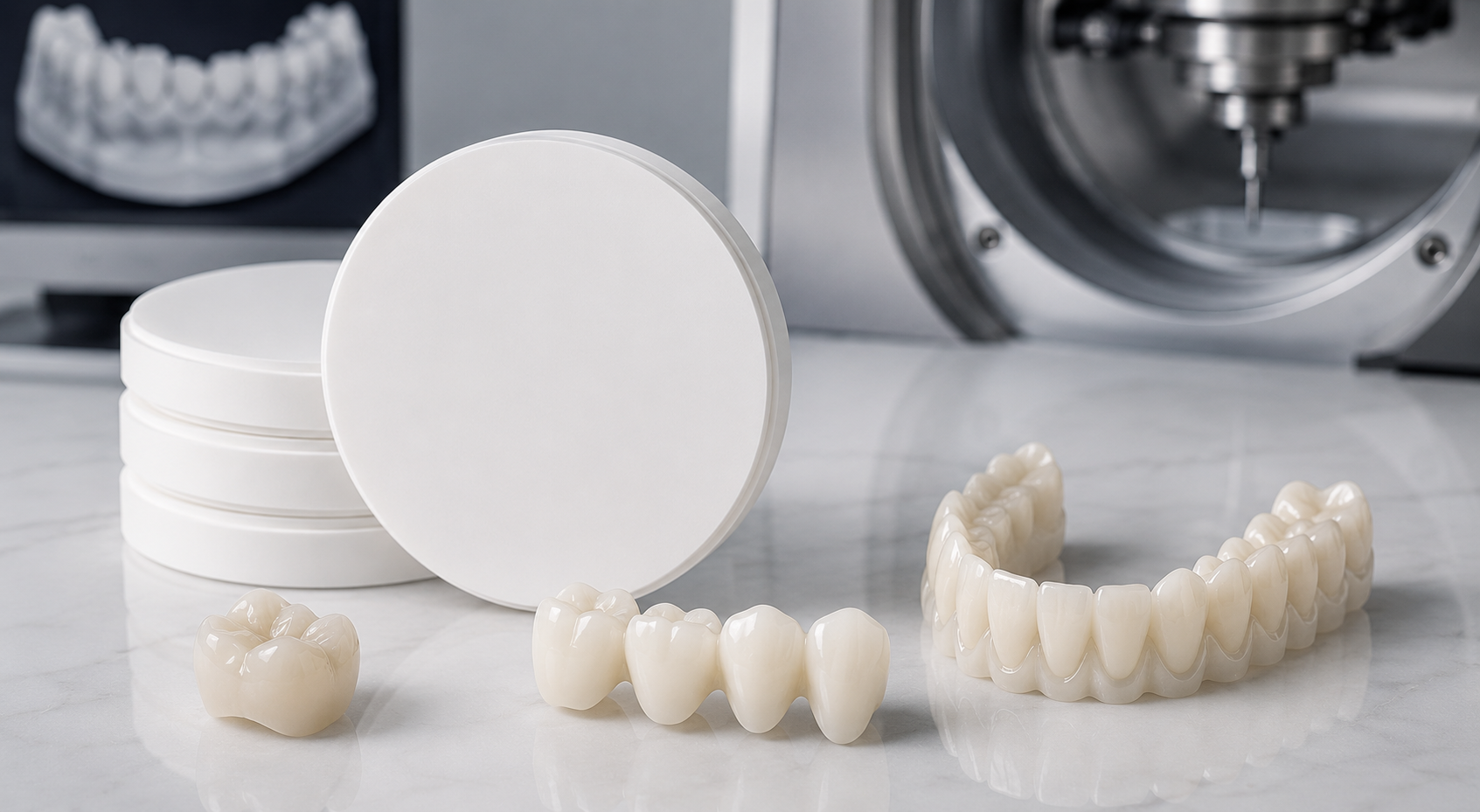
Choosing the wrong zirconia disc for a case is one of the most avoidable sources of remakes in dental lab production. The consequences range from restorations that look flat and opaque in anterior zones to connectors that fracture in posterior bridges — all because the disc grade, format, or architecture wasn't matched to the clinical demand. The material choice happens before milling, and it determines everything downstream.
This guide gives dental labs and dental zirconia discs procurement teams a clear, case-by-case framework for selecting the right disc format across single crowns, multi-unit bridges, and full-arch restorations based on strength requirements, esthetic priorities, and production workflow realities.
Start Here: The Two Variables That Drive Every Decision
Every zirconia disc selection comes down to two variables: how much strength the restoration requires and how much translucency the case demands. These two properties move in opposite directions within the zirconia material class gain translucency, reduce strength; gain strength, reduce translucency. The clinical indication defines where on that spectrum each case needs to sit.
For selecting a disc in production, here is the decision in practical terms:
- Posterior, high-load, bridge connectors → Prioritize strength → 3Y, lower yttria, monolithic or high-strength multilayer
- Anterior, single unit, esthetic zone → Prioritize translucency → 4Y/5Y, multilayer pre-shaded
- Mixed-zone full-arch → Split by quadrant → Strength-grade posterior, esthetic-grade anterior
Every section below applies this logic to a specific restoration type.
Single Crowns: Matching Disc Grade to Zone
Single crowns are the most forgiving indication from a structural standpoint there are no connector cross-sections to worry about and the occlusal load on any single unit is manageable across all zirconia grades. The selection decision is primarily about esthetics and production workflow efficiency.
Posterior Single Crowns
For molars and second premolars under full occlusal load, a 3Y or 4Y disc in pre-shaded format covers the indication cleanly. The 4Y grade is the most practical daily choice: flexural strength of 600–800 MPa is well above what a posterior single crown requires, and the higher translucency of 4Y relative to 3Y provides a better natural appearance without sacrificing any clinically meaningful structural performance. Pre-shaded format eliminates the staining step on standard A-D shade cases, reducing bench time per unit.
For posterior single crowns in bruxism cases or implant-supported scenarios under heavy load, step down to 3Y for the additional strength reserve. The esthetic compromise in the posterior zone is acceptable the posterior zone is low visibility, and patients rarely notice the difference in translucency between 3Y and 4Y at molar positions.
Anterior Single Crowns
This is where the disc selection decision carries the most clinical weight. Anterior single crowns need to match adjacent natural dentition under direct lighting, which means the disc's translucency profile in the incisal zone is the primary selection criterion.
For standard anterior single crown cases in A1–D4 shades, the tt multilayer zirconia disc format delivers the incisal translucency gradient that natural enamel requires — without the post-sintering staining that white blank formats demand. The gradient architecture transitions from a stronger, more opaque cervical zone to a highly translucent incisal zone within a single blank, matching the optical zonation of natural anterior teeth.
For anterior cases where the adjacent teeth have unusually high translucency common in younger patients or cases adjacent to e.max veneers the explore functional zirconia disc range provides 3Y and 4Y/5Y options across strength grades, giving labs the flexibility to match the exact esthetic demand without being locked into a single grade.
Quick Reference — Single Crowns
| Position | Recommended Grade | Format | Staining Needed |
|---|---|---|---|
| Molar (standard) | 4Y | Pre-shaded multilayer | No |
| Molar (bruxism/implant) | 3Y | Pre-shaded or white | Minimal |
| Premolar | 4Y | Pre-shaded multilayer | No |
| Anterior (standard) | 4Y multilayer | Pre-shaded | No |
| Anterior (high translucency) | 5Y multilayer | Pre-shaded | No |
Bridges: Where Strength Selection Becomes Non-Negotiable
Bridges introduce a variable that single crowns don't have: the connector. The connector cross-section the narrowest point between pontic and abutment is where fracture risk concentrates. The connector must carry the full occlusal load transferred through the pontic, and the minimum safe cross-section area depends directly on the flexural strength of the zirconia grade used.
3-Unit Anterior Bridges
4Y multilayer is acceptable for most anterior 3-unit bridges when connector design meets the minimum 9 mm² cross-section for the grade's strength specification. Verify against the manufacturer's technical data before committing the design this is not a calculation to skip. The st multilayer zirconia disc is a proven format for this indication, delivering the esthetic gradient quality of multilayer architecture with sufficient structural performance for short-span anterior bridges.
3-Unit Posterior Bridges
Step to 3Y for all posterior bridge indications. The 900–1200 MPa flexural strength of 3Y-TZP provides the safety margin posterior bridge connectors require under full occlusal loading. Using 4Y or 5Y for posterior bridges to gain translucency trades esthetic benefit against structural risk and the esthetic benefit in the posterior zone does not justify that trade.
4+ Unit Bridges and Long-Span Restorations
3Y monolithic is the only appropriate choice. Long-span posterior bridges carry cumulative occlusal load across multiple pontic units, increasing the bending moment at each connector. High-strength 3Y-TZP in flat monolithic format provides the uniform structural performance that gradient multilayer architecture cannot guarantee across long-span connector geometries.
Connector Calculation Rule
Always calculate minimum connector cross-section area against the manufacturer's published flexural strength for the specific disc not the grade category. Individual products within the same grade can vary by 100–200 MPa depending on sintering conditions and formulation specifics.
Full-Arch Restorations: The Split-Grade Approach
Full-arch fixed restorations whether implant-supported or tooth-supported span both esthetic and posterior structural zones simultaneously. Selecting a single disc grade for the entire arch is the most common planning error in full-arch cases.
The correct approach is quadrant-level material planning: specify an esthetic multilayer grade (4Y or 5Y) for the anterior 6–8 teeth and a high-strength grade (3Y) for the posterior quadrants. This requires the CAM workflow to accommodate different disc specifications per quadrant a minor planning step that delivers a fundamentally better clinical outcome than compromising in both directions with a single mid-range disc.
For labs sourcing full-arch zirconia materials, the aidite zirconia discs range covers both esthetic and structural grades from US inventory enabling single-supplier procurement for the full split-grade arch workflow without mixing documentation from multiple sources.
Full-Arch Planning Checklist
- Anterior teeth (canine to canine): 4Y or 5Y multilayer pre-shaded esthetic priority
- Premolars: 4Y pre-shaded or 3Y depending on occlusal load assessment
- Molars and posterior pontics: 3Y monolithic or high-strength multilayer structural priority
- All connector cross-sections calculated per manufacturer flexural strength spec before finalizing design files
- Sintering profile verified per disc type do not combine different grade discs in the same sintering cycle unless profiles are confirmed compatible
Sourcing: What to Verify Before Stocking a New Disc
As a zirconia materials distributor usa, ZirconiaGuys supplies US dental labs with Upcera and Aidite zirconia blocks dental formats from domestic inventory no international lead times, full batch documentation, and technical support for sintering and milling parameters. When evaluating any new zirconia blank or switching suppliers, verify these four things before committing to production stock:
Shade Consistency Across the Full Disc
Edge zones in multilayer discs must match center specification. Batch drift in this dimension forces re-shade matching on every case and drives remakes.
Published Flexural Strength Data Per Product, Not Per Grade
Individual products vary. The number on the certificate for the specific batch not the grade category average is what your connector calculations should reference.
Open System Compatibility
Standard 98 mm zirconia dental blanks are compatible with all major open-system mills. Confirm before ordering if you are evaluating a new format or thickness.
Sintering Profile Documentation
Esthetic-grade discs require specific ramp rates and hold temperatures. Confirm the profile is within your furnace's capability before stocking.
For a deeper look at how disc architecture, strength grades, and material properties interact across the full zirconia blocks range, our Guide to Materials & Strengths of Zirconia Dental Restorations covers the complete technical reference.
The right zirconia block is the one that matches the mechanical demand and esthetic priority of the specific restoration not the cheapest disc in stock, not the same disc used for every case by default. Single crowns need translucency calibrated to zone. Bridges need connector-grade strength. Full-arch restorations need both, split by quadrant. Getting this decision right before milling begins is the highest-leverage quality control step in the entire production workflow.


