

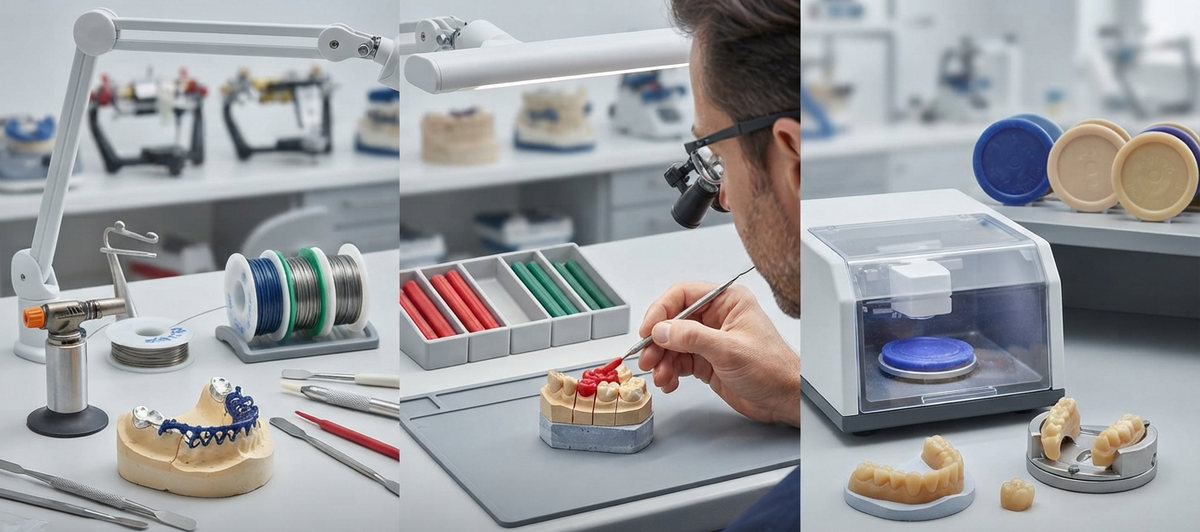
Digital dentistry has changed a lot of lab routines, yet wax is still sitting on almost every bench. It is cheap, easy to shape and burns out cleanly, which makes it hard to replace. But not every wax does the same job. This guide breaks down the main types so you can pick the right wax dental material for each task.
Why Wax Still Earns Its Place on the Bench
Wax lets a technician build, adjust and test a shape before committing to the final material. It melts at low temperatures, can be carved in seconds and holds detail well. For patterns that will be cast or pressed, it vanishes during burnout and leaves a precise cavity behind. In a busy lab that speed matters, particularly for single-unit cases that need a quick try-in before the final material.
Casting Wax: Built for Clean Burnout
Casting wax, often called inlay or pattern wax, is used to create the pattern for crowns, inlays and frameworks that will be cast or pressed. Its key quality is clean burnout: it should leave little or no residue so the final restoration comes out smooth and accurate. It also needs to hold its shape while being carved, without chipping or smearing.
Modeling Wax: For Setups, Trays and Try-Ins
Modeling wax covers a range of everyday tasks. Baseplate wax is used for denture setups and bite registration, utility wax helps with temporary adjustments, and sticky wax holds parts together during soldering or repairs. Modeling waxes are usually softer and more flexible than casting wax, because they need to be adapted by hand rather than burned out with precision.
Milling Wax: The CAD/CAM Option
Milling wax comes as discs or blocks for CAD/CAM machines. The mill cuts the pattern from the disc, which is then invested and cast or pressed just like a hand-made pattern. It saves carving time, improves consistency and pairs well with a digital design. Milling wax is a wax dental material made to cut cleanly without melting, so avoid mixing it with other tools or settings meant for different materials.
Storing and Handling Milling Wax Discs
Milling wax discs should be stored flat in a cool, dry place away from heat sources so they do not warp. Keep them in their packaging until needed, since dust can clog the mill and affect surface quality. After milling, handle the pattern gently by its base and invest it as soon as possible. Because wax shavings can build up in the chamber, clean the extraction system regularly.
A Note on Dental Wax for Filling
One search that comes up often is dental wax for filling. It is worth clearing up: lab wax is not a permanent tooth filling. Casting and modeling waxes are used to create patterns and setups, not to replace tooth structure. Orthodontic wax, sold for braces, only covers sharp edges temporarily. If a patient has a cavity, they need a dentist and a restorative material such as composite or glass ionomer.
Hard, Medium and Soft: Reading a Wax's Working Behavior
Waxes are often described by hardness, which tells you how they behave in the hand. Harder waxes hold fine edges and margins well but can be brittle when cold. Softer waxes are easy to adapt but may flow or slump if the room is warm. Many casting waxes are color-coded to help technicians choose quickly, though shades vary between manufacturers. Test any new wax on a scrap pattern first, and check its melting range and burnout notes on the product sheet.
Handling Tips That Prevent Distorted Patterns
• Store wax at a stable, cool temperature away from sunlight.
• Heat gently and avoid overheating, which changes how the wax flows.
• Let patterns cool fully before removing them from the model.
• Invest patterns promptly, since wax can distort over time.
When Resin Replaces Wax
Some labs now print or mill patterns in resin instead of wax. A castable resin for dental labs burns out like wax but can capture finer detail and handle more reliably. Options such as burnout resin Whip Mix VeriCAST are designed for this purpose. Check your investment and burnout schedule first, since resin and wax do not always follow the same cycle.
The best choice depends on the case, your equipment and how much detail you need. Keeping a mix of waxes on hand, plus a good understanding of each wax dental material, lets you move between hand work and digital workflows.


